Steel Pipe Cutter vs Hacksaw: Which One Should You Buy?
A pipe cutter wheels around round pipe for a square cut, while a hacksaw blade cuts any shape stroke by stroke, so the right choice depends on the cut in front of you.

On this page
Top picks at a glance
As an Amazon Associate I earn from qualifying purchases.
- 1
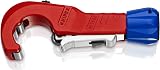 KNIPEX 90 31 02 SBA TubiX Pipe Cutter with Quick Adjustment9.6/10View on Amazon
- 2
 Lenox Tools HT50 High-Tension Hacksaw9.7/10View on Amazon
- 3
 QWORK Heavy Duty Pipe CutterView on Amazon
- 4
 RIDGID 32820 Model 2-A Heavy-Duty Steel Pipe Cutter withView on Amazon
- 5
 Mini Copper Pipe Cutter Adjustable Tubing Cutter 3-22mm TubeView on Amazon
- 6
 EZARC Carbide Hole Saw Heavy DutyView on Amazon
- 7
 LOTOS LTP5505D 55A Pilot Arc Plasma Cutter with Rust RemovalView on Amazon
A steel pipe cutter and a hacksaw both cut steel pipe, but they cut it in different ways. The cutter wheels around the pipe and leaves a square end, while the hacksaw blade cuts through the wall stroke by stroke and fits more shapes. For repeat cuts on round pipe, the cutter is the faster, cleaner choice; for occasional cuts, odd shapes, or work in tight spots, the hacksaw wins. This guide compares steel pipe cutter vs hacksaw on cut quality, speed, shapes, and the hacksaws below.
Other welders and gear to compare
 QWORK Heavy Duty Pipe CutterCheck price on Amazon
 RIDGID 32820 Model 2-A Heavy-Duty Steel Pipe Cutter withCheck price on Amazon
 Mini Copper Pipe Cutter Adjustable Tubing Cutter 3-22mm TubeCheck price on Amazon
 EZARC Carbide Hole Saw Heavy DutyCheck price on Amazon
 LOTOS LTP5505D 55A Pilot Arc Plasma Cutter with Rust RemovalCheck price on Amazon
This guide links to our product roundups, where WeldGearLab gets a commission on purchases made through links on this page, and your price stays the same. Read our affiliate disclosure.
The difference in one paragraph
A pipe cutter is a wheel that rolls around the outside of a pipe, scoring deeper with each pass until the pipe parts. A hacksaw is a toothed blade in a frame that cuts through a wall at a time. The cutter only fits round pipe and needs room to swing; the hacksaw fits the shapes the blade can reach. That split decides the whole choice: round pipe in the open favors the cutter, everything else favors the saw.
Side by side
| Steel pipe cutter | Hacksaw | On the bench | |
|---|---|---|---|
| Cut on round pipe | Wheel runs around the pipe | Blade cuts one wall at a time | Cutter keeps the cut square |
| Shapes it cuts | Round pipe | Pipe, flat bar, rod | Hacksaw covers more shapes |
| Cut end | Square off the wheel | Needs filing to square up | Less cleanup with a cutter |
| Speed on repeats | Fast once the wheel bites | Stroke by stroke | Cutter wins on repeat cuts |
| Tight spots | Needs room to swing | Mini frames fit restricted areas | LENOX mini frame for tight work |
| Wear parts | Wheel | Blades dull and snap | Spares ride in the DOWELL beam |
| Starting kit | One tool | Frame plus blades | BEETRO set covers three sizes |
Blade angles matter on a hacksaw: the DOWELL frame and the BEETRO 12 inch frame hold the blade at 90 or 45 degrees, so a flush cut against a wall or a standard cut both work. The LENOX mini frame trades size for reach, fitting restricted areas at the cost of a shorter blade.
When a pipe cutter is the better choice
- Repeat pipe cuts. The wheel tracks around the pipe, so a marked cut lands square.
- Ends that must fit. A square end fits a coupling or a weld joint with less filing.
- Clean work. No teeth to snap and no blade to change mid-cut.
- Speed on a run of pipe. Once the wheel bites, the cutter moves faster than stroke by stroke sawing.
For powered cutting, our best angle grinder for cutting metal guide covers grinders.
When a hacksaw is the better choice
- More shapes. Pipe, rod and flat bar all cut with the same frame.
- Tight spots. Mini frames reach restricted areas where a cutter cannot swing.
- Mixed materials. The BEETRO 12 inch frame covers metal and wood with its multifunction blade, listed at 24 TPI for metal and 8 TPI for wood.
- Low kit. A frame and spare blades cover most shop cuts.
The hacksaws in this guide
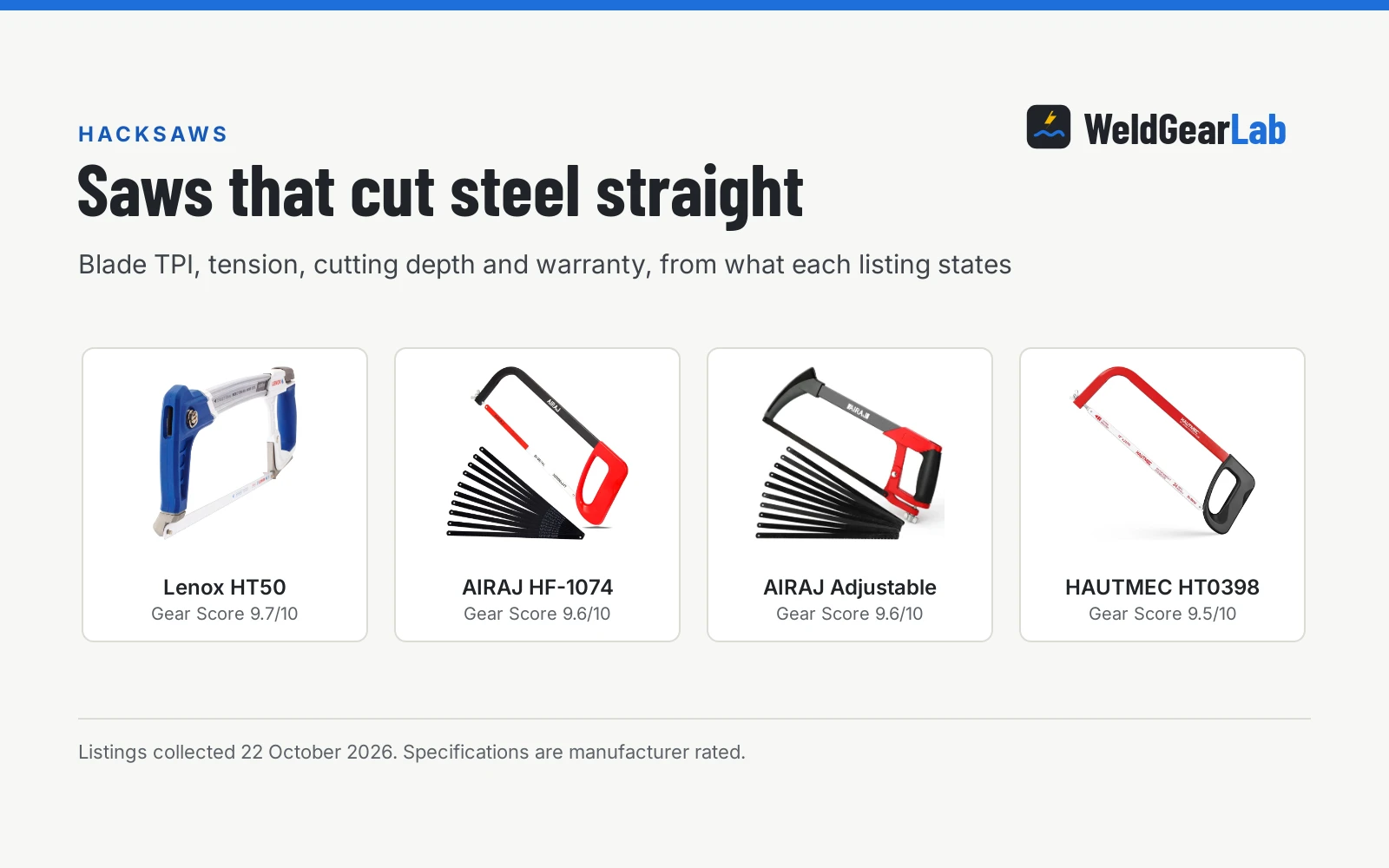
The hacksaws below are ranked for steel pipe work in this order: the DOWELL frame, the BEETRO set, the ELJGKKL set, and the LENOX mini frame.
DOWELL 12 inch heavy duty frame. The listing states 5 pieces of 24 TPI high tension carbon steel blade, blade angles of 90 or 45 degrees, and a square tubular beam that stores extra blades. The handle has nonslip soft rubber grips, and a knob at the bottom of the handle adjusts tension and swaps blades fast. The title lists steel pipe cutting among its uses, which makes this the direct pipe pick of the set.
BEETRO three-size set. The set includes a 12 inch hacksaw, a 6 inch hacksaw, and a mini hacksaw frame, each with two extra blades. The 12 inch frame takes a 300mm multifunction double teeth blade, 8 TPI for wood and 24 TPI for metal, plus extra carbon steel flexible blades at 18T and 24T. The 12 inch frame adjusts to blade angles of 45 and 90 degrees, and the frames are aluminum alloy and high carbon steel. The set weighs 2.2 pounds.
ELJGKKL three-piece set. The set holds a 12 inch metal frame, a 12 inch plastic mini handsaw, a 6 inch metal junior hacksaw, and a metal miter for guiding accurate cutting. The six blades include four 24T black blades for metal and plastic, one silvery 12 inch 10T blade for wood, and one 12 inch wire for woodworking. Blades set at 45 or 90 degrees, and the set weighs 1.7 pounds.
LENOX mini frame. The listing states a compact design for lightweight cutting in very restricted areas, an aluminum handle, and a stainless steel blade for most metals including un-hardened tool steel and stainless steel. Note the listing disagrees with itself: the title lists a 12 inch blade at 10 TPI, while the bullets and spec table list a 10 inch blade at 24 teeth per inch. The listing includes one blade, and the spec table lists a limited lifetime warranty.
Steel pipe cutter vs hacksaw: which one should you buy
For repeat cuts on round pipe that must fit tight, a pipe cutter is the right tool: the wheel tracks around the pipe and the end comes off square. For a single cut, a mix of materials, or pipe already fixed in place, the hacksaw earns its keep: one frame and spare blades cover pipe, rod and flat bar.
Cutting safety. Clamp the pipe before you cut so it cannot roll, and keep your hands clear of the blade path. A fresh cut end is sharp: file the burr off before fitting the pipe, and brush chips off the bench, not with your bare hand.
FAQ for welders
Can a hacksaw cut steel pipe square?
Yes, with care: mark the pipe all the way around and rotate the pipe as you cut so the blade follows the mark. A pipe cutter squares the cut by design, so it needs less cleanup. File the burr off the cut end before fitting.
Which blade tooth count suits steel pipe?
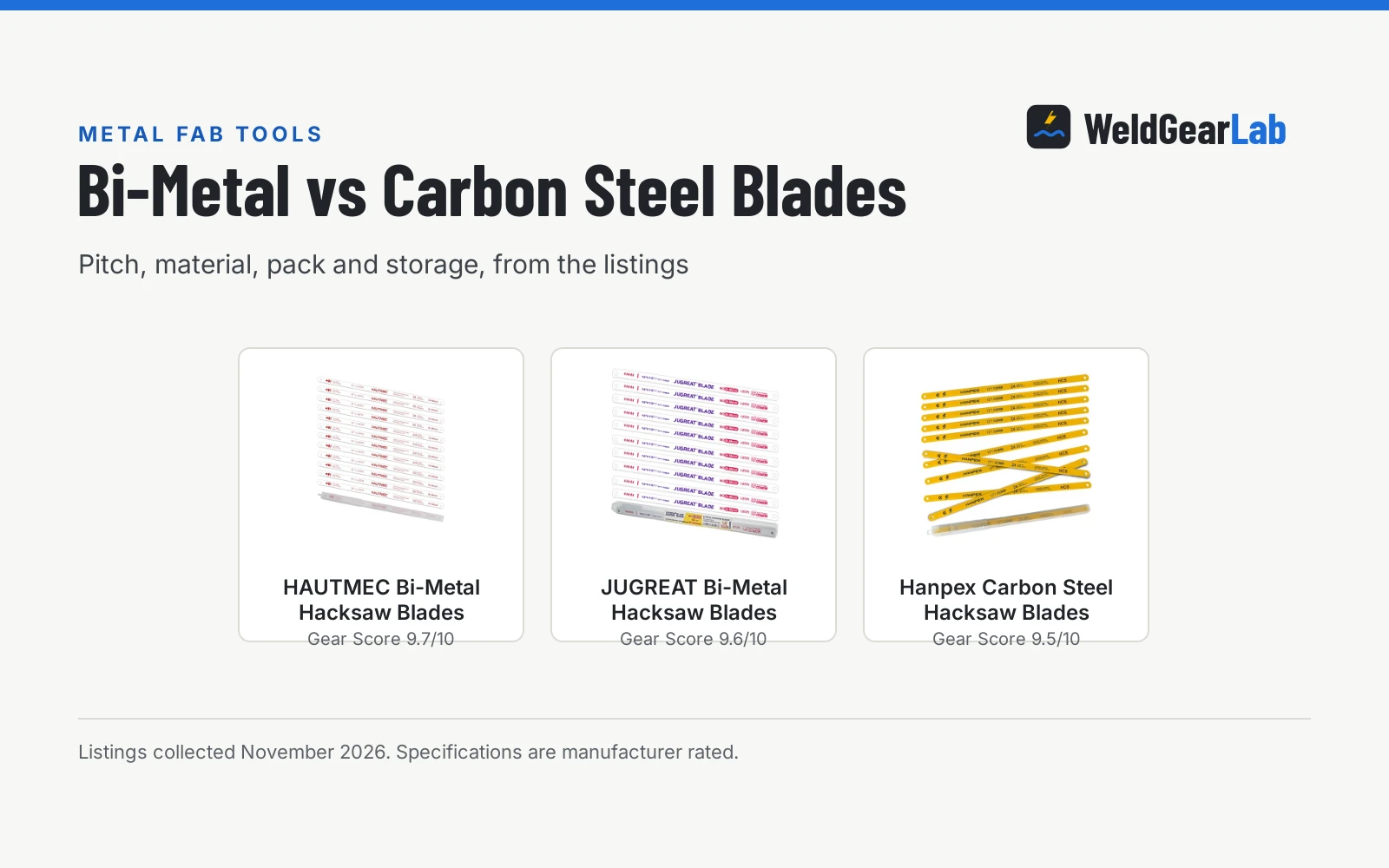
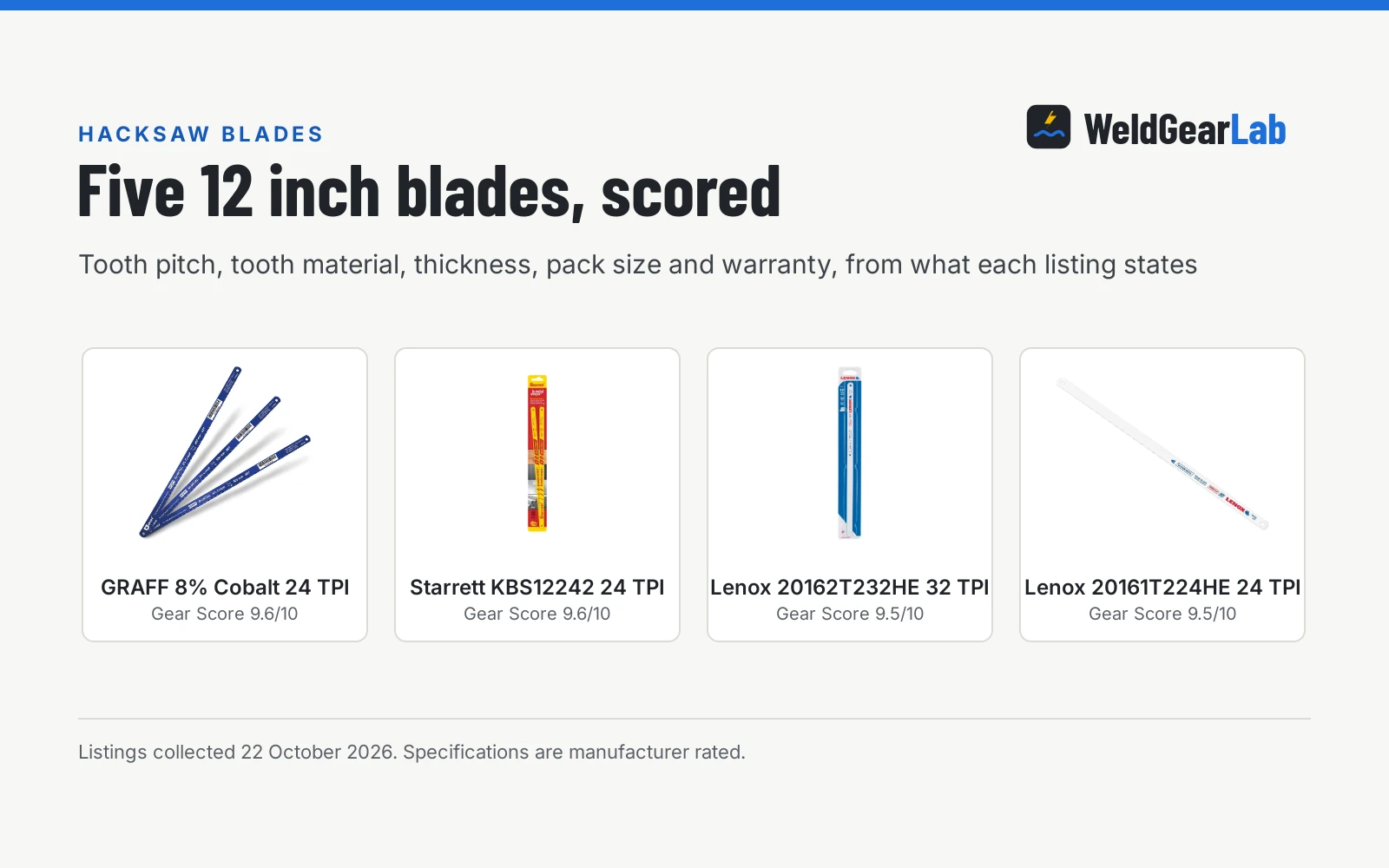
The listings here use 24 teeth per inch for metal, and the BEETRO set pairs a 24 TPI blade for metal with an 8 TPI blade for wood. Use the 24 TPI blade on steel pipe and keep the 8 TPI blade for wood. For pipe, match the blade to the metal, not the wood blade.
Why does a hacksaw blade snap?
Blades snap when the tension is wrong or the blade twists in the cut. The DOWELL frame has a tension knob at the bottom of the handle for setting tightness, and its blades are listed as flexible and shatter resistant. Keep steady pressure and let the teeth do the work, and change a dull blade instead of forcing it.
What size hacksaw frame should I buy?
The sets here cover three sizes: a 12 inch frame for general work, a 6 inch frame for smaller cuts, and a mini frame for restricted areas. The BEETRO set includes all three sizes, and the ELJGKKL set pairs a 12 inch frame with a 12 inch mini handsaw and a 6 inch junior hacksaw. Pick the frame that fits the space the pipe sits in.
Can I cut PVC pipe with these hacksaws?
Yes. The DOWELL frame lists steel pipe cutting and PVC among its uses, the BEETRO set lists metal, wood and PVC pipe, and the ELJGKKL set lists PVC pipes among its uses. Use the 24 TPI metal blade on plastic and metal, and keep the 10 TPI blade for wood. Cut plastic with light pressure so the blade does not grab.
Related: angle grinder vs bench grinder, best extra long hacksaw blades, abrasive chop saw vs cold saw, and the metal fab tools hub.