Slip Roll vs Sheet Metal Brake: Which One Should You Buy?
Here is how a slip roll and a sheet metal brake compare on forming curved cylinders versus sharp angular bends, working width, thickness capacity and shop fit.

On this page
Top picks at a glance
As an Amazon Associate I earn from qualifying purchases.
- 1
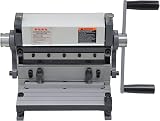 KAKA INDUSTRIAL Metal Brake,8-inch9.6/10View on Amazon
- 2
 VEVOR Box and Pan Brake, 30 in Sheet Metal Bending9.6/10View on Amazon
Verdict. Pick a slip roll like the KAKA 3-in-1 example if your projects require curved metal, round ducts, cones or cylinders, or if you need compact 90-degree bending and shearing in an 8-inch workspace. Pick a sheet metal brake like the VEVOR 30-inch example if you fabricate wide panels, brackets, flanges or covers that require straight-line bends up to 135 degrees across material up to 30 inches wide.
When you have sheet metal laid out on the bench for a patch panel, duct transition or equipment enclosure, choosing between a slip roll vs sheet metal brake comes down to whether that part needs curved geometry or sharp angles. A slip roll forms metal into cylinders, arcs and cones by passing sheet stock between offset rollers. A sheet metal brake clamps the sheet along a rigid edge and folds it along a straight hinge line to produce crisp angular bends, flanges and pans. Both tools belong in metal fabrication, but each serves a completely different forming job.
WeldGearLab gets a commission on purchases made through links on this page, and your price stays the same. Read our affiliate disclosure.
The two machines

KAKA INDUSTRIAL Metal Brake,8-inch
An 8-inch benchtop machine combining slip rolling, press brake bending, and shearing for up to 20-gauge mild steel.
Pros
- Combines slip rolling, press brake bending, and shearing in a single machine
- Slip roll forms cylinders and cones down to 1.14 inches in diameter
- HT200 cast iron body with 45# steel rollers and T10 shear blades
- Segmented removable dies allow box and pan bending up to 90 degrees
Cons
- Bed width is limited to 8 inches for all operations
- No warranty term is stated
- Front mounting holes require extensions per the maker

VEVOR Box and Pan Brake, 30 in Sheet Metal Bending
A 30-inch manual sheet metal brake bending up to 18-gauge mild steel from 0 to 135 degrees with an integrated clamping bar.
Pros
- Handles sheet widths up to 30 inches for straight-line bends
- Bends mild steel up to 18-gauge (1.2 mm) thickness
- Bending angle adjusts from 0 to 135 degrees
- Integrated clamping bar holds sheet metal without separate loose clamps
Cons
- Does not roll curves or shear sheet metal
- No warranty term is stated
- Requires mounting to a workbench via pre-drilled holes for stable operation
Side by side
| Product | Gear Score | Working Width | Capacity |
|---|---|---|---|
| KAKA Industrial 8-Inch 3-in-1 Machine | 9.6/10 | 8 in | 20 Ga. mild steel |
| VEVOR 30-Inch Sheet Metal Brake | 9.6/10 | 30 in | 18-gauge (1.2 mm) mild steel |
These numbers are the manufacturer’s ratings exactly as each listing gives them, recorded on 15 October 2026. Neither listing states a CSA, UL or ETL certification or a written warranty term.
Slip roll vs sheet metal brake: forming geometry
The mechanical difference between a slip roll and a sheet metal brake is how they apply bending force. A slip roll uses parallel steel rolls arranged in an offset configuration. As you turn the crank handle, sheet stock feeds through the rolls while an adjustable roller deflects the material upward into a continuous, uniform curve. The KAKA example uses 45# steel rollers with forming grooves and can roll cylinders and cones down to a minimum diameter of 1.14 inches in 20-gauge mild steel.
A sheet metal brake relies on a stationary bed, a clamping bar, and a pivoting apron. You slide the sheet to your layout line, clamp it down, and lift the apron handles to crease the steel over the bending edge. The VEVOR example uses an integrated clamping bar and a 0.3-inch thick bending blade to fold sheets from 0 to 135 degrees. A dedicated slip roll mechanism curves sheet metal without making angular bends, while a dedicated straight brake folds metal along a hinge without producing cylindrical curves.
Working width and thickness capacity
Working width separates these two tools on the shop floor. The VEVOR sheet metal brake spans 30 inches of bed width, accommodating broad body panels, wide drip pans, and shelving trays. VEVOR rates it for mild steel up to 18-gauge, which corresponds to 1.2 mm thickness. The maker also lists compatibility with stainless steel, copper, and aluminum, though it does not provide separate gauge ratings for those materials.
The KAKA 3-in-1 example is a compact bench machine with an 8-inch working width. It processes mild steel, aluminum, brass, and copper up to 8 inches wide and 20-gauge thick. That 8-inch bed is suited for brackets, small electrical chassis, jewelry parts, and craft components, but it cannot bend or roll wider sheet stock. Between the two listings, the VEVOR brake handles thicker mild steel (18-gauge versus 20-gauge) and a wider material bed.
Versatility and extra operations
Where the sheet metal brake focuses purely on straight folding, the KAKA 3-in-1 machine integrates three separate shop operations into one frame. In addition to slip rolling, it includes a press brake station with removable male and female segmented dies for 90-degree box and pan work, plus a guillotine shear station with T10 high carbon steel blades. For shops with strict space constraints, having rolling, bending, and cutting on one bench mount saves footprint.
The VEVOR brake performs only straight-line bending, but it offers a wider angular range. Its hinge swings from 0 to 135 degrees, whereas the KAKA press brake station tops out at 90 degrees. That extra angle clearance on the VEVOR allows acute bends past 90 degrees that a 90-degree die cannot produce. While the VEVOR title mentions box and pan bending, its bullets describe a continuous integrated clamping bar rather than removable segmented fingers; if your work requires deep four-sided boxes, see our sheet metal brake vs pan brake guide. For sheet cutting options, see our metal shear vs metal nibbler comparison.
Frame build, materials and weight
Rigidity is essential for both tools to prevent deflection along the bend line. The KAKA example features an HT200 cast iron body that resists bowing under press brake loads. Its rollers are machined from 45# steel, and its shear blades use T10 tool steel. The listing presents a contradiction regarding weight: the specification table states an item weight of 16 ounces, while the gross weight is listed at 42 pounds. A cast iron frame with an 8-inch steel mechanism aligns with the 42-pound figure, making 16 ounces an obvious listing error.
The VEVOR brake weighs 45.9 pounds and measures 35.83 x 17.72 x 4.33 inches. Its listing also has a material contradiction: the title describes it as a heavy-duty aluminum folder and bullet text calls it an aluminum brake bender, but the specification table lists low carbon steel. A 45.9-pound machine with a 0.3-inch thick bending blade reflects steel construction rather than lightweight aluminum. Both tools require sturdy mounting to stay rigid during manual leverage.
Bench setup and mounting
Neither tool is designed for free-standing or unbolted use. The VEVOR brake includes pre-drilled mounting holes so fabricators can bolt the frame directly to a workbench, eliminating wobbling when pulling the two included handles through a 135-degree bend. Its integrated clamping bar uses side screws to clamp the workpiece, avoiding loose C-clamps.
The KAKA machine mounts via bottom bolts or clamps. The maker specifically notes that the front holes require extensions if you attempt to bolt through them. It features dual-position handles to adjust leverage between rolling jobs and shearing strokes, and pre-drilled shimming points calibrated with a recommended .006-inch blade gap. The KAKA ships coated in anti-corrosion grease, which must be cleaned off before feeding metal stock.
Warranty and certification
Neither the KAKA INDUSTRIAL nor the VEVOR listing states a written warranty term or a coverage window. If manufacturer warranty backing is a deciding factor in your purchase, contact the sellers directly before ordering to verify return and defect policies. Furthermore, neither product lists an electrical or safety certification such as UL, CSA, or ETL, which is common for purely manual, hand-powered shop equipment.
Choose a slip roll like the KAKA 3-in-1 if
- You need to roll curved cylinders, tubes, arcs or cones down to 1.14 inches in diameter.
- You want rolling, 90-degree press brake bending and shearing in a single benchtop tool.
- Your workpieces are small brackets, jewelry parts or trays under 8 inches wide and 20-gauge thickness.
- You have limited shop bench space and cannot fit three separate fabrication machines.
Choose a sheet metal brake like the VEVOR 30-inch if
- You make straight-line angular bends up to 135 degrees across wide sheets up to 30 inches.
- You work with mild steel up to 18-gauge (1.2 mm) thickness.
- You want an integrated clamping bar that tightens via side screws without separate clamps.
- You build wide panels, brackets, drip trays and chassis covers that require straight-line bends.
Before You Strike an Arc
- Wipe down all bare metal surfaces, rollers and shear blades to remove the protective anti-corrosion grease before feeding sheet stock.
- Bolt the machine securely to a level workbench using the pre-drilled base holes or clamps before pulling bending or shearing handles.
- Check the blade clearance on the shear station and confirm the guide rails are squared, using the shimming points if adjustment is needed.
- Confirm all box components arrived intact, including the operating handles and instruction manual, and verify clamping screws turn freely.
FAQ for welders
Can a slip roll make sharp 90-degree bends?
A standalone slip roll mechanism only produces continuous curves, arcs, and cylinders. However, 3-in-1 combination machines like the KAKA example include a separate press brake station with segmented dies that form 90-degree bends. If you use a dedicated slip roll without a brake attachment, you will need a separate brake to make sharp angular folds.
Can a sheet metal brake roll cylinders or round tubes?
A standard sheet metal brake bends metal along a straight hinge line rather than rolling continuous curves. While fabricators can approximate a curve by making a series of incremental shallow bends, the resulting surface is faceted rather than round. Producing smooth, uniform cylinders, tubes, and cones requires a slip roll.
What is the maximum metal thickness these benchtop tools can form?
Capacity depends on the specific machine and metal type. The VEVOR 30-inch brake bends mild steel up to 18-gauge, which measures 1.2 mm thick. The KAKA 3-in-1 combo machine handles up to 20-gauge mild steel across its rolling, bending, and shearing stations.
Why must you bolt a slip roll or metal brake to a workbench?
Manual bending and shearing apply heavy rotational torque to the tool frame. Unbolted machines can tip or slide during a bend, ruining the layout line and creating a pinch hazard. Bolting through the pre-drilled base holes keeps the unit stable and maintains consistent bending angles.
Can you bend aluminum and copper on a sheet metal brake?
Yes, both listings state compatibility with non-ferrous metals including aluminum and copper. The VEVOR brake listing specifies mild steel, stainless steel, copper, and aluminum, while the KAKA listing includes steel, aluminum, brass, and copper. Check the manufacturer thickness limits for each specific metal before bending.
Related: sheet metal brake vs pan brake, metal shear vs metal nibbler, how to use bead roller, and the metal fab tools hub.
Scoring, line by line
Both machines are scored out of 10 on performance, build, value, safety listing and warranty, with the weights published on our How We Pick page.
| Product | Gear Score | Perf. /35 | Build /25 | Value /25 | Safety /10 | Warranty /5 |
|---|---|---|---|---|---|---|
| KAKA Industrial 8-Inch 3-in-1 Machine | 9.6 | 30 | 21 | 20 | n/a | 0 |
| VEVOR 30-Inch Sheet Metal Brake | 9.6 | 28 | 20 | 20 | n/a | 0 |
Displayed scores fall between 9.2 and 9.8: the weighted point total is mapped onto that band in a straight line, so earning more points always lifts the score. Where safety does not apply (unpowered gear with no listed safety features), it is left out and the remaining 90 points make up the score.