Metal Shear vs Metal Nibbler: Which One Should You Buy?
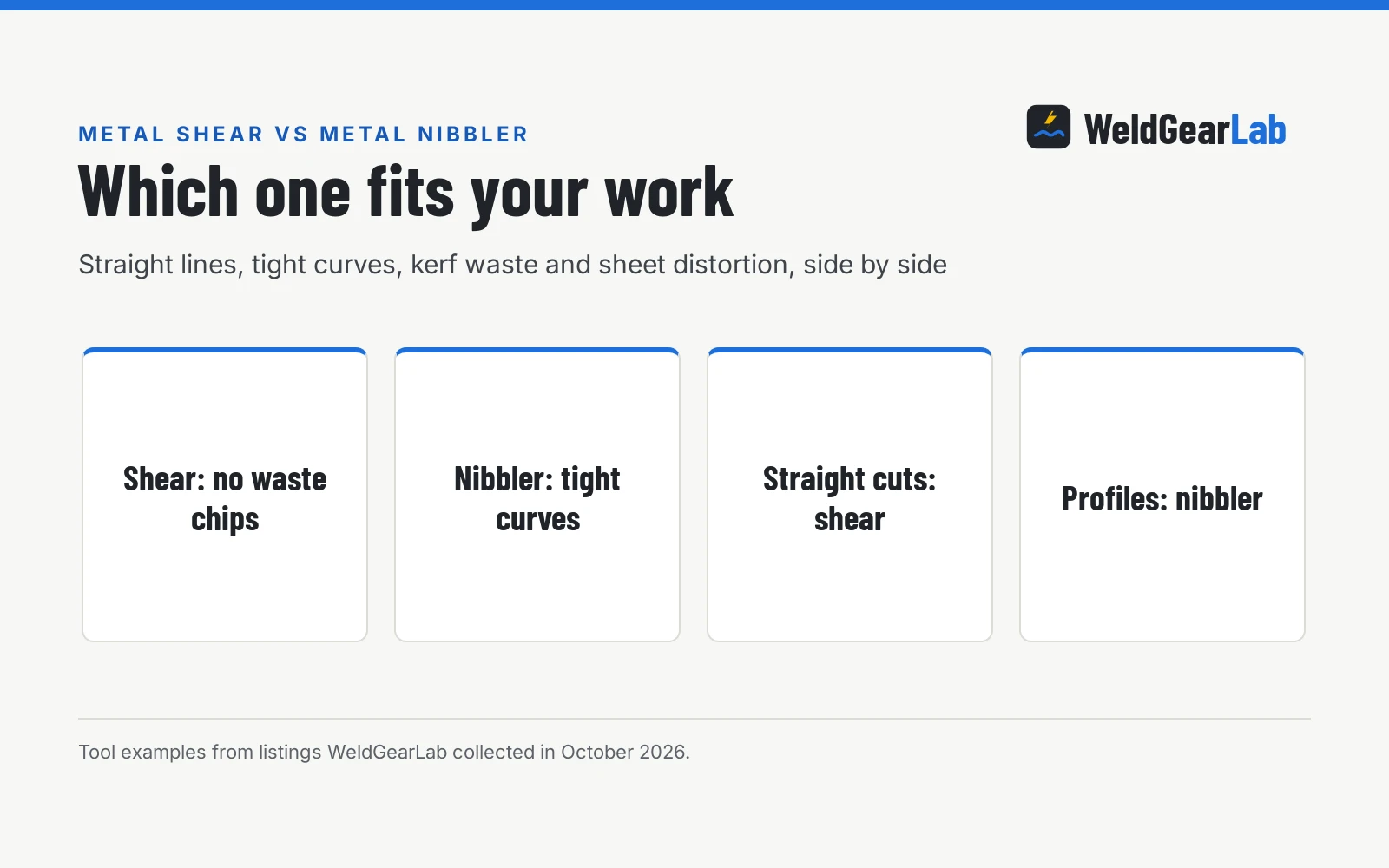
Metal shears cut straight lines quickly without material waste, while metal nibblers punch out tight curves and corrugated profiles without distorting the sheet.

On this page
Top picks at a glance
As an Amazon Associate I earn from qualifying purchases.
- 1
 VEVOR Sheet Metal Shear9.7/10View on Amazon
- 2
 VEVOR Double Head Sheet Metal Nibbler Cutter9.7/10View on Amazon
- 3
 DEWALT Metal Shear/Cutter Drill AttachmentView on Amazon
- 4
 DEWALT Metal ShearView on Amazon
- 5
 Guillotine Sheet Metal ShearView on Amazon
- 6
 WEN Metal ShearView on Amazon
- 7
 VEVOR Sheet Metal BrakeView on Amazon
When you are laying out sheet metal on the fab table for a patch panel, duct run, or machine guard, picking between a metal shear vs metal nibbler comes down to straight cutting speed versus curve flexibility. A metal shear is your tool for straight lines and gentle trimming because it slices metal cleanly with zero kerf loss on single-cut blades or a narrow continuous ribbon on double-cut jaws. A metal nibbler is the right choice when you must cut tight curves, navigate corrugated ribs, or punch out internal cutouts without warping delicate sheet. This guide breaks down how both cutters operate, their capacity limits, and how to pick the right one for your bench.
Other welders and gear to compare
 DEWALT Metal Shear/Cutter Drill AttachmentCheck price on Amazon
 DEWALT Metal ShearCheck price on Amazon
 Guillotine Sheet Metal ShearCheck price on Amazon
 WEN Metal ShearCheck price on Amazon
 VEVOR Sheet Metal BrakeCheck price on Amazon
This guide links to our product roundups, where WeldGearLab gets a commission on purchases made through links on this page, and your price stays the same. Read our affiliate disclosure.
The difference in one paragraph
A metal shear cuts like heavy-duty scissors or a paper trimmer, using opposing blades to shear and slice sheet metal along a continuous line. Single-cut shears leave zero kerf, while double-cut designs remove a narrow waste strip. A metal nibbler works like a high-speed mechanical punch, driving a reciprocating punch through a fixed die to clear tiny crescent-shaped metal chips along your layout line. The shear delivers speed on long straight runs, but single-cut jaws can bend the offcut edge. The nibbler turns in place to follow intricate scribe marks without twisting the stock on either side of the cut, though it leaves sharp punch chips across the floor.
Metal shear vs metal nibbler side by side
| Manual shear | Power metal shear | Metal nibbler | |
|---|---|---|---|
| Cutting mechanism | Manual bypass or lever blades | Center blade between side counter-blades | Reciprocating punch and die |
| Cut shape capability | Straight cuts and wide curves | Long straight runs and gentle arcs | Tight curves, scrollwork, and intricate patterns |
| Material waste | Zero kerf loss | Thin continuous waste ribbon | Small crescent-shaped punch chips |
| Workpiece distortion | Can bow or twist offcut edge on thin sheet | Double-cut curls center strip, sheet stays flat | Distortion-free, leaves sheet edges flat |
| Corrugated and ribbed sheet | Binds on steep formed corrugations | Straight jaws struggle; offset/pivoting heads pass | Rides over corrugations and profiles smoothly |
| Interior cutouts | Requires outside edge access | Requires pre-cut entry slot | Starts inside a small drilled pilot hole |
| Cutting speed | Limited by manual hand leverage | Fast continuous feed along layout lines | Moderate, controlled feed along scribe marks |
| Shop cleanup | Zero debris | Single continuous curl, easy scrap disposal | Scattered sharp chips require magnet or vacuum |
| Typical shop role | Quick bench trimming and small repairs | Ripping full sheets and sizing flat panels | Curves, cutouts, duct openings, roofing profiles |
Cutting action dictates edge finish and layout limits; always match blade clearances and punch dies to your metal thickness to prevent binding. Portable shears cut quickly across broad sheets, while nibblers provide freedom around interior openings and irregular profiles.
When a metal shear is the better choice
- Straight, continuous sheet cuts. Slicing full panels, ripping duct, or sizing metal skins on a bench. Opposing blades glide forward quickly along a scribe line without stopping.
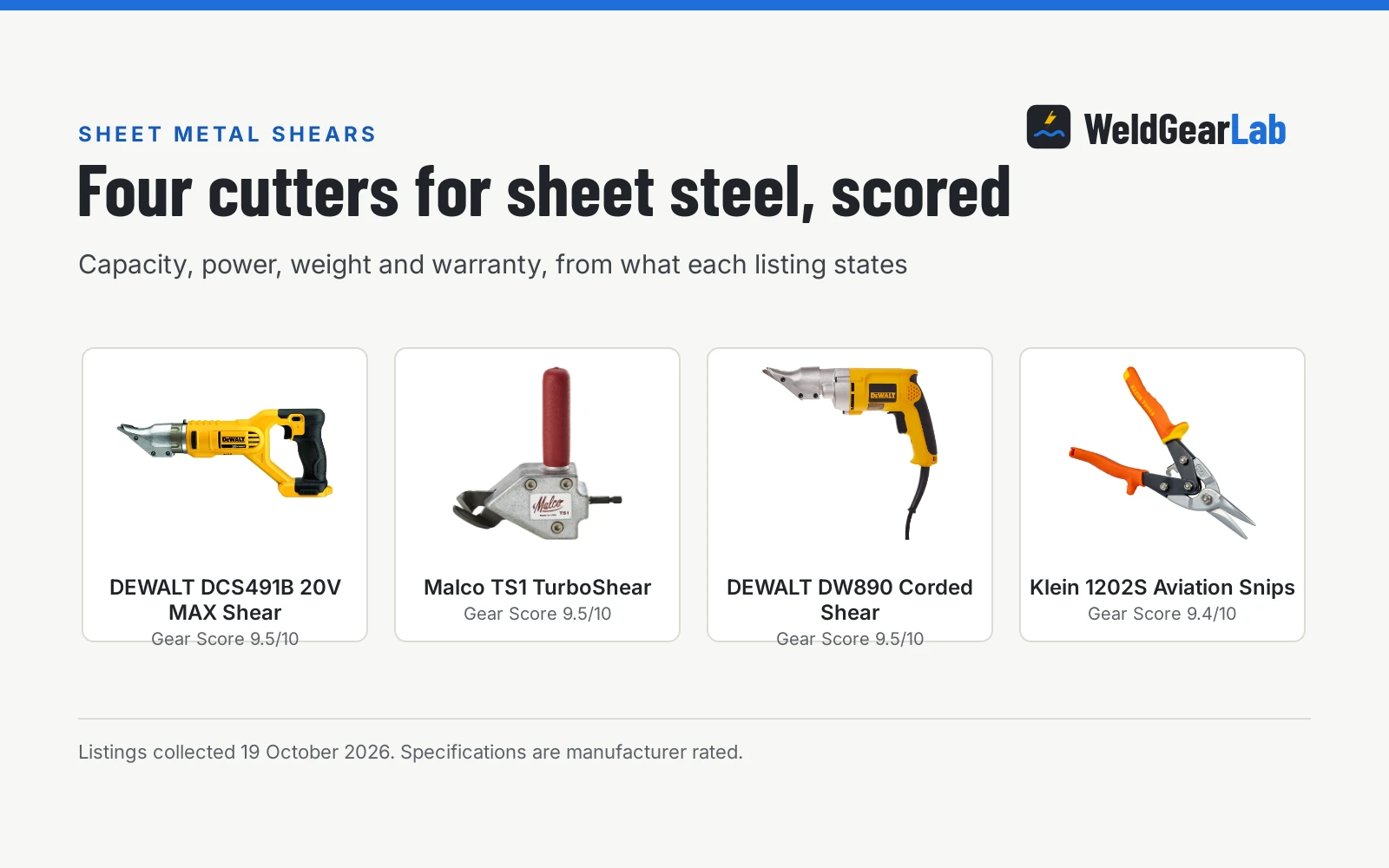
- Zero or low material waste. Single-cut shears slice with zero kerf loss, while double-cut shears remove only a thin strip. For instance, DEWALT lists its DCS491B swivel head shear cutting a 7/32″ strip that curls away from the cut path, keeping the line visible.
- Clean shop cleanup. Because shears slice rather than chew metal, you get either zero waste or one long continuous curl.
- Thicker plate on benchtop cutters. When you move beyond handheld sheet tools to manual shop equipment, heavy lever shears handle substantial stock. VEVOR lists its 12″ hand plate shear cutting up to 1/4″ sheet steel and 1/2″ rod steel, while KAKA INDUSTRIAL rates its HS-5 bench shear with a 5 in blade for 70 x 6 mm flat steel and 11 mm round steel.
- Trimming edges and flanges. Hand snips and powered shears excel at shearing off excess material along panel edges. HURRICANE rates its 10 inch aviation snips for 20-gauge cold rolled steel and 22-gauge stainless steel, and Amazon Basics lists an 18 gauge (1.2 mm) cold-rolled steel capacity on its snip set.
When your job calls for powered straight cutting without dragging an air hose or power cord, modern cordless shears make quick work of panel prep. Our sheet metal brake vs pan brake guide explains how clean shear cuts improve fit-up before bending.
When a metal nibbler is the better choice
- Tight curves and intricate cutouts. Because a nibbler punches tiny bites through a die rather than wedging wide blades between metal sections, you can pivot the tool mid-cut to carve sharp arcs, tight radiuses, and intricate templates without binding.
- Zero edge distortion on sheet metal. While single-cut shears wedge metal downward and can bow or twist the offcut edge, a nibbler punches out downward chips with zero lateral wedging force. Both sides of the cut panel remain flat and ready for weld fit-up.
- Corrugated roofing and ribbed panels. Standard straight-cut shears struggle or bind when trying to traverse steep corrugations and formed seams. A nibbler head straddles profiles, chewing across ridges and valleys without crushing the profile.
- Internal cutouts without edge access. Starting a cut in the center of a panel with a shear requires cutting in from the outside perimeter or pre-drilling a large clearance slot. With a nibbler, you drill a small pilot hole to insert the punch die, then steer in any direction.
If your fabrication work requires carving curves or trimming corrugated sheet, dedicated nibblers offer control that shears cannot match. Our best sheet metal nibbler guide scores top standalone cutters, while our roundup of the best electric metal nibbler models covers corded tools for steady production cutting. For lighter jobs or quick field patches, a drill attachment from our metal nibbler for drill guide lets you use an existing chuck.
How to check cutting capacity and drive type
Evaluating sheet metal cutters requires checking how blade design, power source, and material capacities match your shop work. Look for these details in product listings:
- Stated gauge and material capacities. Manufacturers rate capacity based on mild steel, but harder alloys reduce maximum thickness. For example, HURRICANE lists its snips cutting 20-gauge cold rolled steel but drops to 22-gauge on stainless steel. Amazon Basics states the same difference on its snips, listing 18 gauge (1.2 mm) for cold-rolled steel and 22 gauge (0.8 mm) for stainless steel. Always verify whether a tool capacity covers stainless or only mild steel.
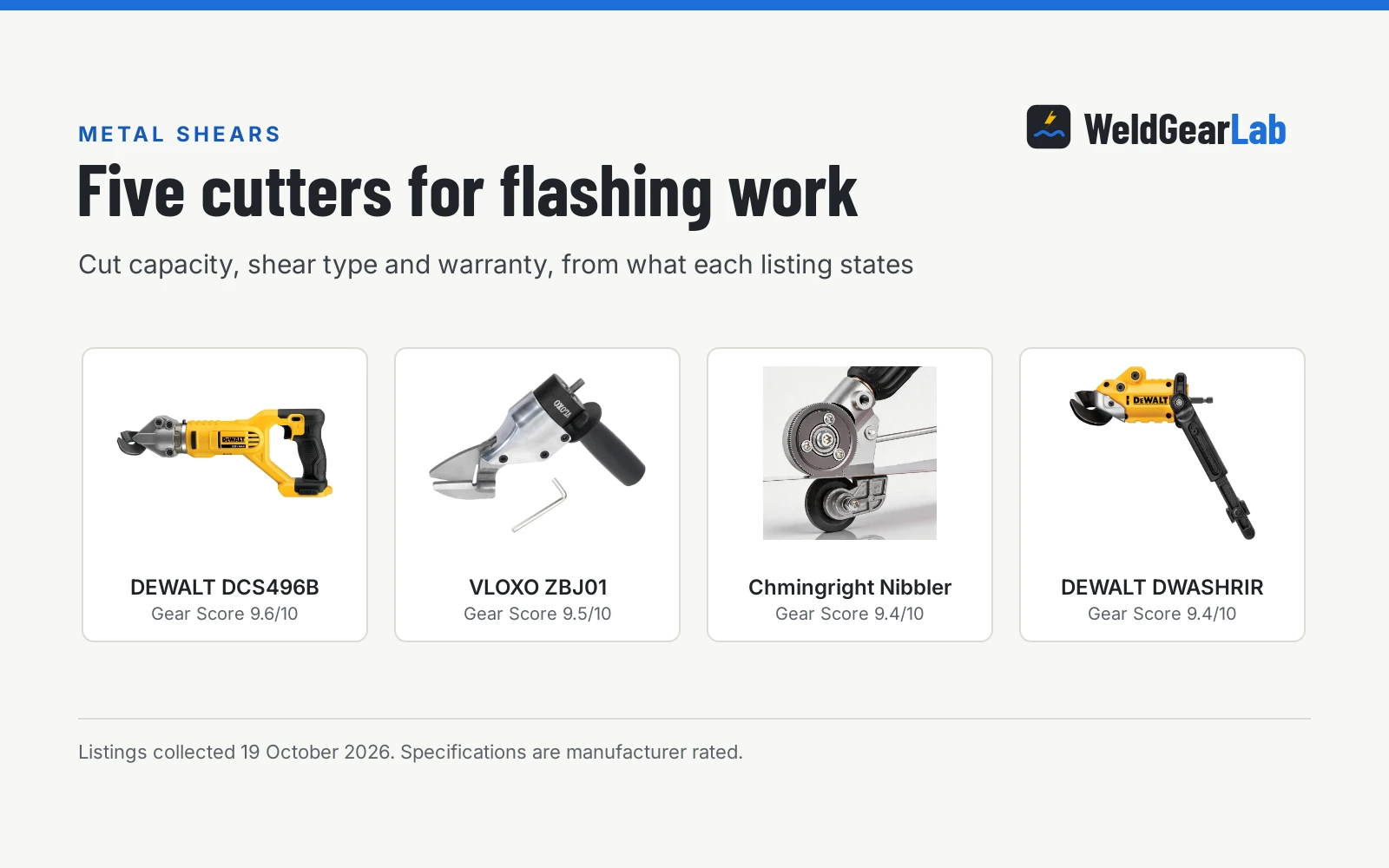
- Drive mechanisms and power. You can choose between dedicated corded tools, cordless tools, and drill accessories. DEWALT lists its DWASHRIR shear attachment featuring a 1/4 in. hex shank that chucks into 18V-20V impact drivers and drills, cutting up to 18 Ga. material. For high-torque cordless demands, PropeLannt lists a 14GA capacity powered by 400Nm torque compatible with 20V Max batteries.
- Head rotation and clearance. Fixed cutter heads force your hands against the workpiece on wide panels. Swivel head designs, such as the DEWALT DW890 electric shear and DCS491B cordless shear, feature a 360 degree pivoting head that lets you rotate the cutting jaws to keep the motor housing clear of the sheet. Offset cutters, like the DEWALT DCS496B offset shear, are built to clear 20ga spiral duct seams.
- Blade geometry and cut control. Single-cut shears function like heavy snips with a single moving blade against a stationary counter-blade. Double-cut shears drive a center blade between two outer blades, curling out a waste ribbon, such as the 7/32″ strip listed on DEWALT shears, leaving both sides of the panel flatter. For feed control, DEWALT lists a speed of 100-350 spm with a variable speed dial on its DW890 corded shear, along with a minimum cutting radius of 5-1/2-inch.
Dealing with curls, chips, and cleanup
Managing the debris each cutter leaves behind is an essential part of shop safety and workflow efficiency. Double-cut shears produce a continuous metal curl that rolls up as the blades advance. The waste curl has sharp razor edges, but it stays in a single intact ribbon that you can drop directly into the scrap bin with heavy work gloves. Metal nibblers punch out small crescent-shaped steel chips that drop directly from the die. If left on the bench or floor, these sharp needles embed in work boot soles, scratch finished panels, and puncture tires, making a magnetic sweep or collection bag necessary to keep the fabrication area clear.
Can one tool handle every sheet metal cut?
In a working shop, shears and nibblers complement each other rather than competing directly. If your work consists primarily of trimming rectangular panels, sizing HVAC ducting, or squaring flat sheet, a metal shear handles the volume with maximum speed and simple cleanup. When your projects shift to complex curves, dash cutouts, round louvers, or corrugated roofing, a metal nibbler is indispensable. Many shops keep a fast shear on hand for panel sizing and a nibbler or drill attachment for interior cutouts and tight contour work.
Sharp edges and flying chips. Both tools leave freshly sheared sheet edges that can slice through soft skin. Always wear heavy leather work gloves when guiding metal through shears or handling trimmed offcuts. With nibblers, the punch ejects sharp steel chips at high frequency that can ricochet off table surfaces; wear ANSI approved safety glasses and avoid brushing away punch debris with bare hands. Clamp your workpiece firmly to the welding table to prevent the sheet from chattering or climbing the punch die during the stroke.
FAQ for welders
Can a metal shear cut corrugated roofing panels?
Standard straight metal shears generally struggle on corrugated roofing because their wide jaws crush the ribs and cannot follow steep profiles. Specialized pivoting shears, such as the DEWALT DWASHRIR attachment rated for corrugated sheet metal, can handle formed profiles, but nibblers remain the easiest tool for the job. A nibbler head rides over corrugated ridges and valleys without pinching or flattening the metal.
Does a metal nibbler distort the edges of sheet metal?
A metal nibbler does not distort sheet metal edges because it cuts by punching small downward bites rather than wedging blades through the sheet. The panel stays completely flat on both sides of the cut line without the offcut bowing or edge twisting common with single-cut shears. This leaves clean, flat edges that clamp easily for welding fit-up.
How do you start an internal cutout with each tool?
With a metal nibbler, you drill a pilot hole large enough to accept the punch die head, insert the tool, and begin cutting in any direction. A standard metal shear cannot start inside a closed boundary unless you pre-cut a large clearance slot, because the blades need edge access to start slicing. For enclosed openings like gauge holes or access ports, a nibbler is far more practical.
Which tool produces less mess in the shop?
A metal shear makes significantly less mess because single-cut designs produce zero scrap and double-cut shears create a single continuous curl. A metal nibbler ejects sharp, crescent-shaped steel chips that scatter across benches and floors. These small chips require careful cleanup with a shop vacuum or magnetic sweep to prevent tire punctures and foot injuries.
Can you cut stainless steel with a metal shear or nibbler?
Both tools can cut stainless steel provided their cutting heads and motor capacities support the harder material. Because stainless steel work-hardens rapidly, tool capacity is typically reduced compared to mild steel. Always check the manufacturer listing to confirm stainless capacities before cutting.
Related: best sheet metal nibbler, best electric metal nibbler, metal nibbler for drill, and the metal fab tools hub. Also see our sheet metal brake vs pan brake guide.