Oxy Acetylene vs Stick Welder: Which One Should You Buy?
Oxy-acetylene vs stick welder: a gas torch that cuts, welds, brazes and heats against an arc welder for steel, compared on what each does and the setups the listings show.

On this page
Top picks at a glance
As an Amazon Associate I earn from qualifying purchases.
- 1
 Stick Welder9.6/10View on Amazon
- 2
 MC 10 cu ft Acetylene + 20 cu ft OxygenView on Amazon
- 3
 RX WELD Oxy Acetylene Regulator SetView on Amazon
- 4
 Hobart 770096 Welding Oxy-Acetylene GoggleView on Amazon
- 5
 Dual Welding Gas GaugesView on Amazon
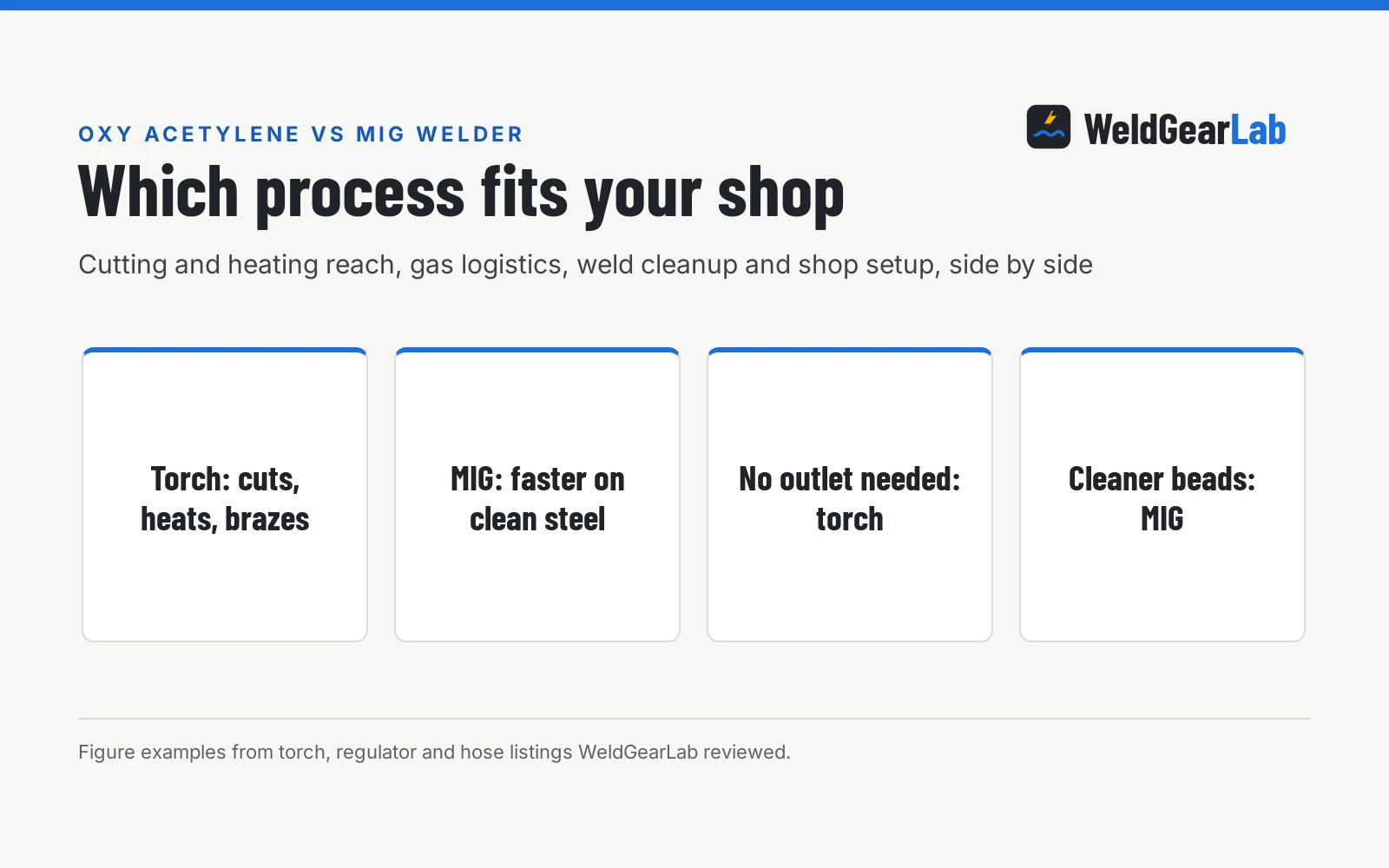
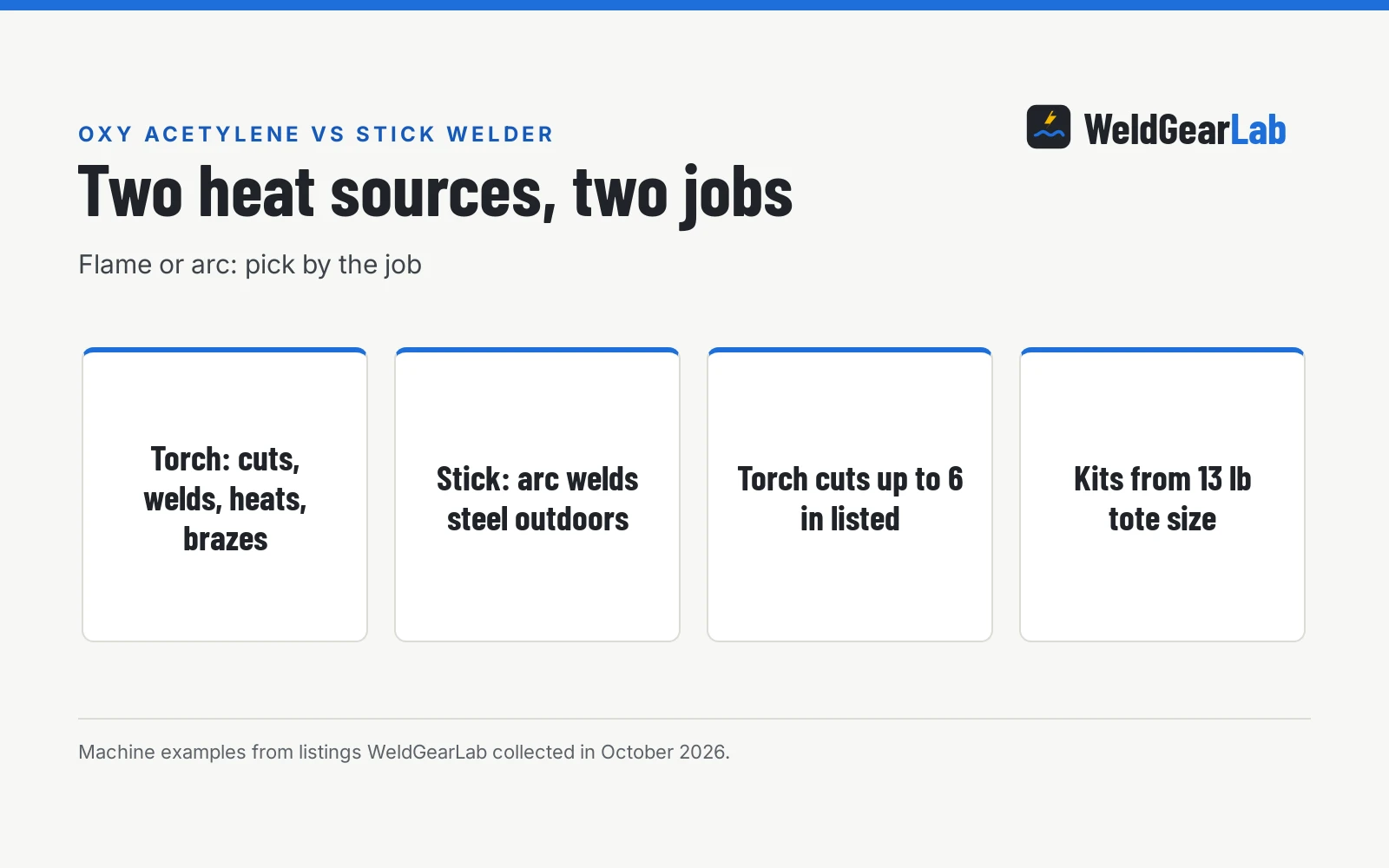
An oxy acetylene vs stick welder choice is really a choice of heat source: oxy-acetylene burns gas to make a flame that cuts, welds, brazes and heats, while a stick welder strikes an electric arc that melts a consumable electrode into the joint. Buy oxy-acetylene for cutting, heating and brazing with no power outlet; buy the stick welder for arc welding steel. Many farm shops end up with both, because the torch cuts and the stick welder joins.
Other welders and gear to compare
 MC 10 cu ft Acetylene + 20 cu ft OxygenCheck price on Amazon
 RX WELD Oxy Acetylene Regulator SetCheck price on Amazon
 Hobart 770096 Welding Oxy-Acetylene GoggleCheck price on Amazon
 Dual Welding Gas GaugesCheck price on Amazon
This guide links to our product roundups, where WeldGearLab gets a commission on purchases made through links on this page, and your price stays the same. Read our affiliate disclosure.
oxy acetylene vs stick welder: the difference in one paragraph
Oxy-acetylene is a gas process: oxygen and acetylene metered through regulators, mixed at the torch, burned at the tip. It cuts steel by oxidizing it, welds by melting filler into the joint, and heats for bending and straightening. Stick welding is an electric process: current arcs between the electrode and the work, the flux coating shields the puddle, and the electrode becomes the filler. One needs gas cylinders; the other needs electricity and electrodes.
Side by side
| Aspect | Oxy-acetylene | Stick welder | Listed by |
|---|---|---|---|
| Heat source | Oxygen and acetylene flame | Electric arc, consumable electrode | General |
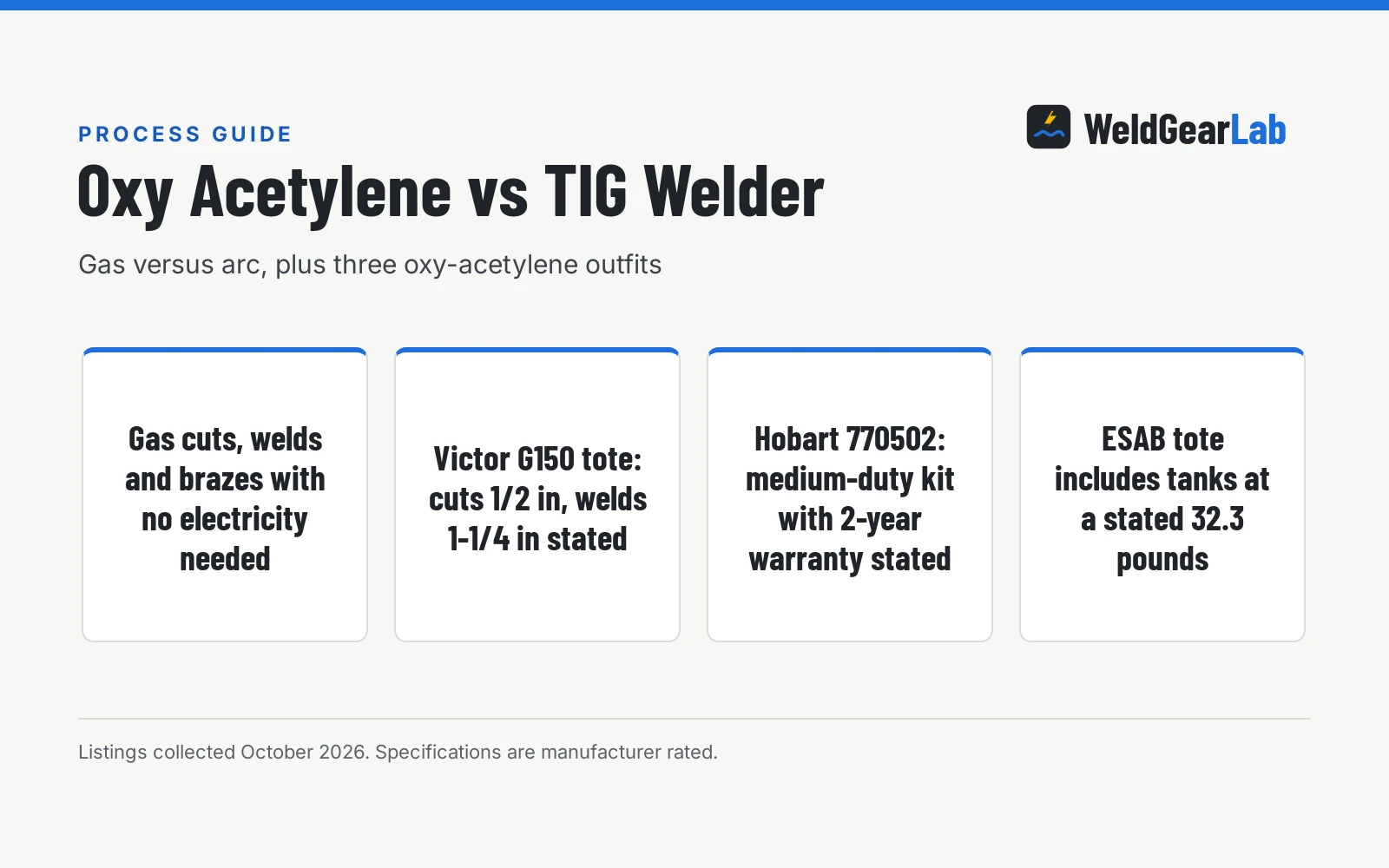
| Cut capacity | Up to 1/2 in (Victor G150); up to 6 in (RX WELD kit) | Not stated | Victor, RX WELD listings |
| Weld and braze capacity | Up to 1-1/4 in with optional nozzles (Victor G150); up to 1/2 in (RX WELD kit) | Not stated | Victor, RX WELD listings |
| Portability | Tote kit 13 lb without tanks; 32.3 lb with tanks included | Not stated | Victor, ESAB listings |
| Power needed | None; runs on cylinders | Mains power or generator | General |
| Stated warranty | 2 year limited (Hobart 770502) | Not stated | Hobart listing |
| Safety stack | Flashback arrestors, check valves, goggles | Helmet, gloves, flame-resistant clothing | Vaphy, Hobart, RX WELD listings |
All oxy-acetylene figures below are manufacturer rated, as published in the reference listings and collected 19 October 2026. The stick side is described in general terms.
When oxy-acetylene is the better choice
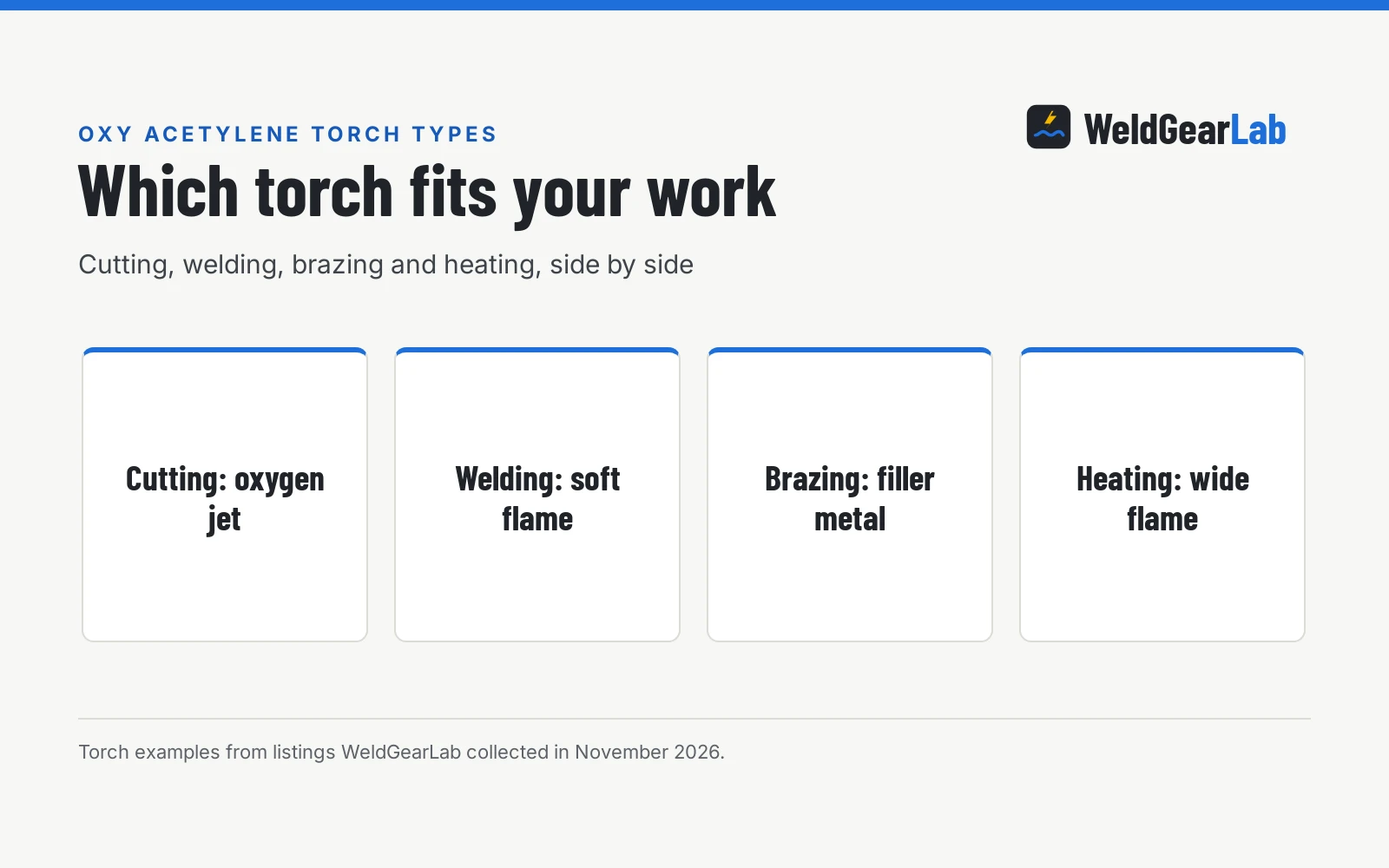
- Cutting steel. The Victor G150 tote kit cuts up to 1/2 in, and the RX WELD medium-duty kit lists clean cuts up to 6 in. A stick welder gouges; it does not cut like a torch.
- Heating and bending. A flame heats a controlled area for bending, straightening and loosening seized parts. Arc heat is too concentrated for that work.
- Brazing and soldering. The RX WELD kit lists welding and brazing on materials up to 1/2 in thick with the right tips. Brazing joins dissimilar metals the stick process cannot.
- No power outlet. The torch runs on cylinders alone. The Victor tote kit without tanks is 13 lb; the ESAB tote with tanks included is 32.3 lb.
When a stick welder is the better choice
- Welding steel. A stick welder joins steel with an electric arc and a consumable electrode, as described in the comparison above.
- Simple consumables. Electrodes store on the shelf; there are no cylinders to fill, no regulators to set, no flashback arrestors to fit.
- One process, learned once. Stick has fewer adjustments than a torch: no flame chemistry to read, no tip changes between cutting and welding.
- Steel repairs. A stick welder joins steel by melting an electrode into the joint, as described in the comparison above.
What the listings show about oxy-acetylene setups
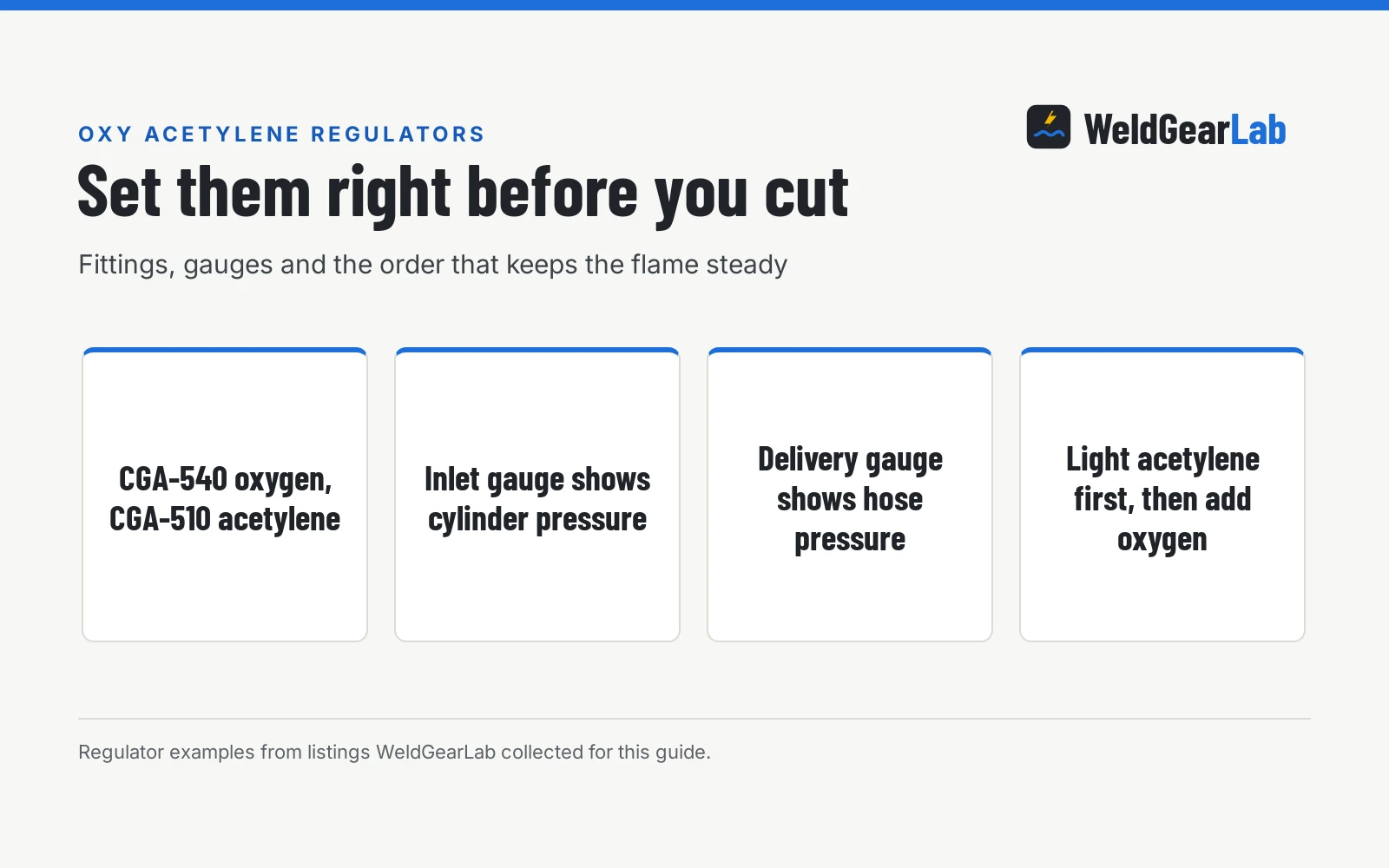
A setup is a stack of parts. The torch kits bundle the handle, tips, regulators and hose: the Victor G150 tote carries R150-200 and R150-540 regulators, a 103-01FP torch handle, a striker, a 12.5 ft 3/16 in hose, goggles and a tank key in a molded case, and cuts up to 1/2 in while welding up to 1-1/4 in with optional nozzles. The Hobart 770502 is a medium-duty kit with a forged brass handle, reverse-flow check valves, tips, goggles, regulators and hose at 16.4 lb, with a 2 year limited warranty, and it runs acetylene or propane with the right tips. The RX WELD regulator set shows the standard layout: oxygen at 0-4000 PSI in and 0-100 PSI out, acetylene at 0-400 PSI in and 0-30 PSI out, on CGA540 and CGA200 tank connections. Hoses run 25 or 50 ft in 1/4 in ID with 9/16-18 B fittings, rated 300 PSI working and 900 PSI burst in Grade R rubber. Cylinders in the reference set are the portable MC 10 cu ft acetylene and 20 cu ft oxygen pair, at 7.68 and 13.67 lb, shipped empty and filled at the gas supplier.
Safety gear both sides need
Oxy-fuel has its own safety stack. Flashback arrestors sit between the torch and the hoses: the Vaphy set is rated 20 bar (290 PSI) on the oxygen side and 1.5 bar (21 PSI) on the acetylene side, with 9/16-18 B threads. The Hobart and RX WELD kits include reverse-flow check valves, and the RX WELD listing recommends flashback arrestors as well. Goggles come in the Victor, Hobart and RX WELD kits. A stick welder needs a different stack: a helmet with the right shade, gloves and flame-resistant clothing. See our best gloves for oxy-fuel welding and best welding jacket for stick welding.
FAQ for welders
Can you weld with oxy-acetylene?
Yes. The Victor G150 welds up to 1-1/4 in with optional nozzles, and the RX WELD kit lists welding and brazing up to 1/2 in. It is slower than arc welding on thick steel, but the same torch also cuts and heats.
Can a stick welder cut metal?
Not like a torch. Stick can gouge and pierce, but clean cutting is the oxy-acetylene torch’s job: up to 1/2 in on the Victor tote, up to 6 in on the RX WELD kit.
Do I need flashback arrestors?
What the listings show: the Hobart and RX WELD kits include check valves, the RX WELD listing recommends arrestors too, and the Vaphy set lists 290 PSI oxygen and 21 PSI acetylene ratings. Fit them at the torch.
What tanks does oxy-acetylene need?
An acetylene cylinder (CGA200 valve on the MC size here) and an oxygen cylinder (CGA540), filled at a gas supplier since they ship empty. Note the RX WELD regulator warning: its small acetylene regulator fits only MC tanks with CGA200 valves.
Which is better for a beginner?
The torch teaches flame control, heating and cutting in one tool; stick teaches the arc with fewer parts to buy. For a farm shop that needs repairs now, the stick welder’s simpler consumables win; for a shop that cuts and bends, the torch wins. Our stick welder vs multi-process welder guide covers the arc side further.
Related: best all around stick welding rod, single stage vs dual stage gas regulator, stick welder vs multi-process welder and best gloves for oxy-fuel welding.