Oxy Acetylene vs Mig Welder: Which One Should You Buy?
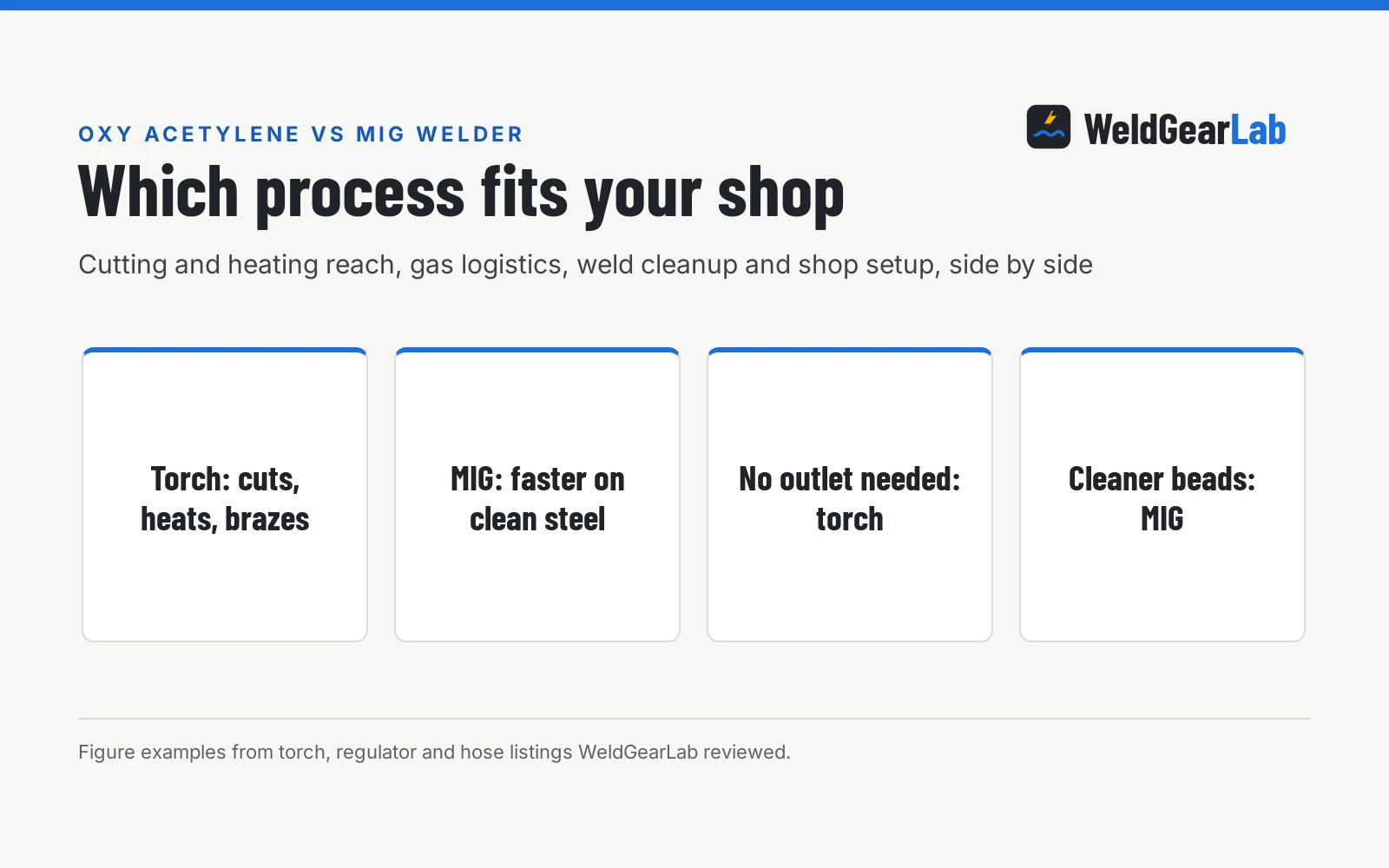
Oxy-acetylene cuts, heats and brazes without shop power while MIG lays faster, cleaner beads on clean steel; this guide compares both so you pick the right process for your work.

On this page
Top picks at a glance
As an Amazon Associate I earn from qualifying purchases.
- 1
 035" V Groove Drive Roll Kit Compatible with Miller9.6/10View on Amazon
- 2
 MC 10 cu ft Acetylene + 20 cu ft OxygenView on Amazon
- 3
 RX WELD Oxy Acetylene Regulator SetView on Amazon
- 4
 Hobart 770096 Welding Oxy-Acetylene GoggleView on Amazon
- 5
 Dual Welding Gas GaugesView on Amazon
You have a cracked mower deck or a busted trailer hitch, and you are weighing oxy acetylene vs mig welder setups. Here is the short answer: pick the torch if you need to cut, heat, braze and solder as well as weld, and you work where there is no shop power. Pick MIG if most of your work is welding clean steel in the shop and you want fast, low cleanup beads. Both join steel; they just earn their keep in different shops.
Other welders and gear to compare
 MC 10 cu ft Acetylene + 20 cu ft OxygenCheck price on Amazon
 RX WELD Oxy Acetylene Regulator SetCheck price on Amazon
 Hobart 770096 Welding Oxy-Acetylene GoggleCheck price on Amazon
 Dual Welding Gas GaugesCheck price on Amazon
This guide links to our product roundups, where WeldGearLab gets a commission on purchases made through links on this page, and your price stays the same. Read our affiliate disclosure.
The difference in one paragraph
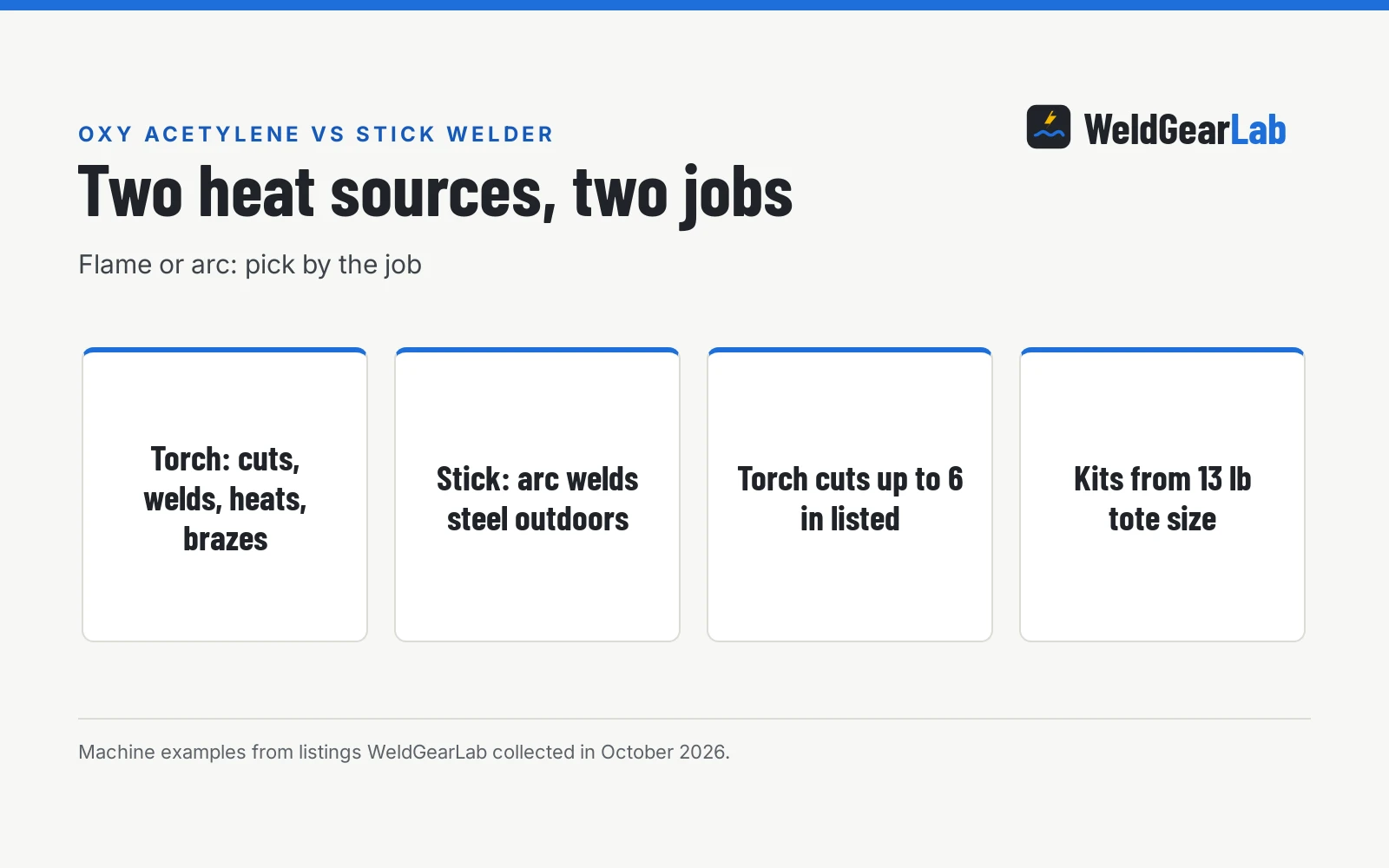
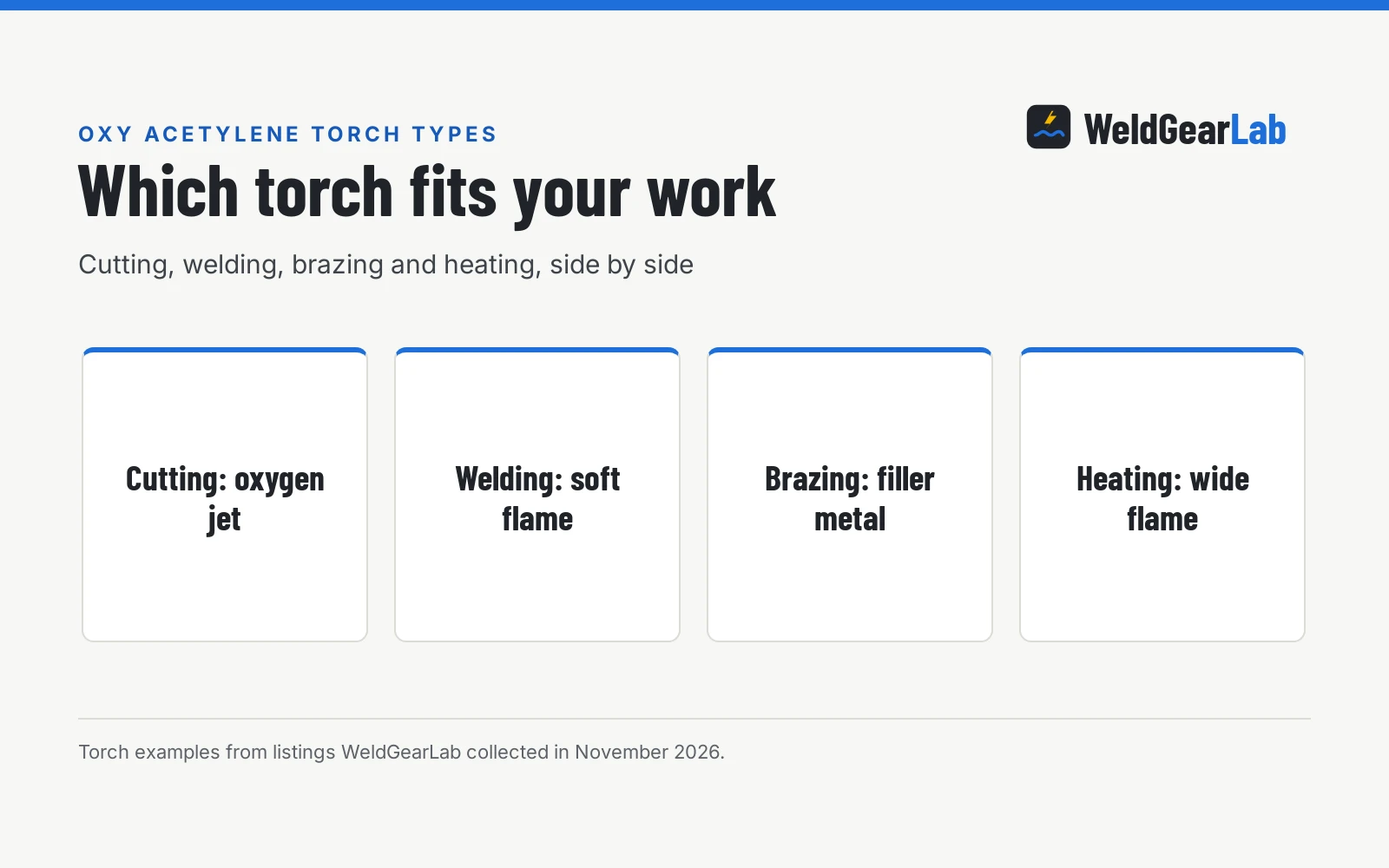
MIG feeds wire through a gun and shields the puddle with gas from a cylinder, or with flux inside the wire on flux core setups, so you can lay a bead nearly as fast as you can move the gun. Oxy-acetylene melts the base metal and a filler rod with a flame mixed from oxygen and acetylene cylinders at the torch. The flame is slower, but the same torch also cuts plate, heats bent parts for straightening, brazes and solders, which makes it a multi-tool where the MIG machine is a specialist.
Side by side
| Factor | Oxy-acetylene | MIG welder | Favors |
|---|---|---|---|
| Main job | Welds, cuts, heats, brazes, solders | Welds; no cutting | Torch on range |
| Power source | Two gas cylinders, no electricity | Shop power plus a gas cylinder | Torch off grid |
| Wind and outdoor work | Works fine outdoors | Shielding gas blows away | Torch outdoors |
| Thin sheet metal | Wider heat zone, harder to control | Fast, narrow, controllable beads | MIG on thin steel |
| Rusty or painted steel | More forgiving of rough prep | Wants cleaner metal | Torch on dirty steel |
| Cutting thick steel | The torch is a cutter too | Not a cutting process | Torch |
| Brazing and soldering | Yes, with the right tip | Not its job | Torch |
| Weld cleanup | Slag on some welds | No slag, lighter spatter | MIG |
| Setup pieces | Torch, regulators, hose, cylinders, striker, flashback arrestors | Machine, gun, wire, cylinder, regulator | Tie |
| Learning curve | Two hands and flame control | Point and pull the trigger | MIG for beginners |
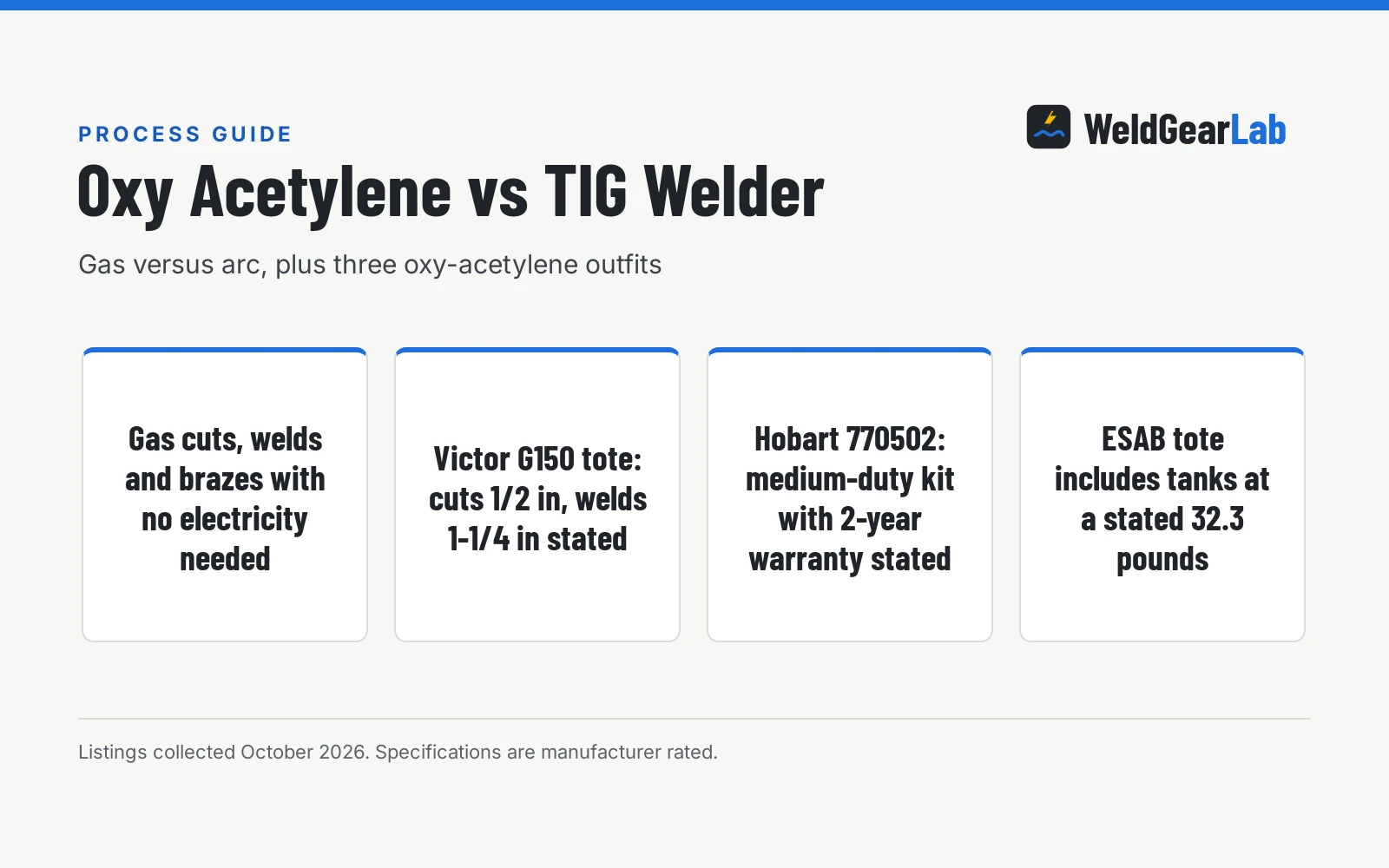
Brands name their torch kits by duty rating, so read the listing the way you read a welder listing: Victor lists light duty for its G150 outfit, Hobart lists medium duty for its 770502 kit, and RX WELD lists medium duty for its RX250H-HC kit. Match the duty rating to the work the way you match a welder to its rated output.
Oxy acetylene vs mig welder: what the kit specs say
Torch listings state exactly what is in the bundle. Victor’s G150 J-P light duty outfit states it welds up to 1 1/4 inch with optional nozzles and cuts up to 1/2 inch, ships with a 12.5 foot, 3/16 inch hose, and weighs 13 pounds without tanks; the G150 J-CPT with tanks included weighs 32.3 pounds. Hobart’s 770502 medium duty kit lists a forged brass handle, reverse flow check valves, acetylene or propane compatibility, and a box with a number 0 cutting tip, a number 0 welding tip, goggles, regulators, flashback arrestors, a spark lighter, a tank wrench and twin hose at 16.4 pounds with a 2 year limited warranty. RX WELD’s RX250H-HC medium duty kit states cuts up to 6 inches and welding and brazing on material up to 1/2 inch thick with appropriate tips, plus 2.5 inch diameter regulators.
A MIG machine is specified differently: a machine listing names its input voltage and duty cycle and states whether it runs gas or flux core wire, so match those figures to your shop circuit.
When the torch is the better choice
- Field and farm calls. No outlet, no problem: the torch runs off its two cylinders. A portable MC set pairs a 10 cubic foot acetylene cylinder at 7.68 pounds with a 20 cubic foot oxygen cylinder at 13.67 pounds; both ship empty and get filled at a local gas supplier.
- Cutting and heating. The torch cuts plate and frees rusted fasteners with heat, jobs a MIG machine cannot touch.
- Brazing and soldering. A soft flame joins copper, brass and dissimilar metals with no arc at all.
- Rough steel. The flame tolerates less than perfect prep better than a MIG puddle, which helps on equipment repairs.
Our oxy acetylene vs stick welder guide covers the other classic shop pairing, and plasma cutter vs oxy-acetylene torch compares cutting tools head to head.
When MIG is the better choice
- Thin sheet and auto body. The arc puts heat in a small spot, so thin panels weld with less distortion and less burn through.
- Speed on clean steel. Point the gun and pull the trigger. On a run of brackets or a long seam, MIG covers ground fast.
- Looks and cleanup. No slag to chip and lighter spatter to grind, which matters on visible work and furniture.
- Indoor shop work. Less smoke than flux core wire, though you still need ventilation and the usual head and eye protection.
See our best welder for beginners guide, plus how to choose a MIG welder if you are shopping machines.
Gas, cylinders and safety basics
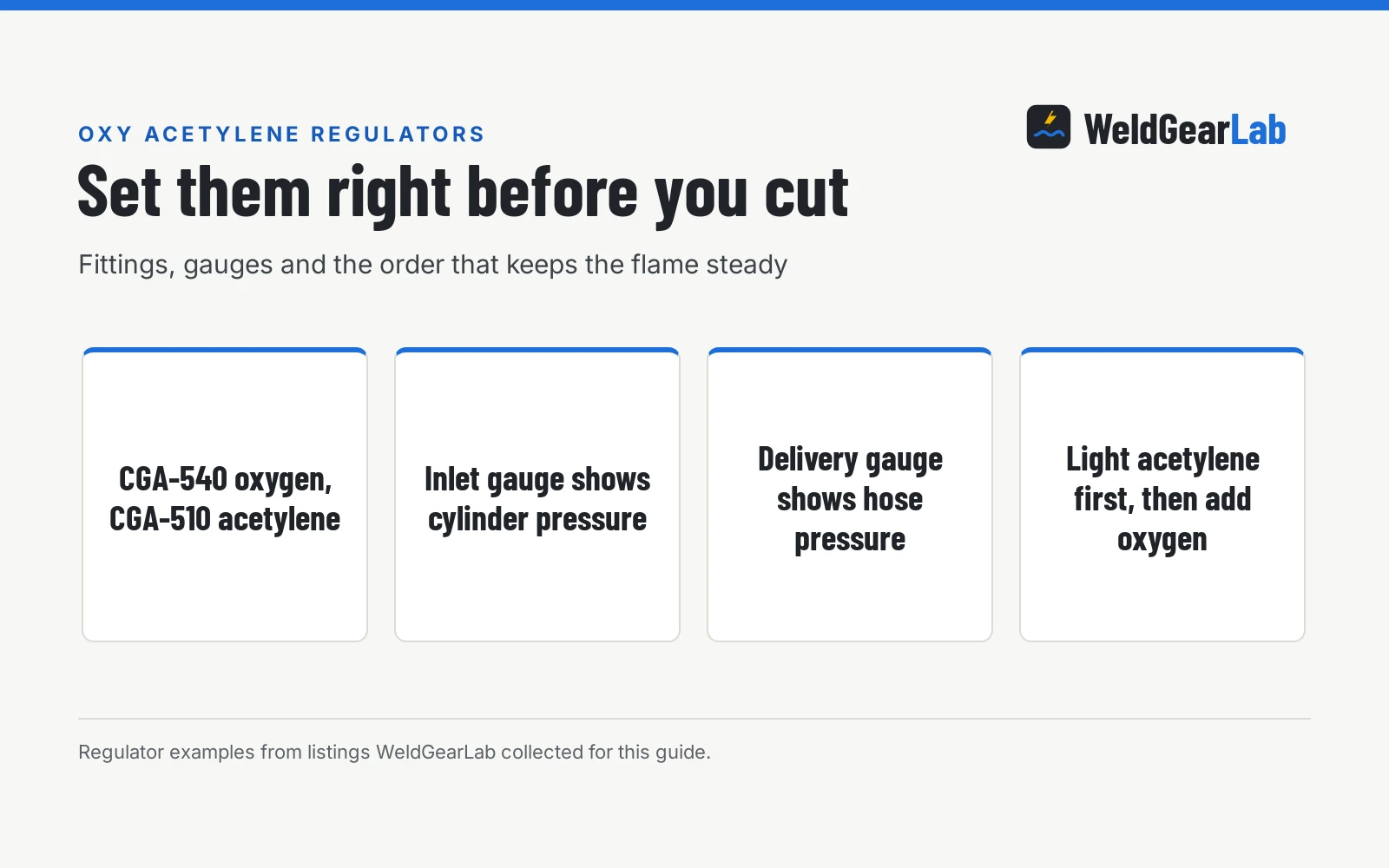
An oxy-acetylene rig has more pieces to respect than a MIG machine. A regulator set like the RX WELD pair lists oxygen at 0 to 4000 PSI inlet and 0 to 100 PSI outlet, and acetylene at 0 to 400 PSI inlet and 0 to 30 PSI outlet, with 9/16-18 B outlets for the hose. The oxygen cylinder in the MC set lists a 2015 PSI service pressure, and RX WELD’s Grade R twin hose lists a 300 PSI working pressure with a 900 PSI burst rating. Flashback arrestors sit between the torch and the hoses.
Cylinders, leaks and flame. Chain cylinders upright so they cannot tip, and check every joint for leaks with soapy water. Keep oil and grease off oxygen fittings entirely, clear flammables from the work area, and fit flashback arrestors as the listings recommend. Ventilate the shop, keep your head out of the fumes, and wear shade rated eye protection plus the gloves in our gloves for oxy-fuel welding guide. See our single stage vs dual stage gas regulator guide before you buy regulators.
FAQ for welders
Can I weld steel with only an oxy-acetylene torch?
Yes. The flame melts the base metal and a filler rod into a fused joint, and the Victor G150 listing states welding up to 1 1/4 inch with optional nozzles. It is slower than MIG and the heat spreads wider, so joint fit up matters more. For thin sheet or long seams, MIG is the easier path.
Can a MIG welder cut metal?
No. A MIG machine welds; it has no cutting flame. If your work needs cutting too, that is the torch’s biggest selling point. Our plasma cutter vs oxy-acetylene torch guide compares the cutting options.
Which costs less to run over time?
It depends on the work. The torch consumes oxygen and acetylene, so heavy cutting and heating means regular cylinder refills. MIG consumes wire spools and shielding gas, and the wire goes fast on long seams. Cutting heavy means the torch earns its gas; long clean welds mean MIG earns its wire.
Do I need flashback arrestors on an oxy-acetylene rig?
Yes, fit them. Some kits include check valves, and the Hobart 770502 kit lists both reverse flow check valves and flashback arrestors in the box. They sit between the torch and the hoses and stop a flame from traveling back into the lines. Cheap insurance on a rig that holds pressurized fuel gas.
Which should a beginner buy first?
If the goal is learning to weld steel in the shop, start with MIG: the technique is simpler and the results come faster, as our best welder for beginners guide explains. If the first jobs are farm repairs, cutting and brazing with no shop power, the torch kit teaches more skills at once. Many small shops end up owning both.
Related: oxy acetylene vs stick welder, best MIG welder for farm repairs, argon vs C25 gas for MIG welding, and the MIG welders hub.