Hacksaw Blade TPI Chart: Teeth Per Inch Guide
A hacksaw blade TPI chart matches teeth per inch to the metal in front of you, so the blade cuts cleanly instead of snagging, skipping or binding.

On this page
Top picks at a glance
As an Amazon Associate I earn from qualifying purchases.
- 1
 Starrett Hacksaw Blade9.5/10View on Amazon
- 2
 Hanpex Hacksaw Replacement Blades9.5/10View on Amazon
- 3
 HAUTMEC Bi-Metal Hacksaw Blades 12 inch9.7/10View on Amazon
A blade that skips across the cut, grabs, or binds in the metal usually has the wrong tooth count for the work in front of you. A hacksaw blade tpi chart matches teeth per inch to the thickness of the metal, so the teeth bite cleanly and the cut stays straight. This guide explains how to read that chart, how tooth count changes the cut, and how to pick a blade from the lengths and tooth counts the listings show.
This guide links to our product roundups, where WeldGearLab gets a commission on purchases made through links on this page, and your price stays the same. Read our affiliate disclosure.
What a hacksaw blade tpi chart shows
A hacksaw blade tpi chart lists teeth per inch, known as TPI, beside the kind of metal each tooth count suits. TPI means how many teeth sit along each inch of the blade edge. A low TPI blade has larger teeth with wider gaps between them, while a high TPI blade has smaller teeth packed close together.
The aim is to keep enough teeth in contact with the metal at all times. When too few teeth touch the work, the teeth catch on the edge and the cut wanders. When the teeth are too fine for thick metal, the gaps fill with chips and the blade drags. Most listings in this guide use 18, 24 or 32 TPI, and a set from Viganoc lists 18, 24 and 32 TPI blades in a 10 pack. See the types of hacksaw blades guide for how tooth shape and blade material fit into the same choice.
Side by side
| 18 TPI | 24 TPI | 32 TPI | |
|---|---|---|---|
| Teeth per inch | 18 | 24 | 32 |
| Common blade length | 12 inch | 12 inch | 12 inch |
| Materials named in listings | Steel, cast iron and copper | Steel, pipe, wood and PVC | Wood, PVC, copper tube and aluminum |
| Pack size in listings | 10 pack | 10 pack | 10 pack |
| Tooth style in listings | Wavy set teeth | Wavy set teeth | Wavy set teeth |
Read across a row to compare the tooth counts, then check length and thickness on the pack before ordering.
When 18 TPI fits the job
An 18 TPI blade suits thicker metal, where larger teeth and wider gaps clear chips well. Hanpex lists a 10 pack with five 18 TPI blades and five 24 TPI blades at 12 inch length, and the maker names soft steel pipes, cast iron rods, copper wire and aluminum brackets among the uses. Lenox lists an 18 TPI blade with a 1/2 inch width, and the maker names unhardened tool steel and stainless among the metals it cuts.
Use 18 TPI when the work is thick enough for the teeth to stay engaged through the cut. Avoid 18 TPI on thin sheet and thin tube, where the teeth can catch the edge, tear the sheet, or snap a tooth.
When 24 TPI fits the job
A 24 TPI blade is the general shop choice in the listings. Wiojided lists a 24 TPI blade at 12 inch length, 0.5 inch width and 0.024 inch thick, in a 10 pack, for cutting steel wire, pipe, wood and other materials. HAUTMEC lists a 24 TPI mini blade at 6 inch length and 0.025 inch thick, in a 10 pack, for metal, wood and PVC.
Great Neck lists a 12 inch, 24 TPI blade in a 2 pack, with bi-metal construction and a maker claim of lasting up to 10 times longer than traditional carbon blades. IVY Classic lists a 10 inch, 24 TPI bi-metal blade at 1/2 inch width and 0.025 inch thick, with an 8 percent cobalt alloy steel cutting edge and a Rockwell Hardness of 65-67 HRC, for cutting metal 1/8 inch to 1/4 inch. Use 24 TPI for general cutting on steel, pipe, tube and mixed materials.
When 32 TPI fits the job
A 32 TPI blade suits thin metal, where small teeth keep many teeth in contact with the work. Viganoc lists a 10 pack set with four 32 TPI blades at 12 inch length, and the maker names wood, PVC, copper tube and aluminum pipe among the uses. Lenox lists a 32 TPI blade at 10 inch length, in a 2 count pack, with bi-metal construction that bends and flexes without breaking.
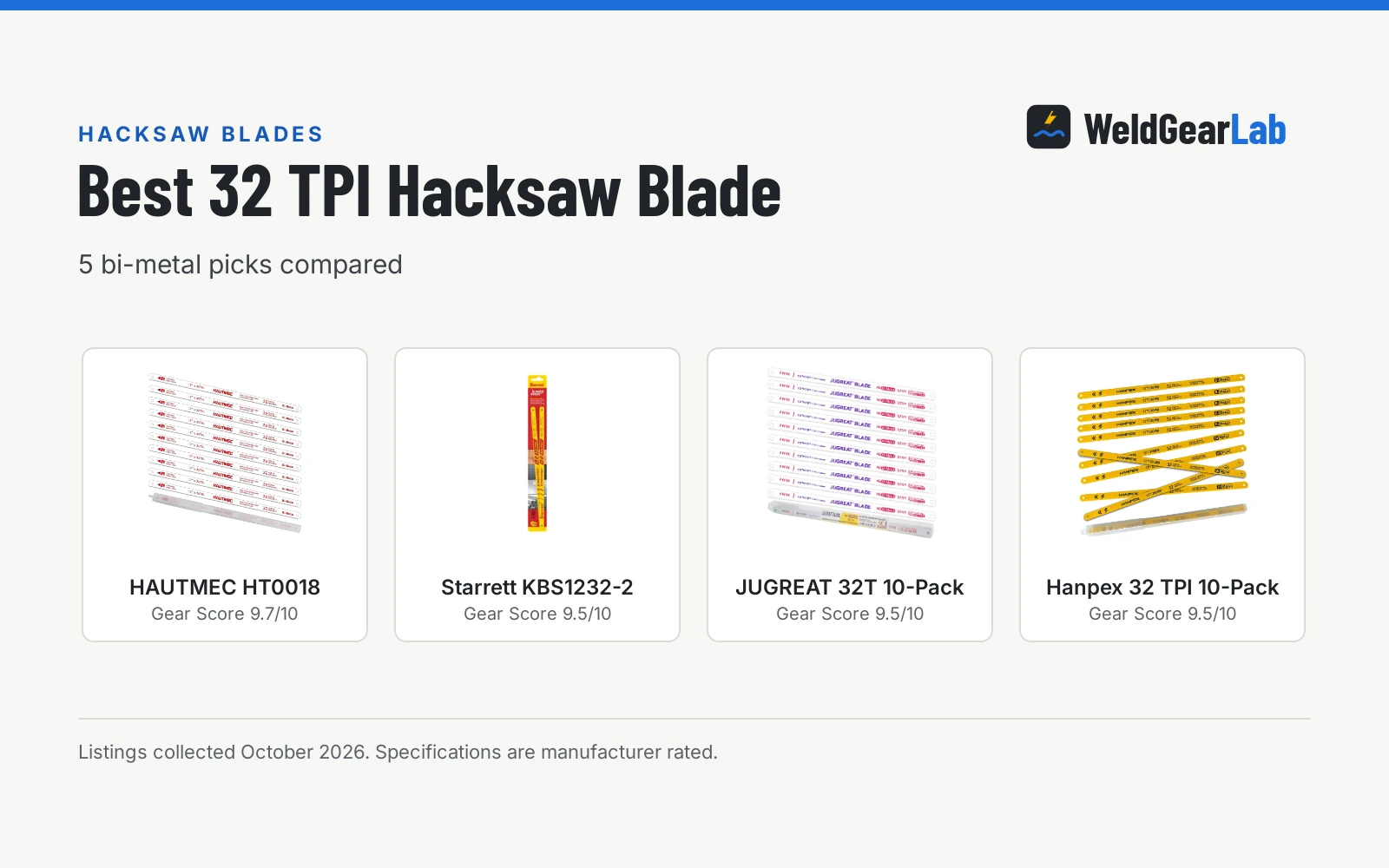
Use 32 TPI on thin sheet, thin tube and small pipe, where a coarse blade would catch and tear. The fine teeth take small bites, which keeps the cut smooth. See the best 32 TPI hacksaw blade guide for packs at this tooth count. On thick metal, a 32 TPI blade cuts slowly, so move to 24 TPI or 18 TPI when the metal gets thicker.
Blade length, width and thickness
Length matters because the blade has to fit the frame. A 12 inch blade is the most common length in the listings, and it fits most standard 12 inch hacksaw frames, as Great Neck states for its 12 inch blade. IVY Classic and Lenox list 10 inch blades, and HAUTMEC and SynHHergyx list 6 inch mini blades, with SynHHergyx listing its mini blade at 150mm in length and 10mm in width. See the hacksaw blade sizes guide for the full range.
Width and thickness shape how the blade behaves in the cut. A 1/2 inch width is common in the listings, including the Lenox 18 TPI blade, the IVY Classic 24 TPI (on Amazon) blade and the Wiojided 24 TPI blade (on Amazon) at 0.5 inch. Thickness in the listings runs from 0.024 inch to 0.039 inch on the blades that state it, with Hanpex listing the thickest at 0.039 inch on its 12 inch blades. Bi-metal blades appear across the listings, with high speed steel teeth bonded to a flexible steel body. For a closer look at those materials, see the bi-metal vs carbon steel hacksaw blade guide.
How to pick a blade from the chart
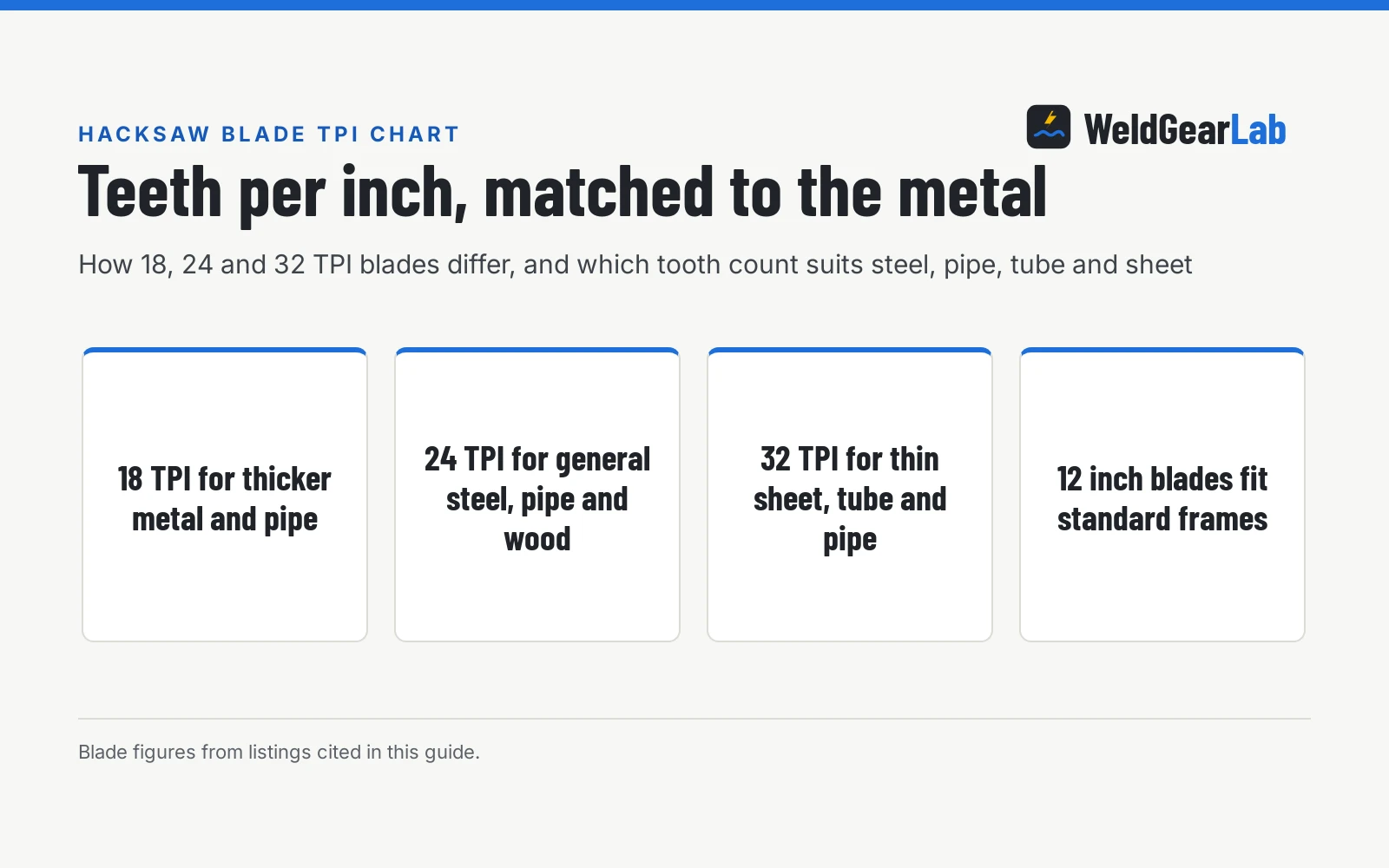
Start with the thickness of the metal. For thicker metal and pipe, pick 18 TPI. For general shop work on steel, pipe, tube and mixed materials, pick 24 TPI. For thin sheet, thin tube and small pipe, pick 32 TPI. When in doubt, pick the finer blade for thin work and the coarser blade for thick work.
Then check length, width and pack size against the frame and the job. A 12 inch blade fits a standard frame, a 10 inch blade fits a shorter frame, and a 6 inch blade fits a mini frame. A 10 pack keeps spares on hand for a busy shop, while a 2 pack suits a short job. See the best hacksaw blades guide for packs compared by tooth count and length. Keep the blade tension firm, keep the teeth facing forward, and change the blade when the teeth dull, rather than pressing harder and bending the blade.
FAQ for welders
What TPI should I use for thin sheet metal?
Use 32 TPI for thin sheet metal. The fine teeth keep many teeth in contact with the thin edge, so the blade cuts smoothly instead of catching and tearing. A coarse blade on thin sheet can snag, bend the edge, or snap a tooth.
Can I cut wood and PVC with a hacksaw blade?
Yes. Wiojided, HAUTMEC, Viganoc and SynHHergyx name wood among the uses, and HAUTMEC and Viganoc name PVC. A 24 TPI blade suits mixed materials in the shop. Match the tooth count to the thickness of the work, and clear chips from the teeth as the cut goes on.
What length hacksaw blade fits a standard frame?
A 12 inch blade fits most standard 12 inch hacksaw frames, as Great Neck states for its 12 inch, 24 TPI blade. Shorter frames need shorter blades, including the 10 inch blades from IVY Classic and Lenox and the 6 inch mini blades from HAUTMEC. Check the frame length on the pack before ordering.
What is the difference between bi-metal and carbon steel hacksaw blades?
A bi-metal blade has high speed steel teeth bonded to a flexible steel body, so the teeth stay hard while the body bends without breaking. A carbon steel blade is made from high carbon steel through the blade, and Hanpex and SynHHergyx list carbon steel blades in their sets. Bi-metal blades suit heavy shop use, while carbon steel blades suit light and occasional cutting.
Why does my hacksaw blade bind in the cut?
A blade binds when the tooth count is wrong for the thickness of the work, or when chips clog the teeth and the blade drags. A coarse blade on thin metal catches and binds, while a fine blade on thick metal clogs and slows. Pick the tooth count from the chart for the thickness in front of you, keep the frame square, and ease off the pressure when the blade starts to drag.
Related: types of hacksaw blades, hacksaw blade sizes, best hacksaw blades, best 32 TPI hacksaw blade, and the metal fab tools hub. Also see can a saw cut metal.