ER70S-6 vs E71T-GS Wire: Which One Should You Buy?
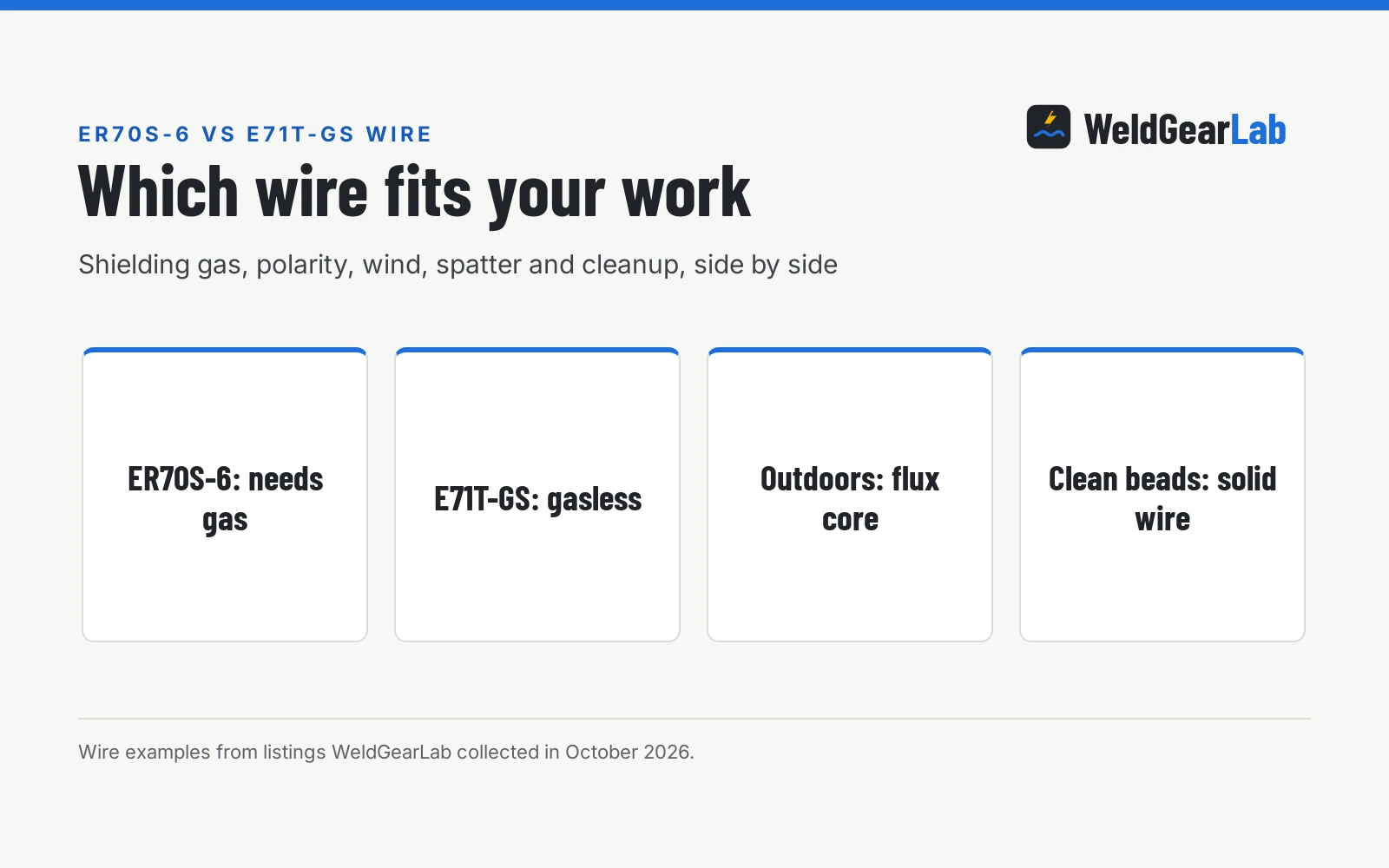
ER70S-6 solid wire and E71T-GS flux-cored wire run through wire feed machines for different jobs, differing on shielding gas, polarity, wind, spatter and post-weld cleanup.

On this page
Top picks at a glance
As an Amazon Associate I earn from qualifying purchases.
- 1
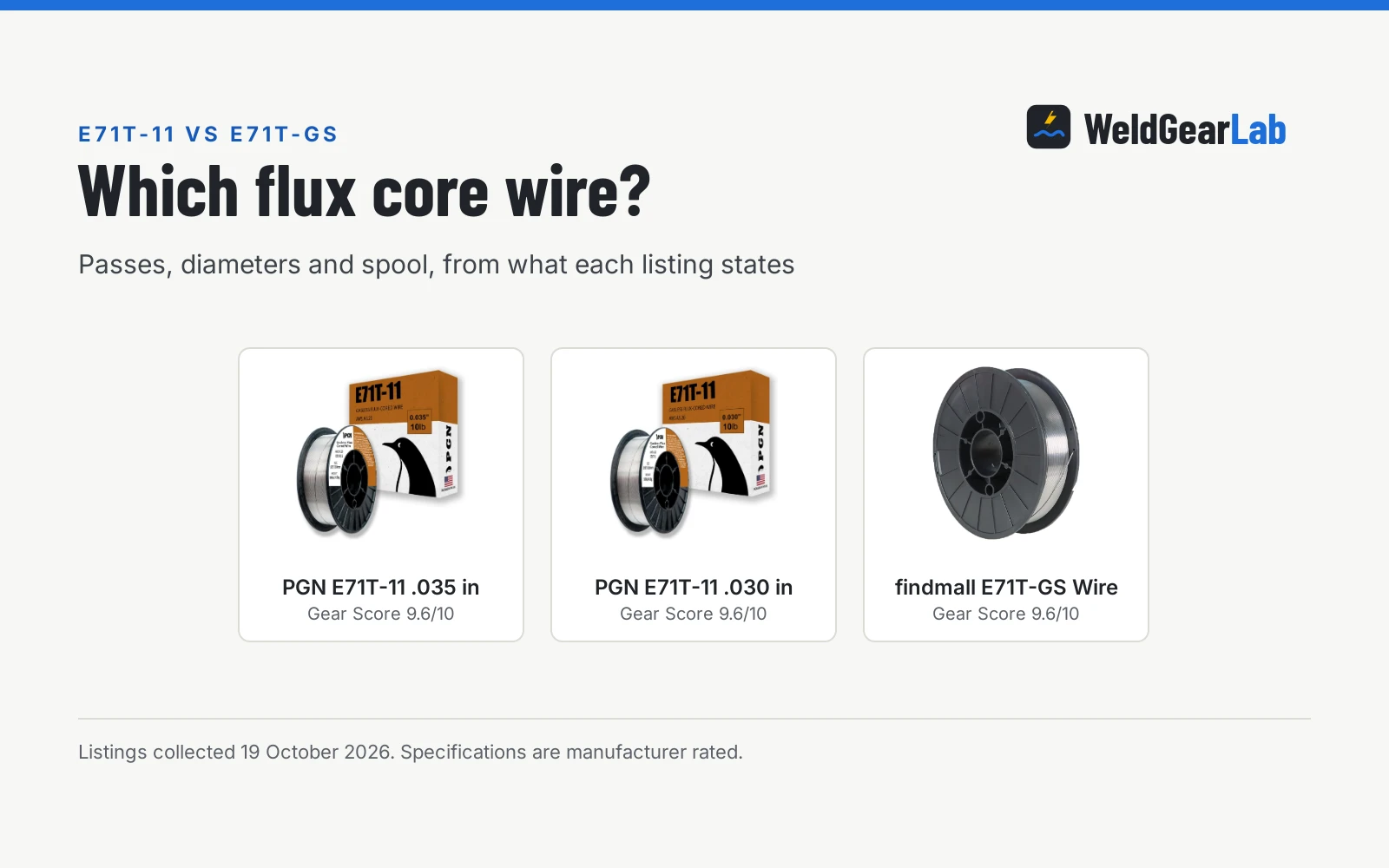
 PGN E71T-11 .035" Gasless Flux Core Welding Wire9.6/10View on Amazon
- 2
 PGN E71T-11 .030" Gasless Flux Core Welding Wire9.6/10View on Amazon
- 3
 findmall E71T-GS Gasless-Flux Core Wire Welding Wire 0.045In9.6/10View on Amazon
- 4
 PGN ER70S-6 .045" Solid MIG Welding WireView on Amazon
- 5
 TOOLIOM ER70S-6 .023" Mild Steel MIG Welding Wire 10LB HighView on Amazon
- 6
 VEVOR Solid MIG Welding WireView on Amazon
- 7
 PGN ER70S-6 .023" Solid MIG Welding WireView on Amazon
- 8
 44 lb Roll ER70S-6 0.035"View on Amazon
- 9
 findmall 1 Spool ER70S-6 Mild Steel MIG Welding Wire 10LbsView on Amazon
When you clamp your ground to the bench or haul a wire feed welder out to repair a farm gate, choosing between er70s-6 vs e71t-gs wire comes down to where you weld and whether you have a shielding gas cylinder. Buy ER70S-6 solid wire if you weld indoors on clean mild steel, sheet metal, or auto body panels where you want smooth beads with low spatter and no slag to chip. Buy E71T-GS flux-cored wire if you weld outdoors in breezy air, tackle rusty equipment in the field, or run a portable wire feeder without gas. This guide compares how both wires handle shielding, polarity, arc stability, and shop cleanup.
Other welders and gear to compare
 PGN ER70S-6 .045" Solid MIG Welding WireCheck price on Amazon
 TOOLIOM ER70S-6 .023" Mild Steel MIG Welding Wire 10LB HighCheck price on Amazon
 VEVOR Solid MIG Welding WireCheck price on Amazon
 PGN ER70S-6 .023" Solid MIG Welding WireCheck price on Amazon
 44 lb Roll ER70S-6 0.035"Check price on Amazon
 findmall 1 Spool ER70S-6 Mild Steel MIG Welding Wire 10LbsCheck price on Amazon
This guide links to our product roundups, where WeldGearLab gets a commission on purchases made through links on this page, and your price stays the same. Read our affiliate disclosure.
ER70S-6 vs E71T-GS wire: the difference in one paragraph
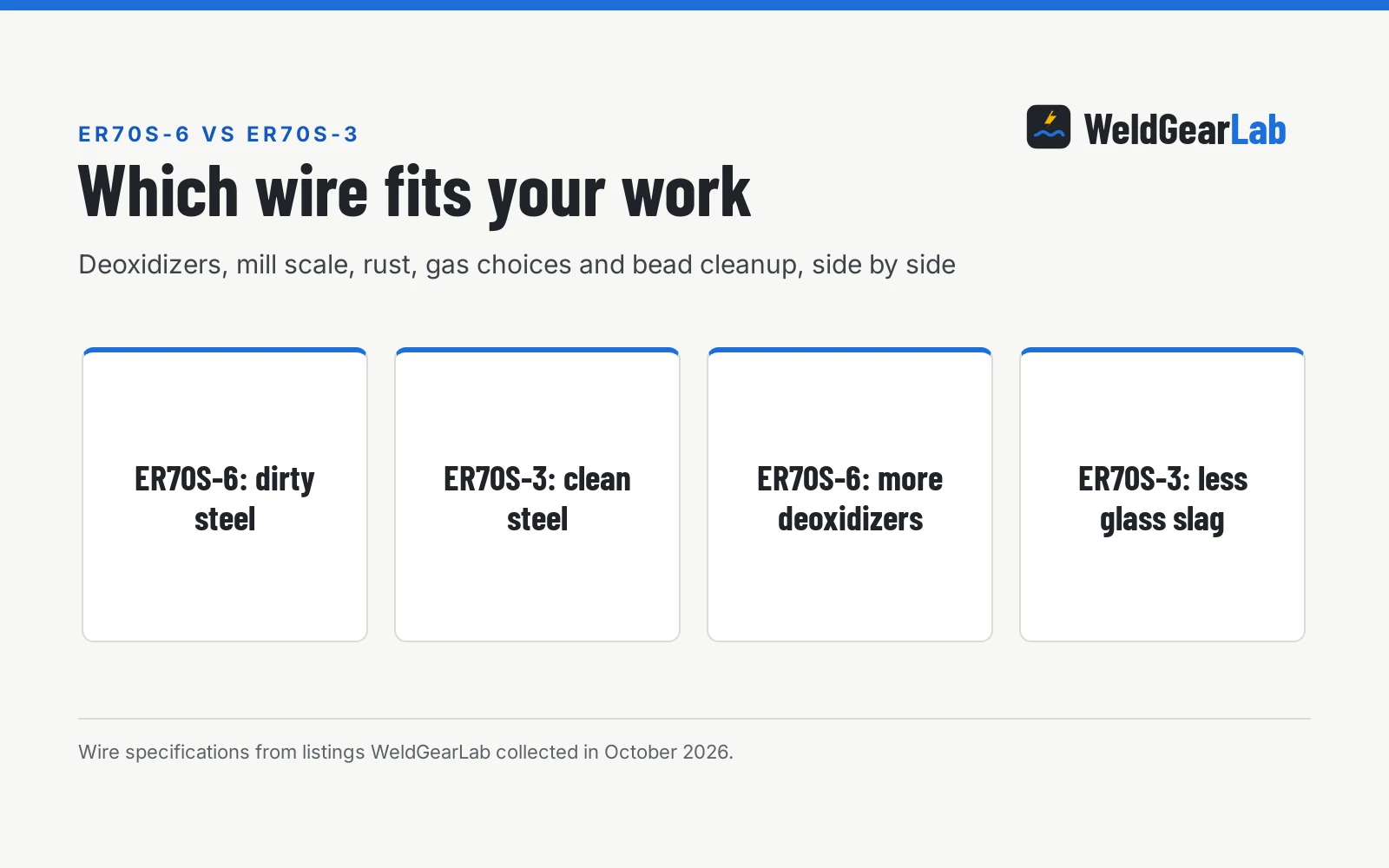
Molten steel reacts quickly with oxygen and nitrogen in the surrounding air, creating weak, porous welds. ER70S-6 solid wire contains manganese and silicon deoxidizers and relies on an external shielding gas cylinder to protect the molten puddle until it freezes. E71T-GS is a hollow carbon steel wire filled with flux compounds that vaporize under arc heat, generating a local gas envelope and leaving a protective slag crust over the cooling bead. No gas cylinder, no regulator, and no hose needed. That basic difference dictates your gear setup, wind tolerance, and post-weld cleanup.
Side by side
| ER70S-6 (solid wire) | E71T-GS (gasless flux core) | Shop verdict | |
|---|---|---|---|
| Wire structure | Solid mild steel wire | Tubular wire filled with flux | ER70S-6 for solid wire |
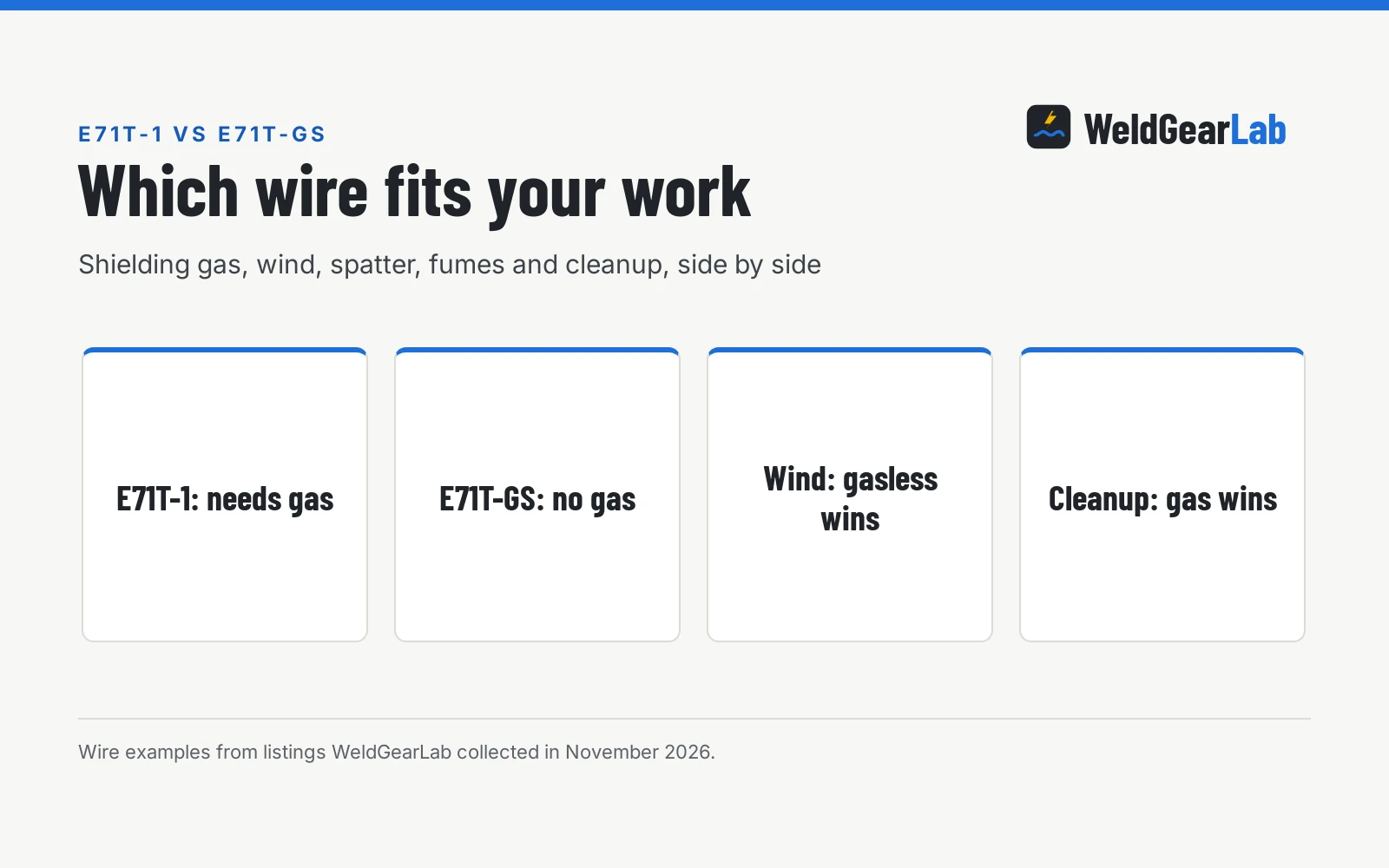
| Shielding method | External shielding gas from a cylinder | Internal flux produces own shield | E71T-GS needs no cylinder |
| External gas required | Yes (100% CO2 or argon/CO2 mix) | None (no gas cylinder needed) | ER70S-6 requires gas |
| Operating polarity | DCEP (electrode positive) | DCEN (electrode negative) | Must match wire type |
| Outdoor wind tolerance | Requires calm air or shelter | Tolerates outdoor breezes | E71T-GS for outdoor jobs |
| Spatter and cleanup | Low spatter, zero slag | Heavier spatter, slag to chip | ER70S-6 for fast cleanup |
| Pass capability | Single or multi-pass welds | Single-pass welds only | ER70S-6 for thick joints |
| Surface tolerance | Best on clean bare steel | Tolerates light rust and mill scale | E71T-GS for field repair |
| Thin sheet metal | Milder short-circuit arc, easier burn-through control | Digging arc, higher burn-through risk on thin sheet | ER70S-6 for sheet metal |
| Portability and gear | Requires gas bottle and regulator | Just wire spool and power cord | E71T-GS for mobile work |
Polarity is a critical difference between these two wires. Solid ER70S-6 runs on direct current electrode positive (DCEP), while E71T-GS flux-cored wire runs on direct current electrode negative (DCEN). Running either wire on the wrong polarity causes erratic arc action, heavy spatter, poor penetration, and porosity. Always check your wire label and switch the machine polarity leads inside the cabinet to match before feeding wire.
When E71T-GS flux-cored wire is the better choice
- Outdoor work and breezy conditions. A light breeze that blows shielding gas away barely affects flux core. That makes E71T-GS dependable for gates, trailers, and field repairs.
- No gas cylinder needed. You skip buying or leasing a high-pressure cylinder, regulator, and hose, cutting down gear weight on portable jobs.
- Forgiving on dirty steel. Flux deoxidizers tolerate light surface rust, mill scale, and imperfect fit-up better than solid wire.
- Portable field equipment. A compact wire feed machine loaded with a flux-cored spool needs only a power source to start welding.
Our best wire for gasless MIG welder guide covers proven gasless spools, and our breakdown on what is flux core wire explains core metallurgy.
When ER70S-6 solid wire is the better choice
- Thin sheet and auto body work. Running small solid wire at low voltage in short-circuit transfer provides tight puddle control, making thin panels easier to weld with less risk of burn-through.
- Clean appearance and fast cleanup. Solid wire produces low spatter and zero slag, saving grinding time on visible frames and furniture.
- Multi-pass welding. ER70S-6 supports single or multi-pass welds. E71T-GS carries an AWS single-pass rating; stacking beads with GS wire risks trapping brittle slag inclusions.
- Indoor shop welding. Solid wire produces far less smoke and fume plume than flux core, keeping shop air cleaner.
See our best MIG wire for mild steel guide for shop spools, and our best MIG wire for auto body guide for sheet metal work.
How to tell what your machine supports
Not every wire feeder runs both wire styles. Check your machine hardware and listing specifications for these features:
- Gas solenoid and rear inlet. A machine that runs solid wire includes an internal gas valve and a rear brass gas inlet. Units lacking gas fittings run flux core only.
- Reversible polarity terminals. Look for accessible terminal connections or quick-swap leads inside the wire compartment to switch between DCEP and DCEN.
- Drive roll profiles. Solid ER70S-6 wire needs smooth V-groove drive rolls. Hollow flux-cored wire requires knurled drive rolls that grip without crushing the wire casing.
- Spool sizes and wire diameters. Listings show how makers package ER70S-6 wire. For instance, PGN Bearings supplies spools from 2 pounds up to 44 pounds in 0.023-inch and 0.045-inch diameters. YESWELDER lists 10-pound spools in 0.023-inch and 0.030-inch sizes, citing compatibility with 100% CO2 or an 80% argon and 20% CO2 mix. TOOLIOM provides 10-pound spools of .023-inch wire. VEVOR lists 11-pound spools in 0.030-inch and 0.035-inch diameters with deoxidizer levels including 1.49 percent manganese and 0.9 percent silicon. HYW Products lists a 44-pound roll of ER70S-6 wire in 0.035-inch and 0.045-inch sizes, rated at 550 megapascals tensile strength, and ATLAS WELDER packages .030-inch wire on 10-pound spools.
Which gas for ER70S-6 on steel
Solid ER70S-6 wire requires an external shielding gas to protect the puddle from atmospheric contamination. Listings in our data cite specific gas options for their wire:
- 100% CO2 shielding gas. YESWELDER and TOOLIOM list their ER70S-6 wire for use with 100% CO2. Pure carbon dioxide provides deep penetration on carbon steel and allows higher welding current, though it produces a stiffer arc with more spatter.
- 80% argon and 20% CO2 mixture. YESWELDER and TOOLIOM also list an 80% argon and 20% CO2 mixture. Adding argon softens the arc, smooths puddle flow, and significantly reduces spatter on mild steel.
Always verify the gas mixture recommended on your wire spool and machine door chart. Self-shielded E71T-GS wire uses no external gas; introducing shielding gas over flux-cored wire alters the chemical reaction of the flux core and produces porosity. See our guide on what gas for MIG welding mild steel for cylinder advice.
Can one machine run both wires?
Yes. Many wire feed welders handle both ER70S-6 solid wire and E71T-GS flux-cored wire. Switching takes only a few minutes: swap the spool, change terminal polarity between DCEP and DCEN, install the correct drive roll, and adjust wire feed tension. Keeping solid wire on hand for bench fabrication and a spool of flux-cored wire for outdoor repairs gives you full shop flexibility. See our picks in best MIG welder for hobbyist and best flux core welder.
Flux core smoke and slag. Flux core produces heavier smoke and fumes than solid wire, and hot slag can flick into your eyes during cleanup. Always weld with adequate ventilation or outdoors with your head out of the fume plume, wear safety glasses under your welding helmet when chipping slag, and clear dry debris from the workspace. Secure any shielding gas cylinders upright with a safety chain. Check our welding safety gear checklist for beginners for proper shop protection.
FAQ for welders
Is ER70S-6 wire stronger than E71T-GS wire?
Both wires make sound welds with comparable tensile strength on mild steel when run with matching machine settings. The key difference is that ER70S-6 is formulated for single or multi-pass welds, while E71T-GS carries an AWS single-pass rating. On thick joints requiring multiple stacked passes, ER70S-6 provides sound joint integrity where E71T-GS should not be used.
Can you run ER70S-6 wire without shielding gas?
No. ER70S-6 solid wire requires an external shielding gas envelope to protect the molten pool. Running solid wire without gas causes immediate porosity, heavy oxidation, and zero joint strength. If you have no gas cylinder, use self-shielded wire like E71T-GS.
Why does E71T-GS wire produce slag?
E71T-GS is a tubular wire filled with flux and deoxidizers. When the arc melts the wire, the flux burns to create shielding vapor while impurities float to the puddle surface, solidifying into a brittle slag crust. You must chip this slag off before applying another bead or paint.
Can you use ER70S-6 and E71T-GS on the same machine?
Yes, if your machine supports gas connections and reversible polarity leads. You must swap terminal polarity between DCEP for solid wire and DCEN for flux core, change drive rolls between smooth and knurled profiles, and match contact tips to wire size.
Which wire is easier for a beginner to run?
ER70S-6 solid wire is generally easier for beginners to produce smooth beads with minimal spatter on clean indoor steel. However, E71T-GS is simpler to set up initially because it requires no cylinder, regulator, or gas hose adjustments. Many beginners start with flux core on portable equipment and add gas capability later.
Related: best MIG welding wire, best wire for gasless MIG welder, what is flux core wire, and the welding consumables hub. Also see our guide on what polarity for flux core welding.