ER70S-6 vs ER70S-3 MIG Wire: Which One Fits Your Work
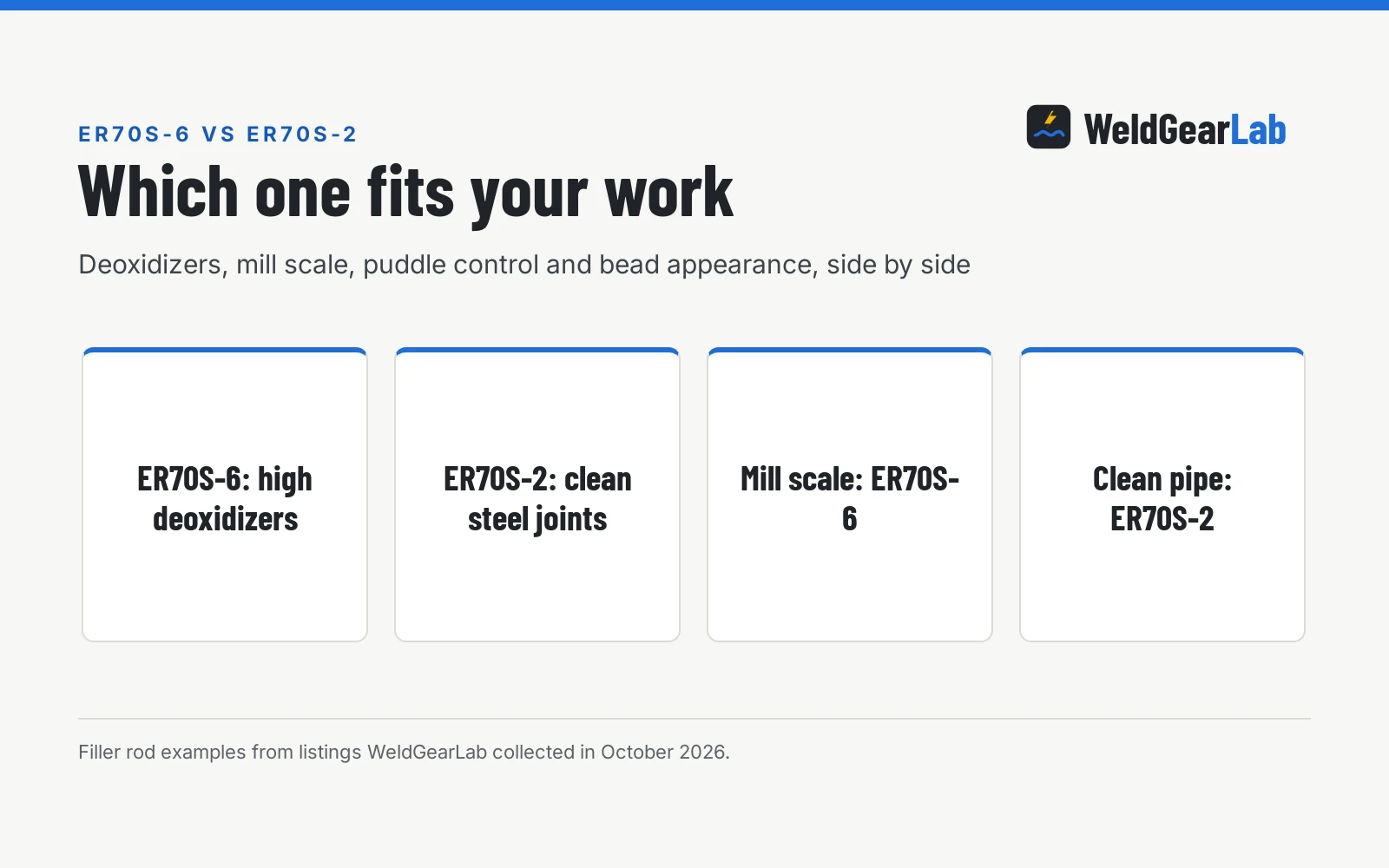
ER70S-6 and ER70S-3 are both carbon steel MIG wires, but ER70S-6 carries more silicon and manganese to handle mill scale and rust while ER70S-3 runs cleaner on pristine steel.

On this page
Top picks at a glance
As an Amazon Associate I earn from qualifying purchases.
- 1
 PGN ER70S-6 .030" Solid MIG Welding Wire9.7/10View on Amazon
- 2
 YESWELDER Silicon Aluminum Welding Wire9.7/10View on Amazon
- 3
 INEFIL ER70S-6 MIG Welding Wire .023"9.7/10View on Amazon
When you set mild steel on the fab bench, you might wonder whether your MIG gun needs a spool with higher deoxidizers or wire made for clean production. Choosing between er70s-6 vs er70s-3 mig wire comes down to surface condition and bead cleanup: ER70S-6 contains higher levels of manganese and silicon to handle light rust, mill scale and oily steel, while ER70S-3 has fewer deoxidizers and creates cleaner beads with less glassy slag on pristine metal. For most home and farm shops, ER70S-6 is the workhorse wire because steel rarely arrives clean from the yard. This guide compares them step by step so you can match the spool to your project.
This guide links to our product roundups, where WeldGearLab gets a commission on purchases made through links on this page, and your price stays the same. Read our affiliate disclosure.
ER70S-6 vs ER70S-3 MIG Wire: The Difference in One Paragraph
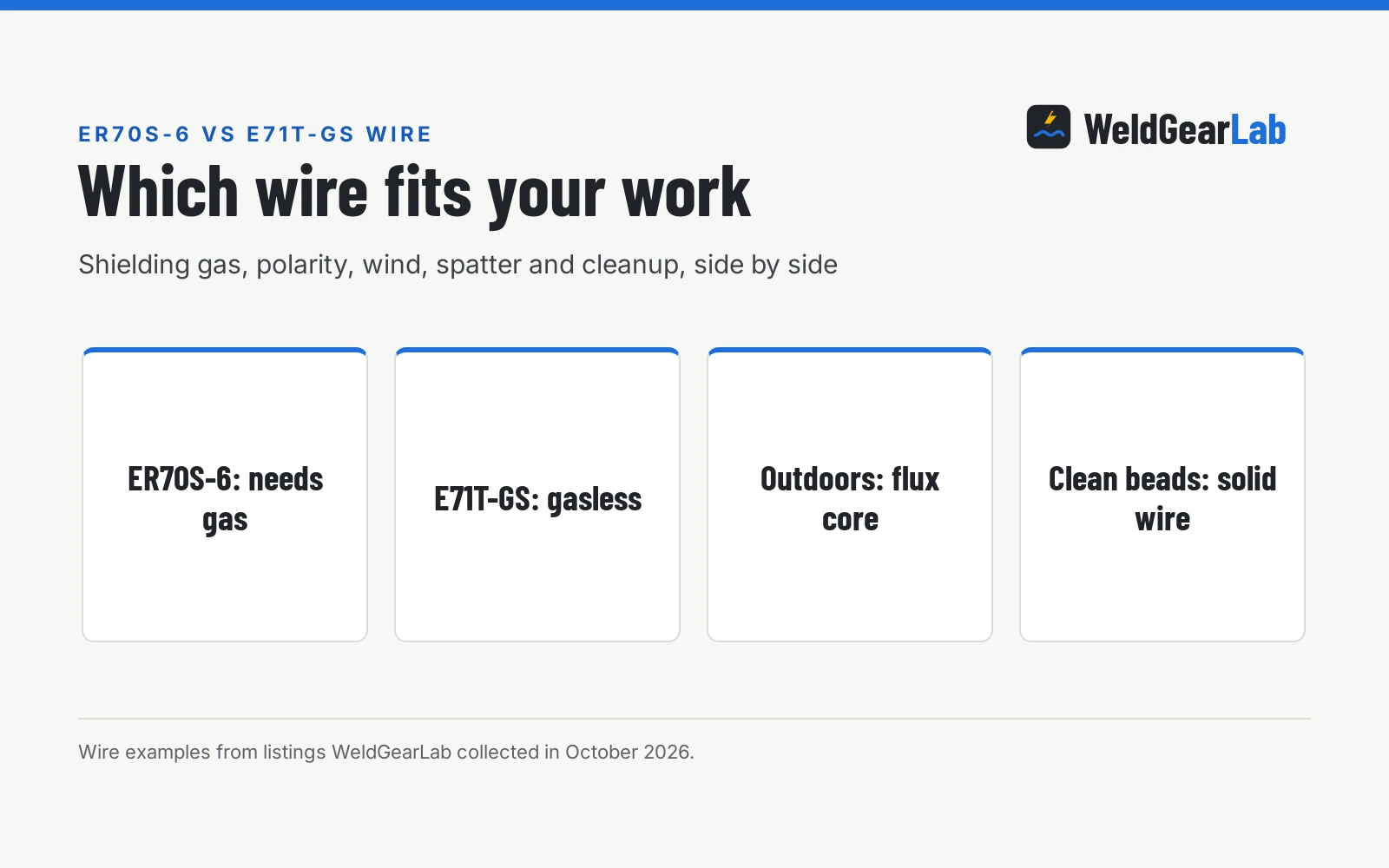
Both wires are solid carbon steel electrodes that run on direct current electrode positive (DCEP) under an external shielding gas supply. The core difference lies in their chemistry: ER70S-6 contains a higher combination of manganese and silicon deoxidizers. When welding, manganese and silicon react with oxygen and contaminants in the molten puddle, floating impurities to the surface as small glassy islands instead of leaving gas trapped as porosity. ER70S-3 contains fewer deoxidizing agents, making the molten puddle slightly stiffer and leaving almost no surface glass deposits, but it requires clean, rust-free, mill-scale-free steel to prevent porosity.
Side by side
| ER70S-6 | ER70S-3 | Shop Takeaway | |
|---|---|---|---|
| Primary role | General fabrication, repair, dirty or rusty metal | Clean production fabrication, new prepped steel | ER70S-6 fits common shop work, ER70S-3 fits clean manufacturing |
| Deoxidizer levels | Higher manganese and silicon | Lower manganese and silicon | ER70S-6 carries more deoxidizers to handle surface oxides |
| Surface tolerance | Tolerates light rust and mill scale | Requires clean, scale-free bare metal | ER70S-6 needs less grinding prep before welding |
| Shielding gas options | Straight CO2 or a CO2/argon mix | Argon-CO2 mixtures preferred; straight CO2 risks spatter | ER70S-6 handles straight carbon dioxide far better |
| Glassy slag on bead | More glassy silicon islands on bead surface | Fewer glassy deposits, cleaner surface | ER70S-3 leaves cleaner beads with less post-weld chipping |
| Multi-pass cleanup | Requires chipping or wire brushing glass islands | Minimal surface slag between passes | ER70S-3 speeds up multi-pass welding without trapped slag |
| Puddle fluidity | More fluid puddle, wets out edges easily | Stiffer puddle, freezes faster | ER70S-6 washes into joints easier, ER70S-3 freezes faster |
| Pre-weld surface prep | Light wire brushing or light grinding | Thorough grinding down to clean bright metal | ER70S-3 demands surgical metal prep to prevent porosity |
Shielding gas options and mechanical properties follow standard industry classifications; always verify the recommendations on your spool label and machine chart. Solid wires run on DCEP (electrode positive) polarity with a smooth drive roll, unlike flux core which runs on DCEN (electrode negative) with knurled rolls.
When ER70S-6 is the better choice
- Rusty, oily, or mill scale steel. The added silicon and manganese act as scavenging deoxidizers, pulling oxygen out of light rust and scale so the bead stays sound without pinholes.
- General fab and farm repairs. When welding trailers, farm equipment, or structural tube where grinding every joint to bare shiny metal is impractical, ER70S-6 tolerates imperfect fit-up.
- Sheet metal and auto body repairs. The fluid puddle wets out smoothly along thin sheet edges; see our best MIG wire for auto body guide.
- Pure carbon dioxide shielding. The high deoxidizer package permits running higher currents with straight carbon dioxide gas while maintaining sound fusion and manageable spatter.
For general shop work, our best MIG wire for mild steel guide reviews popular spools for shop and field repairs, and our best MIG wire for rusty metal roundup breaks down options when surface prep is limited.
When ER70S-3 is the better choice
- Clean plate and factory production. On cold-rolled steel or pickled plate where mill scale has been completely removed, ER70S-3 creates smooth, consistent beads with minimal spatter.
- Less glassy slag cleanup. Lower silicon content means significantly fewer glassy silicon deposits on the bead surface, saving labor before painting, plating, or powder coating.
- Multi-pass welding on clean joints. Without thick glassy islands accumulating along the toes, you spend less time chipping or brushing slag between passes.
- High-volume robotic and bench fabrication. In dedicated manufacturing shops where steel prep is tightly controlled, ER70S-3 provides cleaner finished welds and reduces post-weld cleanup costs.
If your shop works exclusively with clean, prepped mild steel and wants cleaner bead surfaces with less glass chipping, ER70S-3 is an efficient choice.
ER70S-6 meaning and wire markings
The designation on your wire spool follows the American Welding Society (AWS) specification. Understanding the ER70S-6 meaning helps you read any solid wire label:
- ER: Stands for Electrode or Rod, indicating the wire can be used as a continuous electrode in MIG welding or cut into rods for TIG welding.
- 70: Indicates the nominal tensile strength class under AWS standards. In reference listings, manufacturers like VEVOR list this wire with a minimum tensile strength of 490 MPa.
- S: Designates solid wire, meaning the wire is solid carbon steel requiring an external cylinder of shielding gas, unlike hollow flux core wire.
- -6 vs -3: Designates chemical composition, specifically the manganese and silicon levels. S-6 carries higher deoxidizer levels than S-3. For instance, VEVOR lists its ER70S-6 wire with Mn at 1.49 per cent and Si at 0.9 per cent (along with C at 0.068 per cent, P at 0.018 per cent, S at 0.015 per cent, and Cu at 0.124 per cent).
Common wire diameters include .030 inch and .035 inch (0.9 mm). For instance, YESWELDER provides ER70S-6 in .035 inch on 10 lbs (4.5 kg) spools, TASKZOOM lists .030 inch on a 10 lb spool, and findmall supplies .035 inch wire on a 33 pound spool. Check our best MIG welding wire guide for an overview of solid and flux core wire spools across sizes.
Which shielding gas for solid MIG wire
Unlike flux core wire, both ER70S-6 and ER70S-3 require external shielding gas to shield the molten puddle from atmospheric oxygen and nitrogen. Gas compatibility differs based on deoxidizer levels:
- Straight carbon dioxide: Straight carbon dioxide provides deep penetration and is economical. The high deoxidizer content of ER70S-6 makes it well suited for straight carbon dioxide, as the manganese and silicon counteract the oxidizing effect of the arc. In contrast, ER70S-3 lacks sufficient deoxidizers to run smoothly on straight CO2 without excessive spatter and porosity risk.
- Argon and carbon dioxide mixture: Packaging from brands like YESWELDER and VEVOR notes compatibility with an argon and carbon dioxide mixture. Mixed argon-CO2 shielding stabilizes the arc, produces a smoother bead profile, and reduces spatter for cleaner welds on both wires.
If you experience excessive spatter while running solid wire, review your voltage, wire feed speed, and gas flow, or read our guide on why a MIG welder spatters. For an in-depth breakdown of gas cylinder setups, see our guide on what gas for MIG welding mild steel.
Can you switch between ER70S-6 and ER70S-3?
Yes. Both wires use the same gun liner, contact tips, and smooth V-groove drive rolls, provided the wire diameter matches. If you are running .030 inch or .035 inch wire, you can swap spools on your spindle without altering your machine drive setup. You may notice subtle puddle differences: ER70S-6 has a slightly more fluid puddle that wets out edges faster, whereas ER70S-3 feels stiffer under the arc and freezes quicker.
Safety and ventilation on mild steel. Solid wire MIG welding produces ultraviolet arc radiation, hot spatter, and welding fumes. Always wear an auto-darkening helmet with appropriate shade, heavy leather welding gloves, and flame-retardant clothing. Never weld near flammable solvents or combustible shop materials, and keep gas cylinders secured upright with a safety chain. Ensure proper shop ventilation or use a dedicated fume extractor so you keep your head outside the rising smoke plume. If you are shopping for a machine capable of fine voltage adjustments for solid wire, see our guide on how to choose a MIG welder.
FAQ for welders
Can ER70S-6 weld rusty or dirty metal?
ER70S-6 handles light surface rust, mill scale, and minor oil better than ER70S-3 because of its higher manganese and silicon content. These elements deoxidize the puddle and float contaminants to the surface as small glassy slag islands. For heavy rust, flaky scale, or thick grease, you should still grind the steel down to bare metal before striking an arc to prevent weld defects like porosity.
Why does ER70S-6 leave brown glass spots on the weld?
Those shiny brown or amber spots are silicon islands formed by the deoxidizers in the wire. During welding, silicon combines with oxygen and floats to the top of the molten puddle to protect the weld metal. While they are harmless on a finished single-pass weld, you should chip or wire brush them off before applying paint or laying down another weld pass.
Which wire is better for auto body and sheet metal?
For most auto body repair, ER70S-6 in .030 inch diameter is the standard choice because it tolerates traces of primer, rust, or galvanizing on thin panels without blowing holes. ER70S-3 can be used on brand new, surgically clean sheet metal where you want minimal glassy slag, but its low deoxidizers make it prone to porosity if any surface contamination remains. When prepping thin panels, check our guide on what causes porosity in MIG welds to keep your joints solid.
Can I run ER70S-6 or ER70S-3 without shielding gas?
No. Neither wire contains internal flux, so attempting to weld without an external shielding gas like straight carbon dioxide or an argon mixture will result in severe porosity and brittle metal. If you need to weld without an external gas cylinder, you must switch to a gasless flux core wire and change your machine polarity to DCEN.
Is ER70S-6 stronger than ER70S-3?
Both wires share the 70 classification for minimum tensile strength, meaning their yield and tensile strengths are practically identical in normal welding conditions. ER70S-6 provides slightly higher impact toughness in cold temperatures because of its manganese content. For standard shop fabrication and repairs on mild steel, both wires produce strong, sound joints when welded with proper penetration.
Related: welding consumables hub, MIG welders hub, and best welder for beginners.