ER70S-6 vs ER70S-2 TIG Rod: Which One Should You Buy?
ER70S-6 and ER70S-2 TIG rods suit different steel prep, puddle control and bead appearance on the bench, and choosing the right filler wire depends on your base metal.

On this page
Top picks at a glance
As an Amazon Associate I earn from qualifying purchases.
- 1
 1-Lb ER308L Stainless Steel 308 TIG Welding Rod 3/32"x36"9.7/10View on Amazon
- 2
 1-Lb ER316L Stainless Steel 316 TIG Welding Rod 3/32"x36"9.7/10View on Amazon
- 3
 ER70S-6 1/8" x 16" 5LB Mild Steel TIG Welding Wire Filler Rod9.7/10View on Amazon
- 4
 YESWELDER TIG Welding Rod Mild Steel ER70S-6 1/8"x16" 5LB gasView on Amazon
- 5
 ER70S-6 0.045"View on Amazon
- 6
 WeldingCity 10-Lb Mild Steel ER70S-6 TIG Welding RodsView on Amazon
- 7WeldingCity 5-Lb Mild Steel ER70S-6 TIG Welding Rods 3/32"x36"View on Amazon
- 8WeldingCity 10-Lb Mild Steel ER70S-6 TIG Welding Rods 1/8"x36"View on Amazon
- 9
 ARCCAPTAIN Mild Steel TIG Welding Rod ER70S-6View on Amazon
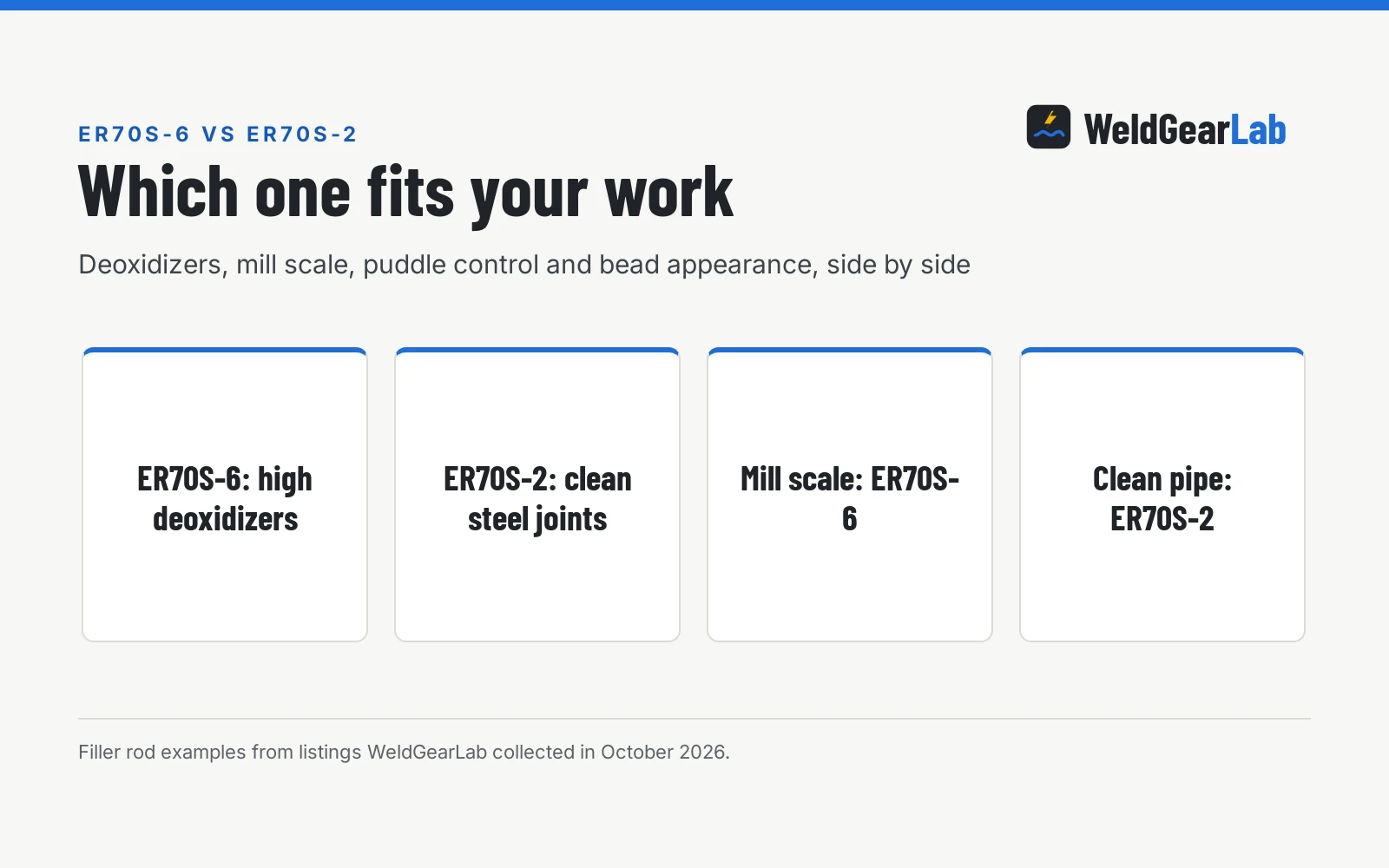
When you clamp mild steel tubing or plate to the fab bench, choosing between er70s-6 vs er70s-2 tig rod comes down to how clean your metal is and how you want the puddle to wet out. If your steel has mill scale, light surface rust, or imperfect fit-up, pick ER70S-6 because its higher manganese and silicon deoxidizers tolerate surface contamination and produce a fluid puddle that washes smoothly into joint toes. If you grind down to bright bare metal and need crisp puddle control on pipe or tubing without glassy silicate deposits, pick ER70S-2. Both filler rods produce sound welds on carbon steel under pure argon shielding gas, but their alloying chemistry suits different shop conditions.
Other welders and gear to compare
 YESWELDER TIG Welding Rod Mild Steel ER70S-6 1/8"x16" 5LB gasCheck price on Amazon
 ER70S-6 0.045"Check price on Amazon
 WeldingCity 10-Lb Mild Steel ER70S-6 TIG Welding RodsCheck price on Amazon
- WeldingCity 5-Lb Mild Steel ER70S-6 TIG Welding Rods 3/32"x36"Check price on Amazon
- WeldingCity 10-Lb Mild Steel ER70S-6 TIG Welding Rods 1/8"x36"Check price on Amazon
 ARCCAPTAIN Mild Steel TIG Welding Rod ER70S-6Check price on Amazon
This guide links to our product roundups, where WeldGearLab gets a commission on purchases made through links on this page, and your price stays the same. Read our affiliate disclosure.
The difference in one paragraph
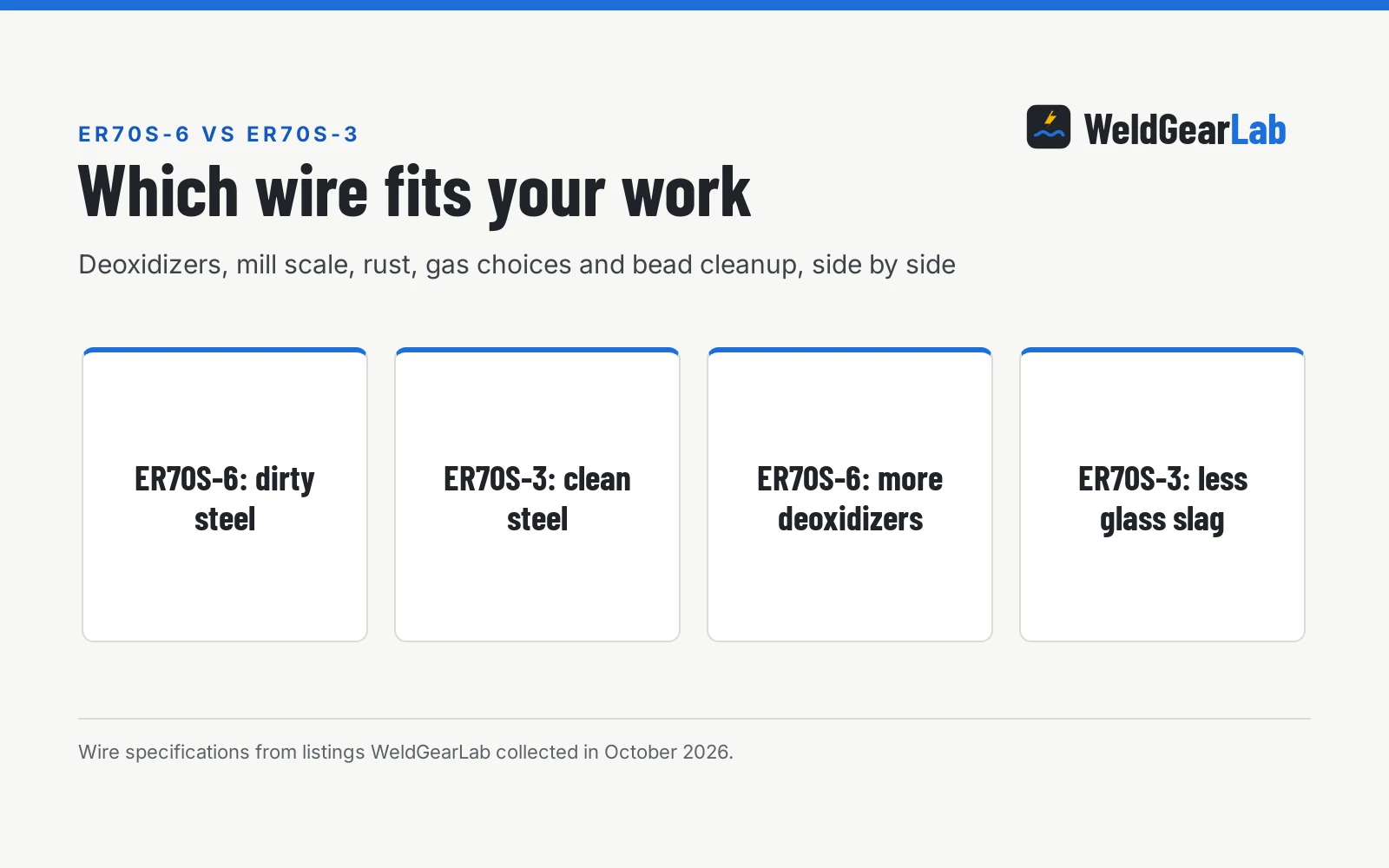
Molten steel reacts quickly with oxygen and nitrogen in the air, creating porosity and brittle weld deposits unless protective deoxidizers tie up those gases. Both filler wires fall under the AWS A5.18 carbon steel specification, but they use different deoxidizer combinations to protect the molten pool. ER70S-6 contains higher levels of manganese and silicon, which draw out impurities and float them to the bead surface as small glassy islands while keeping the molten puddle fluid. ER70S-2 uses a formulation containing titanium, zirconium, and aluminum deoxidizers alongside manganese and silicon. Those added scavengers tie up dissolved gases without making the puddle runny, leaving a clean bead on ground steel but struggling when forced across heavy mill scale.
ER70S-6 vs ER70S-2 TIG rod: Side by side
| Feature | ER70S-6 TIG rod | ER70S-2 TIG rod | Shop takeaway |
|---|---|---|---|
| Deoxidizer package | High manganese and silicon | Titanium, zirconium, and aluminum | ER70S-2 adds triple scavengers |
| Mill scale and rust tolerance | Tolerates light scale and rust | Requires clean bare metal | ER70S-6 for less than spotless prep |
| Puddle fluidity and wetting | Fluid puddle that washes into joint toes | Stiffer puddle with crisp freeze control | ER70S-6 for flat beads, ER70S-2 for out-of-position joints |
| Glassy silicate deposits | Forms small glassy islands to brush off | Leaves minimal glassy deposits | ER70S-2 for faster cleanup before paint |
| Shielding gas on mild steel | 100% argon | 100% argon | Pure argon required for TIG on both alloys |
| Welding polarity | DCEN | DCEN | Direct current electrode negative for both |
| Out-of-position puddle control | More prone to sagging on vertical passes | Resists sagging with crisp puddle freeze | ER70S-2 offers tighter control overhead and vertical |
| Common joint applications | General fabrication, frame repairs, brackets | Out-of-position joints on clean steel | Match alloy to joint prep and position |
| Post-weld cleanup | Wire brush glassy silicate deposits | Light wire brushing | ER70S-2 reduces wire wheeling |
Both filler wires run on direct current electrode negative (DCEN) under pure argon shielding gas. Check the stamped designation on the end of each rod before striking an arc to ensure you feed the intended alloy into the molten pool.
When ER70S-6 is the better choice
ER70S-6 is the workhorse filler wire for general fab shops, equipment repair, and everyday bench projects. Its deoxidizer formulation makes it the practical choice in several shop situations:
- Light mill scale and surface rust. When welding hot-rolled steel bar, angle iron, or square tubing where grinding every surface down to bright metal is impractical, ER70S-6 uses its manganese and silicon to tie up surface oxides and reduce the risk of internal porosity.
- Fluid puddle wetting. The extra silicon promotes molten pool wetting, which allows the puddle to wash into the joint toes cleanly with less torch manipulation and lower risk of edge undercut.
- Bench fabrication and travel speed. The fluid puddle flows easily under the tungsten arc, allowing faster manual travel speeds when welding long seams on sheet metal, brackets, and structural frames.
- Gaps and irregular fit-up. When cut pieces have small gaps or uneven bevels, the fluid puddle bridges the joint smoothly without freezing prematurely at the joint root.
For general shop projects where steel prep is not spotless, our best TIG rod for mild steel guide highlights dependable filler rods for structural and repair work.
When ER70S-2 is the better choice
ER70S-2 is the preferred filler wire when precision, cosmetic cleanliness, and puddle freeze control take priority over forgiving rust tolerance. It belongs on your torch bench for specific applications:
- Clean pipe and tubing fabrication. The titanium, zirconium, and aluminum scavengers yield a quiet, controllable puddle that stays where you direct it.
- Minimal glassy silicate deposits. Because ER70S-2 relies on titanium, zirconium, and aluminum scavengers rather than heavy silicon additions, it leaves minimal glassy islands on the bead surface, saving time when preparing joints for powder coat or paint.
- Out-of-position puddle control. The stiffer puddle does not sag or run when welding in vertical or overhead positions, giving you tighter control over root reinforcement and bead profile.
- Critical structural fabrication. On machined fittings, laser-cut plate, and prepped joints ground down to virgin metal, ER70S-2 suits work where puddle control matters more than rust tolerance.
If you work on thin sheet or automotive projects with clean fit-up, see our guide to what size TIG filler rod for 1/8 steel to match wire thickness to your amperage.
How to check rod stampings and packaging
Because carbon steel rods look similar on the bench, verifying maker packaging and rod identification prevents mixing alloys during fabrication. Look for these details in maker listings:
- Stamped rod ends. While packaging must identify the alloy under AWS A5.18, individual rod stamping varies by supplier. Quality suppliers stamp the alloy designation directly on the rod end so you can identify loose rods on your bench. For example, WeldingCity lists ER70S-6 TIG rods in 36-inch lengths with single end stamped markings, whereas unbranded rods often lack individual end stamps.
- Cut rod lengths. Reference listings show standard packaged lengths. HYW Products and WeldingCity package 36-inch rods suited for standard wall-mounted storage tubes, while YESWELDER, ARCCAPTAIN, and Blulu list 16-inch rods that fit compact carrying cases.
- Rod diameters. Common diameters in reference listings include 1/16-inch, 3/32-inch, and 1/8-inch sizes. WeldingCity and HYW Products list sizes from 1/16-inch through 1/8-inch, while Blue Demon lists 3/32-inch rods in 1-lb tubes and Blulu offers 1/16-inch rods in a 2-lb pack.
- Surface finish. Most carbon steel TIG rods in reference listings, such as those from WeldingCity and YESWELDER, feature a thin copper coating to inhibit rust during shelf storage. However, some makers supply bare wire, such as the unfinished silver wire listed by ARCCAPTAIN. Unlike MIG wire where copper aids electrical contact in a gun tip, copper wash on TIG rod serves only to prevent surface rust while stored on your shop rack.
Before welding structural joints, remove mill scale using an angle grinder or flap disc. Check our guide on how to remove mill scale before welding to prepare joints properly.
Which gas for mild steel TIG
While wire feed MIG welding on mild steel commonly uses a shielding gas blend of argon and carbon dioxide, TIG welding on carbon steel requires 100% argon. Several reference listings, including WeldingCity and Blulu, mention mixed gas or CO2 because online sellers frequently copy MIG wire descriptions into TIG listings. Introducing carbon dioxide into a TIG arc rapidly burns the tungsten electrode, causes tungsten spitting, and creates severe puddle contamination.
Reference listings from YESWELDER and ARCCAPTAIN correctly specify 100% argon. Pure argon protects the tungsten electrode, produces a smooth arc start, and provides the shielding envelope needed for sound deoxidation in the molten pool.
A quality flowmeter ensures steady shielding without turbulence. Check our guide to the argon gas regulator for TIG welding to keep your torch gas steady.
Can you keep both rods in your shop?
Yes, and keeping dedicated tubes of both alloys is standard practice in many fabrication shops. Keep ER70S-6 on hand for quick repairs, farm equipment, structural brackets, and hot-rolled steel where removing every trace of surface oxide is impractical. The fluid puddle and strong wetting action help you complete everyday fabrication quickly and cleanly.
Reserve ER70S-2 for precision tubing and pipe joints, and projects where the steel has been ground or machined clean. The stiffer puddle gives you the precise control needed for open root joints and out-of-position passes, without leaving glassy islands that require aggressive wire wheeling.
TIG safety and personal protection. TIG arcs generate intense ultraviolet radiation that burns exposed skin and damages vision without proper shade protection. Always wear dedicated goatskin gloves for dexterity and heat protection, such as the pairs in our best TIG welding gloves roundup. Keep your helmet shade adjusted to your welding current, maintain adequate shop ventilation to keep your breathing zone clear of welding fumes, and secure compressed argon gas cylinders upright with safety chains at all times.
FAQ for welders
What does the ER70S classification mean?
Under the AWS A5.18 specification, ER indicates an electrode or rod, 70 designates minimum tensile strength classification, and S indicates solid wire. The suffix number, such as 2 or 6, identifies the specific chemical composition and deoxidizer package alloyed into the steel wire.
Does ER70S-6 leave glassy deposits on the bead?
Yes, ER70S-6 contains higher levels of silicon, which reacts with oxygen to form small glassy silicate islands on the surface of the cooled bead. These glassy deposits should be removed with a wire brush or chipping tool before applying primer, paint, or powder coat.
Can you TIG weld mild steel with an argon and CO2 mix?
No, TIG welding on carbon steel requires 100% argon shielding gas. Carbon dioxide in the shielding stream rapidly burns the tungsten electrode, spatters tungsten into the puddle, and creates an erratic arc that ruins the weld.
Is ER70S-2 stronger than ER70S-6?
Both filler rods share the same nominal 70 classification for minimum tensile strength. The real difference on the bench lies in puddle fluidity, surface cleanliness requirements, and freeze control, rather than joint tensile strength.
Which filler rod is easier for a beginner to run?
ER70S-6 is generally easier for a beginner because the fluid puddle wets out smoothly and blends into the base metal with less torch manipulation. Its higher manganese and silicon levels also forgive minor surface rust or light mill scale that might cause porosity with ER70S-2.
Related: best TIG rod for mild steel, what size TIG filler rod for 1/8 steel, how to remove mill scale before welding, and the welding consumables hub. Also see our guide to TIG welding settings for steel.