What Gas for MIG Welding Mild Steel: Which Gas Fits Your Shop
Find out what gas for MIG welding mild steel works for your shop, comparing mixed argon and carbon dioxide shielding against straight carbon dioxide for clean beads.

On this page
Top picks at a glance
As an Amazon Associate I earn from qualifying purchases.
- 1
 ARCCAPTAIN MIG Welding Wire ER70S-6 .030" 10LB x 1 Smooth9.6/10View on Amazon
- 2
 YESWELDER Gasless Flux Core MIG Wire9.6/10View on Amazon
- 3
 ARCCAPTAIN Flux Core Welding Wire E71T-GS .030" 2LB x 1 Mild9.6/10View on Amazon
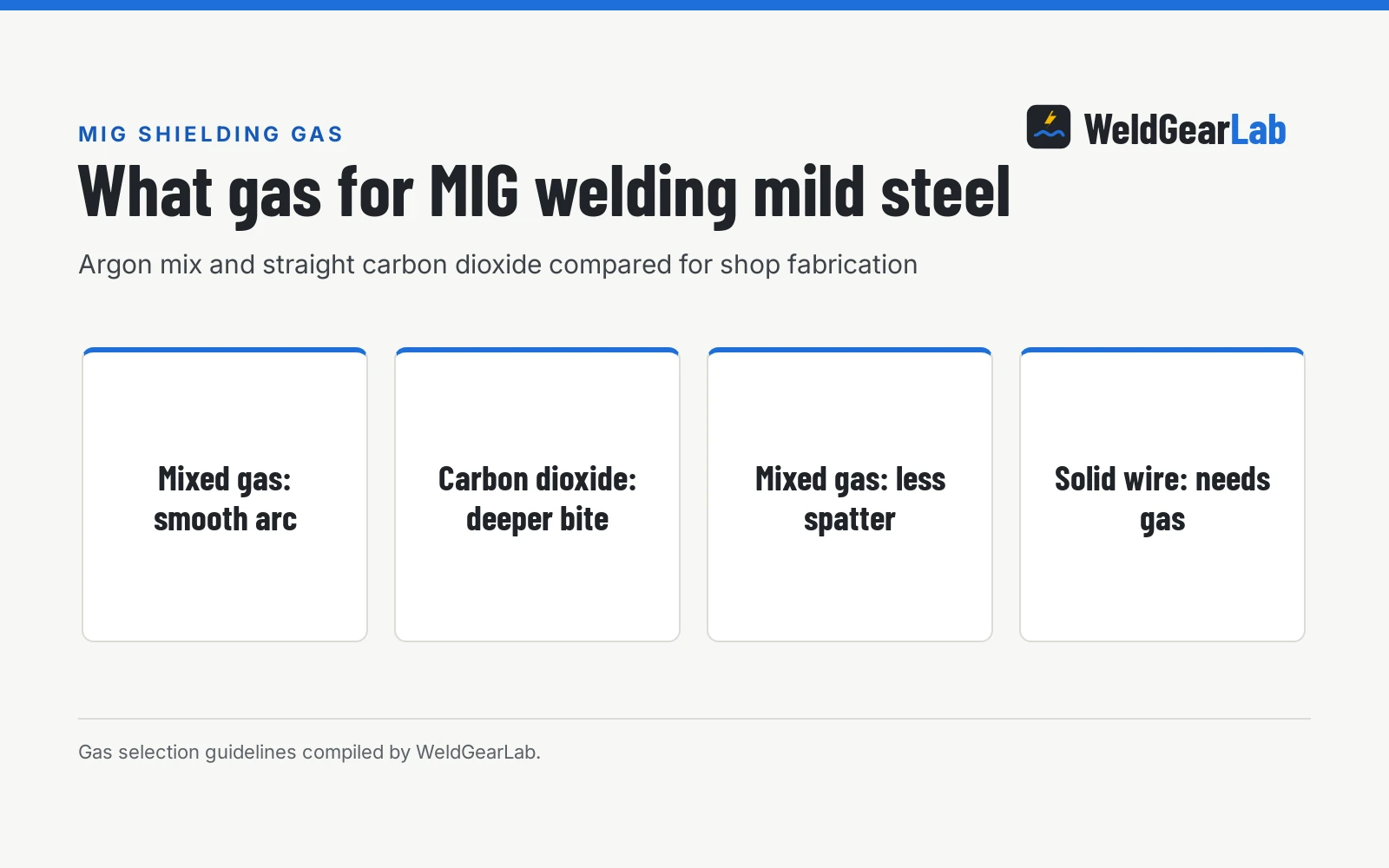
When you clamp clean carbon steel tubing or plate to the bench and load a spool of solid wire into your feeder, knowing what gas for mig welding mild steel to hook up determines the quality of your weld. For general shop fabrication and body panels, an argon and carbon dioxide mix is the standard shielding gas because it produces a smooth arc, steady puddle wet-out, and very little spatter. If you need maximum penetration on heavy farm iron or structural steel and want lower bottle refill costs, straight carbon dioxide is the alternate choice. This guide walks through shielding gas options step by step so you can match the bottle on your cart to your steel project.
This guide links to our product roundups, where WeldGearLab gets a commission on purchases made through links on this page, and your price stays the same. Read our affiliate disclosure.
What gas for MIG welding mild steel
Solid steel wire requires a continuous stream of shielding gas flowing through the gun nozzle to displace air from the molten puddle. Without shielding gas, atmospheric oxygen and nitrogen react with the molten iron, creating porosity, brittle joints, and heavy black scale. When choosing gas for mild steel, welders rely almost exclusively on practical options: a blend of argon and carbon dioxide, or pure carbon dioxide alone.
An argon and carbon dioxide mix serves as the default choice in metal fabrication shops and home garages. Argon provides arc stability, reduces spatter, and promotes a broad, smooth puddle that wets out cleanly into the base metal. The carbon dioxide in the mix provides arc energy, broadens puddle heat, and ensures adequate penetration. For thin sheet, auto body sheet, and general structural tubing, this mixed shielding gas produces clean beads that require almost no grinding.
Straight carbon dioxide is the reactive alternative. Carbon dioxide is an active gas that breaks down in the heat of the welding arc, creating intense heat and deep joint penetration. While it spatters more than a mixed gas blend and leaves a rougher bead face, it costs significantly less per cylinder fill and penetrates deeply into thick steel plate. Pure argon, by contrast, is unsuitable for carbon steel MIG welding because without an active gas addition, it causes erratic arc wander, poor sidewall wetting, and severe undercut along the weld toes.
Side by side
| Argon and Carbon Dioxide Mix | Straight Carbon Dioxide | Pure Argon | |
|---|---|---|---|
| Mild steel compatibility | Recommended standard choice | Recommended for deep penetration | Not recommended (causes erratic arc) |
| Primary shop role | General fabrication and sheet metal | Heavy structural steel and repairs | Aluminum MIG and TIG welding only |
| Arc stability | Smooth, quiet arc with stable puddle | Agitated, stiff arc with higher spatter | Erratic wandering arc across puddle |
| Spatter cleanup | Minimal fine spatter, easy cleanup | Heavier spatter needing chipping | Irregular spatter with poor tie-in |
| Penetration profile | Balanced penetration with smooth tie-in | Deep, narrow penetration into plate | Shallow penetration with sharp undercut |
| Thin metal performance | Excellent on thin sheet without burn through | Deeper penetration increases burn through risk | Severe bead crowning and poor fusion |
| Bead appearance | Flat, uniform bead with clean ripples | More crowned bead with rougher face | Rope-like bead with grooved undercut toes |
| Cylinder fill cost | Higher fill cost for blended gas | Lowest fill cost among shielding options | Moderate fill cost for pure inert gas |
| Regulator compatibility | Standard inert gas regulator and flowmeter | Regulator and flowmeter required | Standard inert gas regulator and flowmeter |
Both recommended shielding gas options run through standard wire feed MIG equipment with solid steel wire. When selecting between them, evaluate whether your priorities center on low cleanup and clean appearance or raw penetration depth and bottle economy. Check your regulator connections before bringing a bottle back to the shop.
When an argon and carbon dioxide mix is the better choice
- Clean sheet metal and auto body panels. The soft, stable arc keeps heat input low, minimizing the risk of burn through and panel warping on thin steel.
- Furniture and visible fabrication. The blend creates very little spatter and leaves a smooth, flat bead profile that needs minimal wire brushing before painting.
- All-position welding. The stable puddle freezes predictably, making vertical-up and overhead joint positions easier to control without drooping or sagging.
- Forbearing machine tuning window. Blended gas provides a broader voltage and wire feed window, making arc dialing straightforward across varying joint fit-ups.
For most shop projects using solid wire from our MIG wire for mild steel guide, an argon and carbon dioxide blend gives the most consistent results across a wide range of steel thicknesses. If you want a deeper look at gas performance, read our argon versus mixed gas comparison.
When straight carbon dioxide is the better choice
- Thick plate and heavy structural joints. The intense arc energy drives heat deep into the joint root, delivering solid penetration on heavy brackets and thick steel plate.
- Lower running costs on high-volume welding. Carbon dioxide cylinders cost less to buy and refill at local gas suppliers than argon-rich gas mixes.
- Heavy structural repairs. When welding heavy brackets, gussets, and structural channels, the deep root penetration of carbon dioxide ensures full joint fusion on heavy steel sections.
- Projects where cosmetic bead appearance is secondary. If the finished weldment will be ground flush or coated with heavy industrial paint, the higher spatter level of carbon dioxide is easily managed.
While straight carbon dioxide produces noticeable spatter that requires chipping or flap disc cleanup, the extra penetration makes it a reliable workhorse for heavy repairs. If you notice excessive spatter sticking across your workpiece, check our MIG spatter troubleshooting guide for voltage and stickout adjustments.
Why pure argon does not work for mild steel
Welders who already own a cylinder of pure argon for TIG welding or spool gun aluminum often wonder if they can hook that same bottle to mild steel wire. Pure argon creates severe problems when paired with solid carbon steel wire. Without an active gas component like carbon dioxide or oxygen to stabilize the arc cathode spot, the electric arc flutters erratically across the puddle surface.
This wandering arc leads to poor penetration, excessive crowning where the weld bead sits high like a rope, and sharp undercut grooves along both toes of the weld. The molten steel puddle refuses to wet out smoothly into the base metal, resulting in weak joints prone to cracking. Save pure argon cylinders for aluminum spool gun work or TIG welding, and use a dedicated mixed gas or carbon dioxide bottle on carbon steel.
If your shop runs both steel and aluminum, pairing a multi-process machine with dedicated cylinders and quality shielding gas regulators keeps each welding process properly shielded without cross-contamination.
Shielding gas flow rate and regulator setup
Proper gas coverage requires steady flow through the torch nozzle without turbulence. Setting gas flow too low allows ambient shop air to reach the molten puddle, while setting flow excessively high creates air-drawing turbulence at the nozzle rim. Adjust your regulator flowmeter to deliver a steady shielding envelope at the torch nozzle when triggering the wire feed gun, following the flow settings on your machine door chart.
Always hold the gun nozzle close enough to keep the puddle fully enveloped inside the gas shield, maintaining a consistent wire stickout. Working in front of open shop bay doors or cooling fans can blow the protective gas shield away from your puddle before the molten steel solidifies. If drafts displace your shielding gas, you will immediately see foamy pinholes and black crust appear in the bead; review our guide on what causes porosity in MIG welds to diagnose coverage faults. You can also read our step-by-step guide on setting your gas flow rate to tune your flowmeter for drafts and nozzle sizes.
Gas cylinder safety and shop practice
Shielding gas cylinders store gas under high pressure and require careful shop handling. Always secure cylinders upright to a rolling cart or wall station with heavy steel chains or ratchet straps. Before threading your regulator onto a fresh bottle, briefly crack the cylinder valve open and shut while standing behind the outlet to blow out dust and metal shavings that could ruin regulator seats.
Carbon dioxide cylinders store liquefied gas under vapor pressure. Never lubricate cylinder valves, stems, or regulator fittings with oil, pipe dope, or grease, because pressurized gas can ignite hydrocarbon residues.
Compressed gas cylinder safety. High-pressure cylinders must remain secured upright with a chain or safety strap at all times. Never lubricate cylinder threads or regulator fittings with oil or grease, keep bottles clear of electrical ground paths and arc flash, and ensure proper room ventilation to prevent gas buildup. For details on shop health and safety practices, explore our overview of welding consumables and read our Safety Disclaimer.
FAQ for welders
Can you MIG weld mild steel with pure argon?
Pure argon is not recommended for MIG welding carbon steel with solid wire. Argon alone creates an erratic, wandering arc that produces poor sidewall wetting, heavy bead crowning, and sharp undercut along the weld toes. For sound mild steel welds, always use an argon and carbon dioxide mix or straight carbon dioxide.
What is the main difference between mixed gas and straight carbon dioxide?
An argon and carbon dioxide mix produces a stable, quiet arc with minimal spatter and a smooth bead profile, making it ideal for thin sheet and shop fabrication. Straight carbon dioxide delivers deeper joint penetration on thick steel plate and costs less to refill, but it generates noticeably higher spatter levels that require extra cleanup.
Can you use flux core wire with MIG shielding gas?
Standard self-shielded flux core wire is formulated to run without external shielding gas and requires electrode negative polarity. Adding shielding gas to self-shielded flux core wire can alter puddle chemistry and cause porous or brittle welds. If you want gas shielding, switch to solid wire on electrode positive polarity or verify whether your wire is a specialized dual-shield consumable.
Can you weld mild steel without any shielding gas?
You cannot weld mild steel using solid wire without shielding gas because room air instantly contaminates the molten puddle with oxygen and nitrogen. If you do not have a shielding gas cylinder, you must switch your machine to self-shielded flux core wire and swap your polarity leads. Check our guide on welding without gas for complete machine setup details.
Why are there pinholes and bubbles in my weld bead?
Pinholes in a weld bead indicate porosity, which occurs when atmospheric air contaminates the molten puddle before it solidifies. The most common causes are an empty gas bottle, a breeze blowing shielding gas away from the nozzle, mill scale on the steel, or a loose gas hose connection. Inspect your gas line for leaks and verify that your regulator delivers steady flow when the gun trigger is pressed.
Related: argon versus mixed gas for MIG, how to set gas flow rate, regulators for MIG and TIG, MIG wire for mild steel, and the MIG welders hub. Also see our guide on why a MIG welder spatters and welding consumables.