Best 6010 Welding Rod for Pipe Root Pass (2026)
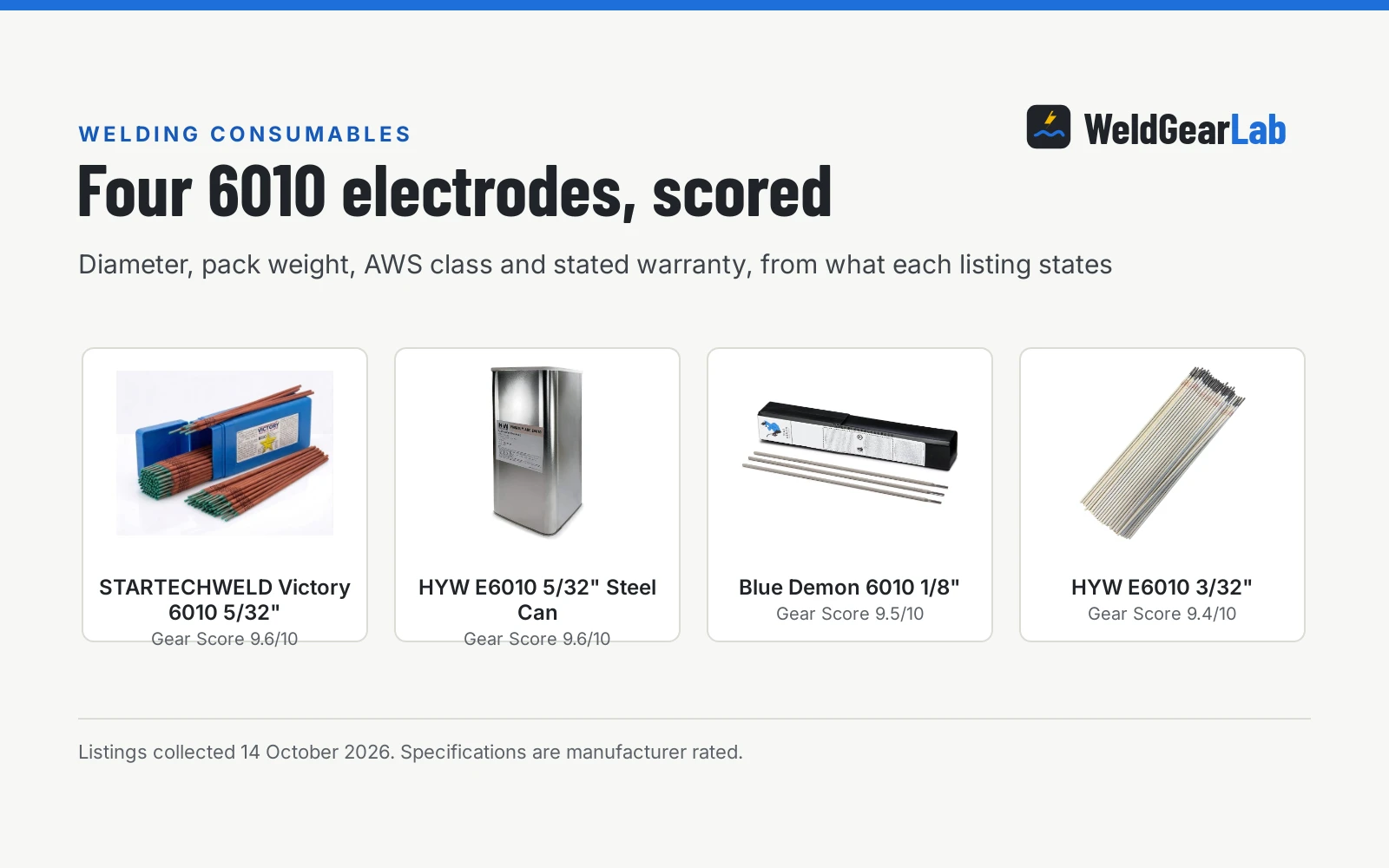
Four 6010 stick electrodes for pipe root pass work, compared on stated diameter, can or box packaging, arc drive, and stated warranty terms.

On this page
Top picks at a glance
As an Amazon Associate I earn from qualifying purchases.
- 1
 Best OverallSTARTECHWELD Victory 6010 5/32″9.6/10View on Amazon
- 2
 Best Bulk CanHYW E6010 5/32″ Steel Can9.6/10View on Amazon
- 3
 Standard Root DiameterBlue Demon 6010 1/8″9.5/10View on Amazon
- 4
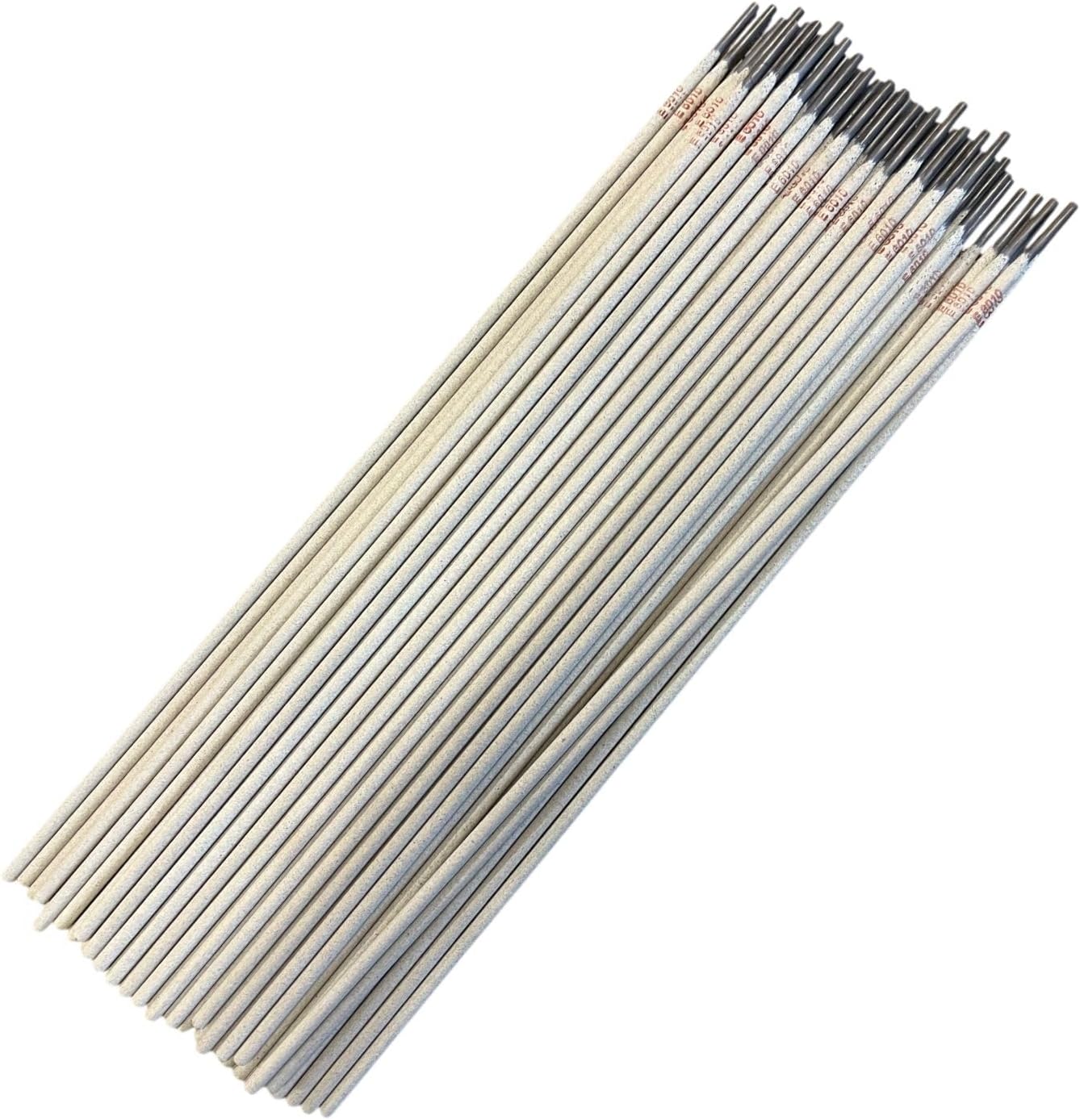 Small Diameter PickHYW E6010 3/32″9.4/10View on Amazon
When you bevel two pipe joints on the bench or line up a repair in the field, putting in an open root pass requires an electrode that digs through the gap and freezes fast before the puddle sags. Choosing the best 6010 welding rod for pipe root pass work comes down to arc force, puddle freeze in all positions, packaging that protects the cellulose coating, and choosing the diameter that matches your pipe wall.
WeldGearLab gets a commission on purchases made through links on this page, and your price stays the same. Read our affiliate disclosure.
Quick picks
- Best Overall STARTECHWELD Victory 6010 5/32″: A 5/32 inch electrode in a 5 lb box with stated forceful arc drive, fast puddle freeze for all positions, and friable slag for open root pipe passes. Check price on Amazon
- Best Bulk Can HYW E6010 5/32″ Steel Can: A 50 lb steel can that protects 5/32 inch electrodes from moisture and shop damage, classified to AWS A 5.1-04. Check price on Amazon
- Standard Root Diameter Blue Demon 6010 1/8″: A 1/8 inch diameter electrode in a 5 lb carton, the standard size for open root passes on pipe, despite listing spec errors. Check price on Amazon
- Small Diameter Pick HYW E6010 3/32″: A 4 lb pack offering 3/32 inch diameter rods for lighter pipe or thin wall root passes where lower heat input is needed. Check price on Amazon
The machines
Victory Welding Alloys 6010 Welding Rod 5/32"
A 5 lb box of 5/32 inch E6010 electrodes with stated forceful arc penetration, fast puddle freeze, and friable slag for pipe joints.
Pros
- Listing describes a forceful penetrating arc and fast freezing puddle for open root passes
- Maker states usability in all positions including vertical-up, vertical-down, and overhead
- Produces friable, easily removable slag and x-ray quality weld deposits per the listing
- Convenient 5 lb box size for pipe repairs and small fabrication jobs
Cons
- Electrode length is not stated in the listing
- Listing does not state an AWS specification revision code
- No warranty term is stated in the listing

50 lb Steel Can E6010 5/32" Stick electrodes
A bulk 50 lb steel can of 5/32 inch by 14 inch E6010 electrodes classified to AWS A 5.1-04 for high-volume pipe welding.
Pros
- Packed in a 50 lb steel can to protect electrodes from moisture and physical shop damage
- Lists AWS A 5.1-04 specification for E6010 carbon steel stick electrodes
- States 5/32 inch diameter with a 14 inch electrode length
- Bulk 50 lb quantity suits high-volume pipe welding and structural work
Cons
- 50 lb steel can is heavy to transport for quick mobile pipe repairs
- No warranty term is stated in the listing
Blue Demon 6010 X 1/8" X 14" X 5LB Carton Steel
A 5 lb carton of 1/8 inch by 14 inch E6010 steel pipe welding electrodes in the standard diameter for open root passes.
Pros
- Standard 1/8 inch diameter and 14 inch length for pipe root pass welding
- Packaged in a compact 5 lb carton for shop and field work
- States carbon steel electrode construction with part number E6010-125-05P
- Blue Demon brand with stated GTIN identification
Cons
- Bullets provide minimal technical details beyond general marketing text
- No warranty term is stated in the listing
E6010 3/32"-1/8"-5/32" Stick electrodes welding
A 4 lb pack of 3/32 inch by 14 inch E6010 electrodes classified to AWS A 5.1-04, suited for lighter pipe wall root passes.
Pros
- Lists AWS A 5.1-04 E6010 specification for stick welding electrodes
- Small 3/32 inch diameter suited for lighter joints or thin pipe roots
- Stated 14 inch length matches standard manual stick electrode size
- Packaged in a lightweight 4 lb quantity
Cons
- Title lists 3/32, 1/8, and 5/32 inch sizes along with 2 lb and 4 lb options
- No warranty term is stated in the listing
Other welders and gear to compare
 Victory Welding Alloys 6010 Welding Rod 3/32" E6010 3/32" 5Check price on Amazon
- Victory Welding Alloys 6010 Welding Rod 1/8" E6010 1/8" 5Check price on Amazon
 E6011 3/32" 1/8" 5/32" Stick electrodes welding rod 10 lb 50Check price on Amazon
 Forney 30301 E6013 Welding RodCheck price on Amazon
 YESWELDER TIG Tungsten Electrode Pre-Sharpened WeldingCheck price on Amazon
 Forney 30685 E7018 AC Welding RodCheck price on Amazon
Spec sheet comparison
| Electrode | Gear Score | Diameter | Length | Pack Weight | Packaging | AWS Class | Warranty |
|---|---|---|---|---|---|---|---|
| STARTECHWELD Victory 6010 5/32″ | 9.6/10 | 5/32 in | Not stated | 5 lb | Box | E6010 | Not stated |
| HYW E6010 5/32″ Steel Can | 9.6/10 | 5/32 in | 14 in | 50 lb | Steel can | E6010 (AWS A 5.1-04) | Not stated |
| Blue Demon 6010 1/8″ | 9.5/10 | 1/8 in | 14 in | 5 lb | Carton | E6010 | Not stated |
| HYW E6010 3/32″ | 9.4/10 | 3/32 in | 14 in | 4 lb | Not stated | E6010 (AWS A 5.1-04) | Not stated |
Ratings in this table are the makers’ own claims taken from each product page (14 October 2026).
Buying guide: how to choose the best 6010 welding rod for pipe root pass
Cellulose coating and digging arc force
An E6010 electrode uses a high-cellulose sodium coating that generates a forceful, concentrated arc stream. This digging arc burns through light surface rust or mill scale and establishes a clean keyhole at the root of the joint. The gas shield generated by the burning cellulose protects the molten pool while the fast-freezing puddle solidifies rapidly, which keeps the bead from dripping when welding in vertical-down, vertical-up, or overhead positions.
Choosing the right electrode diameter
Core wire diameter determines the heat input, deposit size, and keyhole width. A 1/8 inch electrode is the standard choice across fab shops and field pipe welding because it fits common root gaps while remaining easy to manipulate. Stepping up to 5/32 inch provides higher deposition on heavy-wall pipe joints, while a 3/32 inch electrode provides fine control on lighter pipe walls without excessive heat buildup.
Packaging and moisture protection
Unlike low-hydrogen electrodes that require heated holding ovens to eliminate moisture, cellulose 6010 coatings rely on a specific natural moisture content to generate their arc drive and gas shield. Never bake 6010 rods in a rod oven. Heavy steel cans provide durable protection against physical crushing and humidity extremes on field trucks, while smaller 5 lb cartons or boxes suit indoor fab shops where rods are consumed quickly.
Slag removal and bead appearance
Cellulose electrodes produce a thin, friable slag layer rather than the heavy glassy slag found on rutile or basic rods. This thin slag chips away easily with a chipping hammer and wire wheel, revealing a characteristic coarse ripple bead. Thorough cleaning between passes is critical on pipe joints to prevent slag inclusions before depositing hot passes and fill passes.
Joint fit-up and root pass technique
Consistent fit-up makes or breaks an open root pass. Grind the pipe ends to create a uniform bevel and an even root face, maintaining a consistent root opening around the entire joint. When running the root bead, maintain a short arc length and direct the electrode force directly into the root opening to tie both base metal edges together without leaving internal undercut.
Use as directed. Pipe welding produces intense ultraviolet radiation, sparks, hot slag, and metal fumes. Always wear an approved welding hood, leather welding gloves, and flame-resistant clothing. Ensure proper ventilation or use local fume extraction when welding in shop bays, and remove all flammable materials from the work area. Read our Safety Disclaimer.
Before You Strike an Arc
- Check container condition on arrival: inspect steel cans for puncture damage and cardboard cartons for moisture or cracked flux coating.
- Verify machine polarity: 6010 cellulose electrodes run on direct current electrode positive (DCEP) for proper arc penetration and puddle control.
- Inspect electrode flux: ensure the cellulose covering is intact along the core wire without flaking or bare spots before clamping in the holder.
- Match diameter to joint thickness: select 1/8 inch or 5/32 inch rods for standard pipe joints, or 3/32 inch rods for thin-wall pipe assemblies.
FAQ for welders
Why is 6010 preferred for pipe root passes?
An E6010 electrode produces a forceful, digging arc that penetrates deeply into the root opening to form a reliable keyhole. Its fast-freezing weld puddle solidifies quickly, allowing welders to control the puddle across vertical-down, vertical-up, and overhead positions on pipe. The resulting root bead bridges gaps cleanly and ties both pipe lands together.
What polarity should I use for 6010 pipe welding?
Run 6010 electrodes on direct current electrode positive, also called DCEP or reverse polarity. This configuration directs the arc energy into the base metal to achieve full root penetration and smooth arc action. Running on alternating current is not supported by standard 6010 electrodes.
Should 6010 welding rods be stored in a rod oven?
No, 6010 electrodes should not be stored in a standard high-temperature rod oven. The cellulose coating requires a specific internal moisture level to generate its shielding gas and forceful arc drive. Baking them in an oven dries out the flux and ruins their performance.
What size 6010 rod is standard for an open root pass?
A 1/8 inch diameter electrode is the most common industry standard for open root pipe welding. It provides the right balance of arc control, keyhole visibility, and deposition rate across standard pipe schedules. Larger 5/32 inch rods suit heavy-wall pipe, while 3/32 inch rods suit thin-wall tubing.
Can I weld downhill with a 6010 electrode on pipe?
Yes, 6010 electrodes are designed for all-position welding, including vertical-down downhill pipe welding. Downhill progression is widely used on cross-country transmission pipelines because the fast travel speed deposits a clean root bead quickly. Shop fabrication and plant piping often call for vertical-up progression depending on the code.
Related: welding rods guide, welding rods for mild steel, dc vs ac stick welding, how to strike an arc with a stick welder, why does my welding rod keep sticking, welding rod amperage chart, how to stick weld rusty metal, portable stick welder, stick welder for farm use, small inverter stick welders, how many welding rods in a pound, welding rod oven temperature chart, how to use stick welder, stick welder vs wire welder, stick welder ac vs dc, welding consumables, and stick welders.
Scoring, line by line
Each electrode is scored on performance, build, value, safety listing and warranty, with the weights published on our How We Pick page. Welding consumables carry no electrical safety listing, and none of the listings state a warranty term, so those criteria score zero; the ranking comes from performance, build and value.
| Product | Gear Score | Perf. /35 | Build /25 | Value /25 | Safety /10 | Warranty /5 |
|---|---|---|---|---|---|---|
| STARTECHWELD Victory 6010 5/32″ | 9.6 | 30 | 21 | 21 | n/a | 0 |
| HYW E6010 5/32″ Steel Can | 9.6 | 29 | 22 | 20 | n/a | 0 |
| Blue Demon 6010 1/8″ | 9.5 | 28 | 18 | 19 | n/a | 0 |
| HYW E6010 3/32″ | 9.4 | 27 | 18 | 18 | n/a | 0 |
The lowest score we show is 9.2 and the highest is 9.8; every point total is spread proportionally across that span, so extra points mean a higher figure. Safety is only scored for powered machines or when a listing names safety features; otherwise it drops out and the score is worked from the other 90 points.