7018 Welding Rod Temperature and Storage Guide
7018 rods weld clean when the flux stays dry, and this guide covers the holding and reconditioning temperatures the rod ovens on the market actually offer.

On this page
Top picks at a glance
As an Amazon Associate I earn from qualifying purchases.
- 1
 ATLASWELDER 7018 Welding Rod 3/32" 10LB9.5/10View on Amazon
- 2
 Victory Welding Alloys 7018 Welding Rod 1/8" E7018 1/8" 59.5/10View on Amazon
- 3
 ATLASWELDER 7018 Welding Rod 1/8" 10LB9.5/10View on Amazon
7018 welding rod temperature is the temperature you hold low-hydrogen rods at so the flux coating stays dry. A 7018 rod pulls moisture from the air when it sits open in the shop, and that moisture turns to gas in the arc, leaving porosity and cracks in the bead. This guide explains how holding keeps rods dry, the higher range that reconditions rods that got damp, and what the rod ovens on the market actually offer.
This guide links to our product roundups, where WeldGearLab gets a commission on purchases made through links on this page, and your price stays the same. Read our affiliate disclosure.
7018 welding rod temperature: holding vs reconditioning
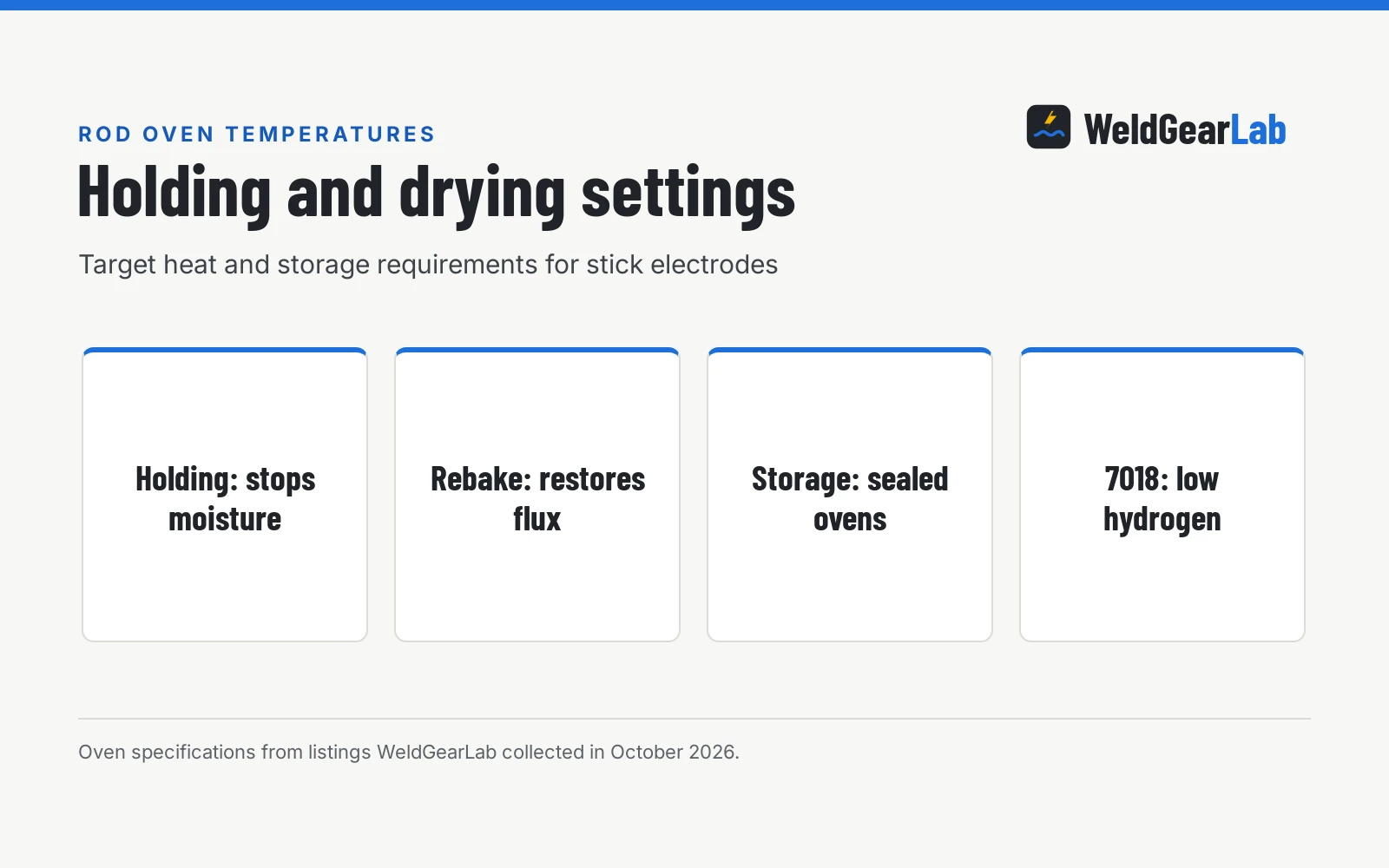
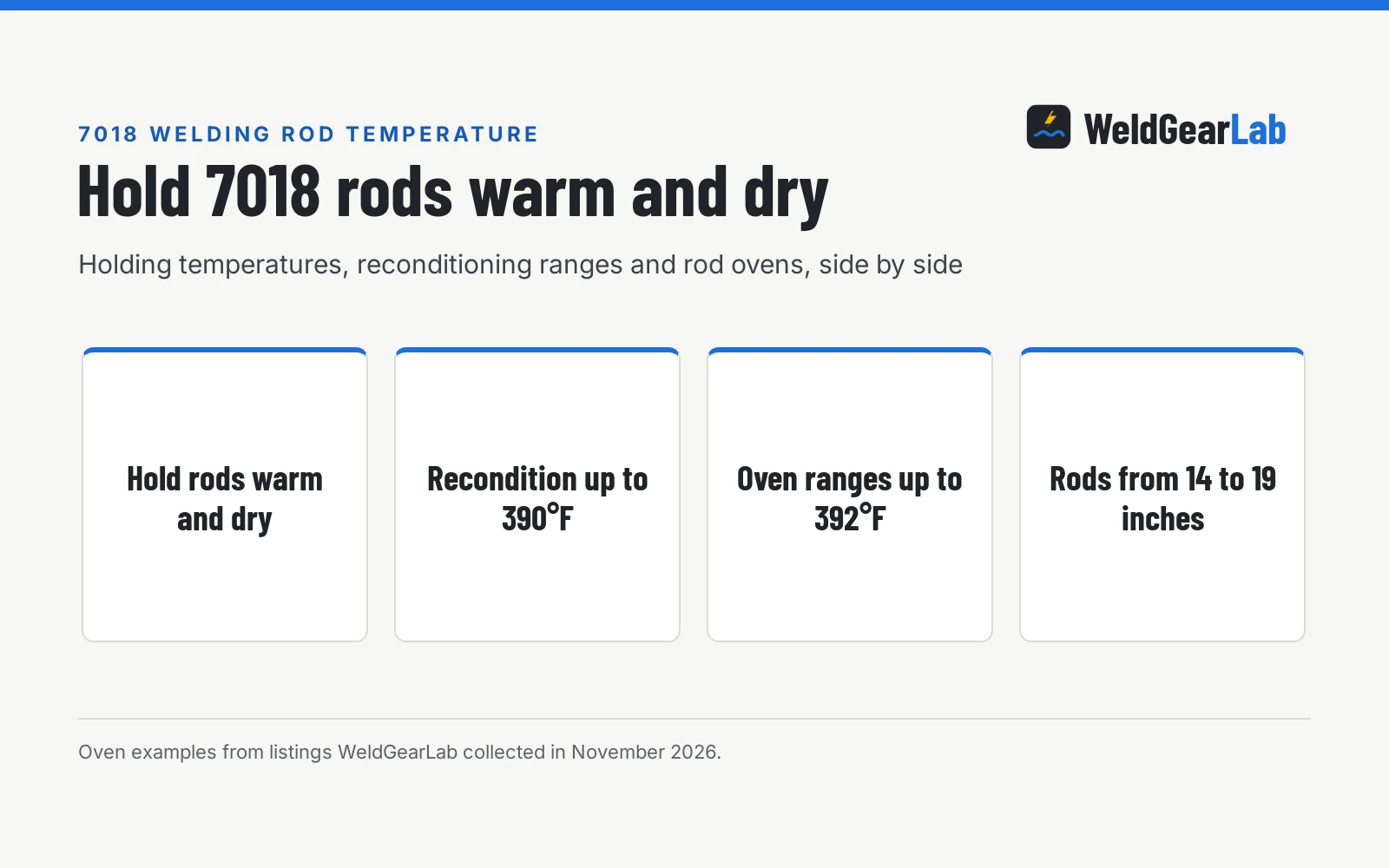
7018 is a low-hydrogen rod, and the flux coating is the part that suffers when the rod gets damp. A rod oven holds rods warm so the flux stays dry. Reconditioning is different: it drives moisture back out of rods that already picked some up, using heat above the holding range. The two jobs need different temperatures, so check which end of the range your oven covers before you load it.
The ovens in the listings adjust from 80°F at the low end to 392°F at the top, and each oven covers a slice of that span. The SÜA is the exception: its dial starts at ambient temperature. The Arc Union and Oakwonder ovens (on Amazon) adjust from 80°F to 300°F, the VEVOR 22 lb oven from 86°F to 302°F, and the VEVOR 110 lb oven from 104°F to 392°F. The TOOLIOM oven (on Amazon) reaches 390°F, and its maker describes that top end as the range for reconditioning used or exposed electrodes. Match the oven’s range to the job: holding rods dry day to day, or bringing damp rods back.
Side by side
| Oven | Capacity | Temperature range | Rod length |
|---|---|---|---|
| VEVOR 22 lb oven | 22 lb | 86-302°F | 18-inch |
| VEVOR 110 lb oven | 110 lb | 104-392°F | 18-inch |
| VEVOR 50 lb oven | 50 lb | 104-302°F | 18-inch |
| TOOLIOM oven | 11 lb | 120-390°F | 14-inch |
| Arc Union oven | 20 lb | 80-300°F | Not stated |
| Oakwonder oven | 22 lb | 80-300°F | 19-inch |
| SÜA TRC-10 oven | 22 lb | Ambient-302°F | 18-inch |
| Vouyar container | 20 lb | 150-300°F | 19-inch |
Capacities run from 11 lb in the TOOLIOM oven to 110 lb in the big VEVOR benchtop oven, and rod length matters as much as weight: the TOOLIOM fits rods up to 14 inches, while the VEVOR ovens and the SÜA take 18-inch rods and the Vouyar and Oakwonder ovens take 19-inch rods.
What the ovens on the market cover
Most of the ovens here are benchtop or portable boxes with a dial or gauge, and several have a locking latch. The VEVOR 22 lb oven runs on 200W at 120V and heats up in 10 minutes, while the VEVOR 50 lb and 110 lb ovens run on 400W and 950W and heat up in 20 minutes. The VEVOR 110 lb oven has a built-in temperature gauge, and the VEVOR 50 lb ovens have a temperature gauge and a locking latch. The SÜA TRC-10 (on Amazon) holds 22 lb of 18-inch rods, runs at 115V, and sets temperature with an analog dial. The Vouyar container (on Amazon) holds 20 lb of 19-inch rods and shows the temperature on a dial from 150°F to 300°F.
Portable ovens trade capacity for carry weight. The TOOLIOM oven holds 11 lb, fits rods up to 14 inches, and has a foldable stand and a carry handle. The Arc Union oven (on Amazon) holds 20 lb and runs at 115V with an analog temperature dial. The Oakwonder oven holds 22 lb of 19-inch rods, runs at 110V, and has a handle and a safety locking latch. For shop use, the big VEVOR oven holds 110 lb of 18-inch rods, so a full box of rods stays warm in one load.
How to pick an oven for 7018 rods
Start with rod length. Measure the rods you buy: the ovens here fit 14-inch, 18-inch and 19-inch rods, and a rod that is longer than the oven simply does not fit. Then check capacity against how many rods you keep on hand. The TOOLIOM holds 11 lb, the Vouyar and Arc Union ovens hold 20 lb, the VEVOR 22 lb and Oakwonder ovens hold 22 lb, and the VEVOR 50 lb ovens hold 50 lb.
Then check the temperature range against the job. An oven that reaches 390°F, like the TOOLIOM, is described by its maker as covering reconditioning as well as holding, while an oven that tops out at 300°F covers holding only. A temperature gauge or dial lets you see the setting: the VEVOR 110 lb and 50 lb ovens have a built-in gauge, the SÜA and Arc Union ovens use an analog dial, and the Vouyar container shows the temperature on a dial. For field work, a handle and a locking latch matter: the VEVOR 22 lb oven has a locking latch and a portable handle, and the Oakwonder oven has a handle and a safety locking latch.
What to do with rods that got damp
Rods that sat open in a damp shop need more than a warm shelf. Reconditioning drives the moisture out with heat, and the TOOLIOM oven’s maker describes its 390°F top end for exactly that job: reconditioning used or exposed electrodes. The VEVOR 110 lb oven reaches 392°F, the highest top end in the listings. Rods that sat in standing water or sat open for a long stretch may not come back, so check the rod maker’s guidance for the electrodes you run and follow the oven’s manual for the setting.
Hot ovens and fumes. A rod oven runs hot enough to burn skin, so move it with care while it is hot and keep it clear of flammable material. Welding 7018 rods makes fumes, so weld with ventilation or outdoors with your head out of the plume, and wear a helmet, gloves and eye protection. See the OSHA welding overview and follow your oven and machine manuals.
FAQ for welders
What temperature should I hold 7018 rods at?
Hold them warm in a rod oven so the flux stays dry. The Vouyar container, for example, indicates 150°F to 300°F. Set the oven to the temperature your rod maker calls for and keep the lid latched.
Can I recondition 7018 rods that got damp?
Yes, with heat above the holding range. The TOOLIOM oven reaches 390°F and its maker describes that top end for reconditioning used or exposed electrodes, and the VEVOR 110 lb oven reaches 392°F, the highest top end in the listings. Rods that sat in standing water may not come back, so check the rod maker’s guidance first.
What size rod oven do I need for 7018 rods?
Match the oven to the rod length and to how many rods you keep. The ovens here fit 14-inch, 18-inch and 19-inch rods, and capacities run from 11 lb in the TOOLIOM oven to 110 lb in the big VEVOR benchtop oven. A 22 lb oven, like the VEVOR 22 lb or Oakwonder oven, covers a home shop’s daily rods.
Do 7018 rods need a rod oven, or can I store them on a shelf?
A shelf leaves the flux open to shop air, and 7018 flux pulls moisture from the air. A rod oven keeps the rods warm and dry, which is why the listings describe these ovens as keeping rods dry to reduce cracking and arc instability. If you have no oven, see the guide on storing 7018 rods without a rod oven.
How long does a rod oven take to heat up?
The VEVOR 22 lb oven heats up in 10 minutes, and the VEVOR 50 lb and 110 lb ovens heat up in 20 minutes. Heat-up time varies by oven, so check the temperature gauge or dial on the oven you buy.
Related: welding rod oven temperature chart, rod oven vs rod storage tube, best welding rod storage, and the welding consumables hub. Also see 7018 welding rod uses and best 7018 welding rod for the home shop.