Welding Rod Uses and Which Rod to Buy
Welding rods carry the filler metal and the flux that shield the weld, and this guide explains what each common rod is for and how to pick one.

On this page
Top picks at a glance
As an Amazon Associate I earn from qualifying purchases.
- 1
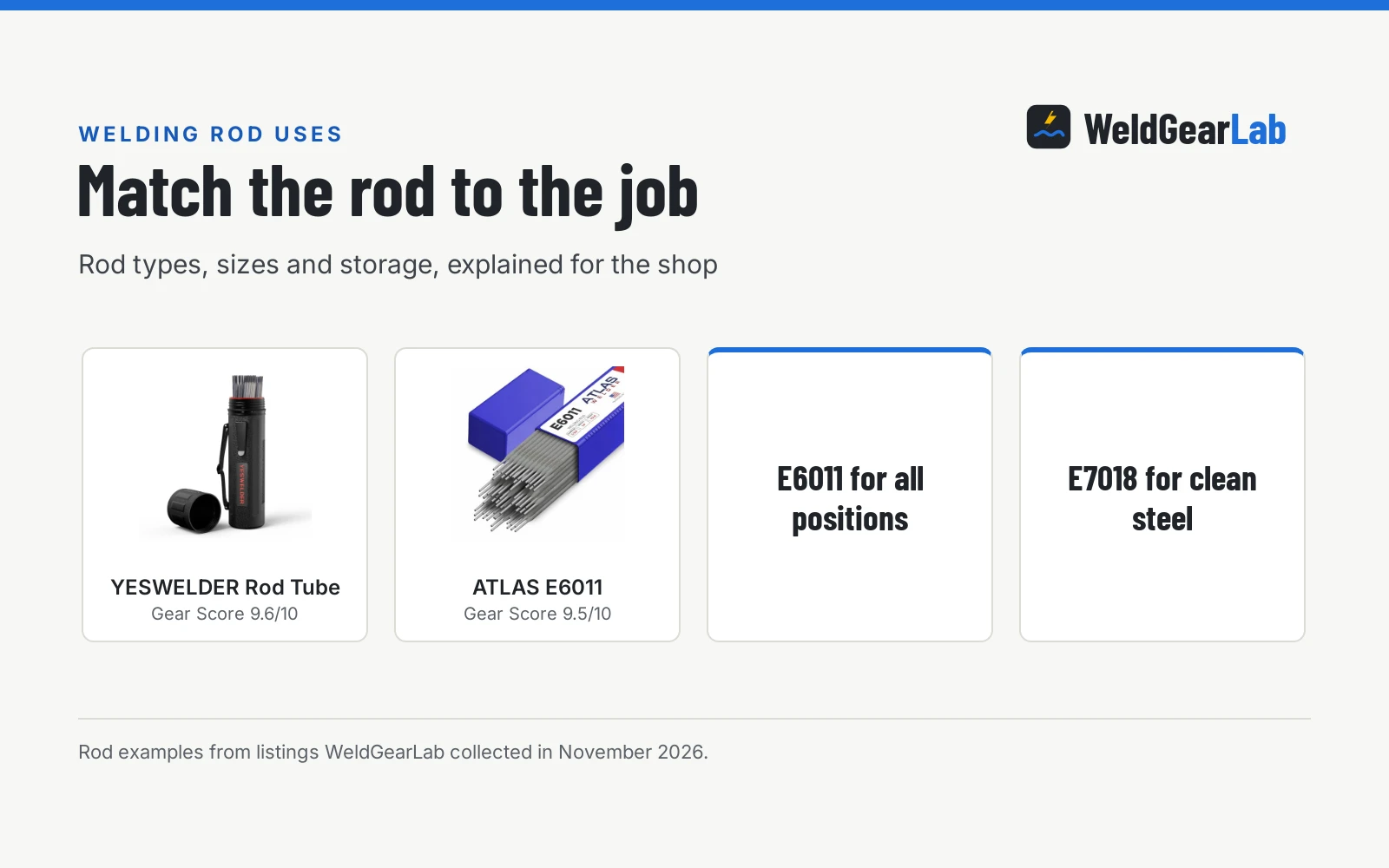
 YESWELDER E6011 E7018 Welding Rods with Tube Black9.6/10View on Amazon
- 2
 ATLASWELDER 6011 Welding Rod 3/32" 10LB9.5/10View on Amazon
A cracked bracket on a trailer, a gate hinge that has worked loose, a mower deck with a split seam. The repair needs metal joined, not glued, and a stick welder with the right rod does the job in the yard or the shop. Welding rod uses come down to this: the rod carries filler metal to the joint, and the flux coating shields the molten pool during the weld and leaves a slag crust over the bead as it cools.
This guide links to our product roundups, where WeldGearLab gets a commission on purchases made through links on this page, and your price stays the same. Read our affiliate disclosure.
YESWELDER E6011 E7018 Welding Rods with Tube Black
A rod tube that holds 4 x 1-lb packs of E6011 and E7018 rods in 3/32 in and 1/8 in sizes, with a threaded cap, a carry strap and a side clip.
Pros
- Includes 4 x 1-lb rod packs, 2 lb per model, in E6011 and E7018
- 4-compartment design keeps rod types sorted and easy to grab
- Threaded cap stays on during storage and transport
- Carry strap and side clip move the tube from shop to jobsite
Cons
- No warranty term is stated
- Holds rods up to about 14 inches, so longer rods do not fit
- Packs hold 1 lb each, so a big job needs several packs
- No amperage or polarity guidance is stated for the rods inside
ATLASWELDER 6011 Welding Rod 3/32" 10LB
A 10 lb box of E6011 carbon steel stick electrodes in 3/32 in for all-position welding.
Pros
- E6011 carbon steel electrodes for all-position stick welding
- 3/32 in size suits thinner metal and smaller beads
- 10 lb box is a shop-size pack for steady use
- Single rod type in the box, so no sorting is needed
Cons
- No warranty term is stated
- No amperage range is stated
- Size choice is limited to 3/32 in
- No tensile strength or polarity is stated
Welding rod uses at a glance
A welding rod, also called a stick electrode, is a metal core rod with a flux coating. The arc melts the core into the joint, and the flux burns to shield the weld pool and leaves a slag crust that chips away after the bead cools. The rod type sets what the weld is for: E6011 runs in all positions on carbon steel, and E7018 suits clean steel where a smooth bead matters. The listings in this guide cover E6011 and E7018 rods, in 3/32 in and 1/8 in sizes.
Rod uses split by the work. E6011 tolerates metal that is less than clean, which suits repair work and maintenance, while E7018 suits clean steel and a smooth bead for fabrication. The YESWELDER tube (on Amazon) packs E6011 and E7018 together for repair work, maintenance and general fabrication, so the welder grabs the rod the job needs.
Side by side
| Rod types | Sizes | Pack | |
|---|---|---|---|
| YESWELDER Rod Tube | E6011 and E7018 | 3/32 in and 1/8 in | 4 x 1-lb packs, 2 lb per model |
| ATLAS E6011 | E6011 | 3/32 in | 10 lb box |
The tube sorts E6011 and E7018 into compartments and carries them to the job, while the ATLAS box is a plain 10 lb supply of E6011 in 3/32 in. Pick the tube for carrying and sorting, and the box for stocking up on the rod already in use.
E6011 and E7018: the rods in this guide
E6011 is an all-position rod in this guide. The ATLAS listing states E6011 carbon steel electrodes for all position, which covers flat, horizontal, vertical and overhead work. E6011 suits repair work on metal that is less than clean, and the ATLAS box holds 3/32 in rods for that work.
E7018 is the other rod in the tube. It suits clean steel and a smooth bead, and it welds best kept dry. The tube keeps the rods sorted and contained, with a threaded cap and compartments that keep E7018 apart from E6011, though the listing does not state that it seals out moisture.
Rod size and the job
Rod size shapes the bead. The listings in this guide cover 3/32 in and 1/8 in sizes: the ATLAS box holds 3/32 in rods, and the YESWELDER tube packs 3/32 in and 1/8 in rods. The smaller size suits thinner metal and smaller beads, while the larger size lays more metal per pass on thicker stock. The tube adds a side scale reference for quick size checks, so the size in hand is easy to confirm before striking an arc.
Pack size matters too. The ATLAS box holds 10 lb of E6011, which suits a shop that burns through rods on steady work. The YESWELDER tube holds 4 x 1-lb packs, 2 lb per model, which suits carrying a working supply to repair work and maintenance jobs. The tube fits common electrodes up to about 14 inches long, with an approximately 4-inch opening.
Gear for the job: rods and storage
Striking an arc needs rods and a way to keep them sorted and contained, so this guide pairs the rods with a tube that carries them.
Storing rods so they stay dry
Storage is part of the job, not an afterthought. A threaded cap keeps rods contained during storage and transport, and a 4-compartment design keeps rod types apart instead of leaving them mixed together. The YESWELDER tube adds a carry strap and side clip, so the tube moves from the truck to the workbench to the jobsite. Store rods dry, keep the cap on, and the rods stay sorted and contained for the next job.
Safety runs with the rod choice. Stick welding throws arc light, fumes and hot slag, so wear a helmet and eye protection, weld with ventilation or outdoors with the head out of the plume, and clear dry grass and anything flammable from the area. See the OSHA welding overview.
For more options, see our welding consumables guides.
FAQ for welders
What are welding rods used for?
Welding rods join metal by stick welding. The rod core melts into the joint as filler metal, and the flux coating shields the molten pool from air during the weld. A slag crust forms over the bead as it cools and chips away after the weld cools.
What is E6011 used for?
E6011 is an all-position carbon steel rod for repair work, maintenance and general fabrication. It runs flat, horizontal, vertical and overhead, and it suits metal that is less than clean.
What is the difference between E6011 and E7018?
E6011 is an all-position rod that tolerates less than perfect metal, while E7018 suits clean steel and a smooth bead. The YESWELDER tube packs E6011 and E7018 together, 2 lb per model, so the welder carries the rod the job needs. E7018 needs dry storage; the tube keeps the rods sorted and contained, but the listing does not state that it seals out moisture.
How should welding rods be stored?
Store rods dry, sorted and capped. A tube with a threaded cap keeps rods contained during storage and transport, and compartments keep rod types apart so the right electrode is easy to find. The tube in this guide fits rods up to about 14 inches long and carries them by strap and side clip.
What size welding rod fits a small repair?
The listings in this guide cover 3/32 in and 1/8 in sizes, and the smaller size suits thinner metal and smaller beads. The YESWELDER tube packs both sizes, with a side scale reference for quick size checks. Match the size to the metal thickness and the rod type to the job.
Related: welding rods types, welding rods vs MIG wire, nickel vs steel welding rod, best welding rod bag, how to choose a MIG welder, and flux coated vs bare brazing rod.