Stick Welder Price: What Affects the Cost
A stick welder price follows output, input power, inverter design and what comes in the box, as shown by a 250A 110V inverter example.

On this page
Top picks at a glance
As an Amazon Associate I earn from qualifying purchases.
- 1
 Shirbly 2/0 Gauge Battery Cable9.5/10View on Amazon
- 2
 WotyWire 1/0 Gauge Wire Battery Cable with Lugs9.5/10View on Amazon
- 3
 TEMCo 4 Gauge AWG 25 Ft Black + 25 Ft Red Flexible Pure9.4/10View on Amazon
A cracked trailer bracket or a gate hinge that needs a bead puts the same question on the bench: what does a stick welder cost, and what makes one machine cost more than another? Stick welder price follows the machine, not the weld: output, input power, inverter design and what comes in the box set the range. This guide walks through each cost driver with a small home machine as the worked example.
This guide links to our product roundups, where WeldGearLab gets a commission on purchases made through links on this page, and your price stays the same. Read our affiliate disclosure.
What sets a stick welder price
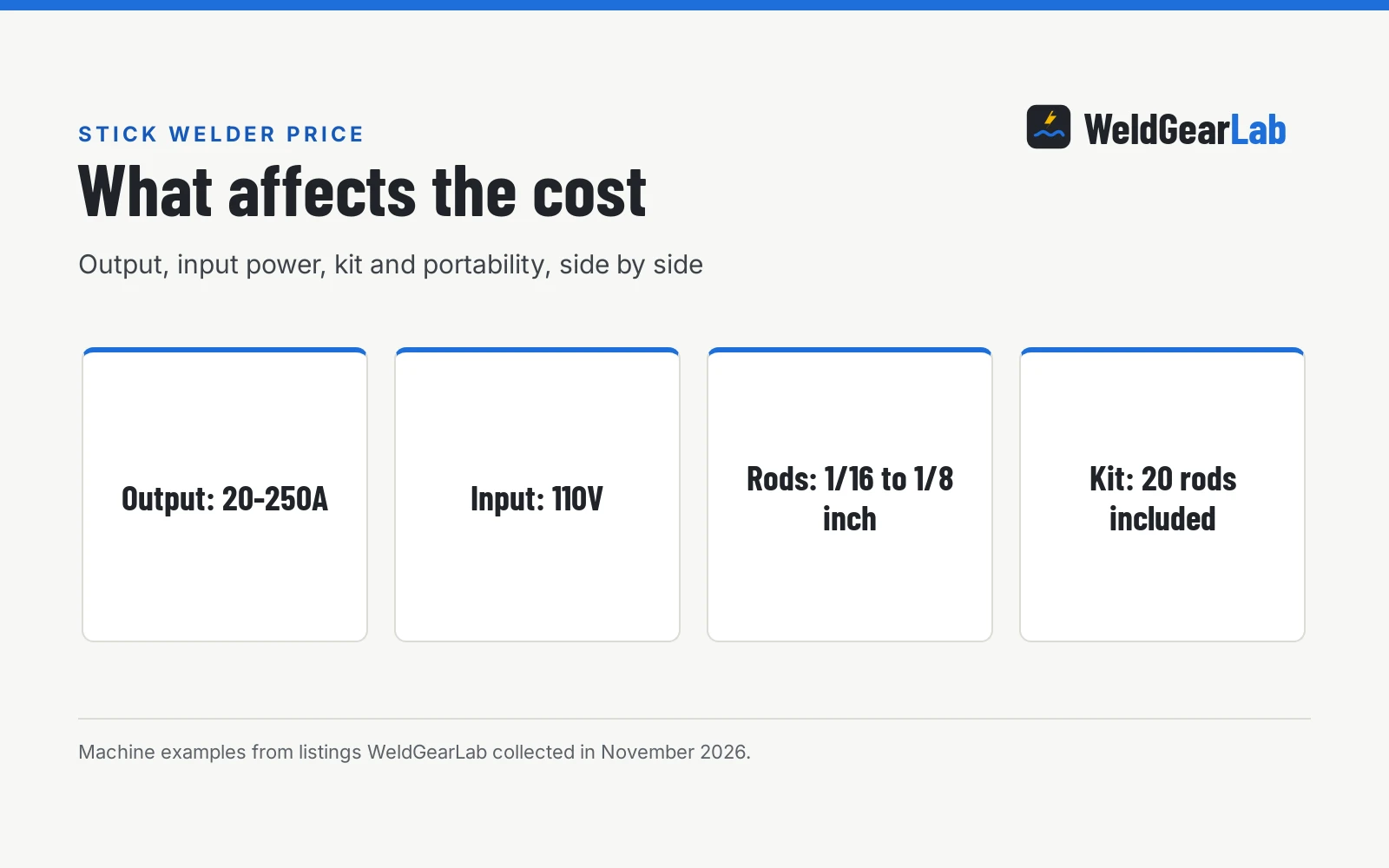
Several things move the price of a stick welder more than anything else: how much current it puts out, what outlet it needs, how the inverter is built, and what comes in the box. A machine with a wider output range and more features tends to cost more than a bare machine with a narrow range. The table below puts the cost drivers side by side with the figures from one small home machine, the FEIFANKE 250A inverter (on Amazon), so you can see what each driver looks like on a real machine.
| Cost driver | What it means | What to check | FEIFANKE example |
|---|---|---|---|
| Output range | Adjustable current in amps | Match the range to your metal thickness | 20-250A |
| Input power | The outlet the machine needs | Check the outlet before you buy | 110V |
| Rod size | The electrodes the machine runs | Check the rod range against your work | 1/16 to 1/8 inch |
| Metal thickness | The thickness the maker rates | Stay inside the rated range | 0.05 to 0.22 inch |
| Size and weight | How portable the machine is | Check the size if you carry it | 8.5 x 3.7 x 5.9 inches, 3.9 lb |
| Kit in the box | Rods and tools included | Count what is included | 20 rods, brush, hammer, gloves, holder |
Use the table as a checklist, not a ranking. A driver only matters if it changes the work you can do: a wider output range matters when you weld thicker metal, and a bigger kit matters when you own no rods or tools yet.
Output and metal thickness
Output is the main cost driver. The FEIFANKE example lists an adjustable current of 20-250A, which covers rod sizes from 1/16 inch to 1/8 inch and metal from 0.05 to 0.22 inch thick. It runs E6013, E6011, E6010 and E7018 rods. A machine that covers a wider amp range and more rod types tends to cost more because it covers more work. Check the output range against the thickest metal you plan to weld, and check the rod list against the rods you already own.
Input power and portability
The FEIFANKE example runs on 110V, the standard home outlet, and weighs 3.9 lb with a size of 8.5 x 3.7 x 5.9 inches. That size fits in a backpack or toolbox, so the machine moves to the work instead of the work coming to the shop. Machines that need a different outlet or a bigger case tend to cost more to set up and move. Check the input power against the outlets where you weld, and check the weight if you carry the machine to the job.
What comes in the box
The kit is the next cost driver. The FEIFANKE example comes with 20 welding rods, a steel wire brush, a chipping hammer, welding gloves and a holder. A kit with rods and tools tends to cost more than a bare machine, and it saves a separate trip for the basics. The machine also lists Hot Start, Arc Force and Anti-Stick, plus IGBT inverter control, which the maker says keeps the arc stable. Check the full kit list, and count what you would buy separately if the box held the machine alone.
How to read a listing before you pay
Read the listing in this order: output range, rod range, thickness range, input power, kit list. The FEIFANKE example gives all of them in one place: 20-250A, rods from 1/16 inch to 1/8 inch, metal from 0.05 to 0.22 inch thick, 110V input, and a kit with 20 rods. If any of them is missing, that gap is part of the price decision, not a detail to guess at. Compare machines on the same points, and the dearer machine should win on at least one point.
Before you weld. Stick welding throws sparks and fumes, so weld in a ventilated space with dry ground underfoot, keep flammable material clear of the work, and wear a helmet, gloves and long sleeves. Read the machine manual for the settings and the polarity for the rod you use, and check the rod type against the DCEP or DCEN connection the listing states. Never weld on a fuel tank or a sealed container.
FAQ for welders
What does a stick welder cost for home use?
It depends on output, input power and the kit in the box. The FEIFANKE example, a small 110V inverter machine with a 20-250A range, is listed for home repairs and DIY work, while larger machines with higher output tend to cost more.
Does a higher amp rating mean a higher price?
Output is a main cost driver. A machine rated 20-250A covers a wider range of rod sizes and metal thickness than a lower-output machine, and that range is part of what you pay for.
What rod sizes does a small stick welder run?
The FEIFANKE example runs 1/16-inch to 1/8-inch rods, including E6013, E6011, E6010 and E7018. Check the rod range on any machine before you buy, and match it to the rods you plan to use.
What else is needed besides the welder?
A stick welder kit can include rods, a brush, a chipping hammer, gloves and a holder, as the FEIFANKE example does with 20 rods. You still need a helmet, protective clothing and a safe place to weld. Check what is included before you pay.
Can a 110V stick welder handle farm repairs?
The FEIFANKE example, a 110V machine with a 20-250A range, is listed for home repairs and DIY projects on metal from 0.05 to 0.22 inch thick. Heavier farm work may need a machine with a higher maximum output, so check the thickness rating against the metal you weld.
Related: best TIG welder, best MIG TIG stick combination welder, stick welding machine for beginners, stick welding set up, and the stick welders hub. Also see the welders hub.