Shrinker Stretcher vs English Wheel: Which One Should You Buy?
Shrinker stretchers shape narrow flanges and curved edges on sheet metal, while an English wheel smooths and crowns large compound curves across broad panels.

On this page
Top picks at a glance
As an Amazon Associate I earn from qualifying purchases.
- 1
 3M Silver Cut-Off Wheel9.7/10View on Amazon
- 2
 Benchmark Abrasives 4.5" Aluminum Oxide Type 1 Cut Off Wheels9.7/10View on Amazon
- 3
 BHA 3 x 1/32 x 3/8 Cut Off Wheels for Die Grinders9.7/10View on Amazon
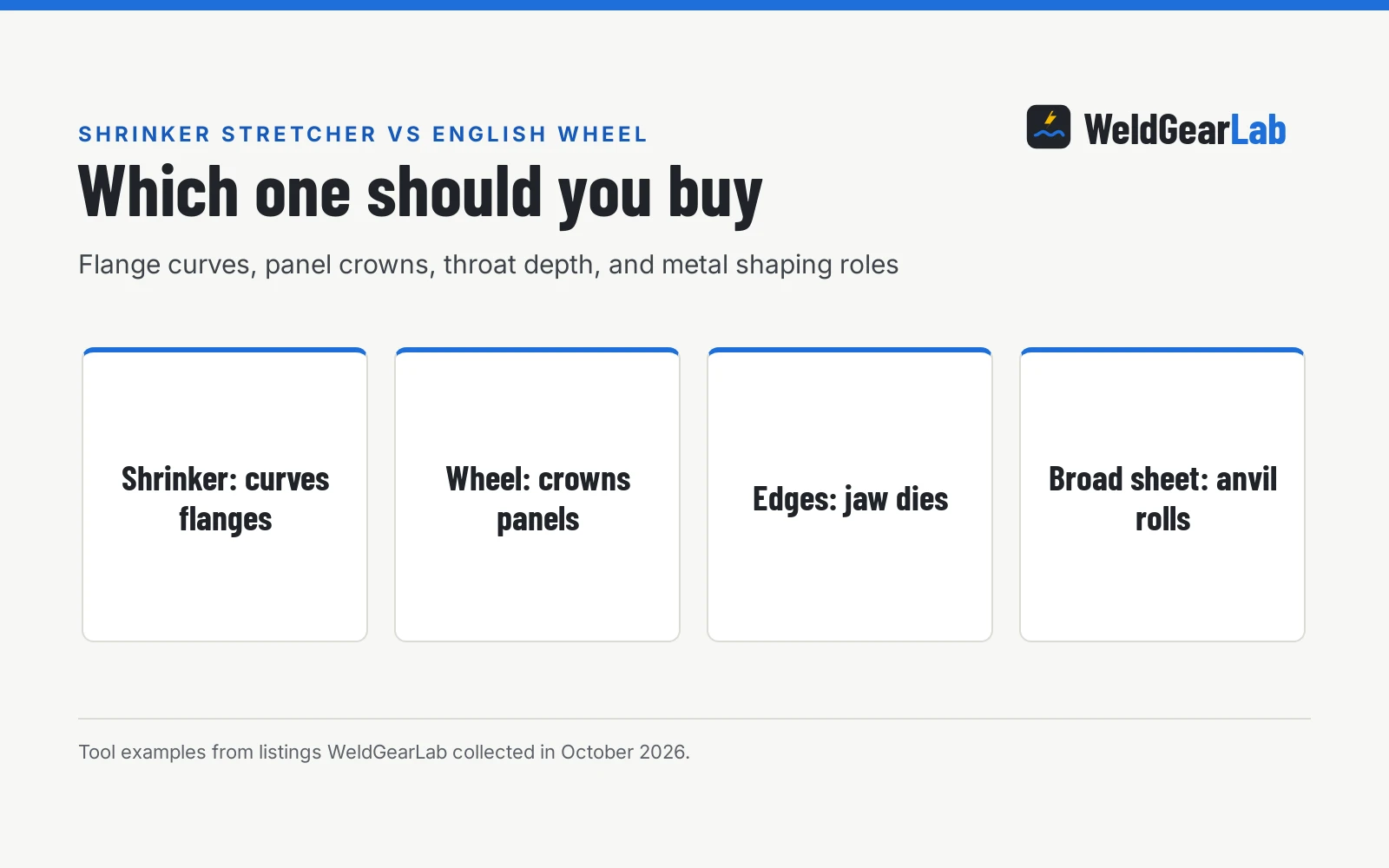
When shaping a curved patch panel or laying out sheet on the bench, choosing between a shrinker stretcher vs english wheel comes down to whether you are curving an edge flange or crowning a broad surface. A shrinker stretcher uses mechanical jaws to compress or expand narrow metal lips, forcing a pre-bent flange to curve along perimeters like wheel arches and window channels. An English wheel uses rolling contact between an upper wheel and a crowned lower anvil to stretch and smooth metal across wide panels. For curved mounting flanges, buy a shrinker stretcher; for rolling crowns into broad skins, buy an English wheel.
This guide links to our product roundups, where WeldGearLab gets a commission on purchases made through links on this page, and your price stays the same. Read our affiliate disclosure.
The difference in one paragraph
Compound curvature in sheet metal requires metal to move: the sheet must either shrink in compression or stretch in expansion. A shrinker stretcher works on flanges and borders by gripping a narrow strip between hardened jaws and wedging that metal tighter together to shorten the edge, or further apart to lengthen it. That localized edge movement forces a pre-bent flange into a curved contour. An English wheel shapes the interior of a panel. Passing sheet under pressure between an upper wheel and a crowned lower anvil stretches the metal outward, raising a smooth compound dome across the panel.
Shrinker Stretcher vs English Wheel: Side by Side
| Shrinker | Stretcher | English Wheel | |
|---|---|---|---|
| Primary action | Compresses metal along edges | Expands metal along edges | Stretches and smooths broad sheet |
| Curve produced | Inside curves and concave lips | Outside curves and convex lips | Compound curves and surface crowns |
| Working zone | Edge flanges and narrow borders | Edge flanges and narrow borders | Broad panel centers and crowns |
| Tooling mechanism | Jaws that grip and squeeze inward | Jaws that grip and wedge outward | Upper rolling wheel and lower anvil |
| Common automotive jobs | Concave flange curves, wheel openings | Convex flange curves, reverse flares | Door skins, hoods, roof panels |
| Surface finish | Textured grip marks on flange | Textured grip marks on flange | Smooth polished rolling burnish |
| Throat reach | Shallow reach along edge flanges | Shallow reach along edge flanges | Deep frame clearance for wide sheets |
| Mounting style | Bench vise mount or floor stand | Bench vise mount or floor stand | Rigid floor stand or heavy frame |
| Learning curve | Quick setup with immediate curve | Quick setup with immediate curve | Requires practiced pressure and tracking |
Choosing between these machines depends on where on the panel the metal needs to move. Flanges, wired edges, and perimeter returns require the mechanical grip of shrinking and stretching jaws. Smooth crowns, double curves, and large panel surfaces require the rolling pressure of an English wheel.
When a shrinker stretcher is the better choice
- Forming curved flanges. When curving an angled flange, the standing lip must shrink on an inside radius to prevent puckering, or stretch on an outside radius to prevent tearing. Shrinker stretchers curve these profiles without heat or relief slits.
- Automotive rust repair. Wheel openings, trunk gutters, door jamb lips, and windshield channels require narrow curved channels that a shrinker stretcher forms right on the bench.
- Straightening distorted bends. Running a warped flange through jaws relieves uneven tension and trues up edge profiles.
- Compact shop footprint. Benchtop units bolt to a workbench corner or clamp into a fabrication vise, saving floor space.
For edge work on rust patches, our guide on how to use a shrinker stretcher covers setup and jaw technique. For trimming blanks before forming, see our guide to the best sheet metal nibbler.
When an English wheel is the better choice
- Crowning broad panels. Hoods, roof skins, door skins, and motorcycle fuel tanks require compound curvature across wide surfaces that edge jaws cannot reach.
- Smoothing hammer marks and welds. After roughing a shape on a shot bag or welding repair seams, an English wheel planishes the surface flat and restores an even crown.
- Reaching across wide sheet. The open C-frame lets broad panels pass completely through the throat for full center access.
- Polished surface finish. Polished rolling anvils burnish the sheet, stretching metal smoothly without leaving jaw teeth gouges.
For shops comparing panel equipment, our guide on the bead roller vs English wheel details how beads and crowns differ on custom builds.
Throat depth and frame rigidity
Throat depth defines how far from the edge a tool reaches. Shrinker stretchers feature compact throats suited for flanges. Compact bench units handle narrow borders; for example, Americangaslogs lists a bench combo set with a 1-inch throat depth (25.4 mm) for 18-gauge mild steel and 16-gauge aluminum. KASTFORCE lists a combo pack with a 2.5-inch throat capacity (63 mm) rated for 18-gauge mild steel (1.2 mm) and 16-gauge aluminum (1.5 mm). For deeper reach on wider flanges, KAKA INDUSTRIAL lists a foot-pedal shrinker stretcher with a 6-inch throat depth and an 84-pound net weight, handling mild steel up to 16-gauge (1.5 mm). For heavy bench mounting, Eastwood lists a deep-jaw model with a 7-inch throat depth for 16-gauge mild steel, alongside a bench combo set rated for 18-gauge mild steel, 16-gauge aluminum, and 20-gauge stainless steel.
An English wheel requires deep, sweeping C-frame clearance so broad panels can pass between the upper wheel and lower anvil. As throat depth increases, leverage against the frame multiplies during rolling passes. Frame rigidity is vital: frame deflection causes inconsistent anvil pressure, leading to tracking errors and uneven crown. Manufacturers build wheeling frames from heavy structural tubing or cast iron to resist spreading under load. Always check the throat depth stated on the equipment tag.
Tooling marks and surface finishing
The surface texture left on the metal reflects how each tool operates. Shrinker stretcher jaws grip metal under leverage. Standard jaws feature serrated teeth that bite into the surface to prevent slipping during movement. This leaves stippled grip marks along the flange. On automotive repairs, these marks sit on hidden mounting lips inside door jambs or trunk channels, where seam sealer covers them. When working exposed panels or softer aluminum, fabricators wrap jaws with tape or use smooth oval-shaped jaws, such as the oval jaw design that KAKA INDUSTRIAL lists to reduce contact marks on formed parts.
An English wheel leaves a smooth surface. The upper wheel has a flat profile of hardened, polished steel, while lower anvil rolls feature convex crowns. As metal rolls between them under screw pressure, the polished contact burnishes the sheet rather than biting it. Rolling tracks smooth out lumps and hammer marks, producing an even finish ready for primer with minimal filing.
Do you need both tools in your shop?
Metal shapers rarely treat these tools as rivals. In an active shop, they work as partners. For instance, when building a replacement rear wheel arch patch, both tools are needed. To begin, you rough out the crown of the outer panel and roll it smooth on the English wheel. Next, after pre-bending the mounting flange, you use the shrinker stretcher to curve the flange to match the wheel opening contour. Without a shrinker stretcher, forcing a pre-bent flange around a tight curve buckles the standing edge. Without the English wheel, the main panel remains flat rather than matching the body crown.
If your budget permits purchasing a single tool right now, let your projects guide the choice. If you primarily repair rusted body panels, patch floors, or restore wheel arches, start with a shrinker stretcher for edge flange work. If your focus is building motorcycle gas tanks or rolling custom compound panels, choose an English wheel for smooth crowns.
Sheet metal shaping safety. Metal shaping produces sharp sheared edges and powerful pinch hazards. Keep fingers clear of closing jaws on shrinker stretchers and the contact point on an English wheel. Mount bench tools firmly to prevent tipping under heavy leverage. Wear sturdy leather work gloves when handling sheet metal and eye protection to guard against flying scale. For more guidance, consult our metal fab tools hub.
FAQ for welders
Can an English wheel shrink metal?
Under standard steel wheels, an English wheel stretches and thins metal rather than shrinking it. Rolling pressure between the wheels thins the sheet, forcing the metal to expand outward. To shrink excess metal, fabricators rely on a shrinker stretcher along edges or use a tucking fork before wheeling.
Can a shrinker stretcher shape the center of a wide panel?
Shrinker stretchers are designed for edge flanges, limited by their throat depth. Even deep-throat models cannot reach across the center of a wide panel. To add shape across the middle of a panel, fabricators use an English wheel, a shot bag, or a bead roller.
Do shrinker stretcher jaws damage sheet metal?
Standard serrated jaws leave textured grip marks on the surface as they bite. These marks are normal on hidden flanges where primer and seam sealer conceal them. For exposed panels or soft aluminum, fabricators apply masking tape over the teeth or install smooth jaws.
Which tool should a metal shaping beginner buy first?
Most beginners in automotive repair get more immediate utility from a shrinker stretcher. It takes up little shop space and quickly solves the challenge of curving mounting lips and rust patches. An English wheel requires more floor space and a steeper learning curve to master rolling pressure.
Can you use an English wheel on aluminum?
Yes, an English wheel works well on aluminum panels. Because aluminum is ductile, it stretches and crowns rapidly under rolling contact. Keep anvil wheels clean and free of steel grit to avoid embedding debris into the softer aluminum.
Related: how to use a shrinker stretcher, bead roller vs English wheel, slip roll vs sheet metal brake, and the metal fab tools hub.