Rotary Positioner vs Welding Turntable: Which One Should You Buy?
A rotary positioner tilts and spins work for roll welding at any angle, while a welding turntable rotates on a flat plane for horizontal seams and shop assembly.

On this page
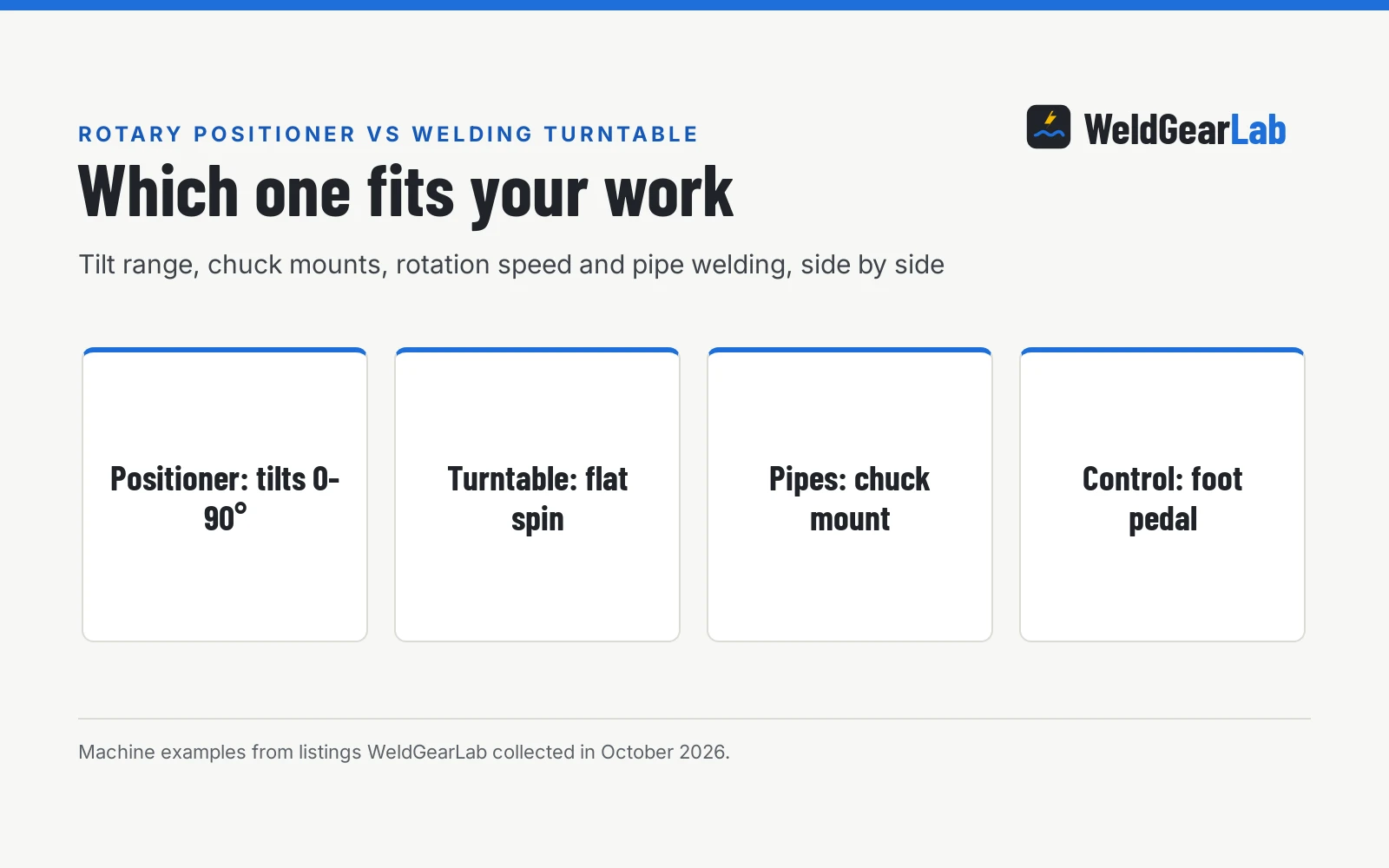
When you are rolling round pipe, flanges, or tubing on the bench, laying down a consistent bead means keeping your puddle flat without stopping to reposition your torch mid-pass. That bench dilemma comes down to rotary positioner vs welding turntable: a rotary positioner tilts its table from horizontal to vertical (0-90°) so you can roll joints in the flat downhand position, while a welding turntable spins work on a fixed horizontal plane. If you fabricate round pipe joints, flanges, or need angled torch access, a tilting rotary positioner fits your bench. If you only rotate flat circular plates, tanks, or round parts horizontally for spatter cleanup or welding, a flat turntable does the job.
As an Amazon Associate I earn from qualifying purchases. This guide links to our product roundups, where WeldGearLab gets a commission on purchases made through links on this page, and your price stays the same. Read our affiliate disclosure.
The difference in one paragraph
A rotary positioner pairs a motorized spindle with an adjustable tilting head, allowing you to lock your weldment anywhere from flat horizontal to vertical. That tilt lets you keep your torch pointed down into the joint while the motorized chuck feeds the seam smoothly under the arc. A welding turntable offers motorized rotation strictly across a flat horizontal plane without a built-in tilt axis. You mount your workpiece flat on its faceplate to spin it under your torch. In short, a rotary positioner tilts the workpiece so you can weld round and angled seams downhand in the flat position; a welding turntable rotates work strictly on a flat horizontal plane.
Side by side
| Rotary positioner | Welding turntable | Shop application | |
|---|---|---|---|
| Worktable tilt | Tilts 0-90° (select models -45° to 90°) | Fixed horizontal flat rotation (0° tilt) | Joint angle control |
| Primary fab work | Pipe rolling, flanges, and round tube welds | Flat circular plates, discs, and assembly | Workpiece geometry |
| Workpiece holding | Three-jaw chuck or slotted faceplate | Slotted faceplate or magnetic clamps | Clamping style |
| Speed regulation | Low-speed stepless control (such as 1-12 RPM) | Variable speed control knob | Puddle matching |
| Hands-free operation | Foot pedal switch on most models | Foot pedal or tabletop switch | Full torch control |
| Torch positioning | Adjustable torch stand holder on select models | Manual torch hold or standalone stand | Mechanized passes |
| TIG shielding | Anti-electromagnetic design on select models | Standard electrical grounding | Circuit isolation |
| Ground connection | Spindle ground contact or copper brush | Rotary ground clamp or base terminal | Bearing protection |
Rotation speeds and tilt limits depend on the motor rating and gearbox design. Always check your machine manual for maximum weight limits, especially when tilting heavy work away from the center spindle where leverage increases load on the worm gear.
When a welding turntable is the better choice
- Flat circular seams and tank ends. Spinning circular plates, flanges, pipe caps, and round bases where the joint stays naturally flat on the bench.
- Simpler bench setup. Work rests directly over the center thrust bearing, eliminating off-center cantilever forces and tilt locking concerns.
- Mechanical simplicity. Fewer pivot joints and clamping bolts mean a rigid platform that requires minimal maintenance during routine shop fabrication.
- Grinding, cutting, and prep work. Spinning round weldments smoothly while running an angle grinder or wire wheel for uniform cleanup without moving around the bench.
If your fabrication work stays flat on the bench, pairing a simple turntable with a sturdy table from our best welding table for home shop guide provides a stable workstation for circular seams.
When a rotary positioner is the better choice
- Pipe and roll cage welding. Rolling round pipe and tubing so you can deposit a continuous root pass or cap without stopping to change body position.
- Angled fillet welds. Tilting the table allows you to place a flange fillet into a natural flat V-trough, preventing molten puddle sag.
- Precision low-speed TIG work. Low-speed rotation paired with a responsive foot pedal lets you feed wire with steady rhythm and clean shielding coverage.
- Chuck-mounted tubular parts. Self-centering three-jaw chucks clamp round stock firmly on center without needing custom fabrication clamps or tack-welded tabs.
When rolling pipe joints on a positioner, having an agile torch setup matters; our guide to the best TIG torch for pipe welding details torch bodies suited for tight clearance around positioner chucks.
Rotary positioner vs welding turntable: key shop differences
The primary mechanical distinction between these shop machines is the tilt mechanism. A welding turntable mounts its faceplate flat on top of the drive assembly. A rotary positioner mounts the drive head on a trunnion or pivot bracket governed by a worm gear. That worm gear turning structure allows angle adjustment from horizontal to vertical, locking securely with a hand wheel or butterfly bolt.
Tilt angle directly impacts workpiece capacity because of cantilever leverage. When a positioner sits flat, weight presses straight down into the main shaft bearings. When tilted to vertical, the workpiece hangs sideways, putting bending strain on the spindle and gearbox. Because of this leverage, several makers publish separate load ratings for horizontal and vertical table positions. VEVOR lists its HD-10 positioner with a 20W motor for a load capacity of 22 lbs horizontal and 11 lbs vertical, tilting 0-90° with a butterfly bolt. Its larger HD-30 model features an 80W motor rated for 66.1 lbs horizontal and 33.1 lbs vertical, using a hand wheel for 0-90° tilt. For heavier fab work, the VEVOR HD-50 uses a 120W motor rated for 110 lbs horizontal and 55 lbs vertical. On heavy industrial units like the VEVOR CNC-100, a 140 watts motor drives a table tilting from -45° to 90°, rated for 441 lbs horizontal and 220 lbs vertical.
Smaller bench models often follow this split rating. LIANDU-US lists a cast iron positioner with a 10W or 15W DC motor supporting 22 lbs horizontal and 11 lbs vertical across 0-90° tilt. KIOMGLE lists a 10W positioner supporting 22 pounds at 0° and 11 pounds at 90° with 0-90° tilt. Other listings, such as TECHTONGDA’s 50KG model, state a single overall load rating without distinguishing table angles. If you only weld parts sitting flat, a turntable avoids cantilever capacity loss because the load never hangs off-axis.
Motor speed, foot pedals, and chuck mounting
Welding rotation demands low rotational speeds that match manual filler metal deposition and puddle freezing rates. Unlike metal lathes that turn at hundreds of revolutions, welding positioners run at low speeds. VEVOR positioners operate at 1-12 RPM on the HD-10 and HD-30, 0.5-6 RPM on the HD-50, and 0.5-5 RPM on the CNC-100. LEHUNDI lists a positioner with 2-20 r/min speed, PreAsion provides 2-10 r/min, and KIOMGLE provides a maximum speed of 10 rpm. Stepless speed control knobs let you dial in the exact surface speed to match your travel speed.
Hands-free control is essential when running a bead. Most positioner packages include a foot pedal switch that starts and stops rotation on demand. This allows you to hold your torch with a steady hand while feeding filler rod with the other, maintaining uninterrupted arc focus without reaching for a bench switch. Some models also include a torch stand holder, like those listed on VEVOR HD-30, HD-50, and TECHTONGDA units, which locks the welding gun in place for mechanized rotation.
Work holding also separates these tools. Basic turntables feature slotted faceplates where you clamp flat plates or bolt down custom jigs. Many rotary positioners come equipped with a three-jaw chuck that mounts directly to the spindle, while standalone tables use an open faceplate. VEVOR equips the HD-10 with a 205mm K01-63 three-jaw chuck offering a clamping range of 2-58mm and a supporting range of 22-50mm. Its HD-30 and HD-50 include a 315mm KD200 three-jaw chuck with a clamping range of 10-210mm and a supporting range of 80-190mm. TECHTONGDA includes a 200 mm chuck with a 180 mm table diameter, PreAsion features an 80mm chuck, and KIOMGLE provides a three-jaw chuck with a clamping range of 0.0787–2.28 inches. These self-centering chucks grip round pipe and tubing quickly on center.
Grounding and high-frequency TIG interference
A critical consideration when rotating any weldment is how welding current returns to the power supply. Clamping a standard ground clamp directly to a spinning workpiece causes tangled cables. Letting high amperage travel through internal drive bearings creates electrical arcing that pits bearing races and destroys the motor. Quality positioners incorporate dedicated rotary grounding assemblies, such as heavy copper brushes riding on the center shaft. VEVOR rates the chuck on its CNC-100 for 300A welding current, while TECHTONGDA supports MIG, MAG, and TIG welding processes.
High-frequency arc starting on TIG welders poses another shop challenge. High-frequency ignition pulses emit electromagnetic radiation that can feed back into sensitive speed controllers, causing erratic motor surging or component failure. Certain models feature dedicated electromagnetic shielding to protect control circuits. Specifically, TECHTONGDA, LIANDU-US, and KIOMGLE highlight anti-electromagnetic interference designs engineered to minimize high-frequency interference during TIG operations. If you plan to run TIG, pairing an interference-shielded positioner with proper setup guidelines from our TIG welder settings chart ensures clean arc starts without motor glitching.
Rotating pinch points and electrical safety. Motorized turntables and positioners create mechanical pinch points between rotating chuck jaws, workpieces, and the machine frame. Keep loose sleeves, gloves, and torch leads clear of the spinning chuck. Secure heavy assemblies so they cannot tip off balance when tilted. Ensure your ground lead connects directly to the machine grounding lug rather than clamping to the chassis bearings. For personal safety in the shop, wear proper eye and skin protection against arc radiation; see our welding safety gear checklist for beginners and our respirator requirements for welding.
FAQ for welders
Can I use a welding turntable to weld pipe?
You can use a turntable to weld pipe if the pipe stands vertically and you only need a flat roll weld around the base or flange. However, welding horizontal pipe spools requires a tilting rotary positioner so the pipe rotates along its horizontal centerline. Without tilt adjustment, a standard turntable cannot roll horizontal pipe passes downhand.
Why does positioner load capacity decrease when tilted?
When a worktable sits flat at horizontal orientation, the workpiece weight presses straight down into the main thrust bearing. Tilting the table to vertical orientation shifts the load perpendicular to the spindle, creating cantilever leverage against the worm drive and pivot bolts. On models that publish separate angle ratings, horizontal capacity is stated higher than vertical capacity to account for that cantilever leverage.
What rotation speed do I need for welding pipe?
Welding rotation requires low speeds to match manual filler metal deposition and puddle freezing rates. Many shop positioners operate in low ranges such as 1-12 RPM, with heavier units turning at 0.5-6 RPM or 0.5-5 RPM for large diameters. While some units offer speeds up to 2-20 r/min for quick repositioning or grinding, high rotation speeds spin the joint too fast for manual puddle control.
Does high frequency TIG welding damage a positioner motor?
High frequency arc ignition can send electrical noise into unshielded DC motor controller circuits, causing erratic speed changes or burnt control boards. Machines built with anti-electromagnetic shielding isolate motor wiring to prevent high frequency interference. Always verify your ground connection connects directly to the dedicated spindle ground contact.
Can I mount a three-jaw chuck on a standard welding turntable?
Many flat turntables feature slotted faceplates where you can bolt down a standard three-jaw lathe chuck. However, you must verify the table diameter and bolt circle match your chuck backplate before mounting. Adding a heavy chuck also counts against the machine’s maximum load rating, so keep the combined weight of chuck and workpiece within stated limits.
Related: what is a pipe stand, best welding table for a home shop, best TIG torch for pipe welding, and the metal fab tools hub. Also see our guide on best welder for beginners.