Respirator Requirements for Welding: Standards, Fit, and Hood Guide (2026)
How OSHA rules, NIOSH particulate filters, and PAPR systems define respirator requirements for welding, and how to select proper protection for your shop.

On this page
Top picks at a glance
As an Amazon Associate I earn from qualifying purchases.
- 1
 Klein Tools 60552 Reusable P100 Half-Mask Respirator9.7/10View on Amazon
- 2
 Parcil Distribution Full Face Respirator Mask9.4/10View on Amazon
- 3
 Full Face Organic Vapor Respirator9.4/10View on Amazon
When you strike an arc on galvanized tube, stainless sheet, or oily plate at the fab bench, respirator requirements for welding demand clean breathing air before you lay down a bead. Federal safety rules call for ventilation and local extraction first, backed by NIOSH approved respiratory protection whenever fumes exceed permissible exposure limits. In farm and home shops, meeting respirator requirements for welding comes down to matching the metal and process with either a tight-fitting half-mask under your hood or a positive-pressure blower system. This guide breaks down the standards, filter ratings, and hood setups that apply to welding work.
This guide links to our product roundups, where WeldGearLab gets a commission on purchases made through links on this page, and your price stays the same. Read our affiliate disclosure.
The difference in one paragraph
Welding fumes consist of microscopic solid metal oxide particles that vaporize from the arc puddle and condense in the air, while the arc’s intense heat and ultraviolet radiation generate gases like ozone and nitrogen oxides. A negative-pressure half-mask respirator seals against your face, relying on your lungs to draw ambient air through replaceable particulate filter cartridges. A powered air purifying respirator, or PAPR, uses a belt-mounted blower assembly to pull air through high-efficiency filters and push a continuous stream of clean air into an enclosed welding helmet. Half-masks offer a compact profile that fits beneath traditional shells, while PAPR systems provide positive pressure that prevents fume leakage and eliminates breathing resistance during long shop shifts.
Side by side
| Disposable mask | Half-mask respirator | PAPR welding helmet | |
|---|---|---|---|
| Air supply method | Negative pressure drawn by lungs | Negative pressure drawn by lungs | Positive pressure blower unit |
| Fit under welding helmet | Fits easily under most hoods | Low-profile mask under standard hood | Integrated into dedicated welding hood |
| Facial hair compatibility | Requires clean-shaven face seal | Requires clean-shaven face seal | Loose-fitting headtop accommodates short beards |
| Breathing resistance | Moderate inhalation resistance | Inhalation resistance through cartridges | Constant fresh airflow across breathing zone |
| Fume and particulate capture | NIOSH particulate filter media | NIOSH particulate or combination cartridges | High-efficiency blower particulate filter |
| Reusability and lifespan | Single-use disposable shell | Durable elastomeric body, replaceable filters | Long-term durable system, replaceable filters |
| Heat and fog reduction | Warm air trapped on face | Exhalation valve reduces moisture | Continuous airflow cools face and clears fog |
| Power source | None required, purely passive | None required, purely passive | Rechargeable lithium-ion battery |
| Typical shop application | Brief grinding and light maintenance | Intermittent welding and fab bench work | Extended welding shifts and heavy production fumes |
Air delivery and hood integration represent the primary mechanical divide across welding respiratory options. Disposable particulate masks and reusable half-masks both rely on negative pressure drawn by lung power, requiring an airtight perimeter seal directly against bare skin. Any facial hair along the sealing flange breaks that barrier, allowing unfiltered air to bypass the filter media. Powered air purifying respirator systems supply positive pressure inside the headtop, continuously flushing fresh air outward so minor gaps do not admit contaminants. All three options must carry official NIOSH approval to satisfy shop safety regulations.
When a half-mask respirator is the better choice
- Intermittent welding and tacking. For quick repairs, hobby projects, or short fabrication runs, a half-mask straps on quickly without the need to manage battery packs, waist belts, or breathing hoses.
- Tight quarters and out-of-position work. Crawling under a truck chassis, squeezing inside equipment frames, or working in cramped corners is simpler without a bulky blower housing mounted on your back.
- Low equipment weight. Standalone negative-pressure facepieces add minimal mass compared to motorized blower assemblies.
- Lower initial cost. Half-mask elastomeric bodies and replaceable cartridges require far less cash upfront than motorized blowers, making them accessible for home garages and farm workbenches.
If you prefer using your current hood, check our best welding respirator for under a helmet guide for low-profile picks designed to clear standard headgear. For a full protective gear rundown across the shop, consult our welding safety gear checklist for beginners.
When a PAPR system is the better choice
- All-day production and long arc time. Drawing air through particulate filters with lung power causes respiratory fatigue over an extended shift. A motorized blower feeds air effortlessly across your breathing zone.
- Heavy plume and toxic metal alloys. Welding stainless steel, galvanized pipe, or hardfacing rod generates hazardous hexavalent chromium and zinc oxide fumes. Positive-pressure airflow prevents inward leakage around the face seal while filtering fine particulate; for instance, YESWELDER states that its PAPR filter captures airborne particles as small as 0.3 microns and captures up to 99.97% of weld fume. ANDELI lists a 99.95% PAPR filtration efficiency on its auto-darkening hood assembly.
- Facial hair compatibility on loose-fitting hoods. Loose-fitting PAPR helmets that do not rely on an elastomeric facepiece seal allow welders with short facial hair or beards to maintain respiratory protection, because continuous positive airflow flushes contaminants outward. Tight-fitting respirators, by contrast, require a completely clean-shaven face to seal properly.
- Cooling and lens defogging. The constant breeze across your face lowers heat build-up under the shell and keeps the viewing lens clear of sweat and fog in hot weather.
- Extended battery runtime. The 3M Adflo high-altitude PAPR lists a turbo battery life of approximately 7 – 9 Hours, while KIPPDURO advertises a rechargeable battery that lasts up to 10 hours on a single charge with three reusable dust filter boxes and twenty premium cotton filter pads. Complete assemblies carry more weight, such as DanVard listing an item weight of 8 pounds, ANDELI listing 11.15 pounds with a 180° panoramic viewing area, and YESWELDER listing 10.53 pounds.
To see dedicated blower hoods and fume-specific filters compared, read our best respirator for welding fumes guide. When fabricating zinc-coated metal, follow our shop breakdown on how to weld galvanized steel safely.
Respirator requirements for welding by process
Meeting respirator requirements for welding starts with assessing the contaminants generated by your specific process and base metal. Stick welding with flux-coated electrodes and self-shielded flux core wire produce heavy smoke, slag vapors, and airborne particulate that quickly overload unventilated spaces. MIG welding on clean steel generates lower particulate volumes, but welding over mill scale, oil, or anti-spatter coatings releases irritating organic vapors that require charcoal relief layers alongside particulate filters.
TIG welding generates very little visible particulate smoke, but electrical arc radiation converts surrounding atmospheric oxygen into ozone and nitrogen oxides. When TIG welding stainless or aluminum in confined spaces, ozone generation and shielding gas displacement make proper airflow critical. Multi-process PAPR systems are built to handle these demands; for example, the 3M Speedglas G5-01 lists arc detection sensitivity down to 1 amp TIG alongside MIG and stick processes in its specification table, while meeting both NIOSH Approved and ANSI Z87.1-2015 specifications.
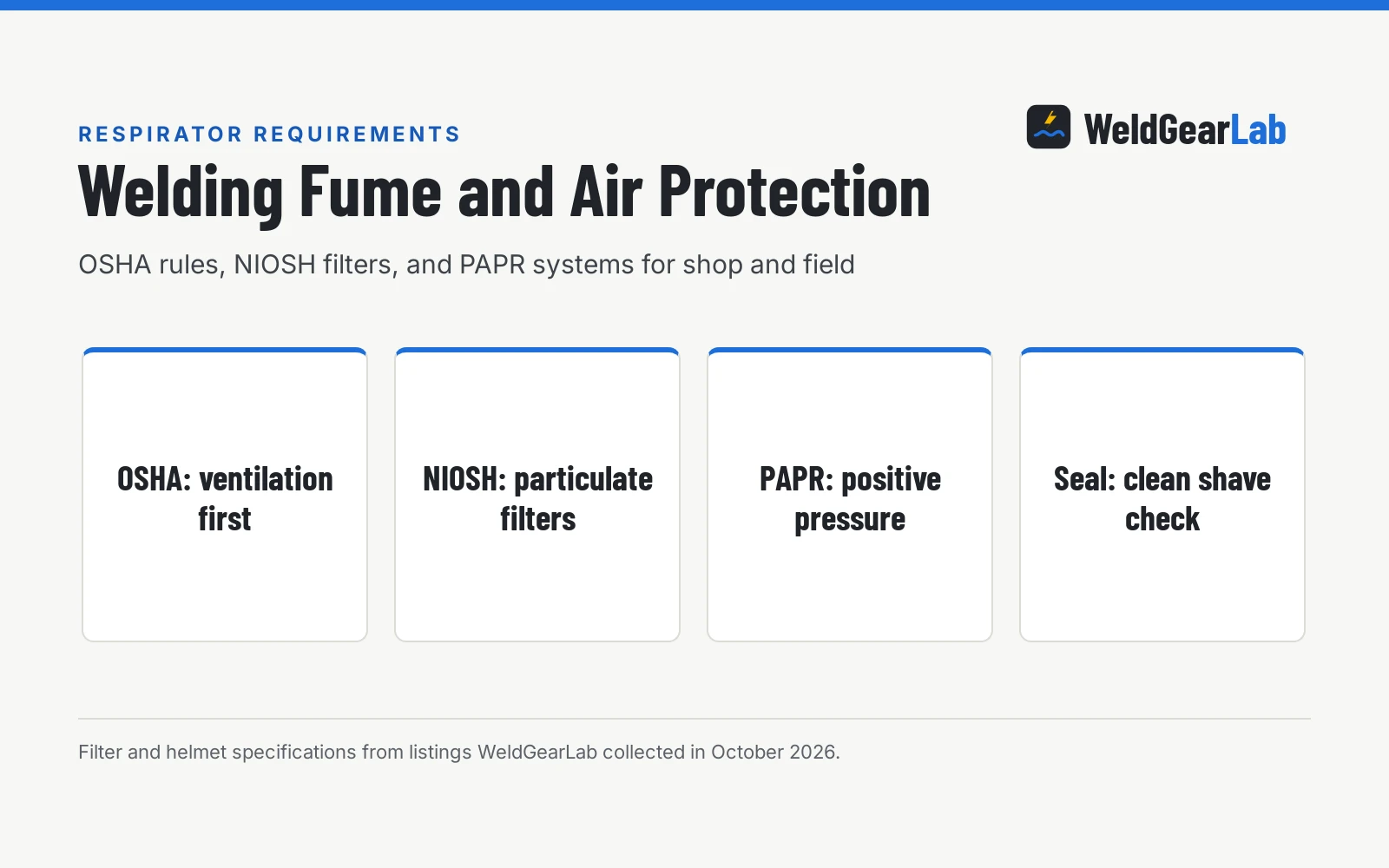
Under OSHA regulations, employers and shop operators must follow the hierarchy of controls: first apply engineering controls like general shop exhaust or source-capture fume extraction arms. If mechanical ventilation cannot pull fumes below legal permissible exposure limits, certified respiratory protection becomes mandatory. Where respirators are required, the employer must establish a written program covering medical clearance, proper equipment selection, routine maintenance, and regular face seal checks.
Which filter for welding fumes
Welding fumes consist of solid metal particles condensed from hot vapor, meaning particulate filtration is the foundational defense. Negative-pressure respirators rely on high-efficiency particulate cartridges to capture airborne metal oxides. Where maker specifications cite particular cartridge ratings, Parcil Distribution lists Particulate Filter P3 cartridges on its WF-101 mask, stating 99% particulate capture alongside organic vapor and acidic gas filtration. The WF-101 pairs this cartridge setup with a 4.5 x 5.25 inch auto-darkening lens offering 1/1/1/1 optical clarity and adjustable Shade 5-13.
When selecting filters, match the media to your shop atmosphere:
- Particulate-only filters. High-efficiency mechanical filters stop solid metal fume particles from iron, mild steel, and aluminum. They do not filter gases or chemical vapors.
- Particulate with nuisance odor relief. These incorporate a thin carbon layer that absorbs ozone from TIG arcs and mild organic vapor odors from heated cutting oils and primers.
- Combination chemical cartridges. Stacked particulate discs and chemical sorbent beds protect against acidic gases and solvent vapors during metal preparation, spray cleaning, and acid pickling.
Can one helmet setup do both?
Fabrication work demands frequent switching between striking an arc and grinding weld beads. Grinding wheels throw high-speed abrasive particles, metal grit, and wheel bonding agents into the air. A proper dual-purpose respiratory helmet integrates impact-rated eye protection and respiratory airflow so you never break your breathing seal during prep or cleanup.
Dedicated PAPR welding helmets solve this in two ways: physical flip-up visors or electronic grind modes. Premium hoods feature an auto-darkening front that flips up to reveal a clear, curved grinding shield certified to ANSI Z87.1-2015 impact standards, maintaining continuous positive airflow while you grind fit-ups. Other configurations, such as YESWELDER hoods, incorporate dedicated electronic grind modes alongside a Shade range 4/5-9/9-13 and a large viewing screen measuring 3.94 x 3.23 inches with 1/1/1/1 optical clarity. Either setup prevents shop dust from entering your breathing zone between weld passes. Explore our best auto darkening welding helmet guide or the wider welding helmets section to evaluate hood shells and grinding visors.
FAQ for welders
Do OSHA regulations require a respirator for all welding?
OSHA does not mandate respirators for every welding job, but it does mandate that airborne contaminant concentrations remain below permissible exposure limits. When welding mild steel in a well-ventilated shop with mechanical exhaust, air monitoring may show contaminants within safe thresholds. When welding toxic alloys like stainless steel or working in confined spaces without sufficient extraction, certified respiratory protection becomes mandatory.
Can I wear a respirator with a beard while welding?
Tight-fitting half-mask respirators cannot be worn safely with beards or stubble because facial hair interferes with the rubber seal against bare skin. Even a small amount of stubble creates microscopic channels that allow toxic metal fumes to bypass the filter media. Welders with facial hair must choose a loose-fitting PAPR helmet or hood that uses continuous positive airflow to keep contaminants out.
What is the difference between a half-mask and a PAPR system?
A half-mask is a passive negative-pressure device where the welder’s lungs pull air through filter cartridges mounted directly on the facepiece. A PAPR system uses an electric blower worn on a waist belt to pull ambient air through high-efficiency filters and pump it into an enclosed helmet under positive pressure. PAPR setups eliminate breathing resistance, prevent seal leakage, and provide cooling face ventilation.
How often do welding respirator filters need replacement?
Particulate filters should be replaced whenever breathing through a half-mask becomes noticeably harder or when a PAPR unit triggers a low-flow alarm due to media loading. If filters suffer physical damage, spark burn holes, or water soaking, discard them immediately. Combination cartridges with carbon layers must be swapped as soon as you smell chemical vapors or ozone inside the facepiece.
Will a standard welding helmet fit over a half-mask respirator?
Many traditional welding helmets have narrow chin profiles that press against standard industrial filter cartridges, preventing the hood from dropping down fully. To weld safely, select a low-profile half-mask engineered with backward-swept filter cartridges and a compact bridge designed specifically to tuck inside auto-darkening helmet shells.
Related: best respirator for welding fumes, best welding respirator for under a helmet, the welding safety gear checklist for beginners, and the welding helmets hub. Also see our guide on how to weld galvanized steel safely.