What Is a Pipe Stand?
A pipe stand supports, levels, and steadies pipe or round tubing for welding, cutting, threading, and fit-up in the shop or field.

On this page
When you need to fit up a long run of steel tubing or heavy pipe across the shop floor to bevel a joint, tack a flange, or weld a root pass, resting the overhang on scrap wood or an automotive jack stand is a recipe for uneven gaps and dropped metal. What is a pipe stand? A pipe stand is a heavy-duty, height-adjustable support tool designed to hold, level, and stabilize pipe and round stock while you cut, fit, bevel, or weld. To understand what a pipe stand is for, look at how pipe fabrication differs from flat plate work: round stock rolls, pivots, and concentrates heavy weight onto narrow contact points. A dedicated stand cradles the circumference of the workpiece, keeping your joint aligned with your welding table and steady under the torch.
As an Amazon Associate I earn from qualifying purchases. This guide links to our product roundups, where WeldGearLab gets a commission on purchases made through links on this page, and your price stays the same. Read our affiliate disclosure.
What is a pipe stand?
At its core, a pipe stand functions as a purpose-built mechanical jack for cylindrical materials. Unlike a flat workbench or standard sawhorse, a pipe stand features a specialized support head mounted on top of a vertical riser tube. This tube telescopes inside a sturdy base to match the exact working height of your saw, pipe threader, or layout table. Once set, the stand holds the workpiece level so that beveled joints stay true while you tack them into place.
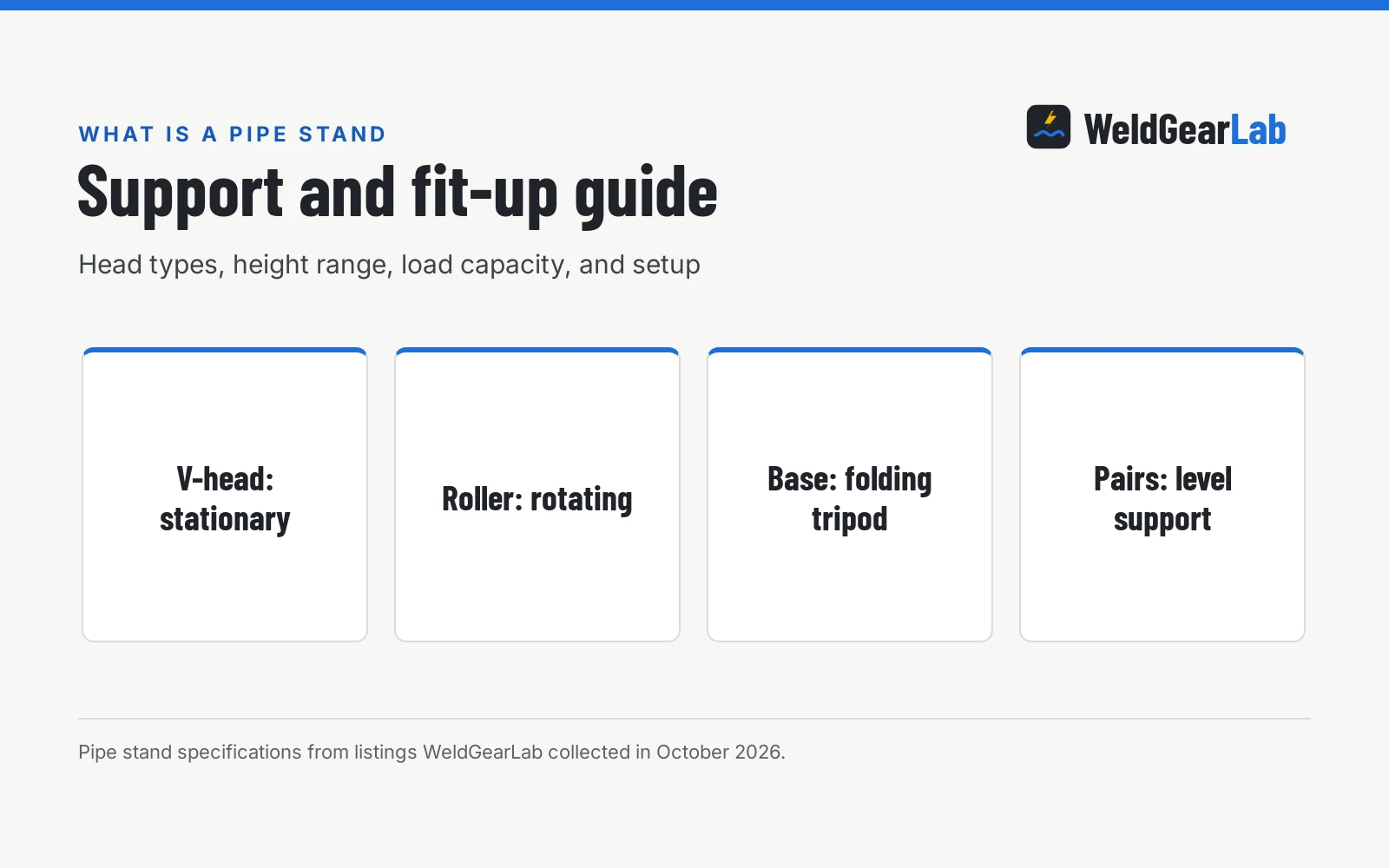
Many portable pipe stands designed for welding use a triangular folding tripod base. This tripod stance provides wide floor contact that resists rocking on uneven shop concrete or compacted field gravel. The head itself cradles the pipe securely. Whether you are running stick, MIG, or TIG, having rigid support prevents the pipe from sagging or kicking out when heat enters the joint. Using dedicated stands provides repeatable joint alignment, stable arc positioning, and improved shop safety.
Side by side: pipe stand head types
| Standard V-Head | Steel Roller Head | Ball Transfer Head | |
|---|---|---|---|
| Primary motion | Stationary (no movement) | Rotational travel around pipe axis | Omni-directional (rotation and linear travel) |
| Support contact | Angled steel cradle plates | Cylindrical steel rollers | Caged ball transfer bearings |
| Key shop use | Tack welding and fixed-position joints | Roll welding and circumferential cuts | Feeding saws, threading, and fit-up positioning |
| Pipe movement | Restrains pipe from rolling | Spins along pipe circumference | Rolls lengthwise and spins freely |
| Joint fit-up | Keeps beveled gaps aligned | Requires a stop to hold still | Requires a clamp to prevent drift |
| Maintenance | No moving parts to clean | Keep roller axles clear of grit | Keep ball cages free of spatter |
| Common pairing | Welding table or companion stand | Pipe rotator or positioner | Band saw, threader, or layout table |
Choosing between a standard V-head, a roller head, or a ball transfer head depends on whether your process requires the pipe to stay locked in place or spin while you work. Always verify that the head style matches your specific cutting or welding setup before loading heavy pipe.
When a V-head stand is the better choice
- Fixed-position pipe welding. When you are running stick or TIG passes around a stationary joint, a V-head prevents the pipe from rolling or shifting while you deposit weld metal.
- Joint fit-up and tacking. Aligning beveled pipe ends requires steady, slip-resistant contact so root gaps do not close up or shift out of square while tacking.
- Cutting and beveling. Holding pipe steady while using a portable band saw, angle grinder, or plasma torch ensures clean, square cuts without unexpected workpiece movement.
- Simple shop durability. With no moving bearings or wheels to collect grinding grit and spatter, solid steel V-plates hold up to heavy abuse with minimal maintenance.
When fitting up joints on a stationary V-head, pair your stand with a rigid layout surface like the options in our best welding table for a home shop guide to keep your spools level and square.
When a roller head stand is the better choice
- Roll welding. Turning the pipe allows you to weld in the flat position continuously under the torch rather than working overhead or vertically around the joint.
- Circumferential cutting and beveling. Rotating the pipe smoothly on rollers lets you make continuous, even bevel cuts with an oxy-fuel torch or plasma cutter around the whole circumference.
- Protecting pipe surfaces. Roller heads with ball transfer or stainless wheels help protect finished exterior coatings from gouging during material handling.
- Long spool rotation. Rotating long piping assemblies for layout marks or multi-pass cap welds takes far less physical effort when resting on rolling bearings.
If you run continuous roll welds on pipe joints, pairing your setup with the right torch makes a noticeable difference in puddle control; see our guide to the best TIG torch for pipe welding.
How height adjustment and locking mechanisms work
A pipe stand uses a dual-action adjustment system to balance rapid setup with precise leveling. Coarse height positioning comes from a quick-locking mechanism. On stands such as the CARVALAX CVPS052B, you lift a lock washer to slide the central adjusting tube up or down to approximate working height. Once released, the washer grips the riser tube under load to prevent mechanical slip.
Fine height adjustment comes from a threaded acme screw or lead screw fitted with a T-handle or spanner nut. Turning the handle allows you to match the height of a companion stand or level a long pipe spool against a machine bed. ALWALKEE lists wear-resistant #45 steel for its V-plate and locking washer, while VEVOR model 1108A highlights a #45 steel build to withstand shop wear.
To keep round stock firmly seated in the V-cradle during heavy grinding or beveling, clamp the pipe securely. Adding tools from our best heavy duty welding clamps guide prevents pipe from vibrating out of alignment.
Working capacities: pipe diameter and load limits
Before placing pipe on a stand, you must confirm that the stand matches the diameter and weight of your material. Across manufacturer listings, pipe diameter capacities vary by head design. Models from VEVOR and ALWALKEE state a working range for pipes from 1/8 inch to 12 inches. CARVALAX models CVPS052 and CVPS052B specify a pipe capacity from 1/2 inch to 12 inches. For larger industrial piping, the Sawyer model 455 lists support for pipes up to 24 inches in diameter.
Load capacity is equally critical for shop safety. Across the reference listings in data, stands from CARVALAX, Sawyer, ALWALKEE, and VEVOR all carry a rated load capacity of 2500 pounds (2500 lbs). While a 2500-pound rating accommodates thick-wall pipe and heavy fittings, actual jobsite capacity depends on condition, floor stability, and whether the load is centered. Never shock-load the stand head by dropping heavy steel onto it from a crane or forklift.
Height range determines whether a stand suits your work station. Standard tall models from CARVALAX, Sawyer, and VEVOR adjust from 28 to 52 inches (also listed as 71 to 132 cm). The VEVOR 1108A lists an adjustment span from 27.2 to 52 inches. If you work from lower benches, mid-height options like the VEVOR 1107B adjust from 24 to 42 inches. For low-clearance tasks near the shop floor, the ALWALKEE AL-VGJ01-E0-V0 adjusts from 20 to 37 inches.
Stand weight affects portability between job sites. Listed weights range from 18.5 pounds for the VEVOR 1108A to 27.6 pounds for the VEVOR 1107. CARVALAX lists its CVPS052B at 20 pounds, while ALWALKEE lists 19.3 pounds (and 23 lbs in its summary). Folding legs allow these stands to collapse compactly for transport in a truck bed.
Shop safety rules for pipe stands
Working with heavy, cylindrical steel presents unique shop hazards. A loose pipe can roll off a support, crush fingers, or crack tack welds under bending stress. Follow these core shop safety practices whenever using pipe stands:
- Support pipe with at least 2 pipe stands. For an independent freestanding run of pipe, the listing bullets for CARVALAX note that a leveled pipe should be supported by at least 2 pipe stands. Supporting both ends prevents seesawing, balances the weight, and keeps the run stable while you fit and weld.
- Set up on level, solid ground. Always position tripod legs on clean, flat concrete or solid ground so widened footpads grip firmly without sinking or sliding.
- Check locking engagement before loading. Verify that the lock washer or locking pin is fully engaged and the adjusting nut is snug before setting the full weight of the pipe onto the head.
- Center the workpiece in the V-cradle. Place the pipe directly in the center of the V-plates so the load presses straight down through the center column rather than exerting side leverage.
- Wear personal protective gear. Always wear steel-toe boots, heavy leather welding gloves, and safety glasses when handling pipe and operating stand mechanisms.
To build out a stable shop layout, explore our guide to the best welding table top material or browse our complete welding tables and carts hub for additional shop fixtures.
FAQ for welders
How many pipe stands are needed to support a pipe?
The CARVALAX listings state that a leveled pipe should be supported by at least 2 pipe stands. Supporting pipe at multiple points prevents tipping, balances the load across the tripod bases, and relieves mechanical stress on your tack welds during fit-up.
What pipe sizes can a standard welding pipe stand hold?
Standard V-head pipe stands from makers like VEVOR and ALWALKEE list capacity for pipes from 1/8 inch to 12 inches in diameter. CARVALAX lists a capacity of 1/2 inch to 12 inches on its stands, while heavy-duty models like the Sawyer 455 list support for pipe up to 24 inches.
How much weight can a pipe stand support?
Load capacity varies by manufacturer and duty rating. The reference models in our data from VEVOR, CARVALAX, Sawyer, and ALWALKEE all specify a rated load capacity of 2500 pounds (2500 lbs). Always check the rating plate on your stand and distribute heavy loads across multiple supports.
What is the typical height adjustment range for a pipe stand?
Standard tall pipe stands from CARVALAX, Sawyer, and VEVOR adjust from 28 to 52 inches in height. Compact models like the ALWALKEE adjust from 20 to 37 inches for lower work, while the VEVOR 1107B covers a mid-range of 24 to 42 inches.
What is a pipe stand for in welding?
A pipe stand is used to support, level, and stabilize round pipe or tubing during welding, beveling, cutting, and fit-up. It keeps cylindrical stock from rolling off work tables and holds long spans level with saws or welding benches.
Related: welding tables and carts, best welding table for a home shop, best welding table top material, best heavy duty welding clamps, and best TIG torch for pipe welding.