Best Welding Table Top Material (2026)
Carbon steel is the best welding table top material for most shops, offering solid electrical grounding, heat resistance, easy spatter cleanup, and simple mounting.

On this page
Top picks at a glance
As an Amazon Associate I earn from qualifying purchases.
- 1
 CAMMOO 1200LBS Welding Table9.7/10View on Amazon
- 2
 VEVOR Welding Table 36"x18"9.6/10View on Amazon
- 3
 Metal Welding Table Folding 1000 lbs Load Capacity Heavy Duty9.6/10View on Amazon
When setting up a fabrication workspace, choosing the best welding table top material determines how well your ground clamp works, how easily spatter comes off, and whether your work stays flat under heat. Carbon steel is the best welding table top material for most home, farm, and professional shops. It provides dependable electrical grounding, handles heavy heat from the welding arc, allows workpieces and stops to be tack welded directly to the surface, and cleans up with basic scrapers or grinding discs. Other metals like cast iron, aluminum, and stainless steel offer distinct benefits for specialized tasks, but none match the overall practicality and value of plain carbon steel for daily welding.
This guide links to our product roundups, where WeldGearLab gets a commission on purchases made through links on this page, and your price stays the same. Read our affiliate disclosure.
The best welding table top material in one paragraph
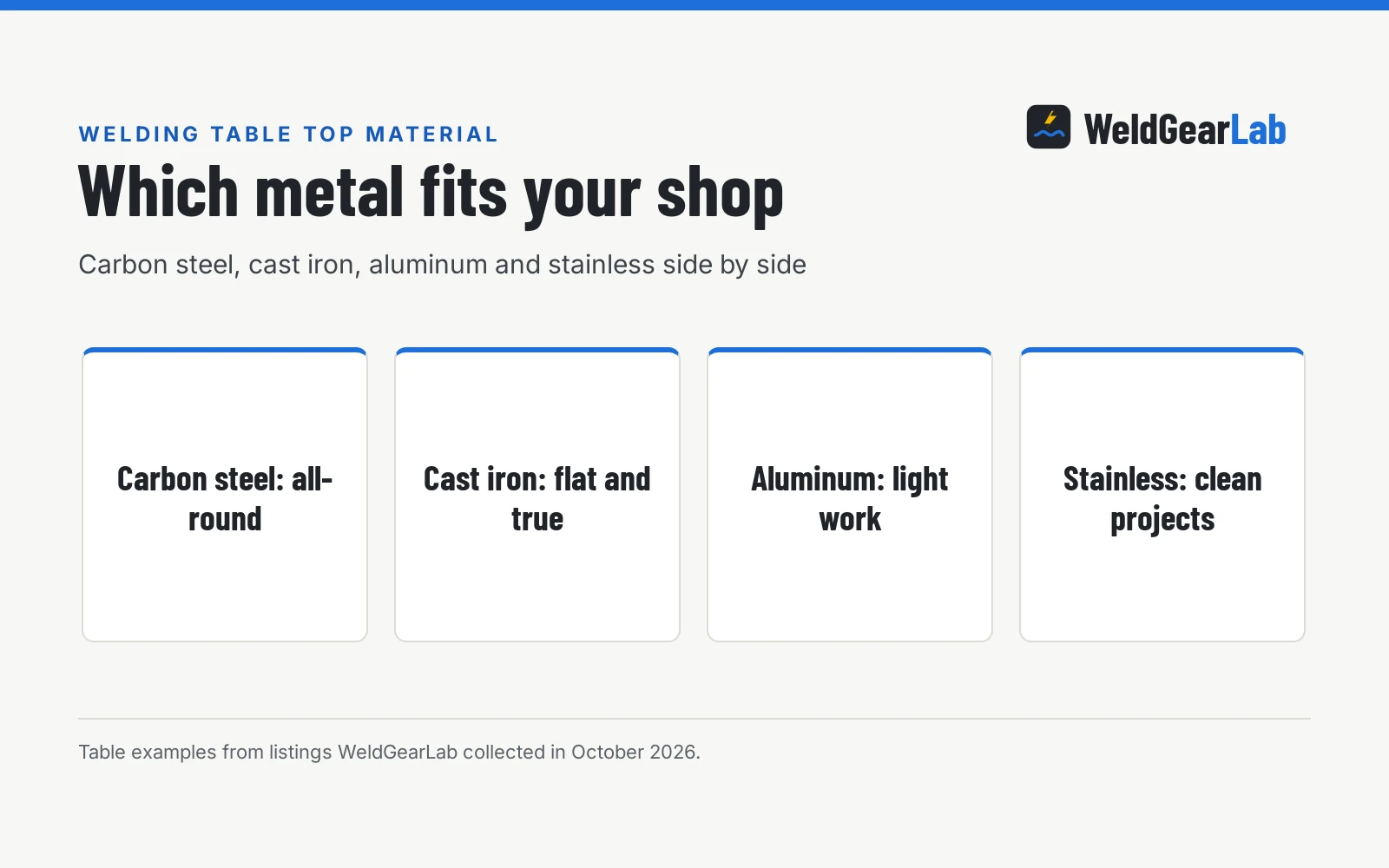
Carbon steel is widely chosen for welding tables because it shares similar metallurgy with the mild steel projects most fabricators build. A solid carbon steel top conducts electricity directly to your work clamp, provides a rigid plane that resists sagging under heavy weldments, and accepts magnetic squares and fixtures anywhere on the surface. When an irregular assembly requires a temporary stop, you can tack a steel block directly to the table and grind the spot smooth when finished. Spatter adheres to untreated carbon steel, but applying anti-spatter spray or light oil prevents beads from bonding, making carbon steel a versatile, repairable, and cost-effective surface for metal fabrication.
Side by side
| Carbon steel | Cast iron | Aluminum | Stainless steel | |
|---|---|---|---|---|
| Electrical grounding | Excellent direct clamp conduction | Good direct clamp conduction | High electrical conduction | Moderate conduction |
| Spatter resistance | Moderate, spatter adheres without spray | High, graphite matrix prevents adhesion | High against steel spatter, will not fuse | Low, spatter bonds tightly |
| Thermal warp resistance | High when using heavy plate | Superior dimensional stability | Low, expands fast and softens | Low, high expansion causes warping |
| Direct tack welding | Yes, tacks cut off and grind smooth | No, arc chilling causes cracking | No, will not weld to steel | Only for stainless steel work |
| Magnetic fixturing | Yes, holds magnetic fixtures firmly | Yes, holds magnetic fixtures firmly | No, non-magnetic surface | No, austenitic grades are non-magnetic |
| Rust and maintenance | Rusts if bare, needs oil or dry lube | Forms light patina, resists deep rust | Does not rust, forms oxide film | Corrosion resistant without coating |
| Best shop role | General fabrication and repair | Precision fixturing and production | Specialized non-magnetic assembly | Food grade and sanitary stainless |
Surface performance varies across alloys. While bare carbon steel requires protection from moisture, cast iron provides natural vibration damping and superior spatter release. Aluminum and stainless steel serve niche roles where non-magnetic properties or strict contamination control outweigh the risk of thermal distortion.
When carbon steel is the best choice
For general repair, automotive fabrication, structural frames, and hobby projects, carbon steel is the standard selection. Its primary benefits include:
- Direct electrical grounding. Attaching your ground clamp directly to the table frame or edge grounds any metal workpiece resting on the clean surface. This eliminates moving the clamp to every individual piece during assembly.
- Magnetic fixture support. Magnetic clamps, positioning squares, and ground blocks stick firmly to carbon steel. This speeds up squaring corners and holding tubing without awkward mechanical clamps.
- Tack welding capability. You can tack weld temporary jigs, stops, or pull tabs directly to a carbon steel tabletop to hold stubborn metal in place, cutting them off with a chisel or grinder afterward.
- Field repairability. If an errant arc gouges the table or a heavy hammer dent marks the surface, you can fill the gouge with a weld bead and grind it flat again.
Commercial specifications reflect this balance of strength and utility. For example, VEVOR lists carbon steel welding workbenches with 0.63-inch fixture holes spaced 2 inches apart, supporting load capacities of 500 pounds and 800 pounds. Similarly, IDEALHOUSE lists a heavy-duty steel welding workbench rated for 1200 pounds that incorporates 78 clamping holes sized at 5/8 inch alongside 4 tool slots for shop organization.
When other materials are the better choice
While carbon steel serves general fabrication, certain shop requirements call for alternative materials:
- Cast iron for extreme precision. High-end industrial platens and modular fixture tables often use ductile or gray cast iron. Cast iron maintains dimensional stability, dampens hammer blows, and resists warping when heated unevenly. Weld spatter does not stick easily to cast iron because the graphite flakes in the metal prevent strong weld adhesion. However, unlike mild steel, a cast iron table cannot be used for casual tack welding. Striking an arc or tacking a steel workpiece directly to a cast iron surface causes rapid chilling and localized cracking in the brittle iron matrix.
- Aluminum for specialized non-magnetic assembly. Aluminum is occasionally considered for specialized benches or non-magnetic assembly surfaces. While steel spatter will not weld to aluminum due to differing metallurgy and surface oxides, aluminum has a significantly lower melting point than steel. An accidental arc strike will melt or gouge the tabletop surface. Furthermore, aluminum cannot hold magnetic positioning squares or ground clamps, and it scratches easily under heavy steel weldments.
- Stainless steel for sanitary fabrication. When welding food-grade equipment, dairy piping, or pharmaceutical tanks, carbon steel table contact can cause iron contamination that leads to rust on stainless workpieces. In those clean environments, a stainless steel tabletop prevents cross-contamination. However, stainless steel has higher thermal expansion and lower thermal conductivity than carbon steel, making it prone to heat warping unless built from heavy plate. Weld spatter also adheres strongly to stainless steel surfaces unless anti-spatter barrier compounds are applied.
Portable steel designs can also remain manageable for transport. Reference listings for folding steel tables include models with a 40-pound frame that support loads up to 1100 pounds or 1102 pounds while offering adjustable working heights from 24 inches to 48 inches.
What makes a good welding table surface
Beyond raw metal selection, several design details separate an effective fabrication surface from a frustrating bench:
- Machined flatness. A table top that dips or twists will transfer that error into every frame or box you build. Heavy structural ribs or truss underpinnings beneath the plate keep the surface flat under clamping force.
- Standardized fixture holes. Pre-machined holes allow quick-acting hold-down clamps, stops, and squares to drop in anywhere. Common hole standards include 16mm holes and 5/8-inch holes spaced 2 inches apart. To support modular clamping on portable tables, Lincoln Electric lists a fixturing kit containing 8 stackable riser stops, 8 V-blocks, and 8 squaring pins.
- Clean surface finish without toxic coatings. A welding table needs bare metal or a light protective oil for electrical contact. While painted frames resist corrosion, paint on the work surface burns under arc heat and creates fumes. Some commercial folding tables feature galvanized or zinc-plated steel tops to resist rust during storage. While makers claim zinc coatings resist spatter, welding directly against zinc-coated steel releases zinc oxide fumes that can cause metal fume fever. When using a table with galvanized components, welders should grind coatings off immediate weld contact areas and maintain adequate shop ventilation.
How table top thickness affects heat and warping
Plate thickness plays a major role in how a welding tabletop handles heat. When you deposit weld beads, localized heat causes steel to expand against colder surrounding metal. Thin sheet metal buckles and warps because it lacks the cross-sectional mass to distribute the thermal load.
A thick carbon steel plate acts as a thermal heat sink, drawing heat rapidly out of the weld puddle and dispersing it across the table. In reference listings, a compact alloy steel bench specifies a 4mm thick table top rated for 600 pounds, which provides adequate support for small brackets and light tubing. However, dedicated fabrication shops prefer much thicker plate to ensure the surface stays flat when heavy clamping pressure is applied. Learn more about selecting plate depth in our guide on how thick should a welding table top be and read our techniques on how to keep a welding table from warping.
Do you need a dedicated fixture table?
Welders often debate between a solid, smooth plate table and a precision fixture table with pre-drilled holes. A solid carbon steel plate is cheaper to fabricate and provides a continuous surface where small parts cannot fall through. However, clamping workpieces in the center of a wide solid plate requires long-reach C-clamps or welded temporary tabs.
A modular tabletop with fixture holes allows clamps to drop in right next to the joint, providing rigid hold-down force across the entire workpiece. If you assemble complex chassis, furniture, or repetitive frames, modular clamping saves substantial layout time. For a detailed comparison between these table styles, review our breakdown of fixture table vs steel plate welding table, or browse our top picks in the best welding table for home shop and our roundup of the best welding table under 500.
FAQ for welders
What makes a good welding table?
A good welding table combines a flat, rigid metal surface with sturdy leg bracing and dependable electrical conductivity. The tabletop must maintain its dimensional flatness under heavy clamping loads and resist heat distortion from repeated arc welding. Convenient fixturing holes, tool storage slots, and leveler pads also help keep fabrication projects square and organized.
Do I need a welding table?
A dedicated welding table is essential for anyone building metal projects that require square corners and accurate alignment. Welding on a concrete garage floor or wooden workbench creates severe fire hazards and makes proper clamping difficult. A metal table provides a safe, fireproof surface while allowing direct grounding through the tabletop.
What size welding table should you choose?
Your table size should match the typical dimensions of your workpieces and the available space in your workshop. Compact benches in reference listings measuring 36 by 24 inches or 44 by 21 inches suit small garage repairs, hand railings, and small brackets. Larger shops working on structural gates or automotive frames benefit from expansive modular platens or multiple joined tables.
How does a welding table work?
A welding table acts as both a rigid mechanical alignment fixture and an electrical conductor for the welding arc. Attaching the welder work clamp to the steel table provides a direct electrical return path across the entire surface, completing the circuit whenever an electrode strikes an arc on a workpiece touching the metal. The flat plane holds components in position while clamps prevent parts from shifting during thermal expansion.
How do you use a welding table with fixture holes?
Fixture tables use patterned holes to secure workpieces using specialized drop-in clamps, squaring pins, and riser blocks. You place positioning stops into the holes to establish a true reference line, align your metal against the stops, and insert hold-down clamps to lock the assembly tight. This fixturing method speeds up repetitive assembly and keeps frames square without measuring every single joint.
Related: best welding table for home shop, best welding table under 500, how thick should a welding table top be, fixture table vs steel plate welding table, and the welding tables and carts hub.