Pulse Tig vs Standard Tig Welder: Which One Should You Buy?
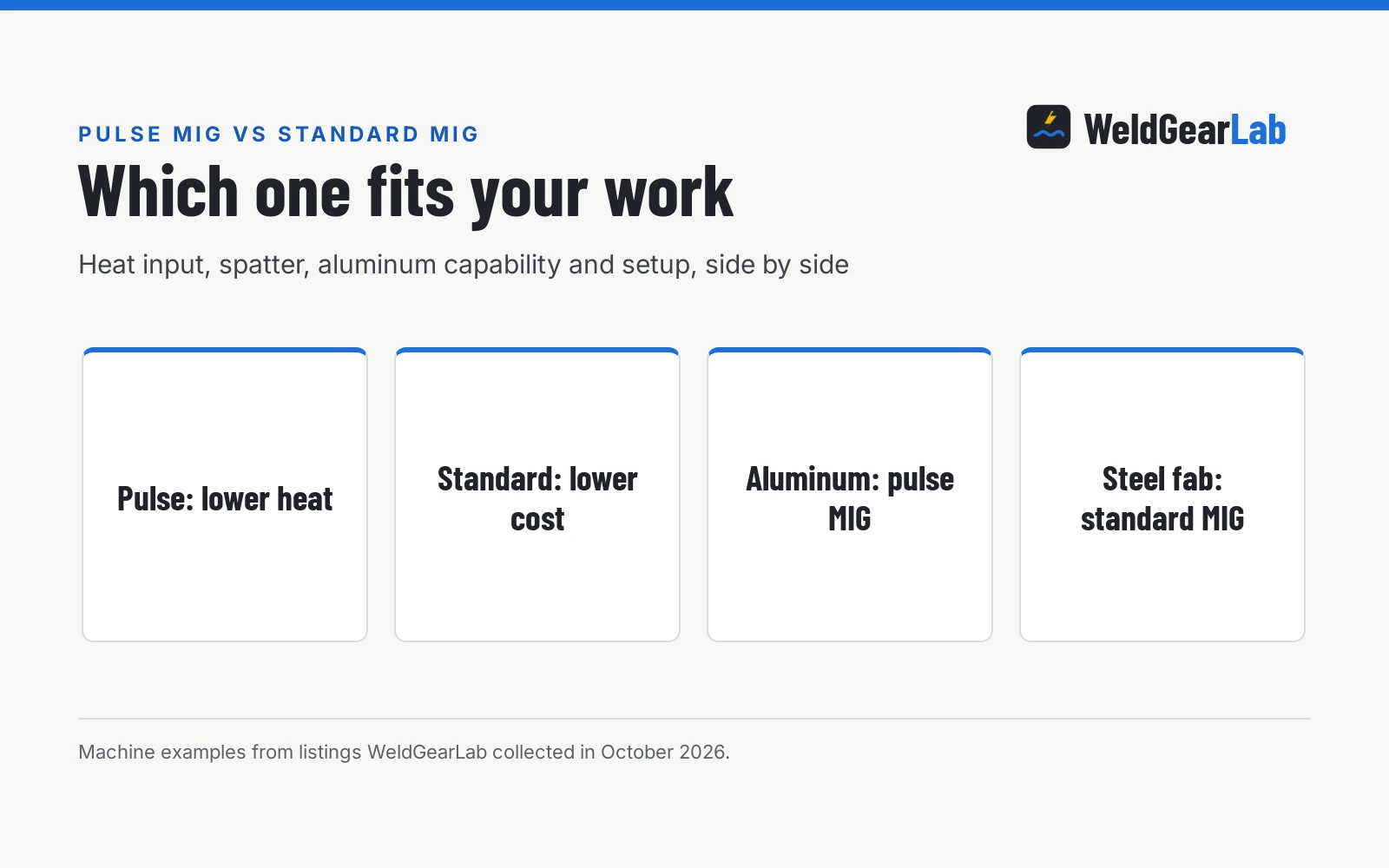
Pulse TIG and standard TIG differ in heat control, arc stability on thin metal, and operator setup for shop fabrication.


On this page
Top picks at a glance
As an Amazon Associate I earn from qualifying purchases.
- 1
 ARCCAPTAIN DC 5 In 1 TIG Welder With PulseView on Amazon
- 2
 Sunstac 200A TIG Welder with PulseView on Amazon
- 3
 Plasma Cutter TIG Welder With PULSE Stick Welder MachineView on Amazon
- 4
 Lincoln Electric Square Wave® 205 TIG Welder K5613-1View on Amazon
- 5
 AWT LED Display 180A Cold TIG Welder with DC PulseView on Amazon
- 6
 Weldpro Digital TIG ACDC 250GD AC DC 250 Amp Tig/Stick WelderView on Amazon
When you fit up thin sheet metal, stainless tubing, or cosmetic corner joints on the bench, managing heat decides whether you get a flat panel or a warped mess. Choosing between a pulse tig vs standard tig welder comes down to heat control: a pulse machine pulses the arc between high peak current and low background current to freeze the puddle quickly and limit distortion, while a standard machine delivers steady continuous amperage that takes finer pedal work to avoid burning through. For thin sheet, delicate edges, and stainless steel, pulse gives you cleaner control with less heat; for thick steel plate and simple bracket fab, standard TIG provides all the penetration you need at a lower equipment cost. This guide compares both setups for shop and garage fabrication, explains how pulse settings work, and shows what to look for on machine spec sheets.
Other welders and gear to compare
 ARCCAPTAIN DC 5 In 1 TIG Welder With PulseCheck price on Amazon
 Sunstac 200A TIG Welder with PulseCheck price on Amazon
 Plasma Cutter TIG Welder With PULSE Stick Welder MachineCheck price on Amazon
 Lincoln Electric Square Wave® 205 TIG Welder K5613-1Check price on Amazon
 AWT LED Display 180A Cold TIG Welder with DC PulseCheck price on Amazon
 Weldpro Digital TIG ACDC 250GD AC DC 250 Amp Tig/Stick WelderCheck price on Amazon
This guide links to our product roundups, where WeldGearLab gets a commission on purchases made through links on this page, and your price stays the same. Read our affiliate disclosure.
The difference in one paragraph
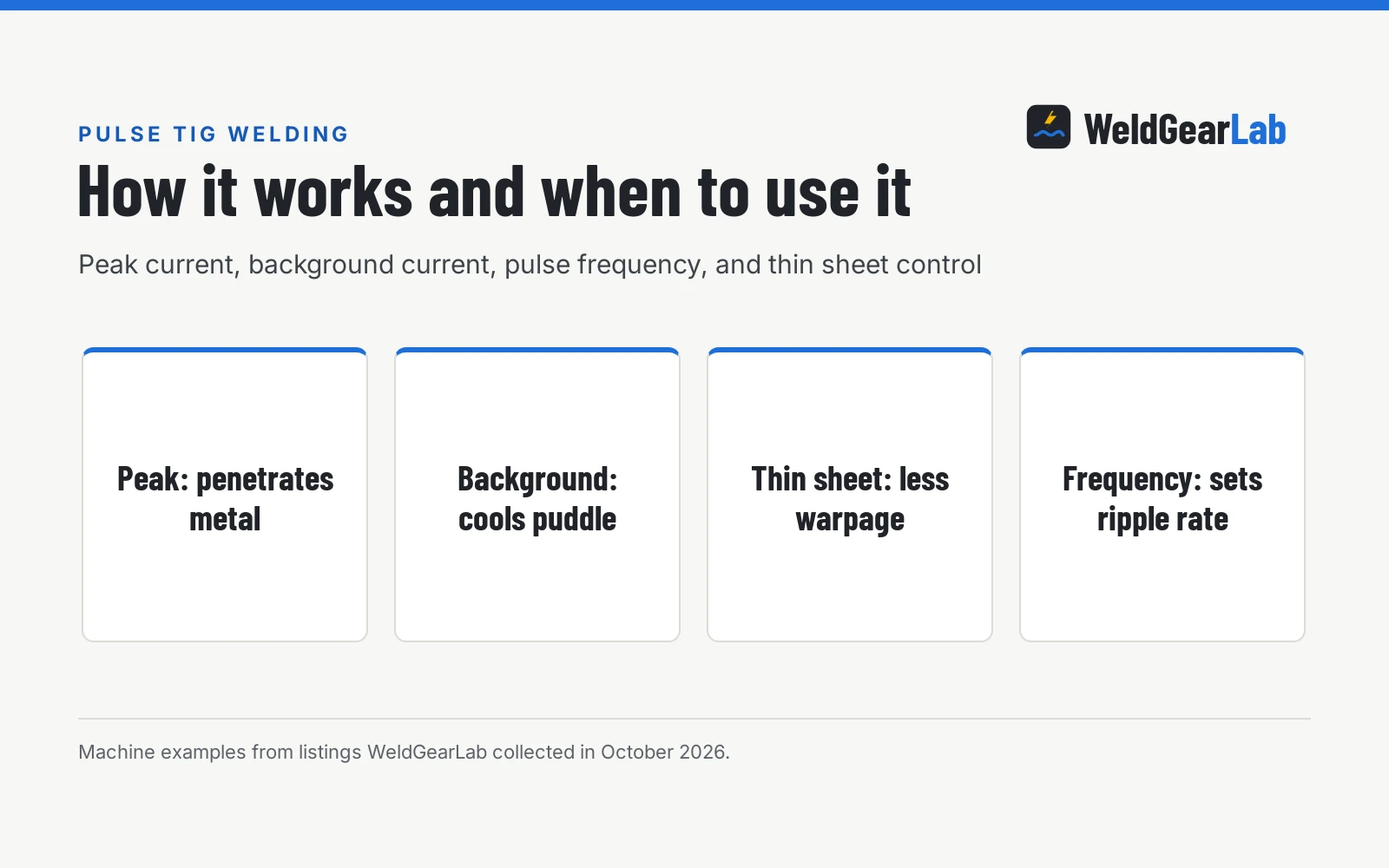
Standard TIG welding runs a continuous electric arc between a non-consumable tungsten electrode and the workpiece at a constant current level you set on the machine or vary with a foot pedal. Pulse TIG cycles that arc between a high peak amperage that penetrates the base metal and a lower background amperage that allows the puddle to cool. By spending part of each cycle at the lower background current, the machine reduces total average heat input, limits distortion, and prevents burning through thin stock while keeping the arc fully lit and stable.
Pulse Tig vs Standard Tig Welder: Side by Side
| Pulse TIG welder | Standard TIG welder | Shop takeaway | |
|---|---|---|---|
| Arc output | Alternates between peak and base current | Constant continuous current | Pulse controls puddle freeze |
| Heat input | Lower average heat, tight heat-affected zone | Continuous heat input into the workpiece | Pulse reduces warping |
| Thin sheet metal | Less burn-through and distortion | Higher risk of warping or burning through | Pulse preferred on sheet |
| Out-of-position welds | Puddle chills during base current at low pulse | Puddle remains fluid and harder to control | Pulse stops puddle sag |
| Machine complexity | More settings to balance (frequency, duty cycle, base amps) | Simpler controls (amperage dial and foot pedal) | Standard easier to tune |
| Arc sound | Buzzing or humming that rises with frequency | Nearly silent on DC, steady hum on AC | Pulse arc makes audible buzz |
| Aluminum capability | Needs AC pulse on machines built for AC | Needs standard AC on machines built for AC | AC required for aluminum |
| Thick material | Standard mode often preferred for deep penetration | Deep, continuous penetration with standard amperage | Standard faster on plate |
| Operator learning curve | Requires tuning pulse parameters | Easier to learn basic puddle control | Master standard arc first |
Pulse parameters work together to shape the bead. Peak current controls weld penetration, background current keeps the arc lit while letting the puddle chill, pulse frequency sets how many pulses cycle each second, and peak duty cycle determines the share of each cycle spent at peak current. Low pulse frequencies create a visible rhythm for dabbing filler wire and controlling puddle freeze, while high pulse frequencies narrow the arc cone and stiffen the puddle. On a standard machine, you balance heat entirely through torch travel speed, filler rod addition, and foot pedal feathering.
When pulse TIG is the better choice
- Thin sheet metal and auto body panels. Alternating between peak and background current limits total heat absorption. The puddle chills between pulses, preventing burn-through and heat warping on delicate sheet metal.
- Stainless steel fabrication. Stainless holds heat and distorts easily. Pulsing keeps the heat-affected zone narrow, which helps preserve corrosion resistance and reduces post-weld discoloration.
- Out-of-position joints. Welding vertical-up or overhead with standard TIG risks puddle sag. Using a low pulse setting allows the puddle to chill during the background cycle, keeping the molten pool under control against gravity.
- Uniform bead appearance. At low pulse frequencies, setting a steady rhythm allows you to add filler rod on each pulse peak, producing a consistent ripple pattern along the joint.
Our best entry level TIG welder guide covers versatile shop machines, while our guide on TIG welding settings for sheet metal details torch technique on delicate sheet.
When standard TIG is the better choice
- Heavy plate and thick structural steel. When you weld thicker sections, you need sustained heat to wet out the puddle and penetrate into the root. Continuous current delivers that heat faster without pausing at a background amperage.
- Simpler machine setup. Standard TIG eliminates extra dials. You set your main amperage, adjust gas flow, and control heat directly with the foot pedal, avoiding setup confusion.
- Budget equipment. Welders without pulse circuitry cost less and use simpler internal components. If you only weld standard mild steel brackets and tubing, a basic machine covers your needs.
- Learning core puddle control. Beginners learning torch travel speed, arc gap consistency, and filler wire dabbing often build smoother muscle memory by mastering a constant arc before adding pulse cycles.
How to tell what a machine supports
Not every machine labeled as a TIG welder includes pulse capability. Basic inverters often supply only continuous DC output, while higher-spec machines add digital controls for pulse parameters. When you inspect machine spec sheets and listings, check for these indicators:
- Pulse parameter adjustments. Fully adjustable pulse machines let you set peak amperage, background amperage, pulse frequency, and duty cycle. ARCCAPTAIN lists adjustable pulse frequency, base current, peak current, and duty cycle on its 200A TIG200P, along with 2T and 4T torch switching.
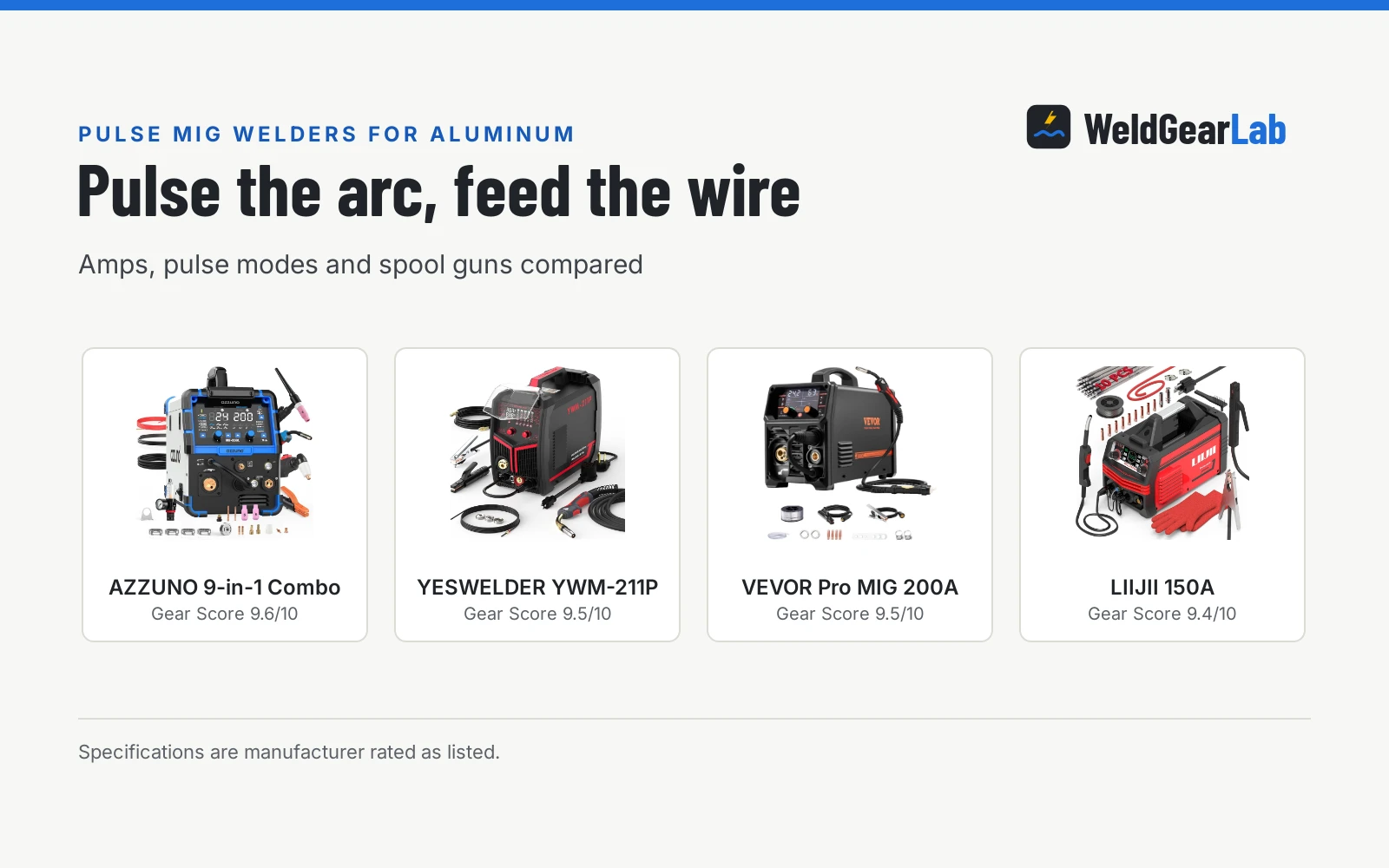
- Memory presets for saved settings. Tuning pulse parameters takes time, so machines with digital memory banks let you recall proven setups. AZZUNO lists 10 custom parameter memory sets on its 200A machine, while AWT lists 5 memory presets on its 180A model.
- Material thickness and electrode ratings. Manufacturers publish working metal thickness and tungsten electrode ranges for their TIG modes. PLASMARGON lists its 520TSCPF unit with a 10-200 amperes TIG range for plates from 0.5-8 millimeters thick using 1.6-3.2 millimeters tungsten electrodes.
- AC versus DC pulse for aluminum. DC pulse welders work on steel, stainless steel, and copper, but cannot clean aluminum oxide. To pulse aluminum, you need an AC machine. VEVOR lists AC pulse TIG alongside DC pulse on its 225A unit, rating it to weld 1/4″ aluminum and 3/8″ low carbon steel.
A foot pedal is not always included in the box. Sunstac lists remote foot pedal compatibility on its SS-200TP, but notes the pedal is not included, so factor pedal costs into your shop budget.
Which gas to use for TIG welding
Unlike MIG welding, which uses gas mixtures containing carbon dioxide, both pulse TIG and standard TIG require pure argon shielding gas for steel, stainless steel, and aluminum. Carbon dioxide or oxygen in the shielding stream rapidly oxidizes and ruins the tungsten electrode. Pure argon delivers a smooth arc start, stable arc column, and clean shielding over the molten pool. For specialty work on thick copper or heavy aluminum, some shops mix helium with argon to raise arc voltage and heat, but pure argon remains the standard choice for general shop fabrication.
Can one machine do both?
Yes. Pulse TIG machines can run as standard TIG welders by turning off the pulse mode on the control panel. When pulse is disabled, the machine delivers continuous DC or AC current just like a conventional unit. That dual capability makes a pulse-equipped machine a flexible investment for a fab shop, since you can use pulse on thin sheet and switch to standard continuous output for thicker work. Machines like the ARCCAPTAIN TIG200P offer standard TIG, pulse TIG, spot welding, and stick modes in a single unit. For shop recommendations, see our guides on the best TIG welder for aluminum and AC vs DC TIG welding.
TIG arc safety and shielding gas. TIG welding produces intense ultraviolet radiation that can cause arc eye and skin burns, even when operating at low background currents. Always wear a shaded helmet, flame-resistant jacket, and goatskin gloves. High-frequency arc starting can interfere with nearby electronic devices and computer equipment. Always secure high-pressure argon cylinders upright with a safety chain to a wall or welding cart, install a dedicated flowmeter regulator, and check all gas hose connections for leaks. Weld in a well-ventilated shop area to prevent argon gas from displacing oxygen in low-lying spaces.
FAQ for welders
Can a pulse TIG welder also do standard TIG welding?
Yes. Turning off pulse mode on the control panel puts the machine into standard DC or AC mode with continuous current output. You do not need two separate welders in your shop to handle both processes.
Does pulse TIG welding make stronger welds?
Pulse welding does not inherently make metal stronger than standard TIG welding. Weld strength depends on proper joint penetration, correct filler metal selection, and clean fit-up. On thin material, however, pulse prevents heat distortion and burn-through that can weaken the finished structure.
Why does a pulse TIG welder make a buzzing sound?
The buzzing sound comes from the rapid cycling of current between peak and background amperage. As the pulse cycles, the arc plasma expands and contracts, vibrating the surrounding air and shielding gas. That audible buzz or high-pitch whine is normal operating behavior for inverter pulse machines.
Can you weld aluminum with a DC pulse TIG welder?
DC pulse TIG cannot properly weld aluminum because direct current lacks the reverse-polarity cleaning action needed to strip off tough aluminum oxide. Aluminum requires an AC machine or an AC pulse welder. Makers like AZZUNO specifically note in their listings that DC pulse models are meant for steel and stainless, recommending dedicated AC units for aluminum work.
Is pulse TIG welding easier for beginners than standard TIG?
Pulse TIG makes heat management easier on thin sheet metal because the machine regulates background cooling for you. However, dialing in peak current, background current, frequency, and duty cycle adds setup complexity. Many welders prefer learning torch motion and puddle feeding on standard TIG first before tuning pulse parameters.
Related: what is pulse TIG welding, pulse TIG welding for thin metal, TIG welder settings chart, and the TIG welders hub. Also see our guide on how to TIG weld thin stainless without warping.