Pulse MIG vs Standard MIG Welder: Which One Should You Buy?
Pulse MIG and standard MIG welders run similar wire feed setups but differ in heat input, spatter control, and how cleanly they weld aluminum and thin sheet.

On this page
Top picks at a glance
As an Amazon Associate I earn from qualifying purchases.
- 1
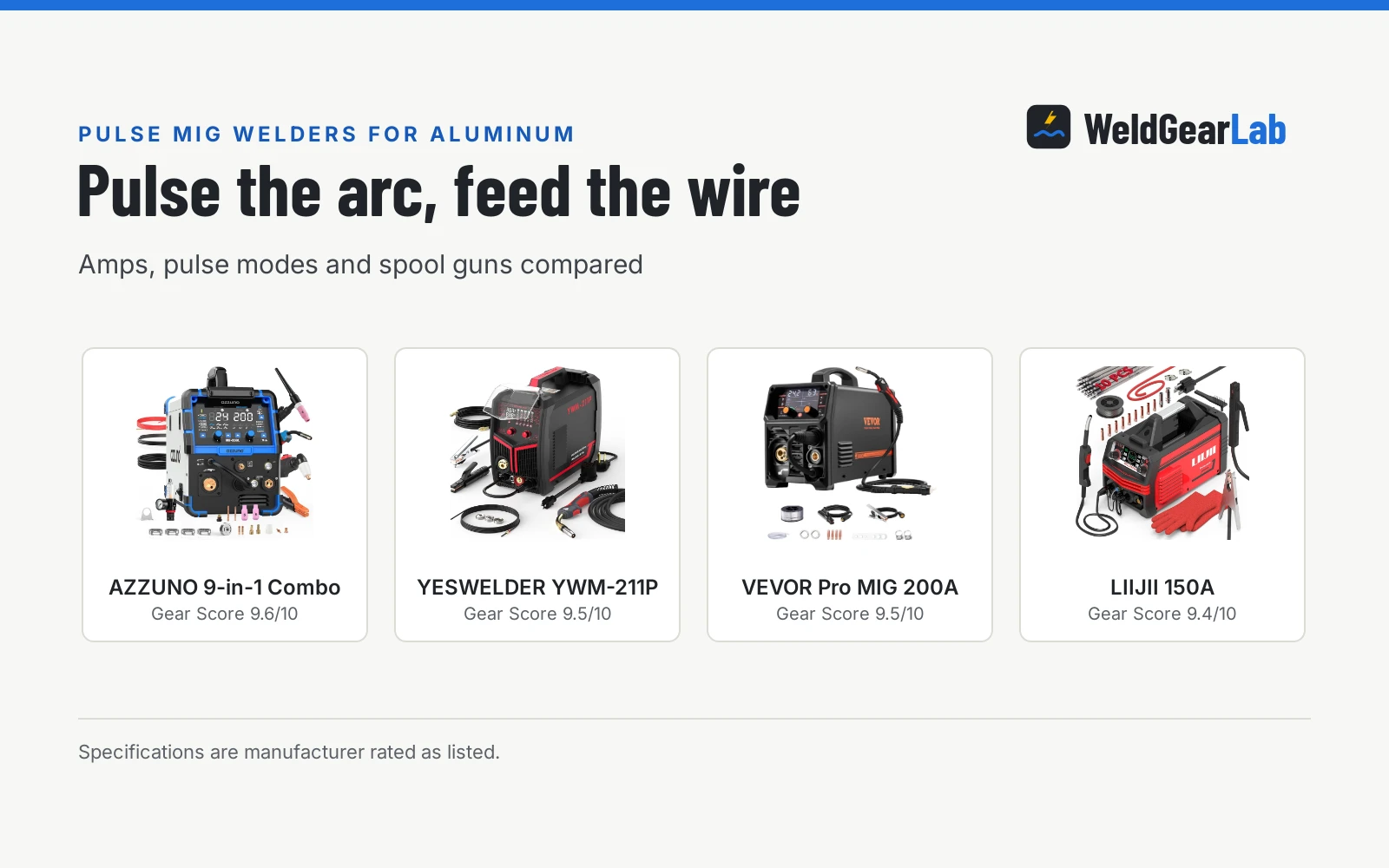
 AZZUNO 200A Plasma Cutter Welder Combo9.6/10View on Amazon
- 2
 VEVOR Pro MIG WelderView on Amazon
- 3
 Aluminum MIG Welder with PulseView on Amazon
- 4
 ANDELI Plasma Cutter Welder ComboView on Amazon
- 5
 Millermatic® 211 PRO MIG Welder MachineView on Amazon
- 6
 YESWELDER 135A MIG WelderView on Amazon
- 7
 ARCCAPTAIN 130A Flux Core Welder MIG Welder 110V Gasless MIGView on Amazon
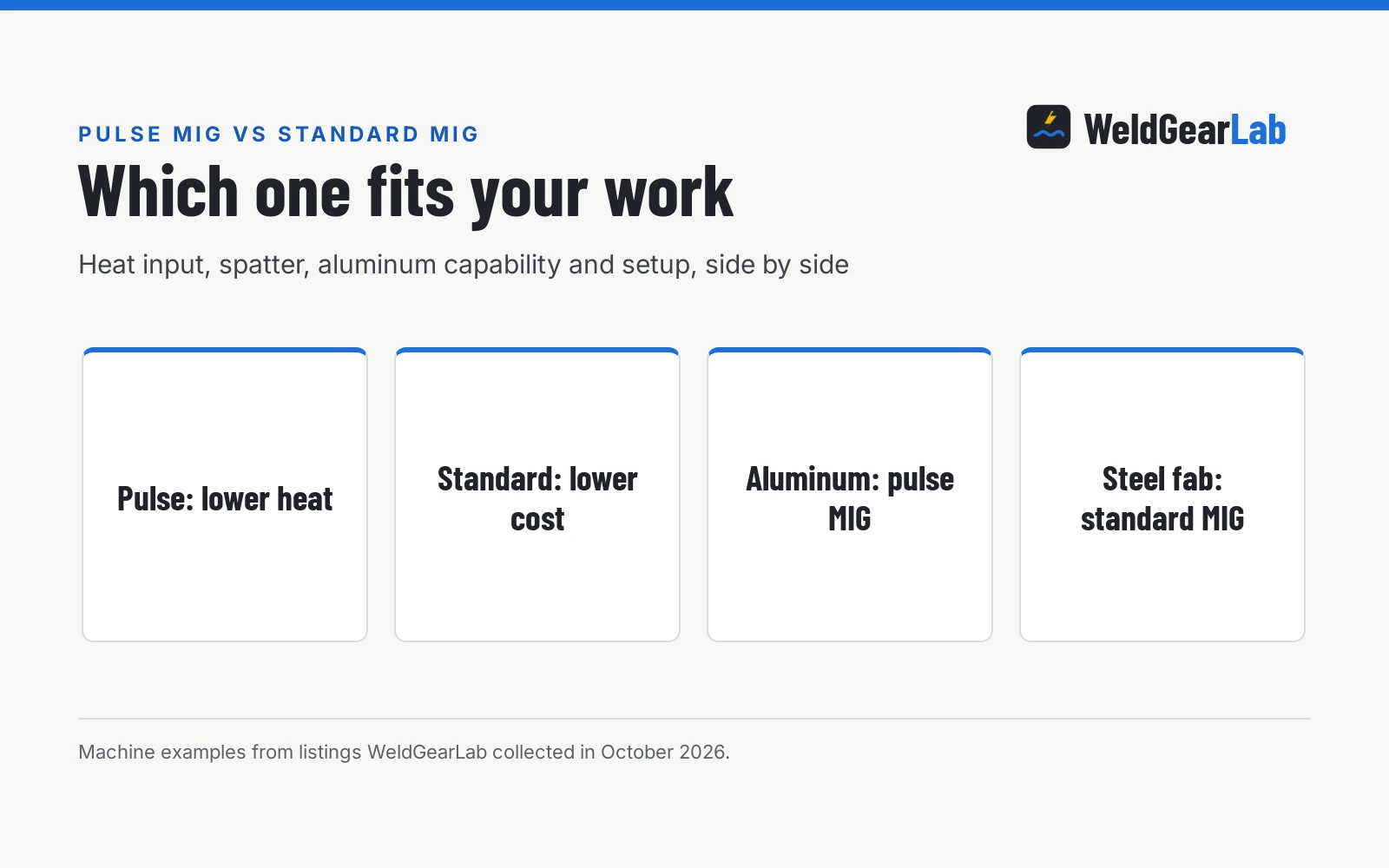
When fabricating aluminum sheet or repairing a thin steel body panel on the bench, heat control decides whether you get a sound bead or burn through the workpiece. Deciding between a pulse mig vs standard mig welder comes down to the metals you run and how much spatter you want to grind off. Standard MIG runs a continuous voltage that suits general carbon steel fabrication, while pulse MIG rapidly drops the current to cool the puddle between droplets. If your projects involve thin aluminum, stainless steel, or sheet metal where heat distortion and burn-through are constant risks, pulse MIG is worth the upgrade; for typical carbon steel repair, farm fabrication, and thicker plate, a standard MIG welder gets the job done at lower machine cost with simpler controls. This guide compares both wire feed processes side by side, explains equipment and shielding gas requirements, and shows how to tell what a machine supports.
Other welders and gear to compare
 VEVOR Pro MIG WelderCheck price on Amazon
 Aluminum MIG Welder with PulseCheck price on Amazon
 ANDELI Plasma Cutter Welder ComboCheck price on Amazon
 Millermatic® 211 PRO MIG Welder MachineCheck price on Amazon
 YESWELDER 135A MIG WelderCheck price on Amazon
 ARCCAPTAIN 130A Flux Core Welder MIG Welder 110V Gasless MIGCheck price on Amazon
This guide links to our product roundups, where WeldGearLab gets a commission on purchases made through links on this page, and your price stays the same. Read our affiliate disclosure.
The difference in one paragraph
Standard MIG and pulse MIG are both wire feed processes using solid or metal-cored wire shielded by gas. The difference is how electrical current transfers filler metal across the arc. Standard MIG operates on a continuous constant voltage that creates a short-circuit arc at common shop amperages: the wire drives into the puddle, shorts out with a pop that throws spatter, and melts off repeatedly. Pulse MIG uses an inverter power source to pulse current between a high peak and a low background level. Each peak pulse pinches off a single droplet cleanly without shorting, while the background cycle lets the puddle cool. That cycle delivers spray transfer with lower average heat input and minimal spatter.
Side by side: pulse mig vs standard mig welder
| Standard MIG | Single Pulse MIG | Double Pulse MIG | |
|---|---|---|---|
| Arc transfer method | Continuous voltage (short circuit, globular, or spray) | Pulsed spray (cycles between peak and background current) | Twin pulsing frequencies (superimposes low and high cycles) |
| Heat input into workpiece | Continuous heat input at equivalent wire feed speed | Lower average heat input with cooling between pulses | Lowest thermal input with fine puddle freezing control |
| Weld spatter | Moderate spatter, particularly in short circuit mode | Minimal spatter across voltage ranges | Near-zero spatter with smooth droplet transitions |
| Thin sheet metal and distortion | Higher risk of burn-through and heat warping | Reduced risk of burn-through on thin gauge | Minimal distortion with stacked-dime bead control |
| Aluminum welding capability | Difficult on thin sections without blow-through | Clean aluminum beads with controlled heat | Stacked-dime finish with excellent puddle agitation |
| Out-of-position welding | Spray mode limited to flat; short circuit sags on heavy joints | Puddle cools during background current for vertical welds | Precise puddle freeze for out-of-position aluminum and steel |
| Machine complexity and cost | Lower machine cost with simple dials | Higher cost with digital waveform inverter controls | Highest cost with dual pulse parameter settings |
| Shielding gas typically required | Carbon dioxide or argon blends; pure argon for aluminum | Argon or argon-gas blends; pure argon for aluminum | Argon or argon-gas blends; pure argon for aluminum |
| Operator setup | Straightforward adjustment of voltage and wire speed dials | Requires setting pulse parameters or synergic presets | Requires balancing dual pulse frequency and duty cycle |
Settings depend on wire alloy, wire diameter, and machine design; always check the door chart inside your wire drive compartment and your manual. While standard MIG welders use manual voltage and wire feed knobs, pulse machines often use synergic lines to coordinate pulse frequency with wire feed rate.
When pulse MIG is the better choice
- Aluminum fabrication without burn-through. Aluminum conducts heat rapidly, making thin sections prone to blowing out under continuous standard MIG voltage. Pulse MIG drops to background current between pulses to cool the puddle, giving precise thermal control on soft aluminum wire. In reference listings, S SIMDER rates its SD-4050Pro to run aluminum wire with pulse MIG on stock up to 1/4 inch thick.
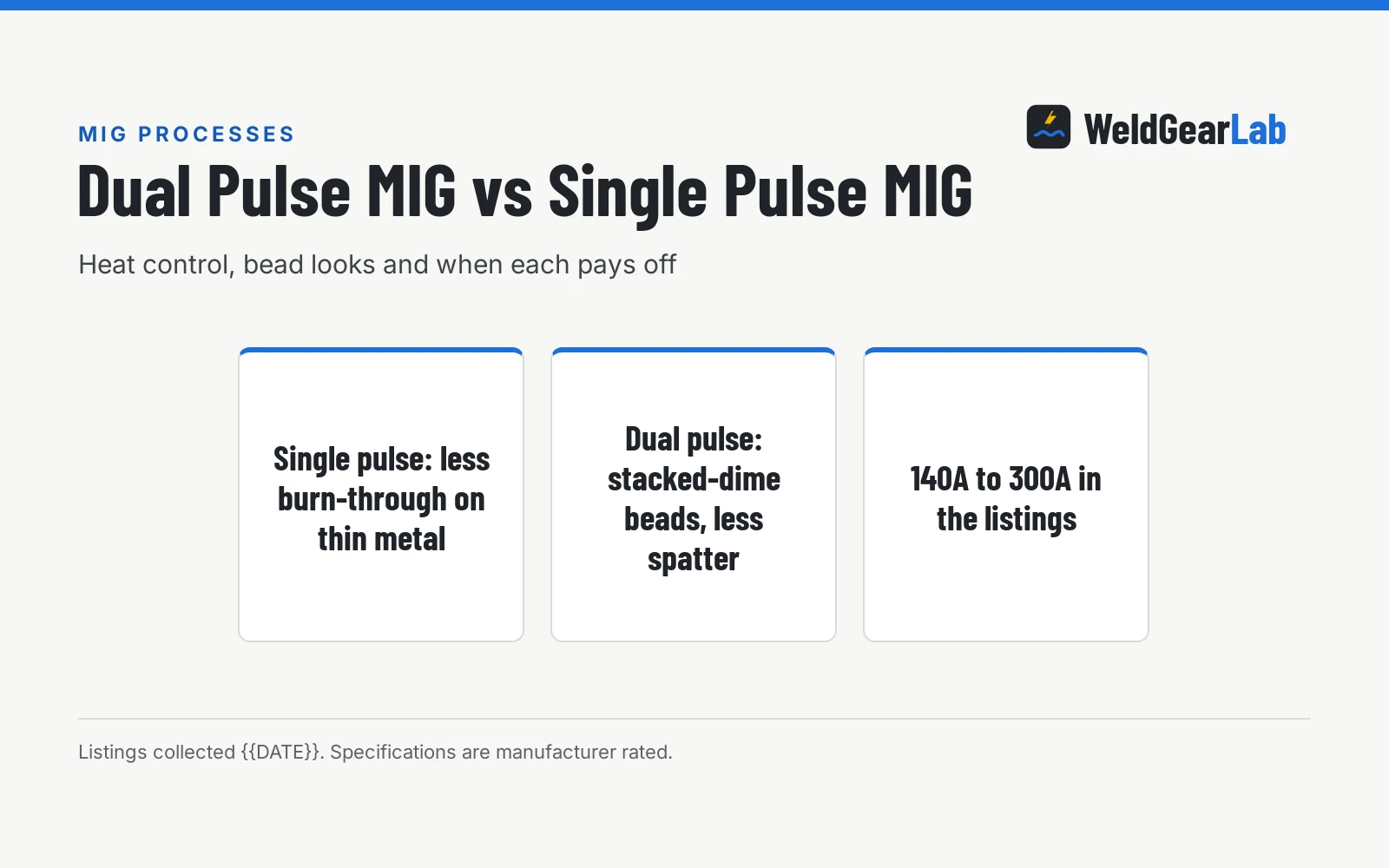
- Thin sheet metal and auto body panels. Lower average heat input reduces distortion and burn-through on thin sheet. ARCCAPTAIN lists its MIG205DP Pro with single pulse for thin sheet metal repair without burn-through, and double pulse for stacked-dime bead appearance.
- Out-of-position joint welding. Standard MIG spray transfer is too fluid for vertical or overhead welding, forcing operators into short-circuit mode which increases spatter and cold lap risk. Pulse MIG delivers spray-arc droplet detachment while allowing the puddle to freeze during background current cycles, keeping vertical-up and overhead welds under control.
- Minimal spatter and faster cleanup. Droplets detach smoothly during peak pulses without the violent popping of short-circuit transfer. This cuts down spatter on the workpiece, reducing grinding time on finished frames.
Our best MIG welder for hobbyist guide covers capable shop machines with advanced arc control settings.
When standard MIG is the better choice
- General carbon steel fabrication. Standard constant-voltage MIG produces strong welds on structural steel tubing, plate, and brackets where heat dissipation is manageable. For shop welders running standard gas MIG on steel, machines like the S SIMDER SD-4050Pro rate steel MIG welding capacity at 3/16 inch.
- Simpler machine operation and setup. A standard MIG welder has straightforward physical controls: set your wire feed speed and voltage dial to match the joint. There are no pulse frequencies, peak-to-background ratios, or digital menus to balance before striking an arc.
- Thicker steel repairs and farm maintenance. On heavier structural steel where burn-through is not a concern, standard constant-voltage MIG provides reliable fusion and steady deposition without requiring complex electronic waveforms.
- Lower equipment investment. Because dedicated standard MIG machines do not require complex inverter pulse programming boards, they provide reliable welding power at a lower equipment entry point with simpler long-term maintenance.
How to tell what a machine supports
Not every wire feed machine includes pulse capabilities. Many entry-level shop units are standard constant-voltage welders only. Look for these indicators in listings:
- Explicit pulse modes. The listing and control panel must state Pulse MIG, Single Pulse, or Double Pulse. Multi-process units that only list Gas MIG or Flux Core operate in continuous constant-voltage mode only. ARCCAPTAIN lists its MIG205DP Pro as an 8-in-1 unit with single pulse and double pulse. YESWELDER explicitly lists single pulse and double pulse MIG modes on its YWM-211P machine.
- Synergic digital displays. Managing pulse frequency, background current, and wire feed speed manually is demanding, so pulse welders feature digital displays with synergic programs that calculate settings automatically. ARCCAPTAIN includes 159 parameter presets on the MIG205DP Pro to coordinate wire speed and pulse parameters.
- Aluminum feed hardware included. Feeding soft aluminum wire through a torch lead requires proper drive hardware to avoid birdnesting. Listings for pulse machines often bundle dedicated Teflon or graphene liners and U-groove drive rolls. ARCCAPTAIN supplies U.035-.040 rollers and a graphene liner with the MIG205DP Pro, while ACEWELDER includes a Teflon liner and runs both 2 lb and 10 lb wire spools on the MIG200PRO.
- Spool gun compatibility ports. Both standard MIG and pulse welders often support optional spool guns for aluminum. On standard MIG machines without pulse, a spool gun is often the only practical way to run aluminum wire without feeding tangles.
A shielding gas regulator is sometimes included in complete packages, but check before buying. Budget for a suitable gas cylinder from a local supplier.
Which gas for MIG on steel and aluminum
Shielding gas selection differs based on whether you are running standard short-circuit MIG or pulse spray transfer, as well as the metal on your bench:
- Mild steel on standard MIG. The common shop choice is an argon and carbon dioxide mixture, or straight carbon dioxide. Straight carbon dioxide offers deep penetration at lower cost but creates more spatter. Argon-carbon dioxide blends produce a smoother arc with moderate spatter.
- Mild steel and stainless on pulse MIG. Pulse MIG requires an argon-rich mixture to establish spray-arc droplet detachment during the high peak pulse. Straight carbon dioxide cannot maintain the spray transfer mechanism needed for pulsing.
- Aluminum on pulse or standard MIG. Welding aluminum requires pure argon shielding gas. Carbon dioxide mixtures cannot be used on aluminum because the reactive gas causes severe oxidation and porosity. AZZUNO notes in its listing that operators must use the correct gas (pure argon, carbon dioxide, or argon-carbon dioxide blends) matching the metal and process to prevent weld failure and safety risks.
Always consult the door chart inside your welder or your wire manufacturer data sheet to confirm the recommended gas blend for your wire alloy.
Can one machine do both?
Yes. Many modern multi-process inverter welders include standard manual MIG, synergic MIG, and pulse MIG in the same machine. Units like the 205A ARCCAPTAIN MIG205DP Pro support dual-voltage operation on 120V and 240V circuits, allowing operators to run standard gas MIG on steel or switch to pulse modes for aluminum and sheet metal. Similarly, the 200A YESWELDER YWM-211P offers manual MIG, synergic MIG, and pulse modes on 110V and 220V power sources. For a small shop handling both heavy steel repairs and light aluminum projects, a dual-mode machine provides versatility without buying two welders; see our best welder for beginners and best MIG welder for farm repairs guides.
Electrical and shielding gas safety. Operating at high output, such as the 60% duty cycle at 200A rated on the S SIMDER SD-4050Pro, generates intense heat and arc radiation. Always wear a shade-appropriate welding helmet, flame-resistant leather sleeves or jacket, and heavy welding gloves to guard against ultraviolet arc flash. When using compressed shielding gas, secure all cylinders upright with a safety chain and inspect regulator fittings before opening the valve. Maintain adequate shop ventilation to avoid inhaling shielding gas displacement and welding fumes. Review our welding safety gear checklist before powering on your machine.
FAQ for welders
Can a standard MIG welder weld aluminum?
Yes, but it is challenging on thin stock. Standard MIG requires a spool gun or a Teflon liner with U-groove drive rolls to feed soft aluminum wire without birdnesting, and continuous constant-voltage heat makes burning through thin sheet very common. Pulse MIG cycles between peak and background currents to cool the puddle, giving cleaner beads on aluminum with much less burn-through.
Does pulse MIG eliminate all welding spatter?
Pulse MIG significantly reduces spatter compared to short-circuit MIG because molten droplets detach cleanly during high peak pulses rather than shorting out in the puddle. While it drastically reduces grinding time on carbon steel, stainless steel, and aluminum, contaminated metal or incorrect shielding gas can still produce spatter. Keeping the weld joint clean and setting proper gas flow delivers nearly spatter-free results.
Can you use standard MIG wire in a pulse MIG welder?
Yes. Pulse MIG welders use standard solid steel, stainless steel, and aluminum wire spools. The pulsing waveform is produced entirely by the welder’s internal inverter power source and digital software, not by specialty wire. You select the wire diameter and alloy on the machine’s control panel and match your drive rolls accordingly.
Why is pulse MIG better for thin metal?
Pulse MIG alternates between a high peak current that melts the wire and a low background current that lets the puddle cool. This cycling lowers the overall heat input into the workpiece while maintaining good penetration. As a result, thin sheet metal and body panels are much less prone to warping, heat distortion, and burning through.
Is a pulse MIG welder worth the extra cost for a home shop?
For general carbon steel fabrication, trailer repair, and farm maintenance on thicker stock, a standard MIG welder provides plenty of capability at a lower initial investment. However, if your projects frequently involve aluminum, automotive body panels, or stainless steel where heat distortion and grinding spatter ruin the finish, pulse MIG is worth the upgrade.
Related: how to choose a MIG welder, best MIG welder for hobbyist, best MIG welder for farm repairs, and the MIG welders hub. Also see our guides on synergic MIG welding and why a MIG welder spatters.