Hardfacing Welding Rod Types for Wear Repairs
Hardfacing welding rod types split into manganese rods that work-harden under impact and hard deposits that resist abrasion, with sizes, packs and application notes.

On this page
Top picks at a glance
As an Amazon Associate I earn from qualifying purchases.
- 1
 ATLASWELDER 6011 Welding Rods 3/32" 5LB9.5/10View on Amazon
- 2
 TOOLIOM E6011 Welding Rod Carbon Steel Stick Electrodes9.4/10View on Amazon
- 3
 ARCCAPTAIN Magnesium Aluminum Welding Wire ER5356 .035" MIG9.6/10View on Amazon
A bucket tooth worn round, a crusher plate thinned by rock, a rail crossing hammered flat by traffic. Hardfacing is the repair that builds worn steel back up with a weld deposit made to take the wear instead of the part. Hardfacing welding rod types split into manganese rods that work-harden under impact, and hard deposits that resist abrasion. This guide explains both, with sizes, packs and application notes from the makers.
This guide links to our product roundups, where WeldGearLab gets a commission on purchases made through links on this page, and your price stays the same. Read our affiliate disclosure.
Hardfacing welding rod types in one paragraph
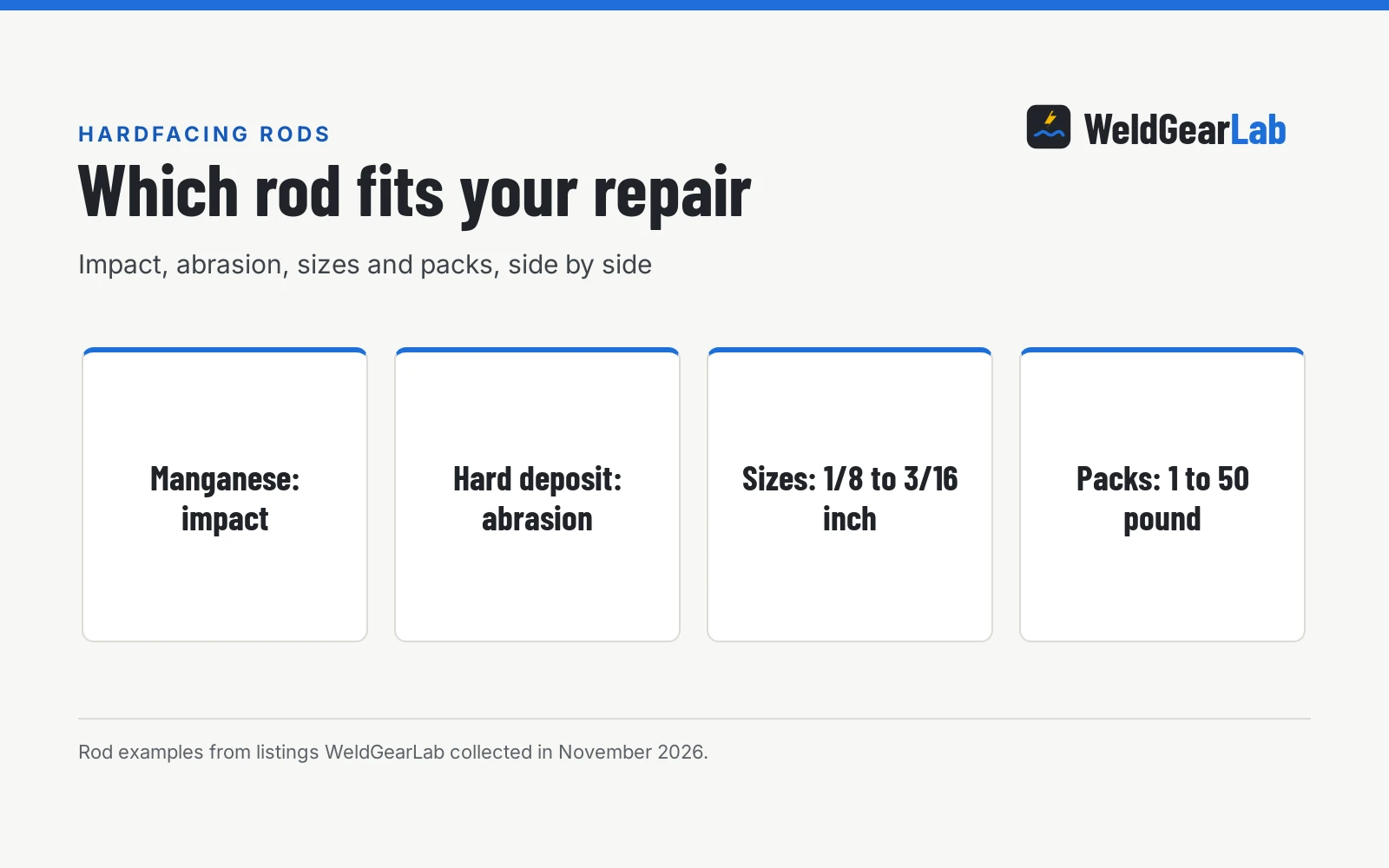
A hardfacing rod lays a wear-resistant deposit on a worn part instead of replacing the part. Manganese rods, such as the SÜA EFeMn-A, deposit a tough austenitic weld metal that hardens under service stress, so they suit parts that take impact. Hard deposits, such as the Forney Supercote at RC 52-58, resist abrasion on parts that slide or rub. The choice is impact against abrasion, and the rods here cover both.
Side by side
| Forney Supercote | SÜA EFeMn-A | SÜA EFeMn-B | Rankin Ranite M | |
|---|---|---|---|---|
| Diameter | 5/32 inch | 1/8, 5/32 and 3/16 inch | 1/8, 5/32 and 3/16 inch | 5/32 inch |
| Rod length | Not stated | 14 and 16 inch | 14 and 16 inch | 14 inch |
| Pack sizes | 1, 5 and 50 pound | 11, 22, 33 and 44 lb | 11, 22, 33 and 44 lb | 10 lb |
| Deposit | Crack resistant, RC 52-58 | Tough manganese, work-hardens | Manganese with molybdenum | Solid steel core, abrasion resistance |
| Best for | Moderate abrasion, low impact | Impact wear on manganese steel | Combined impact and wear | Metal-to-metal rolling, sliding |
| Current | Not stated | AC and DC | AC and DC | Not stated |
| Application | All positions | Low current, narrow bead | Low current, narrow bead | Not stated |
These numbers are the manufacturer’s ratings exactly as each listing gives them, recorded on 14 November 2026. Diameters and packs are as the makers state them; check the rod label before ordering.
When a manganese rod is the better choice
Manganese rods suit work where the part takes hits. The deposit work-hardens in service, so it gets tougher as the part works, where a conventional hard deposit may crack more easily.
- Impact wear. Crusher components, bucket teeth, bulldozer parts, manganese rails, rail crossings and rail frogs take repeated hits, and the EFeMn-A deposit hardens under service stress.
- Manganese steel parts. The deposit is a tough austenitic high manganese weld metal, valued for toughness and wear resistance on manganese steel components.
- Combined impact and wear. The EFeMn-B adds molybdenum for improved resistance to cracking where impact and wear meet.
- AC and DC. The SÜA rods run on AC and DC welding, so they suit either current type.
- Big packs for shop work. The SÜA rods come in 11, 22, 33 and 44 lb packs for maintenance shops and higher-volume repair programs.
When a hard deposit is the better choice
Hard deposits suit work where the part rubs or slides rather than taking hits. The weld metal stays hard from the start instead of hardening in service.
- Moderate abrasion and low impact. The Forney Supercote is a low cost rod for moderate abrasion and low impact application in all positions, with a crack resistant weld at RC 52-58.
- Surface buildup. Typical applications include surface buildup on new or worn machine parts of cast steel and manganese steel.
- Metal-to-metal sliding. The Rankin Ranite M (on Amazon) extends the life of parts worn down from metal-to-metal rolling or sliding, wherever severe abrasion is a problem.
- Smooth arc, easy slag. The Forney lists smooth arc action and easy slag removal, so cleanup between passes stays simple.
How to read the size and pack
The rods here run 1/8, 5/32 and 3/16 inch in diameter. The SÜA rods come in 14 and 16 inch lengths, and the Rankin runs 5/32 inch by 14 inch. Packs run from a 1-pound Forney pack to a 50-pound Forney bulk pack, with the SÜA rods in 11, 22, 33 and 44 lb packs and the Rankin in a 10 lb package. The Forney 50-pound pack lists a 51.2 pound weight, and the SÜA 44 lb pack lists a 44.0 pound weight. Pick the diameter the joint and the machine call for, and the pack size that matches the amount of buildup the job needs.
How to run them
The SÜA rods call for low current and a narrow bead, with the surface prepared first: remove fatigued material before welding. The maker of the EFeMn-A recommends baking electrodes at 300–350C for 1 hour before welding, and using immediate hammering or water quenching while hot to help reduce crack tendency. Light peening or controlled cooling helps reduce crack formation on the EFeMn-B. The Forney runs in all positions.
Hardfacing throws the same hazards as any stick work: arc flash, fumes, fire and hot slag. Weld with good ventilation or outdoors with your head out of the plume, wear safety glasses under the helmet when chipping slag, and clear dry grass and anything flammable from the area. See the OSHA welding overview.
For more options, see our welding consumables guides.
FAQ for welders
What is hardfacing?
Hardfacing lays a wear-resistant weld deposit on a worn part so the deposit takes the wear instead of the part. It suits parts such as crusher components, bucket teeth and rails that wear down in service.
Which hardfacing rod suits impact wear?
A manganese rod such as the SÜA EFeMn-A. Its deposit work-hardens in service and suits crusher components, rails, buckets and bucket teeth in mining, quarry, railroad and heavy equipment service.
Which rod suits abrasion?
A hard deposit. The Forney Supercote at RC 52-58 suits moderate abrasion and low impact buildup, and the Rankin Ranite M suits metal-to-metal rolling or sliding where severe abrasion is a problem.
What diameters do hardfacing rods come in?
The rods here run 1/8, 5/32 and 3/16 inch, with the SÜA rods in 14 and 16 inch lengths and the Rankin at 5/32 inch by 14 inch.
Do hardfacing rods need prep before welding?
Yes. Remove fatigued material from the worn part first, and bake the EFeMn-A electrodes at 300–350C for 1 hour before welding, per the maker.
Related: welding rods types, best all around stick welding rod, 5/32 vs 1/8 welding rod, 1/8 vs 3/16 welding rod, and best welding electrode holder for farm use.