Air vs Electric Angle Grinder: Which One Should You Buy?
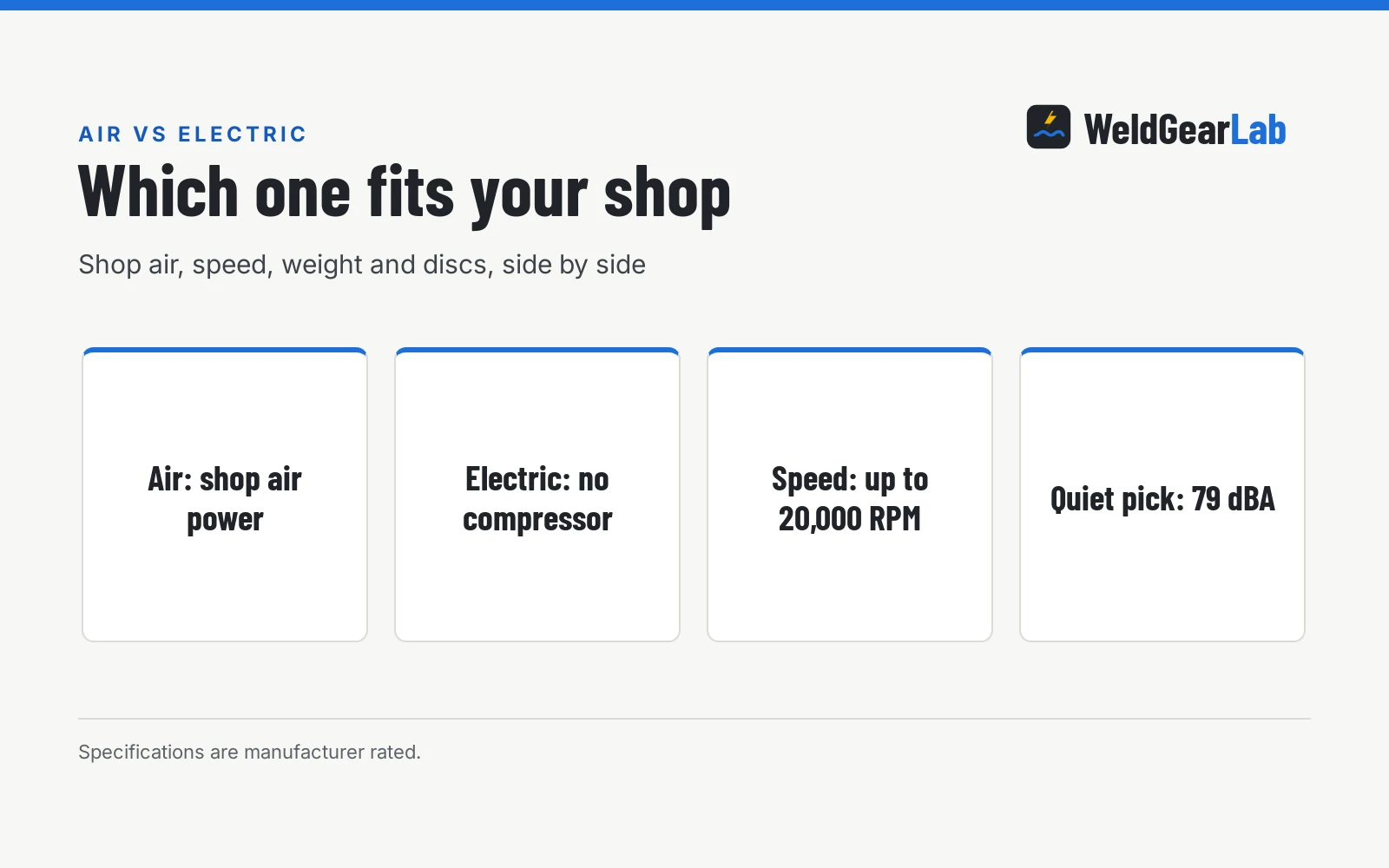
Air and electric angle grinders suit different shops: air runs on shop air and stays light at high speed, while electric needs no compressor, and four air die grinders show what the air side offers.

On this page
Top picks at a glance
As an Amazon Associate I earn from qualifying purchases.
- 1
 Ingersoll Rand 114GCQ EDGE Series 2 5/8" Stroke Air Hammer9.7/10View on Amazon
- 2
 Chicago Pneumatic CP8759.6/10View on Amazon
- 3
 KJE Right Angle Die Grinder Kit9.5/10View on Amazon
- 4
 Angle air die grinder 1/4" with 4 pcs 2" roll lock sandingView on Amazon
- 5
 Gunpla 1/4 inch Angle Air Die GrinderView on Amazon
- 6
 Rockwood 4 in. Air Angle Grinder Cut Off Pneumatic PolisherView on Amazon
- 7
 WORKPRO Air Angle Die GrinderView on Amazon
- 8
 PROSHI 1/4-Inch Air Die Grinder With Rubber SleeveView on Amazon
- 9
 1/4-Inch Angle Air Die GrinderView on Amazon
Pick air when the shop already runs a compressor, and pick electric when it does not. That split decides the air vs electric angle grinder question: an air die grinder runs on shop air, so it stays light and spins fast, while an electric grinder needs no compressor, hose or air supply at all. The rest comes down to the work on the bench and the gear already in the shop.
Other welders and gear to compare
 Angle air die grinder 1/4" with 4 pcs 2" roll lock sandingCheck price on Amazon
 Gunpla 1/4 inch Angle Air Die GrinderCheck price on Amazon
 Rockwood 4 in. Air Angle Grinder Cut Off Pneumatic PolisherCheck price on Amazon
 WORKPRO Air Angle Die GrinderCheck price on Amazon
 PROSHI 1/4-Inch Air Die Grinder With Rubber SleeveCheck price on Amazon
 1/4-Inch Angle Air Die GrinderCheck price on Amazon
This guide links to our product roundups, where WeldGearLab gets a commission on purchases made through links on this page, and your price stays the same. Read our affiliate disclosure.
The difference in one paragraph
An air die grinder is a small air motor with a right angle head. It connects to an air compressor before use, and two listings here state a working pressure of 90 PSI, with one listing stating air use of 3.5 CFM (100 L/min). An electric grinder carries its own motor and needs no air supply, so it suits a bench with no compressor. The listings here describe lightweight aluminum bodies and compact designs, and show speeds of 18,000 RPM and 20,000 RPM.
Air vs electric angle grinder side by side
| Topic | Air die grinder | Electric angle grinder | Shop note |
|---|---|---|---|
| Power source | Shop air from a compressor | Its own motor, no air supply | Air needs a compressor on hand |
| Speed stated | 18,000 RPM to 20,000 RPM | Not stated in this guide | Air speed comes from the listings here |
| Weight stated | 1.8 pounds and 0.6 kg, on two listings | Not stated in this guide | Aluminum bodies on three listings; composite grip on the fourth |
| Noise stated | 79 dBA on one listing | Not stated in this guide | Only the AIRCAT listing states a figure |
| Setup | Hose, inlet, regulator, air filter | No hose or air setup | Air setup takes more gear |
| Discs | 2 in roll lock discs, 1/4 in collet | Not stated in this guide | Discs included with two listings |
Air figures below come from the four air die grinder listings in the gear section. Electric notes describe the trade in general terms.
When air is the better choice
- A compressor already in the shop. When shop air is already plumbed, an air die grinder adds a light, fast tool with no extra power supply to buy.
- Tight spots and detail work. The 90-degree angle head lays a 2 in disc flat on the work, so it dresses welds inside corners, frames, manifolds and cylinder ports a straight grinder cannot reach.
- High-speed detail work. Speeds of 20,000 RPM with a built-in regulator suit smoothing, chamfering, deburring, grinding, polishing and engraving.
- Overhead work. A lightweight aluminum body stays light overhead, and two listings state a rear exhaust.
When electric is the better choice
- No compressor. A bench with no shop air, no hose and no air supply runs an electric grinder straight away.
- Work away from the shop. Electric suits jobs where dragging a hose and compressor along makes no sense.
- Simple setup. No working pressure to set, no inlet oil and no air filter to check before a job.
- One tool, no air setup. Electric keeps the whole setup in the tool itself, which suits a small bench with limited floor space.
The gear: four air die grinders
The four air die grinders below are ranked by their listings, strongest first. All four are air powered with a right angle head, so the ranking turns on stated power, speed, noise, included discs and warranty.
AIRCAT 6280
The AIRCAT leads this group on stated power and quiet running. Its listing states a .75 HP non-stall motor at 18,000 RPM, a composite handle and grip, a top-mounted speed control and a tuned exhaust system that brings noise down to 79 dBA. A spindle lock and an Erickson-style precision collet round out a listing aimed at steady shop use. One contradiction needs noting: the spec table lists horsepower as 75 hp, while the title and bullets state .75 HP, and this guide follows the title and bullets. The listing states a warranty of 2 Years with Proof of Purchase, the only stated warranty term in this group.
YoShin Angle Grinder Kit
The YoShin kit leads on included abrasives. Its listing states a speed of 20,000 RPM at 90 PSI, air use of 3.5 CFM (100 L/min), a 1/4 in NPT inlet and a 1/4 in collet plus a 1/8 in collet. The kit includes 22 pcs of 2-inch Roll Lock sanding discs: 2 wool polishing pads, 5 flap discs in 80 grit, 15 nylon surface conditioning discs, 5 each in coarse, medium and fine, plus one 2 in Roll Lock backing pad. The listing states a 90 degree head for tight spots, and a run of a 3/8 in hose with 2 to 3 drops of air tool oil at the inlet before each use. One contradiction needs noting: the spec table lists horsepower as 800 watts, which reads as a wattage figure, while the bullets state speed and pressure only, so this guide states no horsepower figure for this grinder.
YON.SOU. Angle Die Grinder
The YON.SOU. is the plain, compact air die grinder of the group. Its listing states a 0.3 HP motor with a free speed of up to 20,000 RPM, a 90 degree angle head, a safety lock, a built-in regulator and an air inlet filter. Inner movement parts are made of tungsten steel, which the listing says could be more resistant to high temperature, and the housing is aluminum with ball bearing construction. The listing states a 1/4-inch collet, an air quick connector and wrenches in the box, and a listed weight of 0.6 kg. No warranty term is stated for this grinder.
PROSHI Angle Die Grinder
The PROSHI is the listing with the least stated detail. Its listing states a 0.32 HP motor with a maximum speed of 20,000 RPM, a lock-off throttle to prevent accidental startup, a built-in speed regulator and a 90-degree angle head for tight quarters. The title includes 4 pcs of 2-inch roll lock sanding discs, and the body is lightweight aluminum with a rear exhaust and a durable ball-bearing motor. The listing states uses from precision machining and smoothing to chamfering, deburring, grinding, polishing and engraving. No warranty term is stated for this grinder.
How to tell what a shop air setup needs
Check the listing for working pressure, air use, inlet size and hose size before buying. The YoShin listing states 90 PSI working pressure, 3.5 CFM (100 L/min) air use, a 1/4 in NPT inlet and a 3/8 in hose, which is a clear setup to match against a compressor. The YON.SOU. listing states 90 PSI air pressure and a rear exhaust. If a listing states no air use figure, check the manual before assuming a small compressor will keep up.
Shop air safety. Treat compressed air with respect: check the hose and fittings before each session, keep the work held firm, and wear eye protection when grinding. Keep hoses clear of walkways so nothing trips or pulls the tool off the bench.
FAQ for welders
Do air die grinders need a compressor?
Yes. The listings state these tools are air-powered and must connect to an air compressor before use. One listing states a working pressure of 90 PSI and air use of 3.5 CFM (100 L/min), so match those figures against the compressor on hand.
What speed do these air die grinders run?
Three listings state 20,000 RPM and one states 18,000 RPM. Built-in regulators and top-mounted speed controls on some listings let the user control speed for the job at hand.
Are air die grinders quiet?
Only one listing states a noise figure: the AIRCAT listing states a tuned exhaust system that brings noise down to 79 dBA. The other listings state no noise figure, so do not assume they run quiet.
What discs fit these grinders?
Two listings state 2 in roll lock sanding discs and 1/4 in collets, with one kit adding a 1/8 in collet. The YoShin kit includes 22 pcs of discs, while the PROSHI title includes 4 pcs of 2-inch roll lock sanding discs.
Can an air die grinder reach tight spots?
Yes, that is the point of the 90 degree head. The listings state the right angle head reaches tight spaces where a straight die grinder cannot reach; the YoShin listing adds that the head lays the 2 in disc flat on the work inside corners, frames, manifolds and cylinder ports.
Related: best die grinder for home shop, cordless vs corded die grinder, bench grinder vs die grinder, and die grinder vs cut off tool. Also see the metal fab tools hub.