Best Die Grinder for Home Shop (2026)
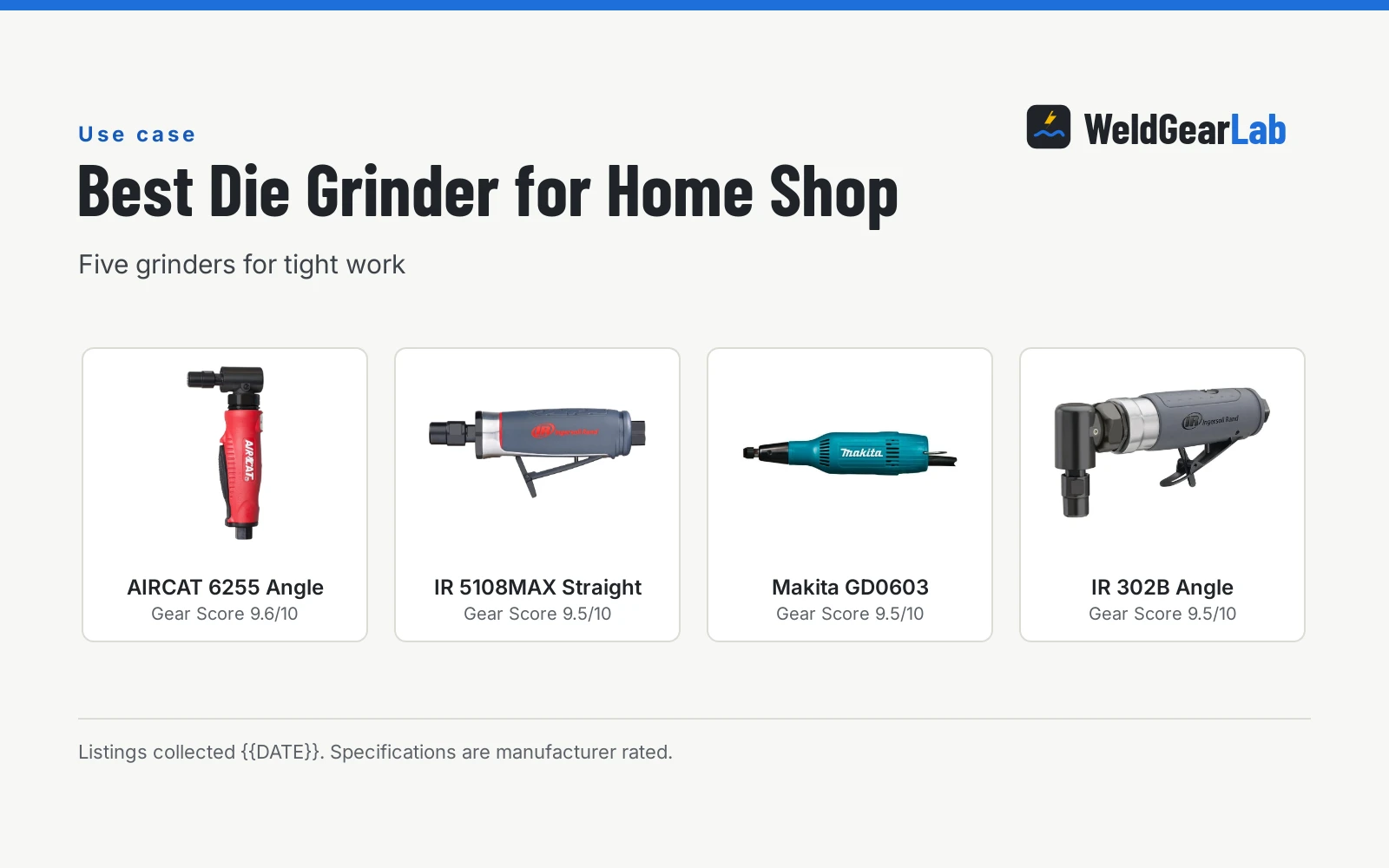
Best die grinder for home shop: five die grinders compared on power, speed, weight, air vs electric, and warranty.

On this page
Top picks at a glance
As an Amazon Associate I earn from qualifying purchases.
- 1
 Top PickAIRCAT 6255 Angle9.6/10View on Amazon
- 2
 Light PickIR 5108MAX Straight9.5/10View on Amazon
- 3
 Speed PickMakita GD06039.5/10View on Amazon
- 4
 Cordless PickMilwaukee 2486-209.5/10View on Amazon
The weld needs cleaning up, a bolt hole needs opening out, and the angle grinder is too big for the spot. The die grinder is the tool that fits where nothing else does: small, fast and made for tight work, the kind of tool that earns its drawer space in the first month.
This is the best die grinder for home shop roundup: five die grinders scored for the home shop, on power, speed, weight, warranty and value, from quiet air tools to cordless.
WeldGearLab gets a commission on purchases made through links on this page, and your price stays the same. Read our affiliate disclosure.
Quick picks
- Top Pick AIRCAT 6255 Angle: 0.4 HP at 82 dBA with a 2-year warranty for home shops. Check price on Amazon
- Light Pick IR 5108MAX Straight: 0.4 HP and 25,000 rpm at just 1.0 pound. Check price on Amazon
- Speed Pick Makita GD0603: 28, 000 rpm corded with accessories included. Check price on Amazon
- Cordless Pick Milwaukee 2486-20: M12 cordless inline with 4-mode RPM control. Check price on Amazon
The machines
AIRCAT 6255 .4 HP Composite Right Angle Die
A 0.4 HP right-angle air die grinder at 18,000 rpm, quiet at 82 dBA, with 2-year warranty.
Pros
- 2-year warranty
- 0.4 HP motor
- 82 dBA quiet
- Feather trigger
Cons
- Needs a compressor
- Item type says 20,000 rpm
- 0.54 kg, mid weight
- Right angle only

Ingersoll Rand 5108MAX 1/4" Collet Air Die Grinder
A 0.4 HP straight air die grinder at 25,000 rpm, 1.0 lb, with spindle lock and 1-year warranty.
Pros
- 0.4 HP motor
- 25,000 rpm
- 1.0 lb, lightest here
- Spindle lock
Cons
- Needs a compressor
- No RPM control modes
- 1-year, not 2
- Straight only
Makita GD0603 1/4" Compact Die Grinder
A 2.2 amp corded die grinder at 28, 000 rpm with collet, wheel points and 1-year warranty.
Pros
- 28, 000 rpm, fastest here
- No compressor needed
- Accessories included
- 1-year limited warranty
Cons
- 2.1 lb, heaviest here
- Corded, not cordless
- No RPM modes

Ingersoll Rand 302B 1/4" Collet Air Die Grinder
A 0.33 HP right-angle air die grinder at 20,000 rpm, 1.3 lb, with safety throttle and 1-year warranty.
Pros
- Self-locking safety throttle
- 1.3 lb lightweight
- Rear exhaust
- 1-year warranty
Cons
- Needs a compressor
- 0.33 HP lowest air power
- No RPM modes
- 1-year, not 2
Milwaukee 2486-20 M12 FUEL Lithium-Ion In line Die
An M12 FUEL cordless inline die grinder at 24,500 rpm with 4-mode control, tool only.
Pros
- Cordless, no compressor
- 4-mode RPM control
- Variable-speed trigger
- 1.2 lb pencil grip
Cons
- No warranty stated
- Tool only, battery extra
- 0.3 HP lowest here
- Inline only
Other welders and gear to compare
 DEWALT DWE4887N DEWALT DWE4887N 1-1/2-Inch Die GrinderCheck price on Amazon
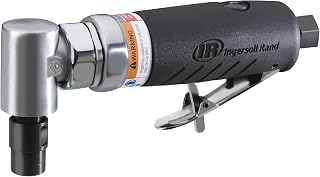 Ingersoll Rand 3101G 1/4" Collet Air Die Grinder Max freeCheck price on Amazon
 Ingersoll Rand 301B 1/4" Collet Air Die Grinder Max freeCheck price on Amazon
 Ingersoll Rand 3107G 1/4-Inch Straight Air Die Grinder withCheck price on Amazon
 Makita GD0601 1/4" Die GrinderCheck price on Amazon
Spec sheet comparison
| Grinder | Score | Power | Speed (listed) | Warranty |
|---|---|---|---|---|
| AIRCAT 6255 Angle | 9.6/10 | 0.4 HP air | 18,000 rpm | 2-year |
| IR 5108MAX Straight | 9.5/10 | 0.4 HP air | 25,000 rpm | 1-year |
| Makita GD0603 | 9.5/10 | 2.2 amp corded | 28, 000 rpm | 1-year |
| IR 302B Angle | 9.5/10 | 0.33 HP air | 20,000 rpm | 1-year |
| Milwaukee 2486-20 | 9.5/10 | 0.3 HP cordless | 24,500 rpm | Not stated |
Treat the specs as maker ratings pulled straight from the listings; we gathered them on 22 October 2026. Where a listing states a figure two ways, the table follows the title and bullets.
Buying guide: best die grinder for home shop
Air, corded or cordless
Three of these need a compressor: the AIRCAT 6255, the IR 302B and the IR 5108MAX are all pneumatic. The Makita GD0603 plugs into the wall at 2.2 amps, and the Milwaukee 2486-20 runs on M12 batteries, which the listing says is compatible with the M12 battery. For a home shop without a big compressor, the corded Makita and the cordless Milwaukee skip the air question entirely; for a shop that already runs air, the pneumatic three are the air-powered options.
Speed and power
Speeds run 18,000 rpm on the AIRCAT, 20,000 on the IR 302B, 24,500 on the Milwaukee, 25,000 on the IR 5108MAX, and 28, 000 on the Makita per its bullets. Power runs 0.3 HP on the Milwaukee, 0.33 on the 302B, and 0.4 on the AIRCAT and 5108MAX; the Makita runs on 2.2 amps corded. The Milwaukee’s 4-mode RPM control and variable-speed trigger give the finest speed control of the five. That control matters most in polishing and detail grinding, where too much speed burns the work.
Right angle vs straight
The AIRCAT 6255 and IR 302B are right-angle grinders for tight spots and porting work; the Milwaukee, Makita and IR 5108MAX are straight inline grinders. Right angle reaches around corners; straight gives a pencil grip for detail work. Most home shop jobs, deburring welds and opening holes, suit either; porting and tight corners favor the right angle. The listing calls the Milwaukee a pencil-style tool at 1.2 pounds.
Noise and comfort
The AIRCAT is the quiet pick at 82 dBA with a tuned exhaust system, and the listing frames it for shop or home use. In a home shop with thin walls or close neighbors, that noise difference is the difference between grinding at night and not. The IR 302B has a rear exhaust to keep the workspace clean and reduced vibration; the 5108MAX adds a piped-away exhaust kit. At 1.0 pound the 5108MAX is the lightest here; the Makita at 2.1 pounds is the heaviest.
Collets and accessories
All five take 1/4 in collets, so burrs and mounted points swap between them freely, which is convenient when the shop eventually owns two. The Makita ships the most in the box: a 1/4 in collet, two wheel points and a spanner wrench. The IR 302B includes two wrenches, a 6 mm collet and manuals; the 5108MAX adds a third wrench, a piped-away exhaust kit and a service clamp block. The AIRCAT and Milwaukee list fewer included parts, so budget for burrs and wheels separately.
Warranty
The AIRCAT leads with a 2-year warranty, the longest here, which is notable on an air tool where seals and bearings are the wear points. The IR 302B, Makita and IR 5108MAX each list a 1-year warranty. The Milwaukee states no warranty term, which is its main scoring gap.
[fgh_safety kind=”tool”]
FAQ for welders
What is the best die grinder for a home shop?
The AIRCAT 6255 leads here: 0.4 HP, 18,000 rpm, quiet at 82 dBA, and a 2-year warranty. This roundup scores it first at 68.
Do I need an air compressor for a die grinder?
Three of these do: the AIRCAT, IR 302B and IR 5108MAX are pneumatic and the compressor is not included. Factor the compressor into the budget if the shop does not have one; the tool prices alone do not tell the whole story. The Makita plugs in and the Milwaukee runs on M12 batteries.
What is the fastest die grinder here?
The Makita at 28, 000 rpm per its bullets, followed by the IR 5108MAX at 25,000 and the Milwaukee at 24,500.
Which of these have a warranty?
The AIRCAT lists 2 years; the IR 302B, Makita and IR 5108MAX list 1 year each. The Milwaukee states no warranty term.
Why do the listings disagree on RPM?
Two do: the AIRCAT’s item type name says 20,000 RPM against 18,000 in the title and bullets, and the Makita’s spec table says 25,000 against 28, 000 in the bullets. Trust the title and bullets in both cases.
Related: the metal fab tools hub.
Scoring, line by line
Each grinder is scored on performance, build, value, safety and warranty, with the weights published on our How We Pick page. A spec the listing does not publish scores nothing. Four of the five state a warranty term; none states a third-party safety certification.
| Product | Gear Score | Perf. /35 | Build /25 | Value /25 | Safety /10 | Warranty /5 |
|---|---|---|---|---|---|---|
| AIRCAT 6255 Angle | 9.6 | 29 | 22 | 21 | 0 | 3 |
| IR 5108MAX Straight | 9.5 | 29 | 22 | 20 | 0 | 3 |
| Makita GD0603 | 9.5 | 28 | 21 | 21 | 0 | 3 |
| IR 302B Angle | 9.5 | 28 | 21 | 20 | 0 | 3 |
| Milwaukee 2486-20 | 9.5 | 30 | 22 | 21 | 0 | 0 |
Think of 9.2 as the bottom and 9.8 as the top. Totals are placed between them in proportion, which keeps the order intact: more points, higher score.