Lincoln AC225 vs Inverter Stick Welder: Which One Should You Buy?
How the classic Lincoln AC225 transformer stick welder compares to modern inverter stick welders on arc quality, power draw, portability, and shop durability.
 By WeldGearLab Editorial
Updated October 9, 2026
By WeldGearLab Editorial
Updated October 9, 2026
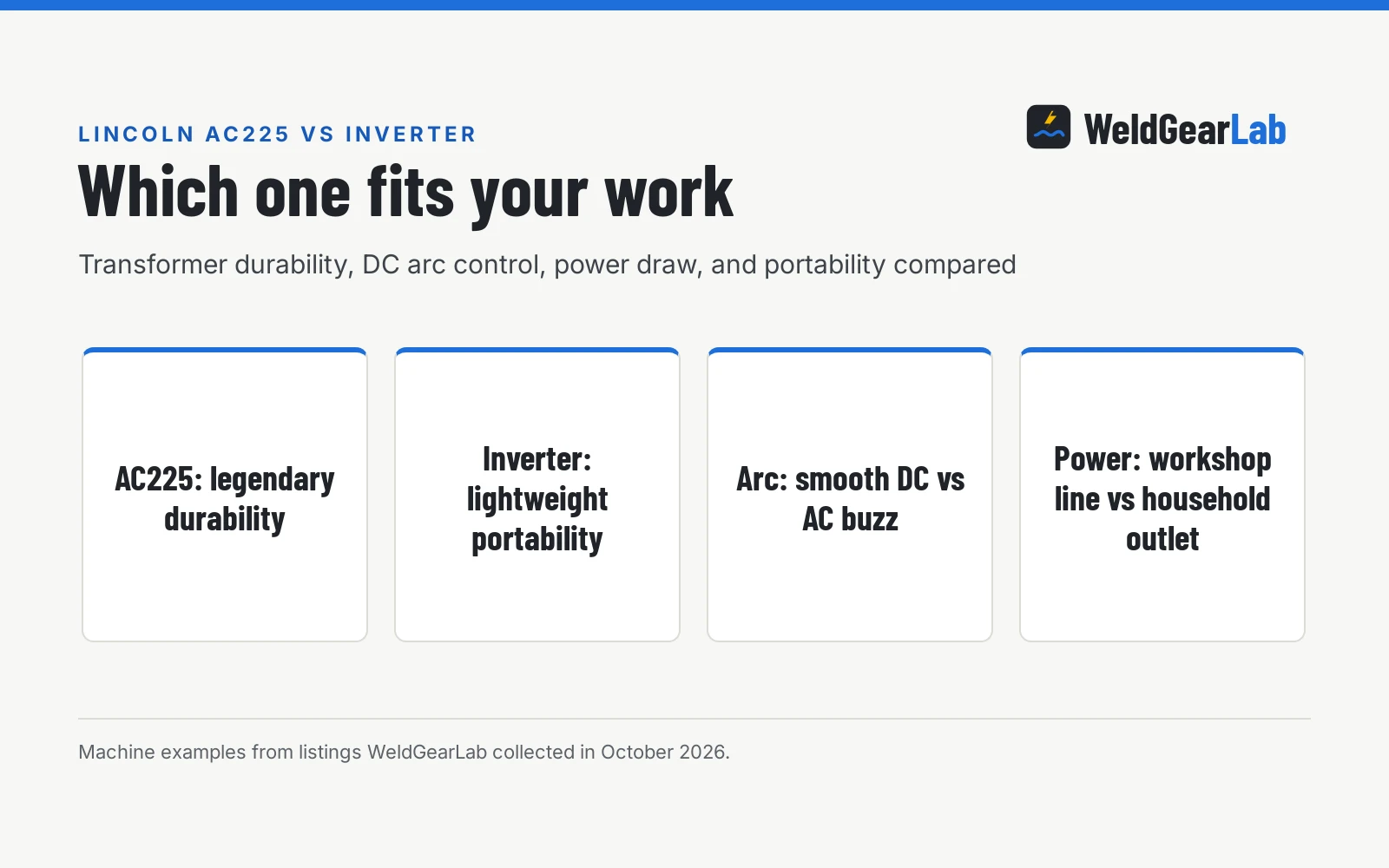
Choosing between a Lincoln AC225 vs inverter stick welder comes down to whether you prioritize stationary, generational durability or lightweight portability with modern arc control. The Lincoln AC225 transformer stick welder, known across farm shops as the tombstone, uses a transformer core that delivers alternating current (AC) and can operate for decades without circuit board failures. In contrast, modern inverter stick welders use solid-state electronic switches to produce direct current (DC), weigh as little as 3.7 lbs in compact listings, and run efficiently on household electricity. When deciding between a tombstone welder vs inverter machine, your shop power supply, mobility needs, and the stick electrodes you burn determine the right choice.
As an Amazon Associate I earn from qualifying purchases. This guide links to our product roundups, where WeldGearLab earns a commission when you buy through links, at no extra cost to you. Read our affiliate disclosure.
The difference in one paragraph
The fundamental difference lies in how each machine transforms wall electricity into welding current. The Lincoln AC225 uses a massive magnetic step-down transformer to take high-voltage alternating current from the wall and reduce it directly to welding voltage, maintaining an alternating current (AC) sine wave at the electrode. An inverter stick welder takes incoming AC power, rectifies it to direct current, uses high-frequency solid-state transistors to chop the voltage at high frequency, and rectifies it back into smooth direct current (DC) output. That electronic transformation allows inverters to shrink iron transformers down to handheld boxes while offering active arc stabilization.
Side by side
| Lincoln AC225 (Transformer) | 110V Inverter Stick | Dual-Voltage 110V/220V Inverter | |
|---|---|---|---|
| Core technology | Heavy magnetic step-down transformer | IGBT solid-state inverter | IGBT solid-state inverter |
| Output current type | Alternating current (AC) only | Direct current (DC) | Direct current (DC) |
| Input power supply | Dedicated high-voltage 230V circuit | Standard 110V household outlet | Dual-voltage 110V or 220V power |
| Portability and weight | Stationary shop fixture on wheels | Handheld unit with shoulder strap | Portable field unit with handle |
| Arc stability and spatter | Harsh AC arc with noticeable spatter | Smooth DC arc with low spatter | Smooth DC arc with low spatter |
| Electrode compatibility | AC rods like E6011 and E6013 | Runs DC rods like E6013, E7018, E6011 | Runs DC rods like E6010, E6013, E7018 |
| Arc starting assistance | Manual scratch start with no assist | Automated hot start and anti-stick | Automated hot start and anti-stick |
| Shop durability | Decades of service with no circuit boards | Sensitive to metal dust and moisture | Sensitive to metal dust and moisture |
| Electrical efficiency | Higher idle current draw from transformer | High efficiency with minimal idle draw | High efficiency with minimal idle draw |
Ratings and capacities reflect stated specifications from manufacturer listings and standard electrical configurations. Inverter figures reflect compact reference units in our dataset, where brands such as TECWELD and GNI report physical weights below 5 lbs and operation on 110V power, while SOARFLY lists dual-voltage 110V/220V input. The Lincoln AC225 represents the classic heavy-duty transformer standard requiring high-voltage workshop electrical service.
When the Lincoln AC225 is the better choice
- Indestructible workshop longevity. Built with heavy copper windings, mechanical tap switches, and steel casing, the Lincoln AC225 has virtually no sensitive microchips or circuit boards to fry from voltage spikes, metal dust, or humidity.
- Fixed station farm and repair shops. For a dedicated welding bench where the machine never needs to travel, parking a heavy transformer on wheels eliminates worries about fragile internal electronics.
- Eliminating magnetic arc blow. Alternating current continuously reverses magnetic fields, which prevents magnetic arc blow when welding deep into corners, heavy plate bevels, or magnetized steel pipe.
- Simplicity with zero software. Output is adjusted through mechanical switch selections that provide direct contact to transformer taps, ensuring repeatable operation across decades of shop use.
For heavy maintenance in dedicated barns, a stationary machine provides unmatched peace of mind. Farmers repairing equipment in a pasture often compare processes; our guide to stick welder vs MIG welder for farm repairs breaks down dirty metal prep and wind resistance across portable and stationary setups.
When an inverter stick welder is the better choice
- Effortless portability. Inverter stick welders weigh a fraction of traditional transformers. In our reference data, Hpoouo lists a weight of 3.7 lbs, GNI lists 4.4 lb, and TECWELD lists 5 lbs with a shoulder strap, allowing operators to climb ladders or work across fields with ease.
- Standard household outlet compatibility. Many inverter stick welders run on common 110V household circuits, while models like SOARFLY provide dual-voltage 110V/220V capability for flexibility between homes and jobsites.
- Superior DC arc stability. Direct current output creates a focused, smooth arc puddle with noticeably less spatter than alternating current, making out-of-position vertical and overhead welding far easier to control.
- Smart electronic arc assist. Modern inverters integrate features like hot start to boost striking current, arc force to prevent puddle snuffing, and anti-stick control to cut current when an electrode freezes to the workpiece.
Operators who need to pack their gear into a truck bed or carry a power source to remote fencing will find portable units far superior. Our best portable stick welder roundup scores lightweight inverter machines designed for field repairs.
Lincoln ac225 vs inverter stick welder: power and shop setup
The most immediate hurdle when setting up a Lincoln AC225 is electrical supply. The classic transformer requires a dedicated high-amperage 230V workshop circuit. Plugging a transformer into a standard household wall outlet is impossible. If your garage or outbuilding does not already have heavy-duty workshop wiring installed, hiring an electrician to run high-voltage conduit can cost more than the machine itself.
Inverter stick welders solve this limitation through advanced electrical efficiency. Solid-state transistors switch current at high frequencies (TECWELD lists a 60kHz frequency), achieving approximately 30% higher electrical efficiency than traditional iron-core designs. Units such as TORQBEAST, ZOJAN, and Siasky plug straight into standard 110V wall receptacles, drawing minimal idle power. For higher output, dual-voltage inverters like SOARFLY automatically adapt between 110V and 220V sources. However, inverters demand clean electrical power. Running an electronic inverter on a cheap generator with high total harmonic distortion can damage sensitive circuit boards, whereas a transformer absorbs electrical fluctuations without complaint.
On thickness and duty cycle, stated capacities vary widely. TECWELD lists metal penetration up to 1/4 inch thick with a solid 60% duty cycle, while GNI lists capacity for steel up to 0.2 inch with output adjustable from 20 to 135 amps. For home mechanics seeking an affordable compact setup, our review of the best small inverter stick welders highlights compact models that deliver reliable arc performance on domestic electrical service.
Which electrodes run on each machine
Electrode selection highlights a major functional contrast between alternating current transformers and direct current inverters. Because the standard Lincoln AC225 outputs AC current only, it requires stick electrodes designed to operate across alternating polarity cycles:
- AC compatible rods. E6011 and E6013 electrodes run reliably on alternating current. E6011 features a cellulose potassium flux coating that maintains arc ionization during polarity reversals, digging aggressively through rust and paint. E6013 provides a softer arc with light spatter for general sheet and ornamental fabrication.
- The E7018 limitation. Standard low-hydrogen E7018 electrodes are engineered primarily for DCEP (direct current electrode positive). Running standard E7018 on an AC transformer causes arc sputtering and frequent rod freezing unless specialized AC-rated variants are purchased.
Inverter stick welders output smooth DC current, unlocking the full potential of standard industrial electrodes. Listings in our dataset, including SOARFLY and Hpoouo, support rod diameters spanning 1/16 to 1/8 inch, as well as 3/32 inch electrodes. Running E7018 on direct current produces an exceptionally quiet, stable arc with clean slag release and high structural joint strength. Inverters also run stainless steel rods like E308 and E308L-16 (listed by GNI and Hpoouo) with excellent puddle control.
For comprehensive guidance on stick electrodes and amperages, visit our stick welders hub, which covers rod classifications, joint preparation, and technique.
Can an inverter replace a Lincoln AC225?
For most home hobbyists, mobile fabricators, and light farm repairs, a modern inverter stick welder can completely replace a bulky transformer. The advantages of carrying a 5 lbs machine to a broken gate, plugging into a 110V outlet, and enjoying a butter-smooth DC arc far outweigh the nostalgic appeal of an old steel tombstone. Inverters make striking an arc dramatically easier for beginners through automated hot start and anti-stick circuitry, which cuts power immediately when a rod adheres to base metal.
However, the Lincoln AC225 retains an unshakeable advantage in pure mechanical survivability. Transformer welders survive in damp, unheated tractor sheds, endure heavy grinding grit settling on windings, and withstand decades of temperature swings without failure. An electronic inverter contains hundreds of sensitive surface-mount components, high-speed cooling fans, and delicate capacitors. If metal grinding dust is sucked into an inverter housing, short circuits can ruin the machine instantly. For harsh shop environments where equipment receives zero maintenance, the transformer remains an enduring workhorse. Explore our guide to the best stick welder for farm use to evaluate dedicated agricultural repair machines.
Frequently Asked Questions
Why is the Lincoln AC225 called a tombstone welder?
The Lincoln AC225 earned the nickname “tombstone” due to its distinctive upright shape, curved top crown, and front-facing central selector dial resembling a cemetery marker. Introduced generations ago, the iconic red sheet metal enclosure housed an indestructible magnetic transformer core. The recognizable silhouette became a staple fixture across American farms, home garages, and industrial vocational shops.
Can a Lincoln AC225 run on a 110V household outlet?
No, the classic Lincoln AC225 cannot run on standard 110V domestic outlets. It requires high-voltage 230V workshop power supplied through a dedicated heavy-duty branch circuit. In contrast, modern inverter stick welders in our reference data, such as TECWELD and TORQBEAST, are engineered specifically to operate directly on standard 110V wall receptacles.
Why is direct current (DC) preferred over alternating current (AC) for stick welding?
Direct current provides a continuous, unidirectional flow of electricity that maintains a stable, steady welding arc with minimal spatter. Alternating current reverses direction constantly, causing momentary arc extinctions that create a rougher puddle and increased spatter. DC also allows welders to switch between DCEP for deeper penetration and DCEN for thinner sheet fabrication.
Why do inverter welders weigh so much less than transformer welders?
Transformer welders rely on massive steel laminations and heavy copper or aluminum coils to step down wall voltage magnetically at low line frequency. Inverter welders use high-speed semiconductor switches operating at elevated frequencies, such as 60kHz on the TECWELD model, to process electrical energy. This high frequency allows engineers to replace large iron transformers with miniature ferrite transformers weighing only a few ounces.
Which machine is easier for a beginner to learn on?
An inverter stick welder is substantially easier for beginners due to electronic arc assistance features. Functions like hot start temporarily boost amperage to ignite the rod smoothly, while anti-stick circuitry prevents the electrode from fusing permanently to the workpiece. A traditional AC transformer lacks electronic assist, requiring a precise striking technique to avoid sticking the rod.
Related: best portable stick welder, best small inverter stick welders, best stick welder for farm use, and our comparison of inverter welder vs transformer welder. Also check our guide to stick welder AC vs DC.
About the author
WeldGearLab Editorial is the editorial team behind WeldGearLab. We research product listings, specifications, safety listings and warranty terms, score every pick with the published Gear Score method, and correct errors when readers report them. We do not run our own shop trials; see How We Pick for exactly how picks are made.