How to Stick Weld Rusty Metal: Shop and Field Guide
How to stick weld rusty metal by removing loose scale, grounding to clean steel, choosing fast-freeze electrodes, and holding a tight arc for sound repairs.
 By WeldGearLab Editorial
Updated October 9, 2026
By WeldGearLab Editorial
Updated October 9, 2026
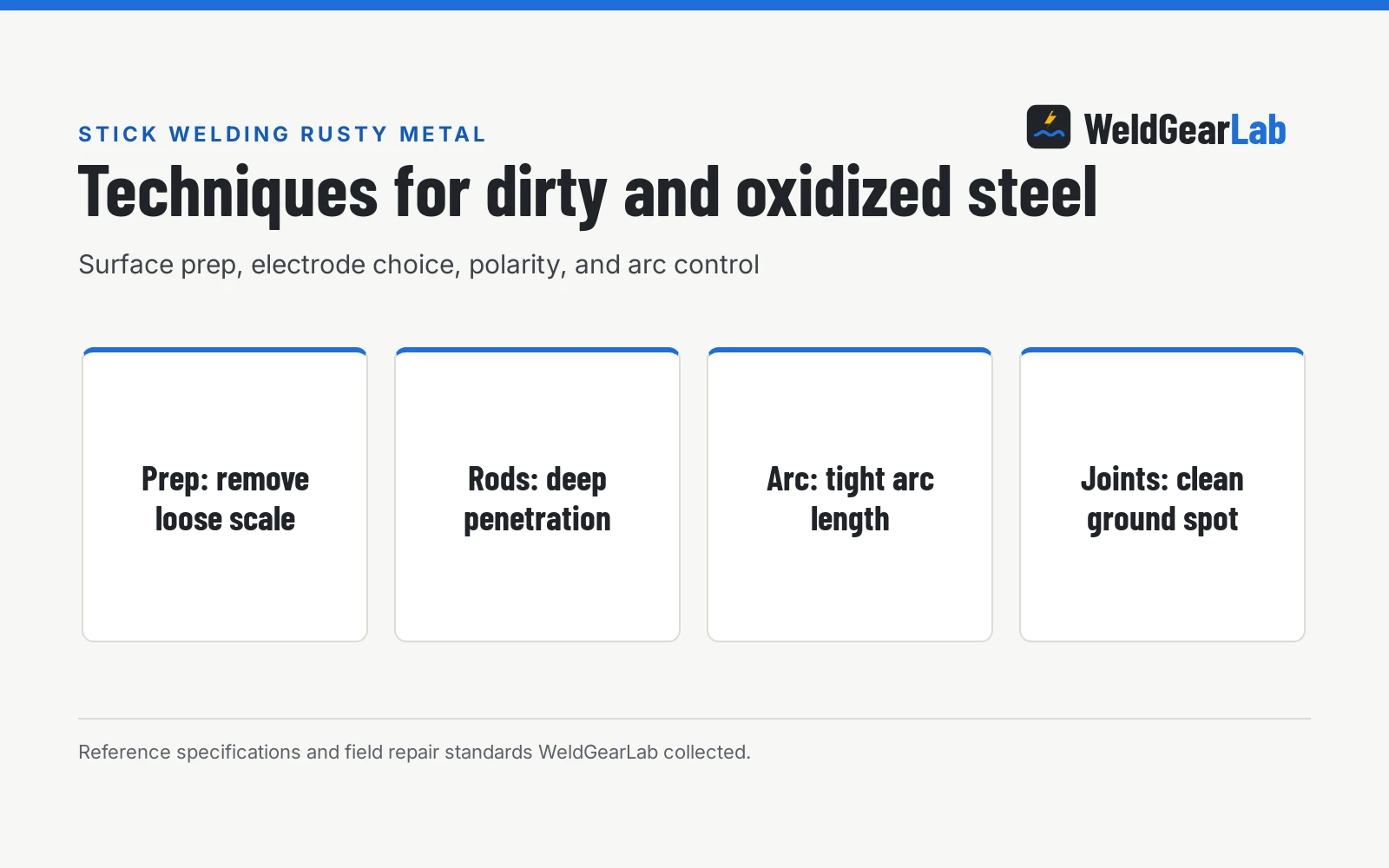
Learning how to stick weld rusty metal requires understanding how shielded metal arc welding penetrates through surface oxides and when cleaning remains mandatory. Stick welding is the most forgiving arc process for weathered or oxidized steel because its flux coating generates a vigorous, digging arc and protective gaseous shield. While heavy, flaking scale must always be removed with mechanical scraping to reach sound base metal, light surface oxidation can be handled directly by running fast-freeze cellulosic electrodes with suitable machine settings and a tight arc length.
As an Amazon Associate I earn from qualifying purchases. This guide links to our product roundups, where WeldGearLab earns a commission when you buy through links, at no extra cost to you. Read our affiliate disclosure.
The core process in brief
Atmospheric oxygen and moisture react eagerly with molten steel, causing gas porosity and trapped slag inclusions in an unprotected puddle. Shielded metal arc welding counters this contamination through the chemistry of the electrode coating. As the core wire melts, the decomposing flux creates an expanding gas shield that displaces air from the molten puddle. Chemical scavengers and deoxidizers in the flux combine with oxidized impurities, floating them safely to the surface where they solidify as a removable slag crust.
When repairing weathered equipment frames, implement brackets, or outdoor fences, operators often rely on the best stick welder for farm use because stick machines handle contaminated steel far better than wire feed systems. The intense, concentrated heat of a stick arc vaporizes superficial surface moisture and cuts through light surface oxidation that would cause severe porosity in a solid-wire MIG puddle. However, stick welding cannot replace lost base metal: severely pitted or flaking rust still requires mechanical cleanup to uncover sound steel.
Side by side
| Stick Welding (SMAW) | Flux-Cored Wire (FCAW) | Solid-Wire MIG (GMAW) | |
|---|---|---|---|
| Rust tolerance | High; forceful arc and flux deoxidizers tolerate moderate surface scale | Moderate; tolerates light surface oxidation | Low; rust causes severe porosity and cold lap |
| Surface preparation | Light scraping to knock off loose, flaking crust | Wire brushing to remove loose dirt and mill scale | Full grinding down to bright, virgin metal |
| Penetration through scale | Deep, aggressive arc cuts through superficial oxidation | Moderate penetration through surface contaminants | Shallow arc tends to sit on top of surface scale |
| Outdoor and wind tolerance | Unaffected by outdoor breezes or field conditions | Tolerates breezes well without external gas shielding | Breeze blows shielding gas away, creating pinholes |
| Shielding method | Vaporizing flux coating on the electrode | Vaporizing flux core within tubular wire | Compressed shielding gas from an external bottle |
| Slag and cleanup | Slag covers bead and requires chipping; cellulosic rods leave thin slag | Moderate slag blanket requires chipping and brushing | No slag blanket; minimal spatter on clean metal |
| Ground connection | Needs clean metal spot ground for clamp contact | Needs clean metal spot ground for clamp contact | Needs clean metal spot ground for clamp contact |
| Equipment portability | Compact power source and lead; no cylinder required | Wire feed unit and lead; no cylinder required | Requires cylinder, gas regulator, and delivery hose |
Electrode polarity depends on your chosen rod classification; always follow the recommended current type and polarity printed on the rod packaging and in your welder manual. Fast-freeze cellulosic rods typically run on direct current electrode positive or alternating current to maximize arc force, while other rod formulations may support straight polarity or alternating current for lighter steel sections.
When stick welding is the better choice
- Windy outdoor environments. Field repairs on farm gates, trailers, and heavy equipment frequently happen in gusty breezes where external shielding gas blows away instantly. Stick flux generates continuous shielding directly at the arc puddle.
- Weathered, painted, or rusted steel. Unlike solid wire that demands spotless, shiny metal, stick electrodes carry chemical deoxidizers that tolerate moderate surface scale.
- No gas bottles or regulators required. Stick welding runs from a basic power source, an electrode holder lead, and a ground clamp, eliminating bulky cylinders, gas hoses, and fragile flowmeters.
- Deep penetration on heavy plate. A digging stick arc drives heat deep into heavy steel sections, penetrating through surface scale to fuse the root of the joint securely.
For shop and field fabrication, our comprehensive guide to stick welders covers machine styles from compact inverter units to heavy transformer equipment.
When mechanical cleaning is the better choice
- Heavy, flaking scale. Thick sheets of crumbling rust act as an electrical insulator, preventing smooth arc ignition and trapping large slag voids inside the bead.
- Critical structural or load-bearing joints. Suspension brackets, trailer hitches, and lifting eyes demand complete joint integrity without oxidized inclusions or weakened cross-sections.
- Deep pitting that thins the wall. When rust has eaten deep into the base metal, you must grind down to sound steel to gauge remaining material thickness before applying heat.
- Finished appearance and painting. Weld beads deposited over rust produce rougher ripple patterns and heavier spatter that require extensive post-weld dressing before painting.
How to stick weld rusty metal
Achieving sound welds on dirty or oxidized steel follows a predictable shop-floor sequence. Rushing past basic setup leads to sticking rods, wandering arcs, and internal defects.
- Knock off loose, flaking crust. Take a chipping hammer, scraper, or stiff wire brush to remove thick, loose flakes. You do not need ground, mirror-bright metal across the entire joint for stick welding, but you must knock away loose flakes that would contaminate the puddle.
- Create a bright ground connection. Never attach your ground clamp over rust, paint, or mill scale. Grind a bare, shiny spot on the metal right beside the repair area to guarantee steady electrical flow and prevent arc wander.
- Select a fast-freeze cellulosic electrode. Electrodes with heavy cellulose in their coatings generate an aggressive, forceful arc that digs through oxidation and floats impurities out of the puddle.
- Adjust heat settings for joint conditions. On sound, heavy steel, setting machine output slightly higher than normal clean-steel settings helps the arc cut through surface scale and maintain puddle fluidity. On steel thinned by rust, keep heat moderate to avoid blowing through weak sections.
- Maintain a tight arc length. Long-arcing over rusty steel allows air to breach the flux envelope, generating porosity and spatter. Keep the rod tip close to the puddle to concentrate heat and maintain dense gaseous shielding.
- Clean each pass thoroughly. When depositing multiple layers, chip away every trace of slag and run a wire brush over the bead before striking the subsequent arc. Leaving slag behind traps glass-like pockets inside the joint.
Which electrodes handle rust best
Electrode flux composition determines how effectively an arc handles surface scale, grease, and oxidation:
- Cellulosic electrodes. These rods feature a paper-pulp and wood-flour coating that produces a harsh, penetrating arc with rapid puddle freezing. They dig through dirty steel and moderate surface rust effectively, making them a common choice for outdoor pipeline and farm repair. The resulting bead has rougher ripples and leaves thin, friable slag.
- Rutile electrodes. Formulated with titanium dioxide, rutile electrodes deliver a smooth, quiet arc, low spatter, and an easily removable slag shell. They tolerate mild oxidation and work well for light fabrication, but they lack the digging force needed to blast through heavy field rust.
- Iron powder electrodes. Heavy iron powder additions increase deposition rates and bead smoothness, but fluid, high-deposition puddles can trap molten slag if pushed across dirty scale.
- Low-hydrogen electrodes. Designed for high-strength structural fabrication, low-hydrogen coatings produce dense, ductile weld metal that resists cracking. However, low-hydrogen rods are exceptionally sensitive to moisture and rust. Welding over oxidized steel with low-hydrogen electrodes creates severe pinhole porosity, so joints must always be ground clean first.
Ventilation and safety precautions
Welding over rusted, painted, or weathered steel generates significantly more hazardous airborne smoke and particulates than welding clean metal. Thermal decomposition of rust, moisture, mill scale, and old coatings produces toxic fumes that can irritate respiratory passages. Always position your work area to keep your helmet out of the rising plume, weld outdoors or under mechanical ventilation, and wear a fitted welding respirator beneath your hood.
Chipping slag from welds on rusty metal poses distinct physical hazards. Slag blankets over contaminated beads can trap localized steam pockets, causing hot flakes to pop off unpredictably as the bead cools. Always wear impact-rated safety glasses with side shields under your welding helmet, and leave them on while chipping and brushing. Keep a dry chemical fire extinguisher nearby, and clear dry vegetation, wood shavings, and flammable solvents from your workspace before striking an arc.
Frequently Asked Questions
Can you stick weld directly over heavy rust?
You should never weld directly over loose, flaking rust because thick scale prevents solid electrical contact and contaminates the puddle with slag pockets. While stick welding tolerates light surface oxidation better than wire processes, loose rust must be scraped away with a wire brush or chipping hammer before striking an arc. Clearing loose flakes down to solid base metal ensures the arc penetrates sound steel rather than popping against crumbling crust.
Which electrode coating works best on dirty steel?
Cellulosic flux coatings deliver a forceful, digging arc that cuts through surface scale and helps float rust impurities effectively. Fast-freeze electrodes allow operators to manipulate the puddle across contaminated joints without trapping molten slag beneath the bead. Rutile and iron powder coatings produce smoother beads on clean joints, but cellulosic rods remain the preferred choice for weathered repairs.
Where should the ground clamp be attached on rusty metal?
The ground clamp must always be attached directly to clean, bare steel rather than clamped over rust or paint. Even a powerful welding arc cannot establish a steady circuit if current cannot flow cleanly through the ground connection. Grind or file a small bright patch on the workpiece near the repair area to secure solid clamping contact.
Why does welding rusty metal create excessive spatter?
Rust contains trapped moisture and oxygen that turn into expanding gas pockets when exposed to the intense heat of the welding arc. These gas bursts pop violently through the molten puddle and throw droplets of molten filler across the workpiece. Removing heavy scale and maintaining a tight arc length helps stabilize the arc column and reduce spatter formation.
Do welds on rusty steel have higher risk of cracking?
Surface iron oxide introduces hydrogen and porosity into the cooling weld pool, which significantly weakens the crystalline grain structure of the joint. In critical or structural joints, this contamination can lead to brittle failures under dynamic stress or impact loads. For structural applications, always grind the joint bevels to bright clean metal before laying down root and filler passes.
Related: how to use a stick welder, best portable stick welder, stick welder AC vs DC, and how to strike an arc with a stick welder. Also see our advice on why welding rods keep sticking.
About the author
WeldGearLab Editorial is the editorial team behind WeldGearLab. We research product listings, specifications, safety listings and warranty terms, score every pick with the published Gear Score method, and correct errors when readers report them. We do not run our own shop trials; see How We Pick for exactly how picks are made.