Why Does My Welding Rod Keep Sticking?
Welding rods stick when arc length is too short, amperage is set too low, or striking technique hesitates on cold metal, and here is how to diagnose and solve it.
 By WeldGearLab Editorial
Updated October 9, 2026
By WeldGearLab Editorial
Updated October 9, 2026
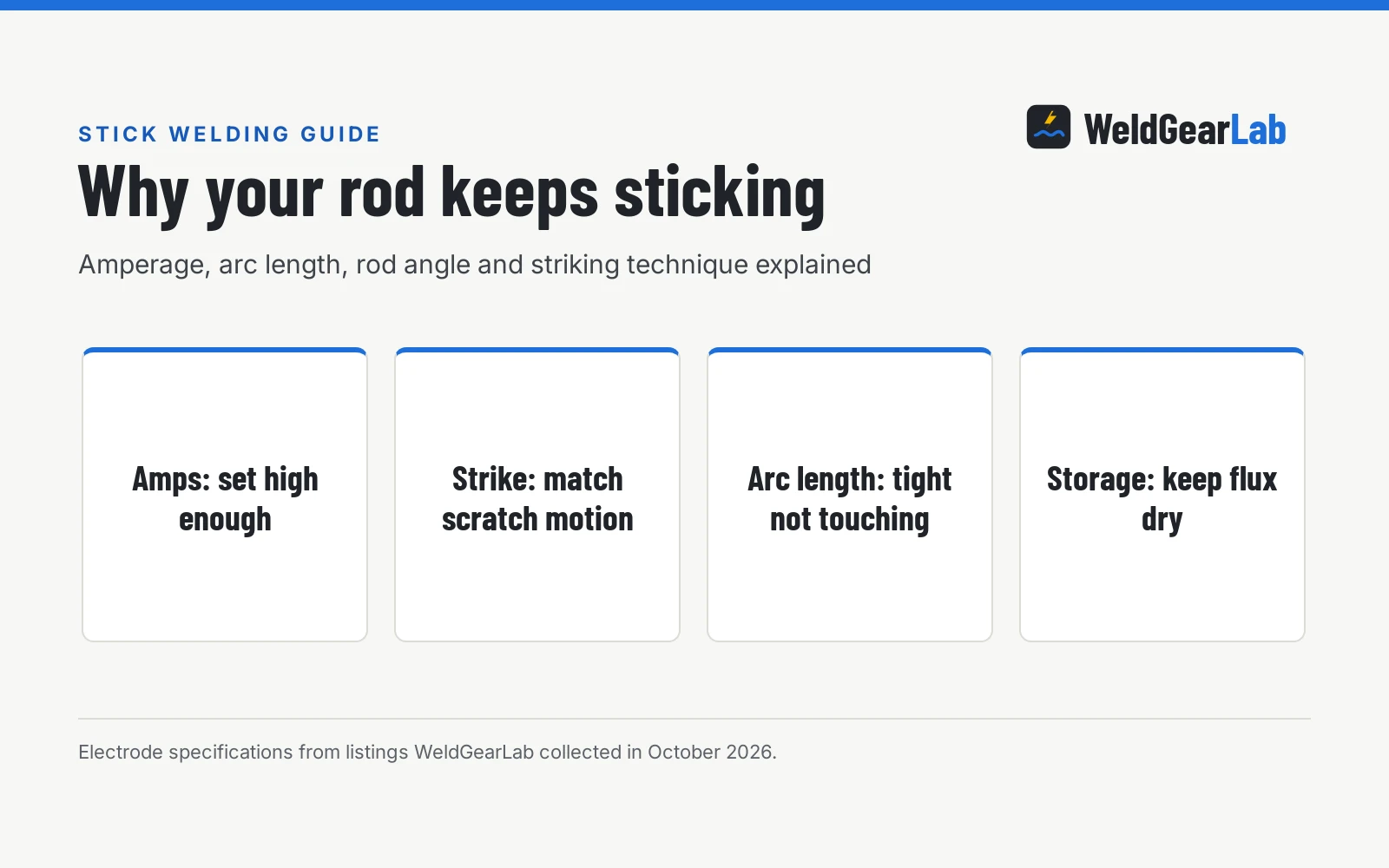
If you are asking why does my welding rod keep sticking, the core problem is that the rod makes direct contact with the workpiece without enough heat to establish an electric arc. Sticking happens when your amperage is set too low, your arc length collapses into the puddle, or your striking stroke hesitates on cold steel. When the rod touches the base metal without an active arc, the electrical circuit shorts out, the core wire fuses to the work, and the electrode freezes instantly.
As an Amazon Associate I earn from qualifying purchases. This guide links to our product roundups, where WeldGearLab earns a commission when you buy through links, at no extra cost to you. Read our affiliate disclosure.
Why does my welding rod keep sticking
When striking an arc, the electrode must scratch or tap the base metal to start current flow, and then lift immediately to maintain an arc gap. If the tip stays pressed against the metal, the short circuit generates resistance heating that melts the contact point, fusing the core wire directly to the workpiece. Low machine amperage starves the arc of the energy needed to bridge that gap. A long cable run or loose ground clamp drops available voltage, making arc initiation even harder. Once stuck, current surges through the rod, heating the coating until you break the contact.
Side by side
| E6013 (1/8 inch) | E7018 (3/32 inch) | E7018 (1/8 inch) | |
|---|---|---|---|
| Flux coating type | Rutile coating for easy striking | Low-hydrogen iron powder coating | Low-hydrogen iron powder coating |
| Amperage recommendation | 80-130A listed by ELESEDI | 50-80A reference current by WISUNO | 100-125A by WISUNO, 115A-165A by TOOLIOM |
| Arc striking behavior | Easy arc strike and restart | Prone to sticking on cold starts | Needs firm scratch stroke to initiate |
| Arc length control | Tolerates slightly longer arc | Requires tight arc without contact | Requires tight arc without contacting puddle |
| Penetration profile | Shallow penetration on light steel | Moderate to deep penetration | Deep penetration on heavy plate |
| Moisture handling | Bake at 150°C – 170°C for 0.5 – 1 hour if damp (SUNSIMIAO) | ABS case (TASKZOOM) or bake at 350-380°C (WISUNO) | Bake at 350-380°C for 1 hour listed by WISUNO |
| Package rod length | 14 inches listed by ELESEDI | 14 inches listed by TASKZOOM and Buelkmag | 14 inches listed by TOOLIOM |
| Slag behavior on restrike | Fluid slag peels off cleanly | Slag crust forms over core wire tip | Heavy slag crust insulates tip on restrike |
| Primary sticking hazard | Hesitating before arc stabilizes | Tapping without immediate upward lift | Amperage dialled below maker recommended range |
Electrode choice changes how easily an arc ignites and stays lit. Rutile rods like E6013 run on lower open-circuit voltage and strike easily, making them common for light fabrication. Low-hydrogen rods like E7018 require higher starting heat and a steady short arc, which means beginners stick them more frequently on cold steel. Check the manufacturer guidelines on your rod packaging and welder faceplate for recommended current settings.
When amperage and arc length cause sticking
- Low welding amperage. Setting current below the rod diameter requirements prevents the arc from sustaining when you strike. Recommended current varies between manufacturers even for the same electrode classification: for 1/8 inch E7018, WISUNO specifies 100-125A while TOOLIOM lists 115A-165A. For 1/8 inch E6013, ELESEDI specifies 80-130A. If your machine is dialled below the specific range recommended by your rod maker, the cold arc cannot sustain itself and repeatedly freezes to the plate.
- Arc length pushed too close. A proper arc gap matches the diameter of the core wire. If your hand shoves the rod tip into the molten puddle, the liquid metal quenches the arc and welds the rod solid.
- Long arc flaring. Pulling the rod too far away raises arc voltage and destabilizes the plasma column. The arc snuffs out, and when you instinctively push back down, the rod sticks.
- Selecting the proper rod diameter for available power. Attempting to weld at very low machine output with an oversized electrode causes the rod to freeze because current density is too low to maintain an arc. WISUNO lists reference ranges of 25-40A for 1/16 inch and 40-60A for 5/64 inch electrodes, demonstrating that smaller diameters allow stable arc operation at lower machine amperages without sticking.
Our guide to the best stick welder for farm use highlights machines with responsive arc force controls that boost amperage automatically when the arc gap narrows.
When striking technique and electrode angle cause sticking
- The tapping hesitation. Pecking straight down like a bird pecking grain often causes the rod to bounce and jam directly into the molten spot. If your upward recoil is delayed, the rod freezes instantly.
- The match-strike stroke. Striking the electrode like lighting a large wooden match allows the tip to strike the surface along a curved arc. This keeps the rod in motion as current begins flowing, preventing fusion at the initial contact point.
- Travel angle drag. Holding the electrode perpendicular or dragging at too shallow an angle can cause the molten puddle and slag to crowd the rod tip. Maintaining a steady drag angle keeps the molten pool behind the arc. Reboot provides an electrode holder with grooved jaws at 45°, 90°, and 180° positions, allowing operators to clamp the rod securely at convenient working angles without slipping.
- Slag capping on restrikes. When an E7018 rod stops mid-bead, the flux cools into a glassy, non-conductive slag crust over the core wire. Tapping that insulated tip will not strike an arc; instead, you push harder until the rod shatters or sticks. Scratch or file the slag crust off the steel tip before attempting a restrike.
How to check machine polarity and ground clamp connection
Poor electrical continuity causes voltage drops that choke arc initiation. Inspect these hardware points:
- Ground clamp contact. A ground clamp attached over thick mill scale, heavy rust, or paint creates high electrical resistance. This causes a significant voltage drop across the connection, starving the arc of striking voltage and causing the rod to stick instantly. Always grind the clamp attachment point down to bare, shiny steel.
- Work clamp mechanical connection. A weak clamp spring or loose cable lug generates resistance and heat at the ground return point. Ensure the ground clamp jaw spring provides tight mechanical pressure and the ground cable is firmly tightened.
- Electrode holder condition. A loose or worn stinger fails to transfer current efficiently to the electrode core wire. High-capacity stingers like the Reboot holder are rated for 500 amp and feature grooved brass and copper jaws to clamp the rod firmly in 45°, 90°, and 180° positions, preventing resistance heating and voltage loss inside the holder handle.
- Machine polarity and current type. Common carbon steel stick electrodes, including products from TOOLIOM, WISUNO, ELESEDI, and SUNSIMIAO, are designed for AC and DC operation. On DC machines, running DCEP (direct current electrode positive) provides a stable arc and smooth metal transfer. Running an electrode on the wrong polarity or on an AC machine with insufficient open-circuit voltage makes arc initiation sluggish and prone to sticking. Always verify that your machine leads match the polarity specified on the electrode packaging.
Explore our complete stick welders hub for equipment setups, machine comparisons, and shop configuration advice.
Which electrode moisture controls stop sticking
Damp flux coatings absorb humidity from shop air, degrading arc characteristics and causing violent spatter, poor arc stability, and persistent sticking:
- Low-hydrogen storage requirements. E7018 electrodes rely on a basic flux coating designed to keep hydrogen out of structural steel. When exposed to ambient moisture, the flux coating absorbs water, making arc starts erratic and sticky. WISUNO specifies that its E7018 electrodes must be baked at 350-380°C for 1 hour and used immediately after baking to maintain weld quality.
- Protective cases. TASKZOOM supplies its 3/32 inch E7018 rods in a sealed ABS storage case built to block dust and ambient moisture between welding sessions. Keeping electrodes sealed preserves dry flux chemistry in humid shops.
- Rutile electrode drying. E6013 electrodes feature a rutile-based flux that tolerates normal atmospheric moisture better than low-hydrogen rods. SUNSIMIAO notes that its E6013 rods usually do not require baking, but if they become damp, baking them at 150°C – 170°C for 0.5 – 1 hour restores reliable arc striking performance.
Can you unstick a frozen electrode safely?
When an electrode freezes to the workpiece, react immediately to prevent damaging your machine or overheating your cables:
- Snap the holder sideways. Immediately roll your wrist with a sharp twist to break the core wire away from the weld puddle. The mechanical snap shears the small fusion point while the metal remains molten.
- Release the stinger clamp. If the rod will not snap loose immediately, open the stinger jaws to drop the electrode. Leaving a dead short circuit engaged overheats the welding transformer or inverter circuitry, melts cable insulation, and can blow breakers.
- Cut the stuck rod. Once released from the holder, break or cut the frozen rod off the plate with pliers or an angle grinder. Grind the remaining stub flat before striking your next arc.
Shop safety and electrical precautions. A shorted electrode heats up red hot within seconds and will ignite gloves or nearby shop debris. Always wear dry leather welding gloves and proper eye protection when freeing frozen rods. Keep cables untangled and ensure your work area is clear of flammables. Review our welding safety gear checklist for beginners to verify your protective equipment before striking an arc.
Frequently Asked Questions
Why does my rod stick when I scratch strike?
Scratching the rod like a match is the standard way to strike an arc, but dragging the tip too slowly allows molten filler metal to fuse directly to cold steel. If you drag the electrode without lifting the tip up as soon as sparks appear, the arc extinguishes and the rod freezes. Lift the electrode slightly the instant the spark catches to establish a stable arc gap.
Does low amperage make stick welding rods stick more?
Yes, insufficient amperage is a primary reason a stick rod sticks to the workpiece. When current is dialled too low, the arc lacks the electrical energy required to melt both the electrode and the base metal simultaneously. Increasing your machine output provides the heat needed to maintain an uninterrupted arc.
Why is E7018 harder to strike than E6013?
E7018 has a low-hydrogen flux coating containing iron powder, which requires higher starting heat and a strict short arc compared to rutile rods. After stopping mid-weld, E7018 also leaves a hard, non-conductive slag bead over the tip of the wire that prevents electrical contact. Breaking that hardened slag cap off the tip with a file or scrap plate restores metal-to-metal contact for a clean restrike.
Will dirty metal cause my welding rod to keep sticking?
Heavy rust, grease, paint, and thick mill scale act as electrical insulators that interrupt the flow of welding current. When the electrode scratches over contaminated steel, the arc flickers out and the rod binds against the surface. Cleaning your joint and ground connection down to bare metal with a wire brush or grinder eliminates striking resistance.
What should I do if my electrode glows red hot?
If an electrode glows red hot, it is locked in a direct short circuit that is pulling maximum machine current through the core wire. Release the stinger jaws immediately to cut electrical current to the rod, or switch off your power source if the holder is stuck. Discard the overheated rod because the intense heat ruins the chemical properties of the flux coating.
Related: how to use stick welder, welding rod amperage chart, best welding rods for mild steel, and stick welder AC vs DC. Also see our best portable stick welder review.
About the author
WeldGearLab Editorial is the editorial team behind WeldGearLab. We research product listings, specifications, safety listings and warranty terms, score every pick with the published Gear Score method, and correct errors when readers report them. We do not run our own shop trials; see How We Pick for exactly how picks are made.