Stick Welder vs MIG Welder for Farm Repairs
Stick and MIG welders suit different farm repairs: stick excels outdoors on dirty, thick steel, while MIG delivers cleaner welds on thin shop projects.
 By WeldGearLab Editorial
Updated October 9, 2026
By WeldGearLab Editorial
Updated October 9, 2026
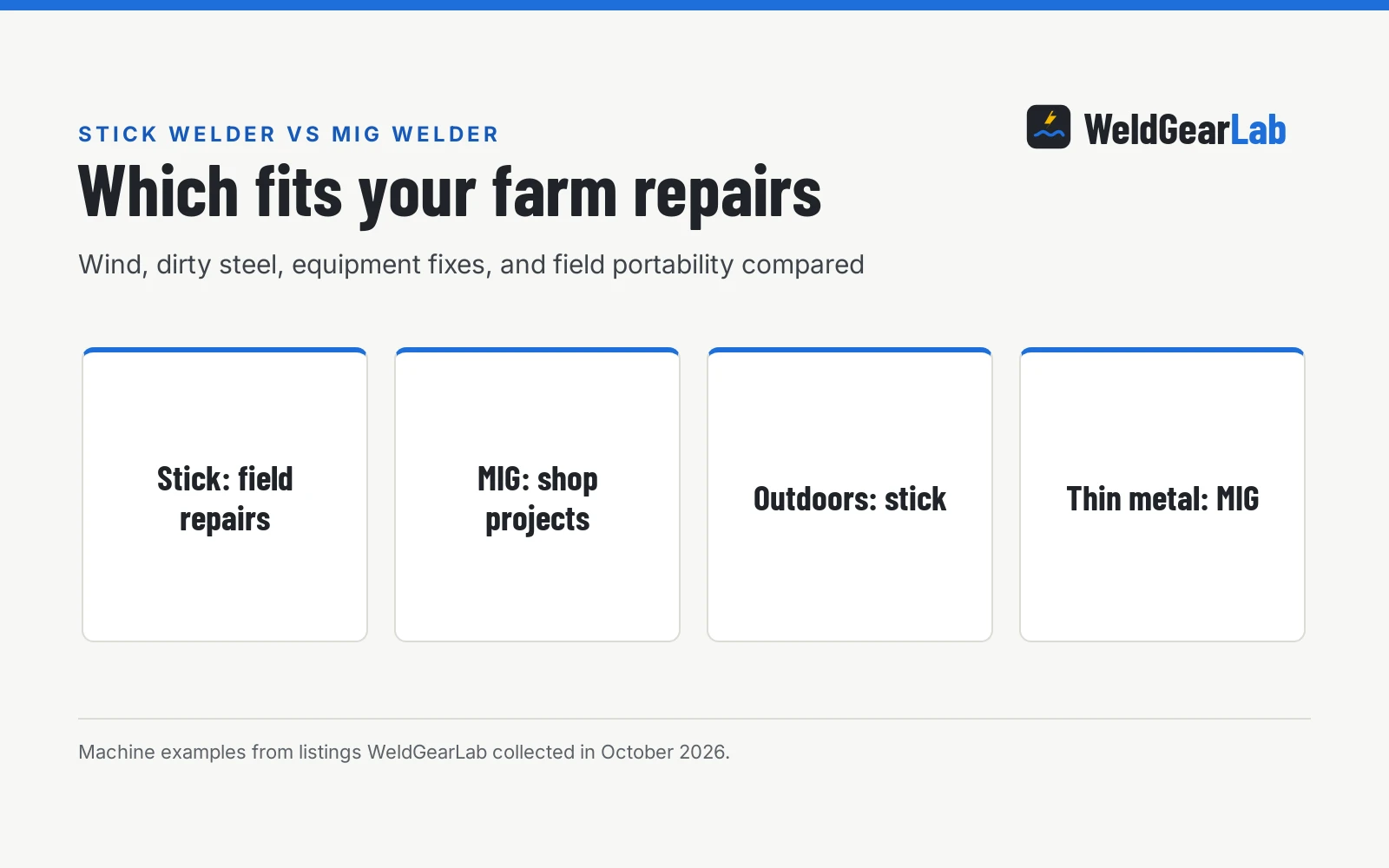
When comparing a stick welder vs mig welder for farm repairs, stick welding is usually the better choice for outdoor field repairs on rusty, painted, or thick steel equipment, while a MIG welder is ideal for indoor shop fabrication, clean steel, and thin sheet metal. Stick welders operate without an external gas cylinder, preventing gusty winds from ruining your arc when repairing implements, trailers, or fence lines in open pastures. In contrast, gas-shielded MIG welders feed continuous wire for fast, clean beads, but shielding gas quickly blows away in breezy outdoor conditions. This guide compares both processes across field durability, surface prep, material thickness, and portability.
As an Amazon Associate I earn from qualifying purchases. This guide links to our product roundups, where WeldGearLab earns a commission when you buy through links, at no extra cost to you. Read our affiliate disclosure.
Stick welder vs mig welder for farm repairs: the difference in one paragraph
The core difference between stick and MIG welding is how the molten puddle is shielded from atmospheric contamination. Stick welding uses a consumable steel electrode coated in chemical flux that burns in the arc to create protective gas and a solid slag crust over the bead. Gas MIG pushes solid steel wire through a gun while streaming compressed shielding gas from a cylinder over the joint. Because stick welding carries flux on the rod, it tolerates dirty metal and breezy weather without extra gear, whereas gas MIG demands clean surfaces and calm air to avoid porous joints.
Side by side
| Stick Welder (SMAW) | Gas MIG (Solid Wire) | Flux-Core MIG (Gasless) | |
|---|---|---|---|
| Shielding method | Flux coating on consumable electrode rod | Compressed shielding gas from cylinder | Flux core inside hollow wire |
| Wind and outdoor work | Tolerates gusty wind and open fields | Shielding gas blows away without shelter | Tolerates breezy outdoor conditions |
| Dirty or rusty steel | Forgiving on rust, dirt, and paint | Requires clean, bare ground metal | More forgiving than solid wire MIG |
| Metal thickness | Deep penetration on heavy structural steel | Best on thin sheet; multi-pass on thick plate | Good penetration on medium and thick steel |
| Field portability | Machine and cable leads only, no cylinder | Heavy cylinder, regulator, hose, and wire feed | Wire feed unit only, no gas cylinder |
| Cleanup and slag | Heavy slag layer to chip and wire brush | Minimal spatter and no slag to chip | Noticeable spatter and slag crust to chip |
| Fumes and smoke | Heavy smoke plume from burning flux | Lower smoke levels in ventilated areas | Substantial smoke plume from core flux |
| Equipment setup | Simple: clamp lead and insert electrode rod | Spool installation, drive roll tension, gas flow | Spool installation and knurled roll tension |
| Thin sheet and body panels | Difficult; high risk of burn-through | Easier with precise heat control | Higher heat than solid wire, risk on thin sheet |
Welding performance on farm equipment depends on operating conditions. Stick welding handles rough outdoor environments and weathered steel, while MIG provides faster speed and cleaner beads on prepared metal inside a shop. Always check machine settings and manual instructions before structural repairs.
When stick welding is the better choice
- Outdoor repairs in windy weather. Gates, corrals, and field implements cannot wait for calm air. Wind that blows away MIG shielding gas does not disturb a flux-coated stick electrode.
- Rusty, painted, or weathered steel. Farm equipment faces mud, weather, and rust. Stick electrodes burn through surface scale and contamination far better than fine wire, reducing prep time.
- Heavy structural steel. Thick sections on plow frames, loader buckets, and trailer hitches benefit from the deep penetration of stick welding.
- Simple field transport. Moving a stick machine to remote pastures requires only the power unit and cables, eliminating heavy gas cylinders on truck beds.
For dedicated field equipment, check our review of the best stick welder for farm use to compare top picks.
When MIG welding is the better choice
- Thin sheet metal and light tubing. Tractor body panels, hoods, fenders, and thin tubing easily burn through under stick arcs. MIG offers precise voltage and wire control that prevents blow-through.
- Clean shop fabrication. Building workbenches, feed bunks, and brackets from clean steel moves faster with continuous trigger feed than replacing stick rods.
- Minimal spatter and no slag chipping. Solid-wire MIG leaves no heavy slag to chip with a hammer, producing clean beads ready for paint.
- Smooth continuous passes. Spooled wire feed allows long uninterrupted seams without frequent electrode rod changes.
If you primarily fabricate new brackets and repair light equipment indoors, explore our guide to the best MIG welder for hobbyist workshops.
How to tell what a machine supports
Compact repair machines often combine several processes in one chassis. Checking listing specs clarifies what capabilities a welder provides before purchase:
- Stick vs multi-process wire units. Basic stick units include an electrode holder and clamp. Several machines combine flux-core wire feed and stick in one box. Cobowo lists a 250A unit supporting flux-core wire and stick welding with 3/32″ to 1/8″ rods, weighing 3.96 lb. XOFEKER lists a 20-250A handheld machine supporting 3/32″ and 1/8″ welding rods alongside flux-core wire, weighing 3.97 lb. These compact units are gasless and do not run solid wire.
- Dual voltage power. Farm shops often have 110V outlets alongside 220V receptacles. PONEY lists a 165A machine with dual-voltage 110V/220V power handling butt joints up to 3 mm (0.12 in) on 110V and 4 mm (0.16 in) on 220V, with stick starting at 1.5 mm. BESTMIG lists a 145A 110V/220V multi-process unit welding mild steel up to 3mm thick.
- Compact 110V portable machines. For barn outlet repairs, Acewelder lists a 140A 110V multi-process machine welding mild plate up to 4.0mm, while migbloom lists a 145 amp 110v unit claiming capacity up to 2/5 inch thick with wire feed speed adjustable from 120 to 420 inches per minute.
- Gas MIG vs gasless flux core. Not all wire units run gas. Pure flux-core machines lack gas solenoids and fittings. Units supporting true gas MIG, like the PONEY 165A listing, include a gas inlet and torch hose.
Review our guides on how to use stick welder and best portable stick welder for shop and field setups.
Which wire and gas for farm MIG welding
Wire choice dictates whether wire feed work can happen outdoors or inside the shop. Solid steel wire requires an external shielding gas cylinder of mixed argon and carbon dioxide to protect the puddle. This creates clean beads on fresh metal, but breezes disperse the gas envelope, causing porosity.
Self-shielded flux-core wire serves as a wire-fed alternative for field work without gas tanks. Flux inside the wire shields the puddle. Acewelder lists compatibility with .030″, .035″, and 0.040″ flux wire rolls up to 2.2 pounds, while PONEY includes .030″/.039″ flux wire with its 135A package. Flux-core wire tolerates outdoor air and surface rust, though it leaves slag to chip. See our roundup of the best flux core welder picks.
Can one machine do both?
Yes. Multi-process welders combining stick and wire feed in one chassis are widely available. Check whether the wire feed supports gas MIG or only gasless flux core. A gas-capable multi-process machine lets you run stick outdoors on heavy, rusty equipment and switch to solid wire indoors for clean fabrication.
Listings show multiple configurations: Cobowo and XOFEKER offer compact machines supporting 20-250A stick welding and flux-core wire, while PONEY lists a 165A dual-voltage unit supporting gas MIG, flux core, and stick with a 2-year warranty term. Acewelder lists a two-year coverage term on its 140A multi-process machine. A dual-voltage multi-process machine provides broad flexibility across field and shop chores.
Farm repair welding safety. Stick and flux core produce hot slag, sparks, and fumes. Chip slag away from your eyes with safety glasses on under your hood. Farm shops and barns contain flammable hay, straw, and fuels: clear flammable materials before striking an arc, keep a fire extinguisher nearby, and maintain ventilation. Secure shielding gas cylinders upright with a safety chain.
Frequently Asked Questions
Is stick welding stronger than MIG welding for farm equipment?
Both stick and MIG produce sound, durable welds when set up correctly and applied with proper technique. Stick welding is often preferred on farm machinery because its arc penetrates through rust, paint, and thick steel where MIG can experience lack of fusion. On clean joint preparations, both processes provide high strength.
Can I run a farm repair welder on a standard household outlet?
Many compact welders plug directly into a standard 110V household outlet for light repairs. Listings like the Acewelder 140A unit state 110V operation for mild plate up to 4.0mm, while PONEY rates its 110V capacity up to 3 mm (0.12 in). Heavy structural repairs on thick steel benefit from a 220V circuit with higher amperage.
Why is stick welding preferred over MIG in the field?
Stick welding requires no gas cylinder, making it lighter and simpler to carry to remote fence lines and pastures. While wire welders can run flux-core wire outdoors, stick welding handles heavily rusted steel with fewer feed complications. Wind does not blow away stick shielding because flux burns directly at the puddle.
What stick welding rod size is best for farm repairs?
On portable farm repair units, 3/32 inch and 1/8 inch rods are common sizes for carbon steel and equipment frames. Cobowo and XOFEKER both specify compatibility with 3/32″ and 1/8″ rods on their 110V portable units. A 3/32 inch rod suits lower amperage on thin tubing, while a 1/8 inch rod deposits more metal on heavier steel.
Which welder is easier for a beginner to learn for farm maintenance?
MIG welding is generally easier for beginners to strike and run beads because wire feeds automatically with a trigger squeeze. However, adjusting drive rolls, wire tension, and gas flow adds mechanical complexity. Stick welding requires more practice to strike the arc without sticking the rod, but equipment setup is simpler.
Related: how to choose a MIG welder, stick welder vs wire welder, stick welder AC vs DC, MIG welders category, and the stick welders hub.
About the author
WeldGearLab Editorial is the editorial team behind WeldGearLab. We research product listings, specifications, safety listings and warranty terms, score every pick with the published Gear Score method, and correct errors when readers report them. We do not run our own shop trials; see How We Pick for exactly how picks are made.