1/16 vs 1/8 Welding Rod: Which One Should You Buy?
A 1/8 inch rod for structural work and thicker steel, a 1/16 inch rod for thin stock and small machines, plus amperage, dryness and the four rod listings ranked.

On this page
Top picks at a glance
As an Amazon Associate I earn from qualifying purchases.
- 1
 Victory Welding Alloys 6010 Welding Rod 5/32" E6010 5/32" 59.6/10View on Amazon
- 2
 50 lb Steel Can E6010 5/32" Stick electrodes welding rod9.6/10View on Amazon
- 3
 Forney 31105 E6011 Welding Rod9.6/10View on Amazon
- 4
 ER70S-6 TIG Welding Rod 1/16" x 16"View on Amazon
- 5
 RG-45View on Amazon
- 6
 Mild Steel TIG Welding RodsView on Amazon
- 7
 Forney 30301 E6013 Welding RodView on Amazon
- 8
 YESWELDER TIG Tungsten Electrode Pre-Sharpened WeldingView on Amazon
- 9
 Forney 30705 E7018 Welding RodView on Amazon
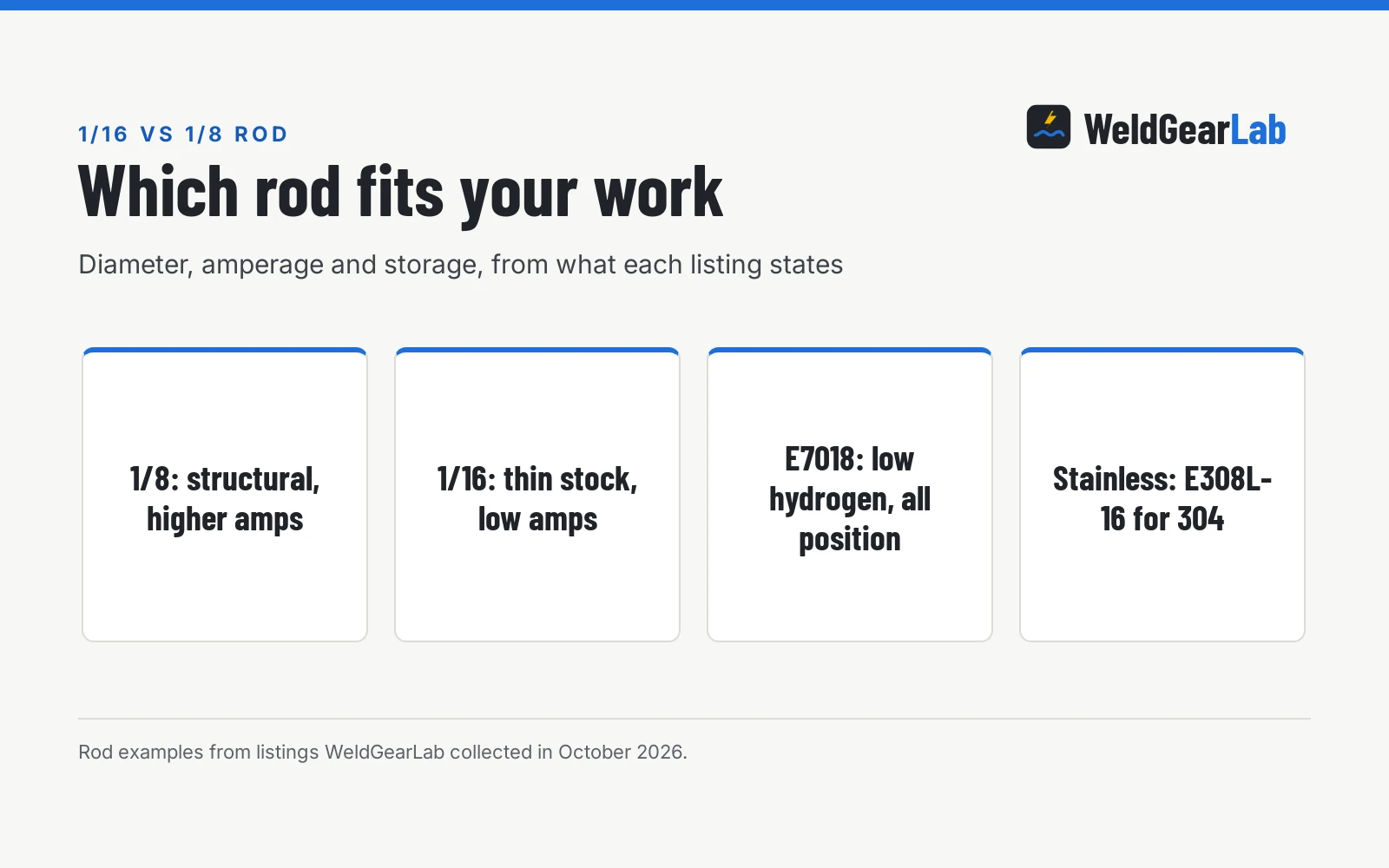
The short answer to 1/16 vs 1/8 welding rod: pick 1/8 inch when the work is structural and your machine can push the amps it needs; pick 1/16 inch for thin stock, low-amperage machines and detail work. The thicker rod lays down more metal per pass and handles heavier joints, while the thinner rod runs at lower settings and is kinder to thin metal. The four listings below give concrete examples of each.
Other welders and gear to compare
 ER70S-6 TIG Welding Rod 1/16" x 16"Check price on Amazon
 RG-45Check price on Amazon
 Mild Steel TIG Welding RodsCheck price on Amazon
 Forney 30301 E6013 Welding RodCheck price on Amazon
 YESWELDER TIG Tungsten Electrode Pre-Sharpened WeldingCheck price on Amazon
 Forney 30705 E7018 Welding RodCheck price on Amazon
This guide links to our product roundups, where WeldGearLab gets a commission on purchases made through links on this page, and your price stays the same. Read our affiliate disclosure.
The difference in one paragraph
Rod diameter sets how much metal a pass can deposit and how much current the rod needs. A 1/8 inch rod carries more current and fills a joint faster, which suits structural steel and thicker plate. A 1/16 inch rod runs on less current, starts easier on thin stock, and is the common choice where burn-through is the risk. Diameter does not change what a classification welds: E7018 stays a carbon-steel rod at any diameter, and E308L-16 stays a stainless rod. Diameter suits the metal thickness; classification suits the base metal.
When 1/8 inch is the better choice
- Structural and load bearing joints. Frames, brackets, trailers and anything that carries weight.
- Thicker steel. The larger puddle and deeper fusion suit thicker plate in one or two passes.
- Your machine has the amps. The YESWELDER listing below recommends 115A-165A for its 1/8 inch E7018; check your machine can reach that.
- All position work. Every E7018 listing here is rated for all positions, so overhead and vertical are covered.
When 1/16 inch is the better choice
- Thin stock. Sheet and light tubing where a 1/8 inch rod would burn straight through.
- Small or low-amp machines. The thinner rod runs at lower settings, which suits budget inverters.
- Stainless repair. The HARFINGTON listing below is a 1/16 inch E308L-16 for stainless steel, galvanized steel and maintenance work.
- Detail and tack work. Less heat per pass means more control on small joints.
The gear that matches each side, ranked
1. YESWELDER E7018, 1/8 inch, 10 lb. The top score here. Low-hydrogen E7018 rated for all positions on AC or DC reverse polarity, with a stated amperage window of 115A-165A, steady arc, low spatter and strong re-striking. The 10 lb pack suits anyone burning through rod on structural work.
2. Metal Marlin E7018 H4R, 1/8 inch, 5 lb. AWS A5.1 compliant with stated tensile strength of 70,000-84,000 psi and yield of 58,000+ psi. Vacuum packed to arrive dry, which matters for low-hydrogen rod. All positions, AC and DC, with easy slag removal.
3. ARCCAPTAIN E7018, 1/8 inch, 5 lb. Low-hydrogen E7018 rated for all positions on AC or DC reverse polarity, with high melting efficiency, a smooth stable arc and less spatter. Suited to structural steel, pipelines, bridges and fabrication. No amperage window or strength figures are stated.
4. HARFINGTON E308L-16, 1/16 inch, 10-rod pack. The only 1/16 inch example: a 10 inch stainless rod for 304 stainless and galvanized steel, all positions on AC or DC, with a listed package weight of 2.99 ounces. The listing says keep it as dry as possible. It is the maintenance and repair option of the four.
1/16 vs 1/8 welding rod: what the listings say about amperage
Only the YESWELDER listing states an amperage window: 115A-165A for its 1/8 inch rod. The ARCCAPTAIN, Metal Marlin and HARFINGTON listings state no amperage figures, which is a gap, not a guess. Size your machine to the one stated window and treat the others as compatible with machines in the same class.
Keep low-hydrogen rod dry
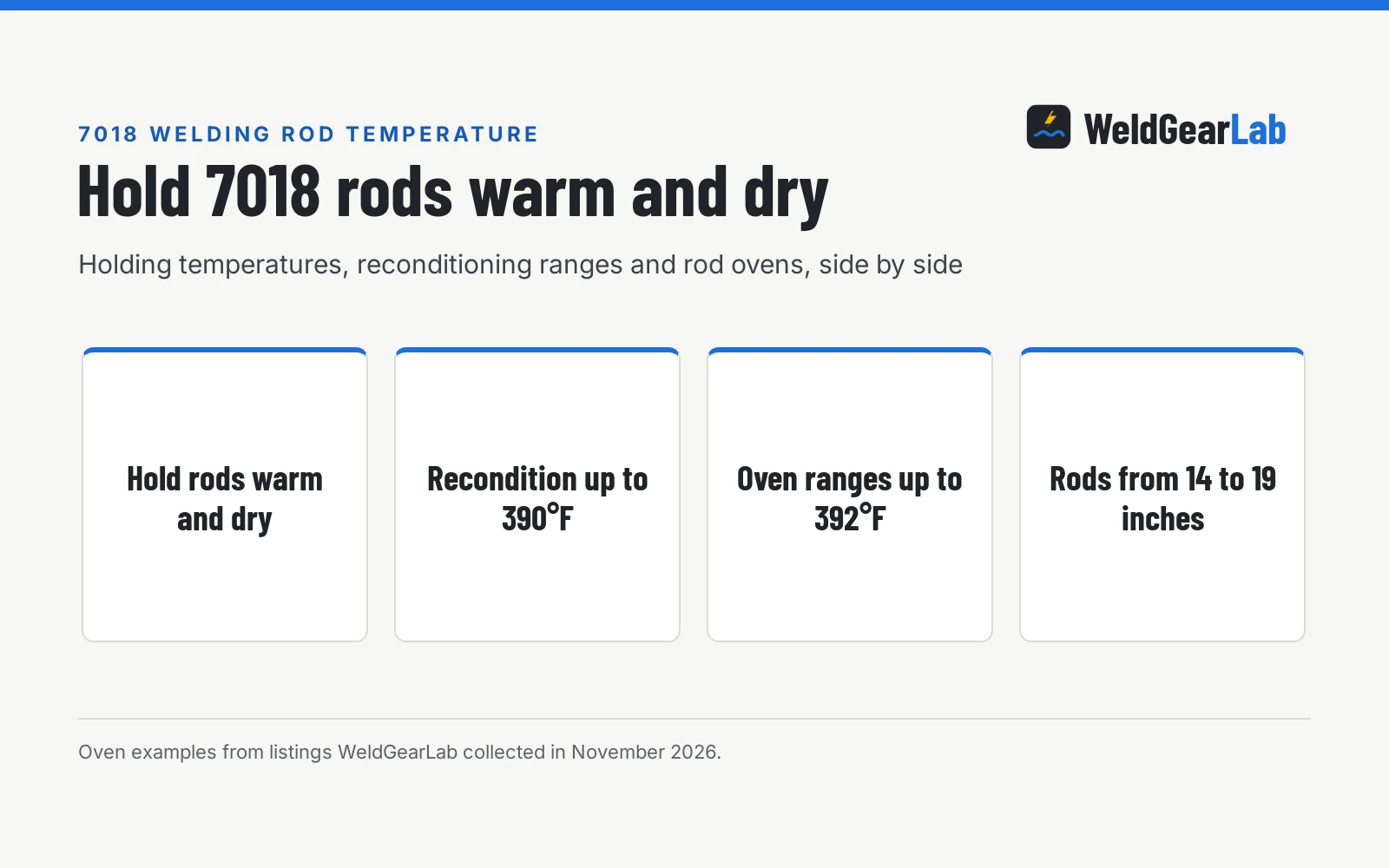
E7018 is a low-hydrogen electrode, and moisture ruins that property. The Metal Marlin listing ships vacuum packed to block moisture, and the HARFINGTON listing says keep it as dry as possible. The best welding rod storage guide covers tubes and cans that keep rod dry between jobs. Rod stored damp welds porous; if in doubt, warm and dry before striking.
Stick welding smoke, slag and heat. Stick welding makes fumes and spatter, and slag flicks off when chipped. Weld with good ventilation or outdoors with your head out of the plume, wear safety glasses under the helmet when chipping slag, and clear dry grass and anything flammable from the area. Wear a helmet with the right shade, leather gloves and flame resistant clothing. See the OSHA welding overview and our Safety Disclaimer.
Before You Strike an Arc
- Match the rod diameter to the joint thickness before you strike: too hot a rod burns thin stock.
- Check your machine reaches the 115A-165A window the YESWELDER listing states for 1/8 inch.
- Store E7018 dry; porous welds often trace back to damp rod.
- Chip slag fully before the next pass or painting.
FAQ for welders
Can I use 1/8 inch rod on thin metal?
Not well. A 1/8 inch rod carries too much heat for thin stock and burns through. Drop to 1/16 inch and lower settings for thin sheet and light tubing.
Is E7018 good for structural welding?
Yes. Every E7018 listing here is rated for all positions on structural and carbon steels, and the Metal Marlin example states 70,000-84,000 psi tensile. For load bearing or code work, have a certified welder do or inspect it.
What does low-hydrogen mean?
It means the flux is formulated to keep hydrogen out of the weld, which cuts the risk of cracking and porosity. That only works if the rod stays dry, which is why the Metal Marlin listing ships vacuum packed.
Can I weld stainless with E7018?
No. E7018 is for carbon and low-alloy steels. For stainless use the E308L-16 type, like the HARFINGTON 1/16 inch listing here.
How much rod do I need for a project?
Depends on joint length and thickness. The YESWELDER 10 lb pack suits heavy users; the 5 lb ARCCAPTAIN and Metal Marlin packs suit lighter or trial work; the 10-rod HARFINGTON is a repair-size pack. Buy more than you think for structural jobs.
Related: best welding rod storage, flux core vs stick for thick steel, best welding electrode holder for beginners, how to choose a MIG welder, best welder for beginners.