What Size Gas Bottle for Home Welding: How to Choose for Your Shop
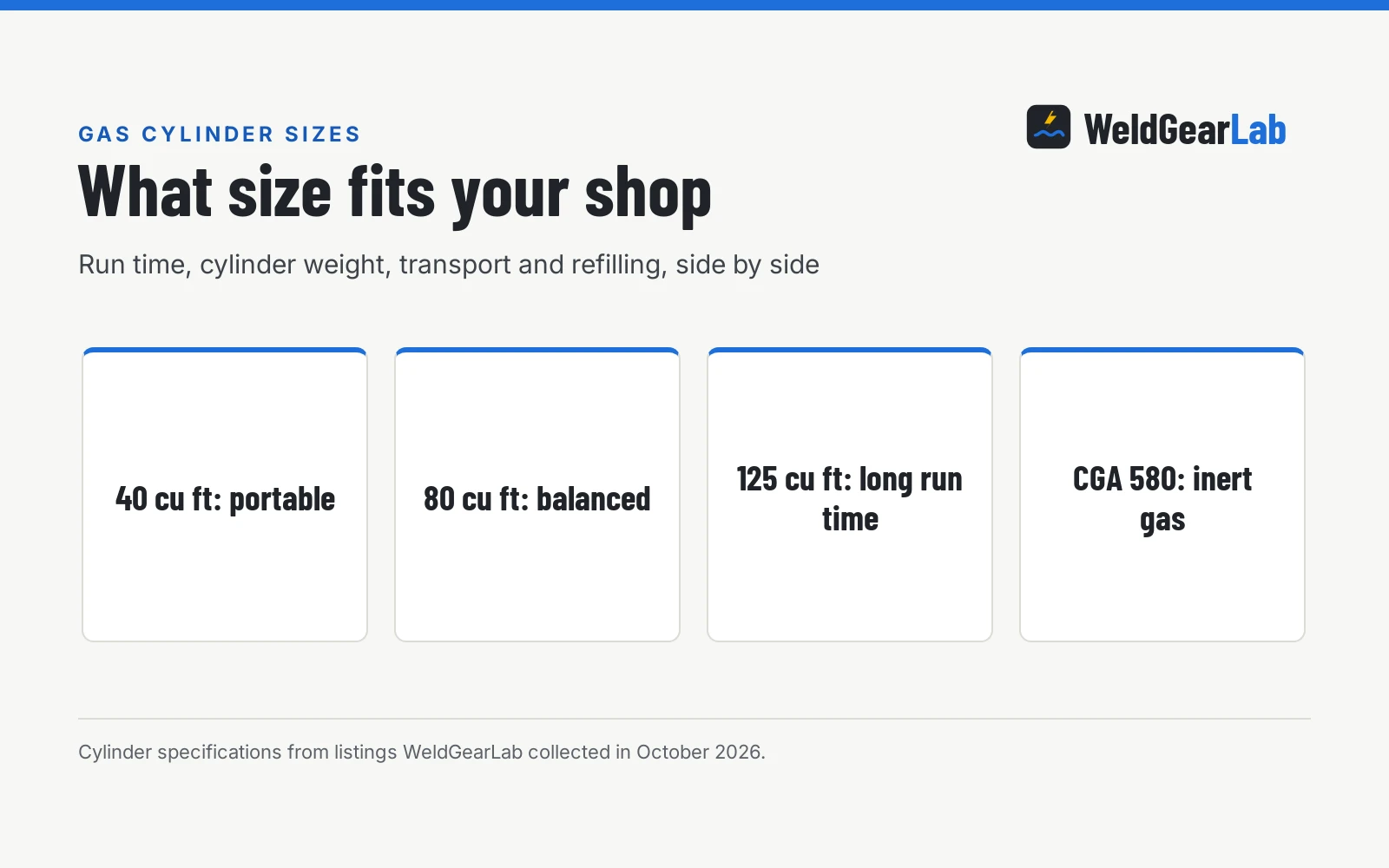
An 80 cu ft cylinder balances arc time and weight for home welding at 47 to 50 pounds, while 40 cu ft and 125 cu ft bottles suit mobile work and dedicated fab tables.

On this page
Top picks at a glance
As an Amazon Associate I earn from qualifying purchases.
- 1
 Forney 30686 E7018 AC Welding Rod9.5/10View on Amazon
- 2Forney 30685 E7018 AC Welding Rod9.5/10View on Amazon
- 3
 YESWELDER E7018 3/32'' 10LB Welding Rods Stick Electrodes Low9.4/10View on Amazon
When you set up a MIG or TIG welder in your garage, deciding what size gas bottle for home welding comes down to balancing arc time against cylinder weight. For most home shops, an 80 cu ft gas bottle balances arc time against cylinder weight at 47 to 50 pounds, and it must be secured for transport to refills at your local gas supplier.
This guide links to our product roundups, where WeldGearLab gets a commission on purchases made through links on this page, and your price stays the same. Read our affiliate disclosure.
What size gas bottle for home welding in one paragraph
Shielding gas protects molten weld puddles from oxygen and nitrogen in shop air. If you run out mid bead, the weld becomes porous and must be ground out. A 40 cu ft bottle is light at 30 pounds but empties quickly. A 125 cu ft bottle offers long run time but weighs 69 pounds. An 80 cu ft cylinder at 47 to 50 pounds sits between the 30 pound 40 cu ft bottle and the 69 pound 125 cu ft bottle.
Side by side
| 40 cu ft cylinder | 80 cu ft cylinder | 125 cu ft cylinder | |
|---|---|---|---|
| Gas capacity | 40 cu ft | 80 cu ft | 125 cu ft |
| Stated weight | 30 pounds | 47 to 50 pounds | 69 pounds |
| Diameter | 7 inches (C25 listing) | 7 inches | 7 inches (Weldfabulous listing) |
| Dimensions as listed | 6 x 1 x 22 inches (argon listing) | 7 x 7 x 31 inches (47 lb listing) | 6 x 1 x 46 inches (Kaplan listing) |
| Height | 22 inches | 31 inches | 46 inches |
| Stated pressure | Not stated | 2015 PSI service pressure | 3360 psi maximum pressure |
| Valve type | CGA 580 | CGA 580 | CGA 580 |
| Stamped inspection date | 10 year stamped date | 10 year stamped date | 10 year stamped date |
| Primary role | Mobile repairs and small carts | General home garage welding | Stationary shop fabrication |
Cylinder weights and dimensions come from manufacturer specifications. All high pressure cylinders for argon and argon mixes listed here use the standard CGA 580 valve connection.
When a 40 cu ft cylinder is the better choice
A 40 cu ft bottle weighs 30 pounds in these listings. The listings conflict on its size: one Weldfabulous 40 cu ft listing states a 7 inches diameter, while another Weldfabulous 40 cu ft listing states dimensions of 6 x 1 x 22 inches. The 6 inch dimension does not agree with the 7 inch diameter, so treat the exact diameter as unclear from these listings. Choose 40 cu ft for:
- Mobile indoor repairs. Transporting your welder to another sheltered shop at 30 pounds.
- Small carts. A compact bottle standing around 22 inches tall per its listed dimensions.
- Occasional welding. For infrequent small repairs, it saves shop floor space.
- Tacking and fit-up. Gas consumption is low during fit-up before final welding.
The downside is frequent refilling. On larger projects, a 40 cu ft bottle empties quickly.
When an 80 cu ft cylinder is the better choice
For most home shops, an 80 cu ft cylinder is the benchmark size in these listings. One 80 cu ft steel cylinder listing weighs 47 pounds tare weight, standing 31 inches tall with a 7 inches diameter and a 2015 PSI service pressure, while a Weldfabulous 80 cu ft listing weighs 50 pounds with a 7 inches diameter.
- Balanced run time. An 80 cu ft tank provides sufficient gas for multiple builds before refilling.
- Manageable weight. At 47 to 50 pounds, it weighs more than the 30 pound 40 cu ft bottle and less than the 69 pound 125 cu ft bottle.
- Standard cart fit. Commercial carts secure an 80 cu ft tank cleanly. See our guide to welding cart setup and our review of the welding cart with drawers.
When a 125 cu ft cylinder is the better choice
A 125 cu ft cylinder suits frequent fabricators. Kaplan Industries lists a 125 cu ft steel cylinder at 69 pounds with a maximum pressure of 3360 psi and dimensions of 6 x 1 x 46 inches. Weldfabulous also lists a 125 cu ft cylinder at 69 pounds with a 7 inches diameter. The listings conflict on size: the 6 inch dimension in the Kaplan dimensions does not agree with the 7 inch diameter on the Weldfabulous listing, so treat the exact diameter as unclear from these listings. Step up to 125 cu ft for:
- Heavy fabrication. Long projects consume gas quickly, and a 125 cu ft bottle prevents frequent downtime.
- Stationary shops. If your welder stays by a dedicated table, cylinder weight matters less.
- Long distributor drives. Larger capacity reduces trips to distant welding suppliers.
The drawback is weight. At 69 pounds and around 46 inches tall, loading it into a vehicle requires care.
The 60 cu ft middle ground
WPARHUS lists a 60 cu ft steel cylinder with a tare weight of 29 pounds, a 7 inches diameter, a height of 28.5 inches, and a service pressure of 2015 PSI. It offers more welding capacity than a 40 cu ft tank while keeping weight at 29 pounds. If your local distributor stocks 60 cu ft bottles, it provides a solid middle ground below the 50 pounds weight of an 80 cu ft tank.
How to choose between owning and leasing a cylinder
Home welders generally choose between purchasing an owner bottle and leasing from a supplier.
Purchasing an owner cylinder outright is usually best for home shops. Sizes like 40, 60, and 80 cu ft, and often 125 cu ft, are sold as customer-owned bottles with no recurring lease fees. Check with your local distributor before ordering online to confirm they refill or swap customer-owned tanks of that size.
Listings note high pressure steel cylinders include a 10 year stamped date and ship within 2 years of that date under DOT regulations. Distributors handle requalification when you exchange empty tanks.
Which gas for MIG and TIG on home projects
Gas choice depends on the process and metal. For mild steel MIG, 75% argon and 25% CO2 (C25) is standard, providing a stable arc and low spatter. Read our guide on what gas for MIG welding mild steel and our comparison of argon vs C25 gas for MIG welding.
For TIG on steel, stainless, or aluminum, or MIG on aluminum, you need 100% pure argon. Both C25 and 100% argon bottles use the CGA 580 valve connection. Connect a matching gas regulator for a welder to set flow.
Can one gas bottle do both MIG and TIG?
Pure 100% argon can TIG weld steel, stainless, and aluminum, and can MIG weld aluminum. However, pure argon on mild steel MIG produces an erratic arc and sluggish puddle.
A 75% argon and 25% CO2 mix works well for steel MIG, but contaminates tungsten if used for TIG. To run both steel MIG and TIG, keep dedicated bottles: an 80 cu ft tank of C25 and an 80 cu ft tank of pure argon. See how to choose a MIG welder and our comparison of flux core vs MIG if you want gasless outdoor welding.
Compressed gas cylinder safety. Cylinders hold high pressure, with listings stating 2015 PSI service pressure and maximum ratings up to 3360 psi. Always secure bottles upright with a chain to a cart or wall. Never move a cylinder without its threaded cap over the valve. Store tanks away from sparks and ground leads, and weld with good ventilation. See our welding safety gear checklist for beginners and review respirator requirements for welding.
FAQ for welders
What size gas bottle is most popular for home welding?
An 80 cu ft cylinder provides enough gas for multiple projects at 47 to 50 pounds.
How do I check the stamped inspection date on a cylinder?
High pressure cylinders carry a stamped date on the shoulder. Cylinders in these listings feature a 10 year stamped date under DOT rules. Suppliers verify this date when you exchange tanks.
How should I transport a welding gas bottle for refills?
Transport cylinders secured upright in a truck bed rather than an enclosed passenger area. Always thread the protective cap over the valve and strap the tank so it cannot move.
What valve connection do argon and C25 gas bottles use?
Argon and 75% argon with 25% CO2 cylinders use the CGA 580 valve fitting. Pure argon, helium, and nitrogen also share this connection. Regulators for inert gases thread directly onto CGA 580 valves.
Is a 40 cu ft gas bottle too small for a home shop?
A 40 cu ft bottle works well for occasional small repairs and portable jobs. For active fabrication, it empties quickly, making an 80 cu ft tank more practical.
Related: what gas for MIG welding mild steel, argon vs C25 gas for MIG welding, how to set gas flow rate for MIG welding, welding cart setup, and the welding consumables hub. Also see our guide on gas regulators for welders.