Welding Cart Setup: How to Arrange Your Machine, Gas, and Leads
A practical guide to welding cart setup covering machine shelf layout, gas cylinder safety, cable management, and storage for shop accessories.

On this page
Top picks at a glance
As an Amazon Associate I earn from qualifying purchases.
- 1
 Holdwell S Welding Cart9.7/10View on Amazon
- 2
 VEVOR Welding Cart9.6/10View on Amazon
- 3
 YESWELDER 2-Tier Welding Cart with 4 Drawers and Dual9.6/10View on Amazon
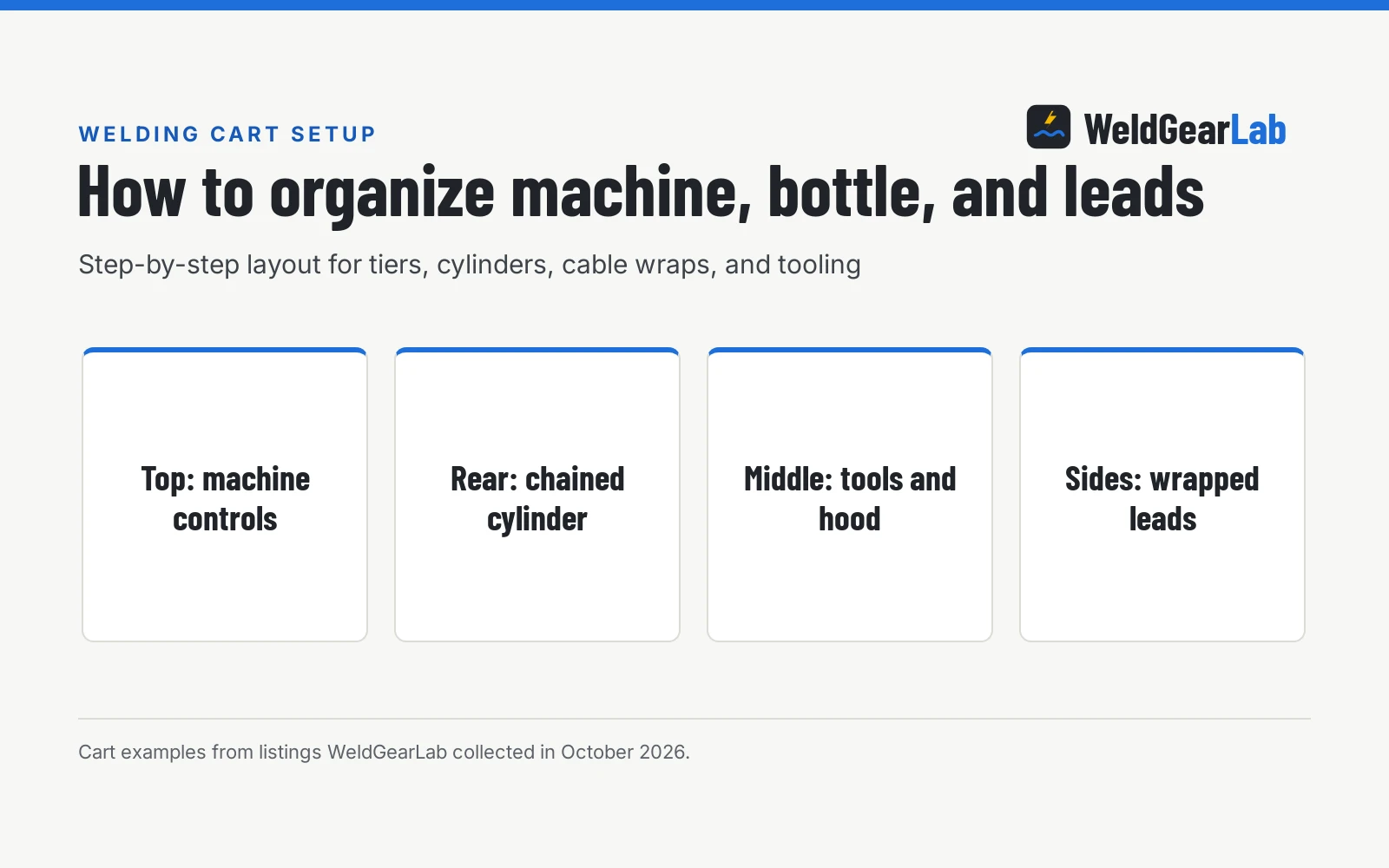
When you are fabricating a square-tubing cart frame or welding a cracked bracket on the bench, dragging leads across the shop floor and tripping over loose ground cables wastes time. A proper welding cart setup arranges your power source on the top shelf, straps the shielding gas cylinder upright on the rear platform, and hangs torches and ground leads on dedicated side brackets. Placing the welding machine on the upper shelf gives you immediate access to voltage and wire feed knobs, while the rear tank rack keeps high-pressure cylinders immobilized and safe from workshop traffic. This guide explains how to configure a rolling cart for MIG, TIG, or stick work, manage shop cables, and choose between open shelving and drawer storage.
This guide links to our product roundups, where WeldGearLab gets a commission on purchases made through links on this page, and your price stays the same. Read our affiliate disclosure.
Welding cart setup step by step
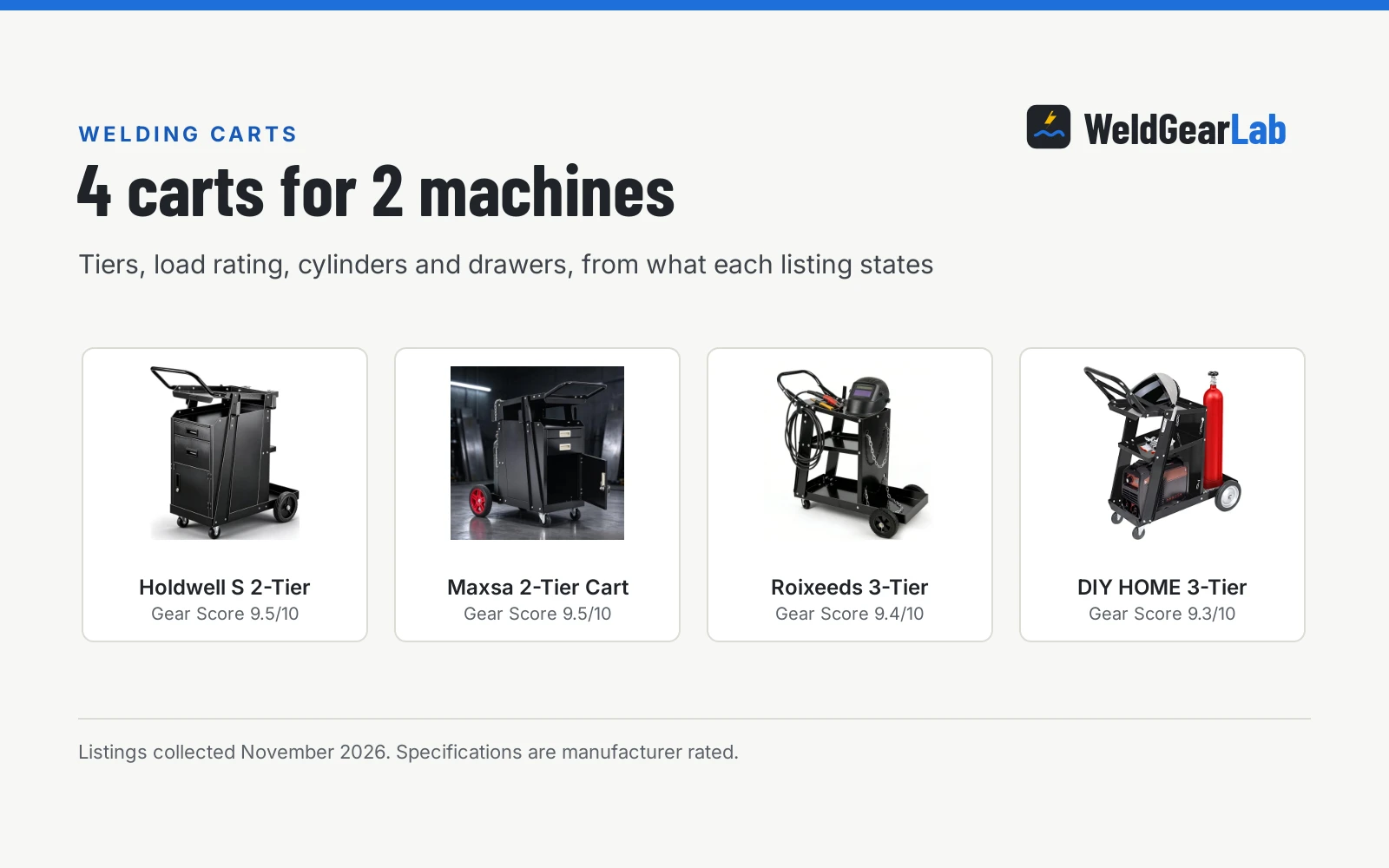
Setting up a welding cart begins with machine placement on the upper shelf. Trays range in size, from the VEVOR 3-tier cart with an upper tray measuring 11 x 18.1 in to the Weldpro cart with an upper tray measuring 20.9 x 13 in. Some models, such as the VEVOR 3-tier cart, feature an adjustable inclined top shelf that tilts the front panel upward toward your line of sight, making voltage controls, wire feed dials, and digital displays easier to read. Other models use a flat top tray. In either configuration, ensure your welder sits squarely inside the raised lips of the shelf so vibration does not shift the chassis during transport.
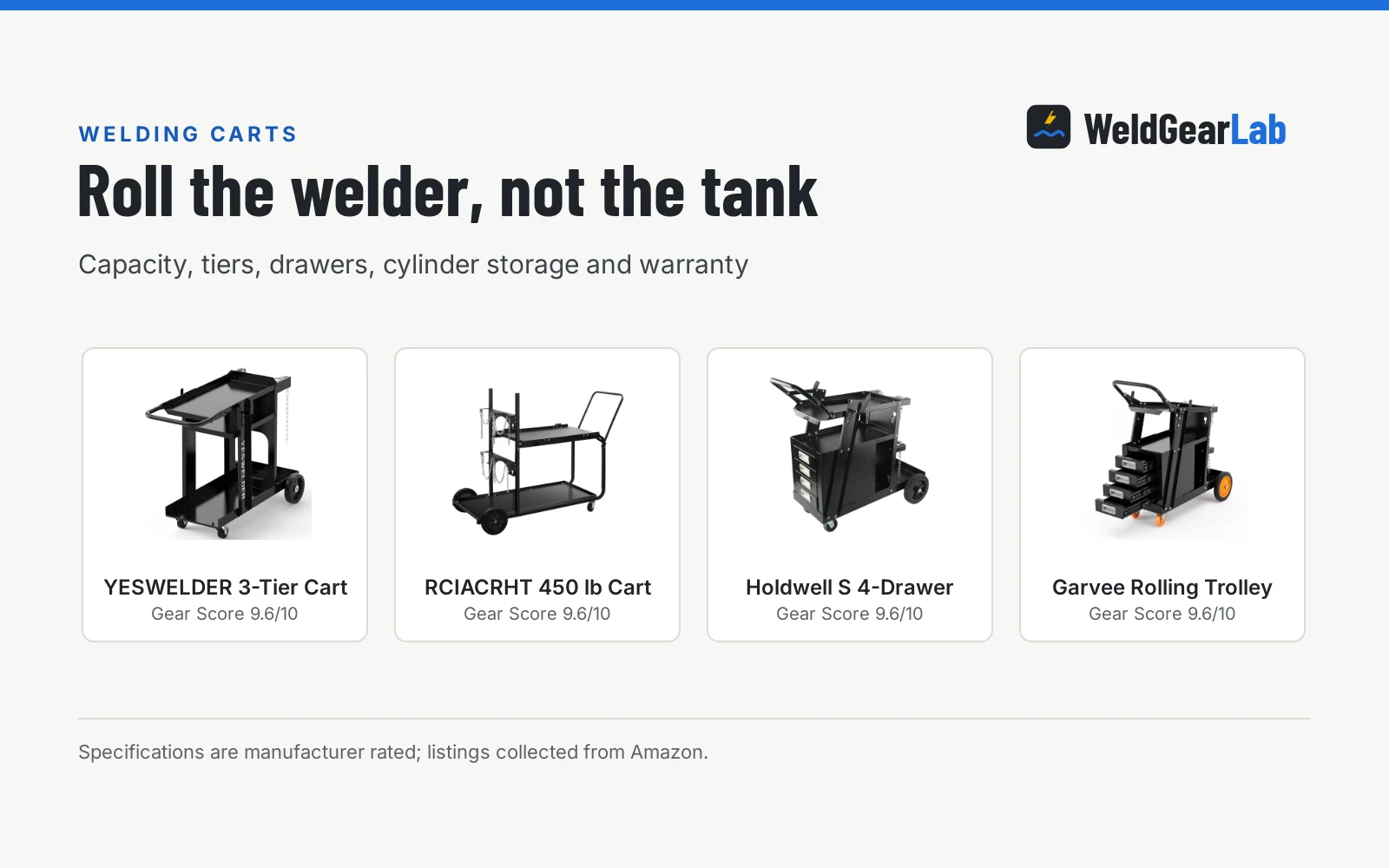
Next, install your shielding gas cylinder on the rear lower platform before connecting regulators or gas hoses. Cylinders must always remain upright. Secure the bottle against the cart frame using the provided safety chains. For example, HantekSteel includes a chain and a rack fitting cylinders up to 9.6 inches in diameter, while Weldpro equips its platform with two safety chains sized to hold cylinders up to 125CF. YESWELDER equips models like HJC-04 and HJC-03-3D with cylinder safety chains measuring between 29.13 inches and 31.10 inches in length. Fasten chains securely around the cylinder body to eliminate wobble when wheeling over thresholds.
Cable routing and torch storage come next. Hang the work clamp cable and torch lead on opposite sides of the cart using the side brackets. VEVOR and Weldpro provide four side brackets and hooks, while Garvee includes two brackets. Keeping the ground lead and MIG torch or TIG torch on separate sides avoids snarls and prevents sharp bends at the machine plug connections.
Finally, organize your middle and bottom shelves or drawers for auxiliary gear. The middle tray holds your welding helmet, gloves, chipping hammer, and wire brush. Lower trays provide space for spools of solid wire or spare steel plates.
Side by side
| Open 3-tier cart | Drawer cart | Cabinet cart | |
|---|---|---|---|
| Main equipment tray | Flat or inclined open upper shelf | Flat top shelf with side hooks | Flat top shelf or work surface |
| Enclosed storage | None, open middle and bottom shelves | Three or four sliding drawers | Lockable cabinet with drawers or shelf |
| Protection from grinding grit | Exposed to shop dust and spatter | Enclosed drawers shield small consumables | Enclosed cabinet seals out abrasive dust |
| Maximum static weight capacity | 350 to 400 lbs | 235 to 350 lbs | 265 to 350 lbs |
| Tare cart weight | 23.2 to 28.5 pounds | 43 to 86.1 pounds | 40 to 56.3 pounds |
| Gas cylinder mounting | Rear tray with one or two safety chains | Rear platform or dual slots with safety chains | Dual cylinder slots with safety chains |
| Security against tool loss | Open access, no lockable compartments | Concealed drawers without keyed locks | Keyed lockable cabinet for high-value gear |
| Primary shop role | Quick machine access and frequent shop moves | Organizing tips, nozzles, wire, and hand tools | Securing high-value torches, regulators, and PPE |
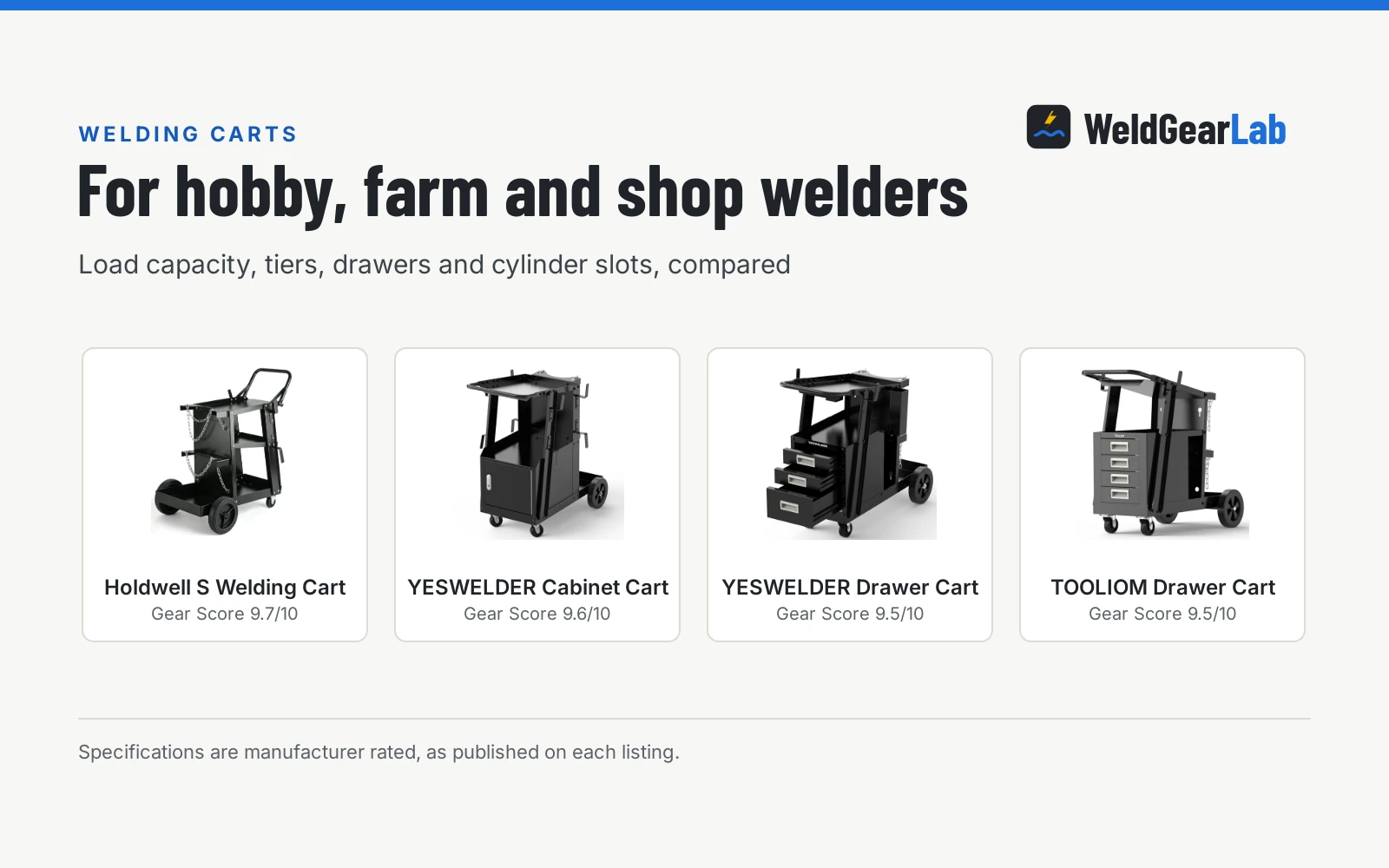
Choosing between an open 3-tier utility cart, a multi-drawer organizer, and an enclosed cabinet cart depends on your equipment and shop environment. Open carts roll easily with lighter chassis tare weights, such as Garvee at 28.5 pounds or VEVOR at 23.2 pounds. Drawer models like JEGS at 86.1 pounds or YESWELDER at 43 pounds keep consumables sorted, while lockable cabinet units like VEVOR WT-178 or YESWELDER HJC-04 at 40 pounds seal valuable regulators and torches away from grinding grit.
When an open 3-tier cart is the better choice
- Frequent relocation around the shop. Open carts carry less empty steel weight, rolling smoothly across floors on swivel casters.
- Tall machine clearance. Without enclosing drawer slides or upper cabinets, open middle trays accommodate bulky equipment, spools, or helmets.
- Heavy static loading. Open frames from makers like VEVOR, Weldpro, and Garvee support up to a 400-pound static load capacity and dynamic ratings up to 370 or 375 pounds.
- Straightforward assembly and maintenance. Fewer moving parts, sliding tracks, and latches mean quick initial setup and no drawer slides to bind with shop grit.
For dedicated layout and cutting tasks, pair an open cart with a sturdy work surface from our best welding table for a home shop guide, or mount a compact power source from our best MIG welder for hobbyist roundup.
When a drawer and cabinet cart is the better choice
- Protection from abrasive grinding dust. Metal fab shops generate grit from angle grinders that ruins open consumables. Enclosed drawers keep nozzles, contact tips, and tungsten clean.
- Tool and accessory classification. Multi-drawer carts like YESWELDER models with 3 drawers or 4 drawers separate pliers, magnets, squares, and consumables into dedicated compartments.
- Secure storage for valuable accessories. Models featuring a lockable cabinet, such as VEVOR WT-178 or YESWELDER HJC-04, secure expensive torches, regulators, and gauges from loss.
- Integrated welding rod storage. Certain drawer carts include dedicated vertical rod tubes to keep stick electrodes organized and within reach.
If you keep numerous specialty tips and hand tools near your welder, explore our best welding cart with drawers roundup to compare rolling models with heavy-duty slides.
Cylinder safety and secure tank mounting
Compressed shielding gas cylinders holding argon or carbon dioxide mixes represent a major shop hazard if tipped. Always keep the valve protection cap installed while loading a cylinder onto the cart. Once the cylinder is positioned on the rear platform, cinch the safety chains tight before removing the cap or attaching a regulator.
When tightening your gas regulator for welder connections, use an open-end wrench and check for leaks with an approved leak-detection solution. For rolling the cart short distances across smooth concrete floors, a secured cylinder with its valve closed can remain in place. If moving over rough thresholds, gravel, or loading the cart for transport, always close the cylinder valve, remove the regulator, and reinstall the threaded valve protection cap. Carts with two cylinder slots, such as YESWELDER units, allow transporting both a shielding gas cylinder and an auxiliary tank, provided both chains remain tensioned.
Cable management and ground lead routing
Proper cable management extends the service life of expensive torches and ground clamps. Avoid coiling welding leads in tight loops, and never operate a welding machine with excess cable tightly wound on cart brackets, as tightly coiled leads trap heat and introduce unwanted inductance into the welding circuit.
Instead, drape torch hoses and ground cables in wide, relaxed loops over the side brackets. Always position the cart so the ground lead reaches your workpiece without stretching taut across shop walkways. When pairing a multi-process power source from our best multi-process welder guide, use separate hooks for MIG guns, TIG torches, and stick electrode holders to prevent cable tangling.
FAQ for welders
How much weight should a welding cart hold?
A cart should comfortably hold your power source, a full gas cylinder, and essential tools without flexing. Open 3-tier models from VEVOR, Weldpro, and Garvee list static weight capacities up to 400 pounds, while drawer carts from YESWELDER support 245 to 265 pounds. Check your machine weight and add the weight of a full gas bottle to ensure your total load remains below the maker’s stated limit.
Can a welding cart hold two gas cylinders?
Certain carts feature rear platforms designed specifically for dual tanks. Models from VEVOR and YESWELDER include two cylinder slots and separate safety chains to accommodate two bottles, such as argon and a carbon dioxide mix. If your cart only features a single cylinder slot or one safety chain, like HantekSteel’s single-chain tray fitting up to a 9.6-inch diameter bottle, never attempt to squeeze a second cylinder onto the platform.
Should a welding machine sit flat or tilted on the cart?
Both designs work well depending on machine size and door clearance. An inclined top shelf, like the adjustable upper tray on VEVOR 3-tier carts, tilts the front display and control knobs toward your line of sight. However, flat trays on carts like Weldpro or YESWELDER provide stable universal support and ensure side doors for wire spools can open without hitting cart handles or raised lip edges.
How do you keep grinding dust out of welding cart drawers?
Position your grinding station away from your cart and avoid directing sparks toward the drawers. Carts with closed drawer faces and lockable cabinets provide far superior dust shielding compared to open wire or steel shelves. Periodically wipe down drawer slides to prevent abrasive dust from accumulating in the grease and binding the ball bearings.
What wheel configuration works best on a welding cart?
A combination of front swivel casters and larger fixed rear wheels delivers the most stable maneuverability in a shop. Front 360-degree swivel casters allow sharp turns around tables and machinery, while fixed rear wheels keep the cart tracking straight when pulled by the handle. For example, VEVOR specifies two 2.9-inch front swivel casters paired with two 7-inch rear wheels, providing smooth rolling over concrete seams and minor floor debris.
Related: best welding cart with drawers, best welding table for a home shop, best MIG welder for hobbyist, and the welding tables and carts hub. Also see our guide on how to set up a welding area in a home garage.