Tubing Notcher vs Hole Saw Jig: Which One Should You Buy?
Tubing notcher vs hole saw jig: dedicated notchers with angle adjustment that varies by listing against a simple drill-press jig, compared with figures from eight listings.

On this page
Top picks at a glance
As an Amazon Associate I earn from qualifying purchases.
- 1
 Tube Notcher 9/16-2in Pipe Notcher 40-90 Degree Hole Saw Tool9.5/10View on Amazon
- 2
 EZARC Carbide Hole Saw Heavy Duty9.7/10View on Amazon
- 3
 Professional Tube & Pipe NotcherView on Amazon
- 4
 Allstar Performance ALL10411 Tubing Notcher Brand: AllstarView on Amazon
You are building a roll cage, a bike frame or a tube steel table, and every joint needs a fish-mouth cut that hugs the mating tube. Tubing notcher vs hole saw jig comes down to how the hole saw is held. A tubing notcher is a dedicated frame that clamps the tube and feeds it into a hole saw at an adjustable angle. A hole saw jig is a simpler guide that steadies the saw, usually in a drill press, while you hold the work. For repeated, accurate notches, the dedicated notcher wins; for the occasional single notch, the jig gets you there.
Other welders and gear to compare
 Professional Tube & Pipe NotcherCheck price on Amazon
 Allstar Performance ALL10411 Tubing Notcher Brand: AllstarCheck price on Amazon
This guide links to our product roundups, where WeldGearLab gets a commission on purchases made through links on this page, and your price stays the same. Read our affiliate disclosure.
Tubing notcher vs hole saw jig: the short answer
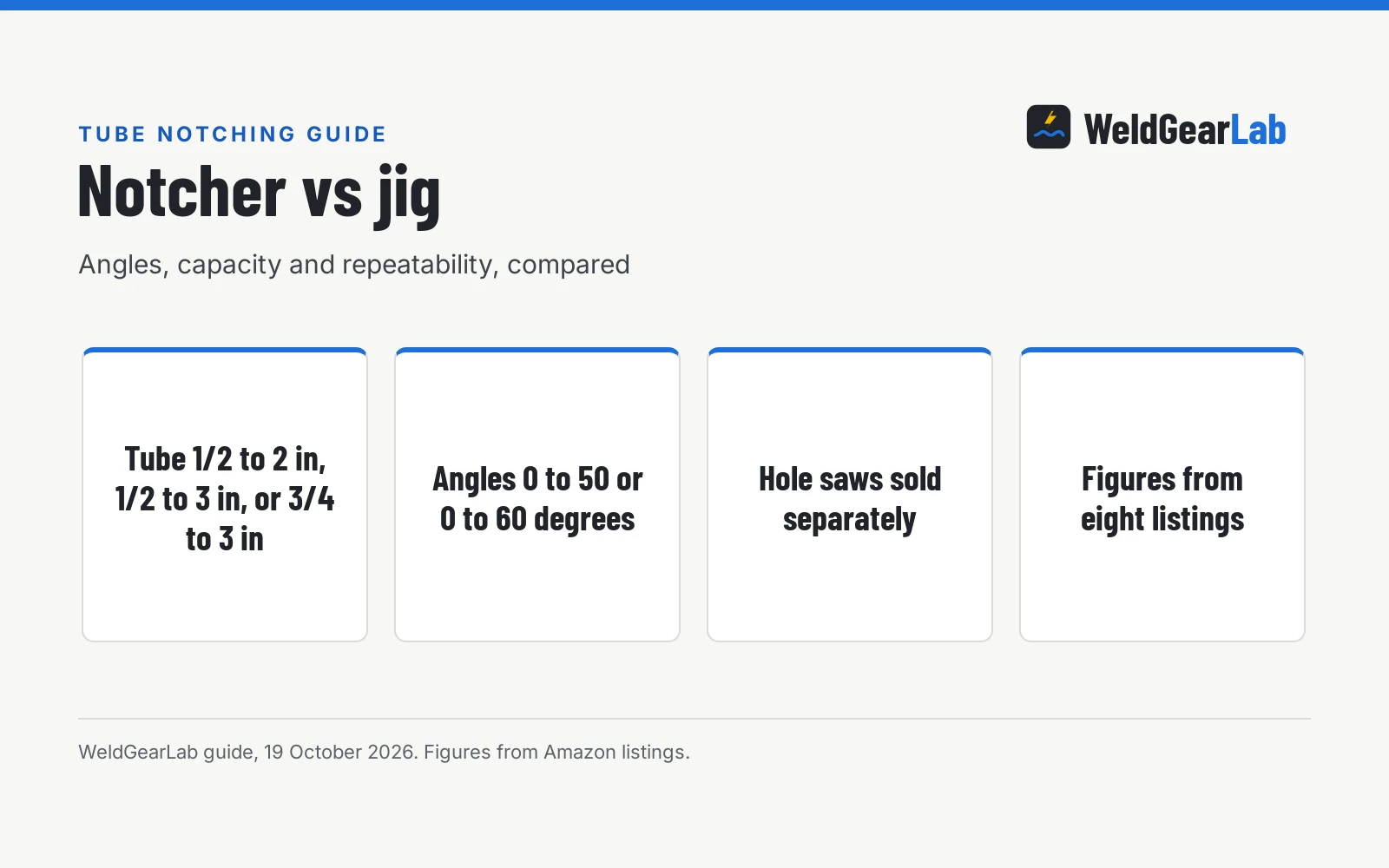
Choose the tubing notcher when notching is a regular job. The listings show the format: tube capacity of 1/2 to 2 inches on the smaller units, 1/2 to 3 inches on the larger VEVOR unit, and 3/4 to 3 inches on the WONDERSUNM units, angle adjustment of 0 to 50 or 0 to 60 degrees by listing, and weights from 6.02 to 20.9 pounds, with the tube clamped in a frame while the hole saw feeds in. Choose the hole saw jig when you notch a few tubes a year: it costs less, stores in a drawer and works with the drill press and hole saws you already own. Our best tubing notcher roundup scores dedicated notchers for fabrication.
How a tubing notcher works
A tubing notcher holds both sides of the cut. The tube clamps into an adjustable vise jaw, the frame sets the angle, and a hole saw on the spindle feeds into the tube end to carve the saddle. Because the work cannot wander, the notch comes out centered and repeatable, which is what weld fit-up needs. The listings show two mounting styles: the KAKA PN-1/2S mounts to a drill press table with an adjustable angle joint plate, while the WONDERSUNM units clamp in a vise or bolt to a workbench and run with any handheld drill.
Capacity and angles are the headline figures. The KAKA PN-1/2S and Eastwood notchers hold round tube up to 2 inches, the VEVOR 1/2 to 2 inch units and the generic unit cover 1/2 to 2 inches, the VEVOR 1/2 to 3 inch unit covers 1/2 to 3 inches, and both WONDERSUNM notchers cover 3/4 to 3 inches. Angle adjustment runs 0 to 60 degrees on the Eastwood and VEVOR 1/2 to 2 inch models, and 0 to 50 degrees on the generic, WONDERSUNM and VEVOR 1/2 to 3 inch models. The KAKA bullets claim 0 to 60 degrees while its spec table says 0 to 45 degrees, so confirm the range before buying. Hole saws are sold separately on every listing, with two VEVOR 1/2 to 2 inch units taking 3/4 to 3-1/4 inch saws, the VEVOR 1/2 to 3 inch unit taking 1/2 to 5/8 inch saws, and the WONDERSUNM units accepting 1/2-20 and 5/8-18 TPI threads.
How a hole saw jig works
A hole saw jig is the minimal version: a guide block or plate that keeps the hole saw aligned while you feed it by hand or in a drill press. You mark the tube, set the angle by eye or with a simple fence, and cut. It works, and it is cheap and portable, but every notch depends on your setup that day: the tube can rotate, the angle can drift and the cut can walk. For one or two notches on a project, that is acceptable. For a roll cage with dozens of identical joints, the setup time and scrap add up fast.
Angles, capacity and repeatability compared
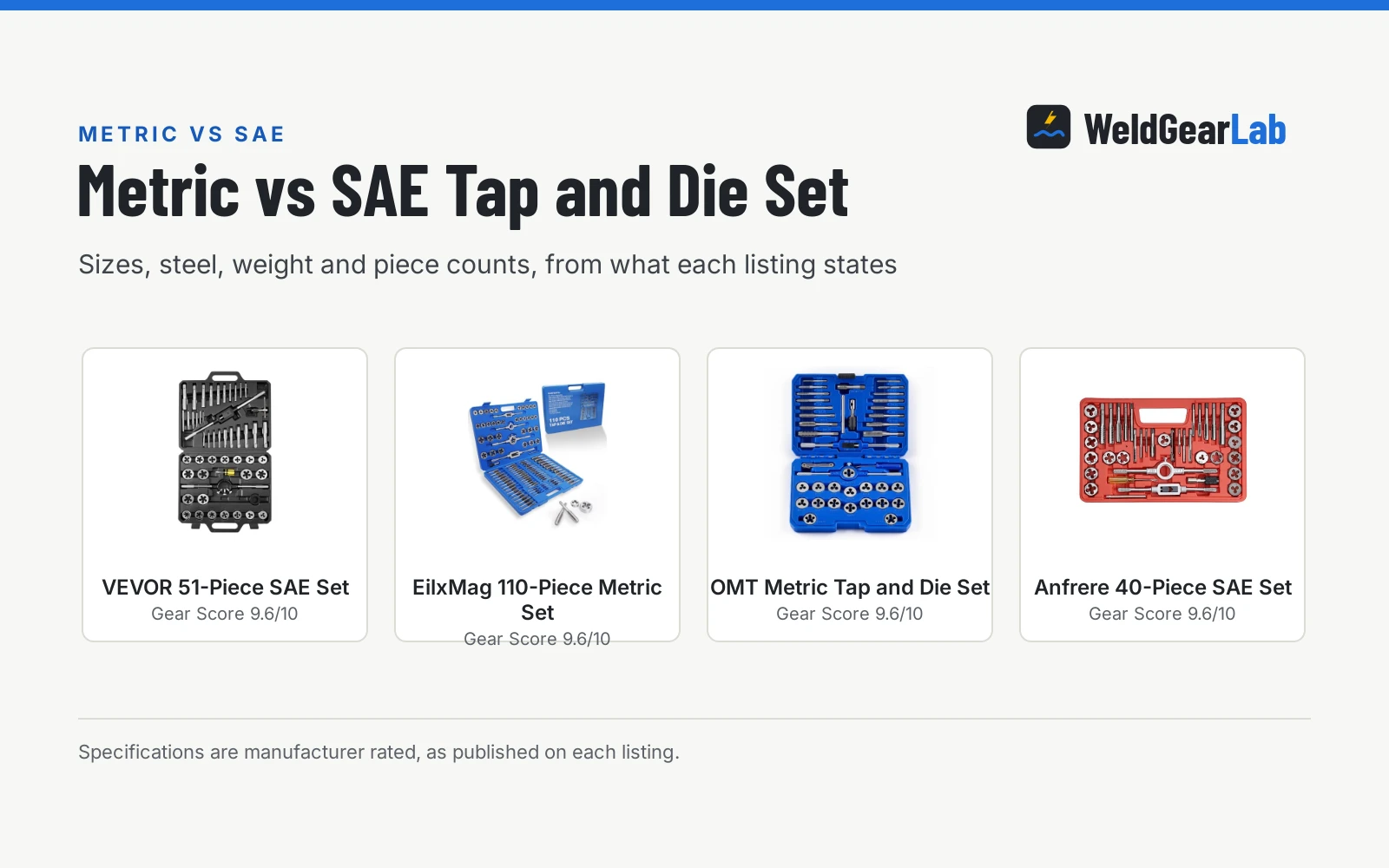
| Tubing notcher | Hole saw jig | |
|---|---|---|
| How it cuts | Hole saw in a clamped, angle-adjustable frame | Hole saw steadied by a guide, work held by hand |
| Tube capacity cited | 1/2 to 2 in, or 3/4 to 3 in, by listing | Not listed here |
| Angle range cited | 0 to 50 or 0 to 60 degrees by listing; KAKA spec table says 0 to 45 | Set by eye or simple fence |
| Offset adjustment | Up to 1 in from centerline (WONDERSUNM) | Not listed here |
| Weight cited | 6.02 to 20.9 lb | Not listed here |
| Hole saws | Sold separately on every listing | Uses the saws you own |
| Repeatability | Clamped setup, same notch every time | Depends on the setup each time |
Which one suits which shop
Match the tool to the notch count. A fabrication shop cutting cages, frames or furniture buys the notcher: the clamped setup holds the tube in a frame while the hole saw feeds in. The 6.02 pound VEVOR gray unit is the portable end of the range, while the 20.5 and 20.9 pound VEVOR and WONDERSUNM units are the heavy end. A home shop that notches a few tubes a year does fine with the jig and a drill press, spending the savings on hole saws.
Either way, budget for the saws: every notcher listing sells the hole saws separately, so the tool price is not the cutting price. If you are setting up the whole tube workflow, our best tube bender under 100 guide covers the bending side, and how to use a tube bender walks through the layout.
Common mistakes to avoid
- Buying capacity you do not need. The 3/4 to 3 inch notchers weigh 10.8 to 20.9 pounds; if your work is 1/2 to 2 inch tube, the 6.02 to 11.6 pound units cover that range.
- Trusting the angle figure without checking. The KAKA lists 0 to 60 degrees in the bullets and 0 to 45 in the spec table. Verify the real range on the listing before you plan angled joints.
- Forgetting the hole saws. No listing includes them. Price the saws in the sizes your tube needs before comparing tool prices.
- Notching without clamping. The whole point of the notcher frame is that the tube cannot move. A loose tube in a notcher cuts worse than a careful jig setup.
- Skipping the offset. The WONDERSUNM units offset the notch up to 1 inch from the centerline, which matters for joints that do not meet on center. A jig cannot do this repeatably.
FAQ for welders
What size tube can a notcher handle?
The listings cover 1/2 to 2 inches on the smaller units, 1/2 to 3 inches on the larger VEVOR unit, and 3/4 to 3 inches on the WONDERSUNM models. Match the notcher to the largest tube you plan to cut.
Do tubing notchers include hole saws?
No. Every listing states the hole saws are sold separately. Two VEVOR 1/2 to 2 inch units take 3/4 to 3-1/4 inch saws, the VEVOR 1/2 to 3 inch unit takes 1/2 to 5/8 inch saws, and the WONDERSUNM units take 1/2-20 and 5/8-18 TPI threads.
Can a notcher cut angled joints?
Yes. The listings state 0 to 60 degrees on the Eastwood and VEVOR 1/2 to 2 inch models and 0 to 50 degrees on the generic, WONDERSUNM and VEVOR 1/2 to 3 inch models; the KAKA bullets claim 0 to 60 degrees while its spec table says 0 to 45 degrees.
Is a hole saw jig accurate enough for a roll cage?
For one or two joints, with care. For a full cage, the clamped, angle-set repeatability of a dedicated notcher gives tighter fit-up with less grinding.
How much does a tubing notcher weigh?
The listings run from 6.02 pounds for the gray VEVOR 1/2 to 2 inch unit to 20.9 pounds for the WONDERSUNM steel model. Vise-clamped units travel; bench-mounted units stay put.
Related: the metal fab tools hub, our best tubing notcher roundup, rotary draw vs mandrel tube bender and the best angle grinder roundup for cleanup.