How to Use a Tube Bender: Step-by-Step Shop Guide
Learn how to use a tube bender to form clean bends in metal tubing by choosing the right die, aligning layout marks, and controlling springback.

On this page
Top picks at a glance
As an Amazon Associate I earn from qualifying purchases.
- 1
 Imperial Tool 470FH Triple Head 180 Degree Tube Bender with9.7/10View on Amazon
- 2
 OEMTOOLS 25440 Tube Bender Pliers & Brake Line Bender for9.7/10View on Amazon
- 3
 VEVOR Pipe Tube Bender9.7/10View on Amazon
Bending a custom roll cage bar, routing a fuel hardline, or fitting an exhaust run on the bench requires smooth curves that do not crush or wrinkle. Knowing how to use a tube bender lets you form clean bends in metal tubing without flat spots or cracked walls. Clamp the matched round die to fit your tube outside diameter, align your mark with the die reference line, lock the retaining hook, and sweep the lever arm steadily to your target angle. A tube bender supports the outer wall inside a matched groove so the metal does not collapse into an oval or buckle along the throat. Overbend slightly past your layout angle to compensate for springback before releasing the clamp.
This guide links to our product roundups, where WeldGearLab gets a commission on purchases made through links on this page, and your price stays the same. Read our affiliate disclosure.
How to use a tube bender in one paragraph
A tube bender forms hollow metal by supporting the outside diameter inside a machined die while a follower shoe guides the tubing around a fixed radius. As the tool sweeps, metal along the outside of the bend stretches in tension while metal on the inside compresses. Solid rod bends easily without collapsing, but hollow tubing caves into an oval unless the die groove supports the sidewall. Controlling sweep speed, clamping tightly to prevent slip, and overbending slightly for springback are the basic habits of clean tube bending.
Side by side
| Manual lever bender | Manual bench bender | Hydraulic ram bender | |
|---|---|---|---|
| Bending mechanism | Manual lever or ratchet | Rotary draw with degree ring | Center ram push between rollers |
| Stock standard | Tubing (actual outside diameter) | Round and square tubing | Pipe (nominal pipe size) |
| Die support style | Round groove with follower shoe | Dedicated round or square die | Cast die with dual outer rollers |
| Thin wall tubing capability | Maintains roundness with matched shoe | Maintains shape with rotary draw die | Prone to flattening and kinking |
| Square stock capability | No | Yes with optional square dies | No |
| Mounting style | Handheld or bench vise | Bolted to bench or pedestal stand | 4-leg support |
| Common shop uses | Brake lines, fuel lines, HVAC copper | Chassis frames, roll cages, furniture | Plumbing pipe, heavy railings, posts |
Tool mechanism, capacity, and mounting style decide which bender fits your fabrication job. Hand lever tools suit fluid hardlines, manual bench benders handle tube frames, and hydraulic benders supply force for heavy pipe.
When manual lever benders are the better choice
Manual lever benders are compact and easy to carry to a chassis or frame. They rely on direct leverage or a ratchet mechanism to sweep tubing around a fixed die.
- Brake and fuel hardlines. Small lines route cleanly around engine bays and frame rails.
- Soft copper and aluminum. HVAC and fluid plumbing form smoothly by hand without high tonnage.
- Tight quarters. Compact bender bodies fit into engine compartments and under vehicles.
- Fast setup. Lever benders operate handheld or clamped in a bench vise without floor anchoring.
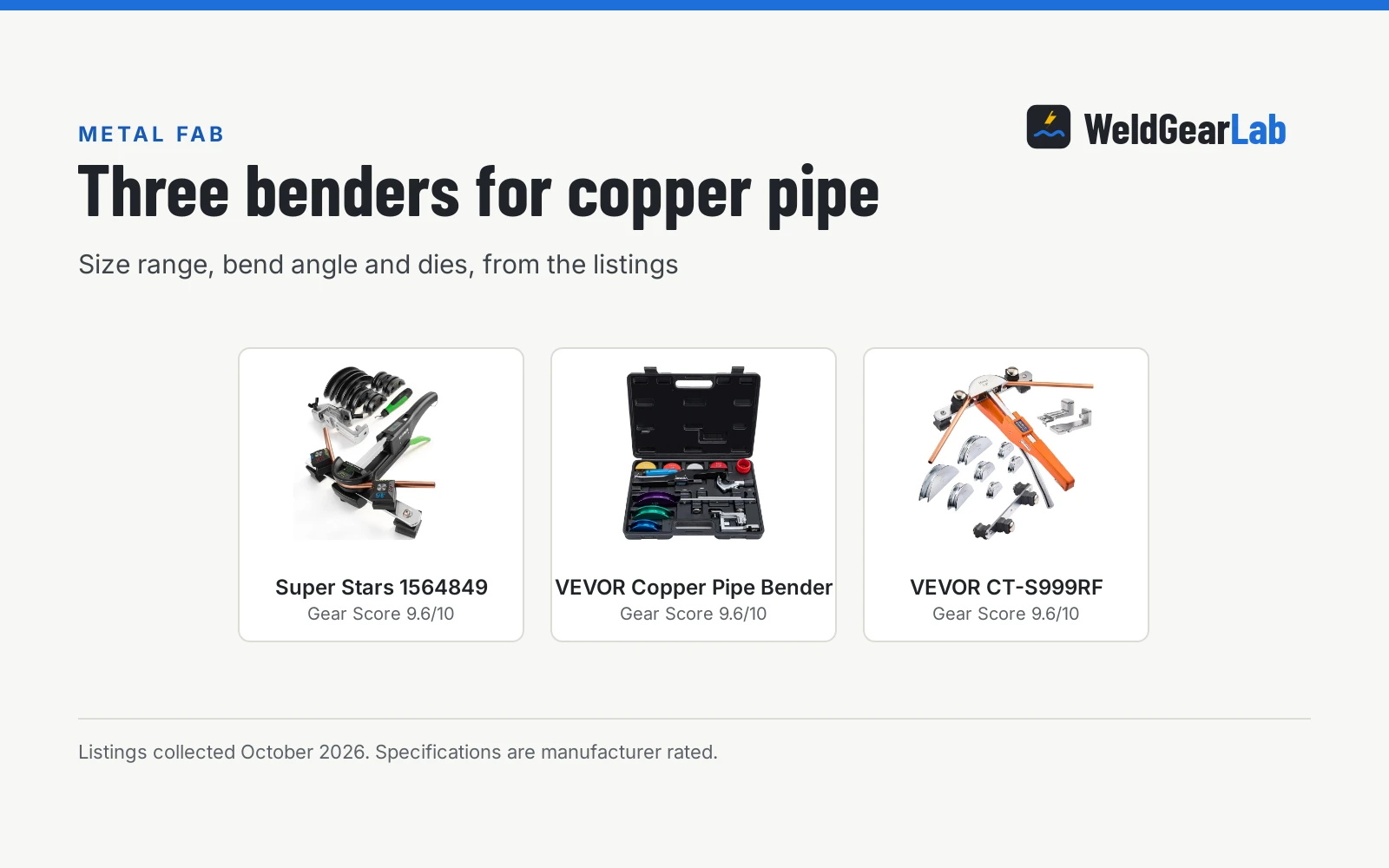
For small fluid lines, RopeTon lists a 3-in-1 tool covering 1/4″, 3/8″, and 1/2″ outside diameter tubing with stated bending radii of 0.82″, 1.14″, and 1.43″. For broader HVAC work, Holdwell S supplies 7 color-coded aluminum heads spanning 1/4″ to 7/8″ OD with a ratcheting handle designed for tight spaces. If you are plumbing vehicle hardlines, see our guide to the tube bender for brake lines and our roundup of the best tube bender under 100.
When hydraulic benders are the better choice
When bending heavy structural pipe, manual leverage is not enough. Hydraulic benders use a hydraulic cylinder to advance forming dies into pipe supported on dual outer rollers.
- Thick-wall pipe. Heavy wall metal needs hydraulic tonnage to bend without operator strain.
- Railings and gates. Structural pipe projects demand steady hydraulic force.
- Floor stability. A wide base keeps long pipe sticks balanced during the bend.
- Nominal pipe dies. Large frames support wide die sizes for industrial pipe and railings.
For high-tonnage pipe forming, VEVOR lists its hydraulic pipe bender with a 16 Ton rating, a stroke of 10-inch (253mm), an adjustable height from 13.5-23.4 inch, and 8 dies covering 1/2″, 3/4″, 1″, 1-1/4″, 1-1/2″, 2″, 2.5″, and 3″. Center-push ram benders with outer rollers suit heavy-wall pipe rather than thin tubing, which flattens without a follower shoe. For roll cages and chassis frames using round or square tubing, fabricators choose rotary draw benders. For manual rotary draw work, ECOTRIC lists a steel bender rated for round tubing up to 2″ and square tubing up to 1-1/2″ with wall thickness up to .125″. See our top workshop picks in the best tube bender for hobby fabrication.
How to match tubing to the right die
Mismatching tubing stock to the die groove ruins bends quickly. Metal tubing and standard pipe use different sizing standards, and bending tube in a pipe die causes flattening or binding.
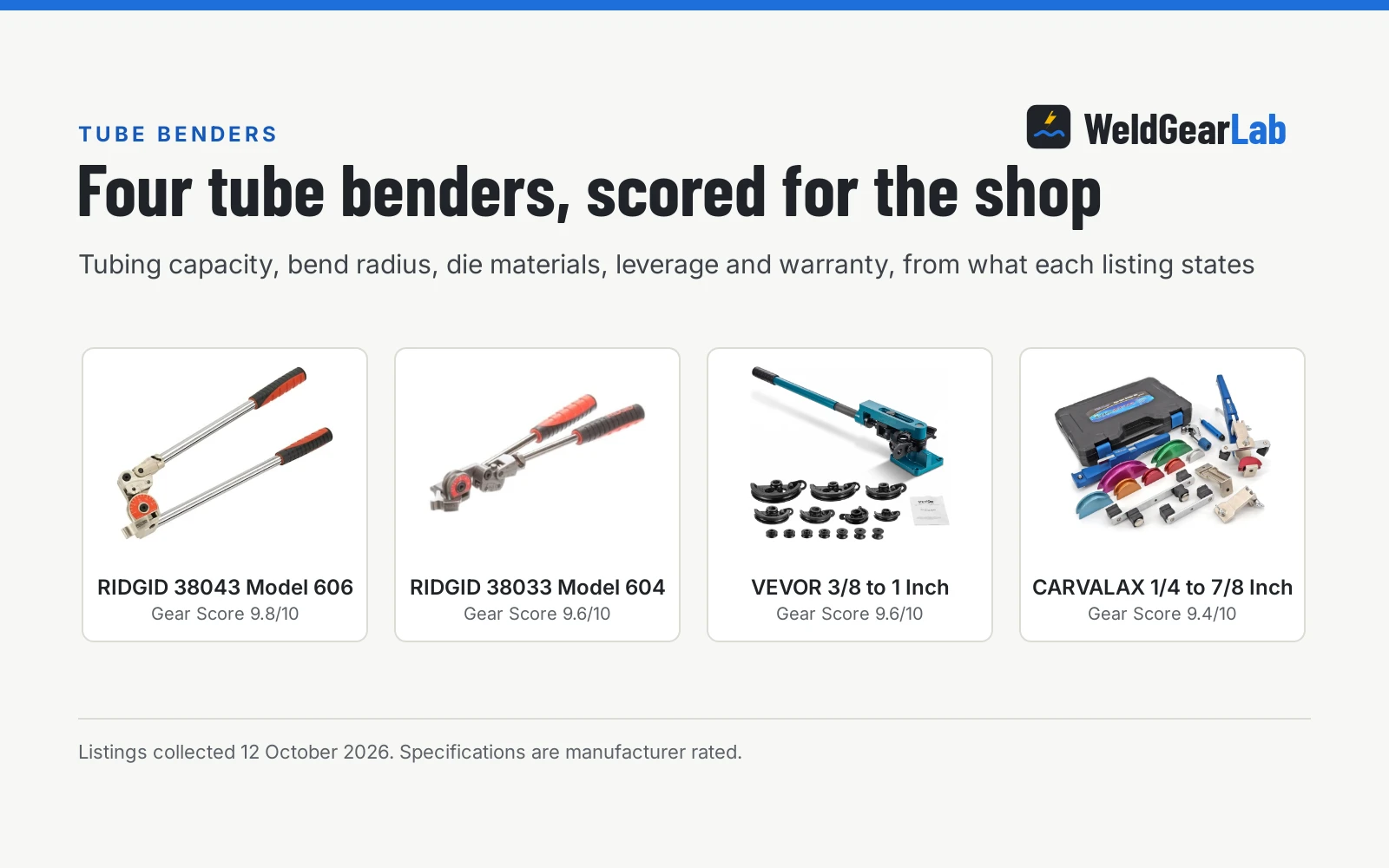
- Tubing uses outside diameter. A 1/2″ tube has an outside diameter of 0.5 Inch. RIDGID lists its Model 608 explicitly for 1/2″ tubing with a 0.5 Inch size.
- Pipe uses nominal sizing. A 1/2″ pipe has an outside diameter significantly larger than 0.5 Inch. Placing a 1/2″ tube in a 1/2″ pipe die leaves sidewalls unsupported, flattening the tube.
- Check published wall thickness limits. RopeTon lists a wall thickness range from 0.027″ to 0.059″ (0.7mm to 1.5mm) on its lever tool, while ECOTRIC states a maximum .125″ wall on its manual steel bender. Stay inside the range the maker lists for your tool.
- Match the tool to the material. Makers list which metals each tool is built for, such as soft copper, aluminum and thin-wall steel on the RopeTon listing. Harder alloys generally call for rigid tooling and firm clamping. For tough alloys, see our guide to the tube bender for stainless steel.
How to use a tube bender step by step
This sequence fits a manual rotary draw bench bender, the type the ECOTRIC and maXpeedingrods listings describe: a bolted frame, a ratchet-style handle and a degree ring. Check your own tool’s manual for its exact parts.
- Choose the die. Pick the round die groove that matches your tube. Use a square die only for square stock.
- Check the OD. Measure the raw tube outside diameter with calipers. If the tube rocks in the groove, switch to the matched die. Confirm the wall is within the maker’s stated limit.
- Mark the tube. Scribe or mark the bend point and line it up with the zero reference mark on the die.
- Clamp. Seat the tube in the groove and lock the retaining hook firmly. Slip during the stroke ruins placement and gouges the surface.
- Bend. Work the handle with even, continuous force and watch the pointer on the degree ring. Pausing midway can leave a crease along the radius.
- Overbend. Tubing generally springs open a little when handle pressure relaxes, so sweep slightly past your target angle.
- Verify. Release the clamp and check the angle against a protractor or template. Adjust the overbend on the next piece if needed.
Springback varies with tube material, wall and bend radius, so bend a scrap piece from the same stock first and note how far it opens before you shape the final workpiece.
Can a bender handle pipe and tube?
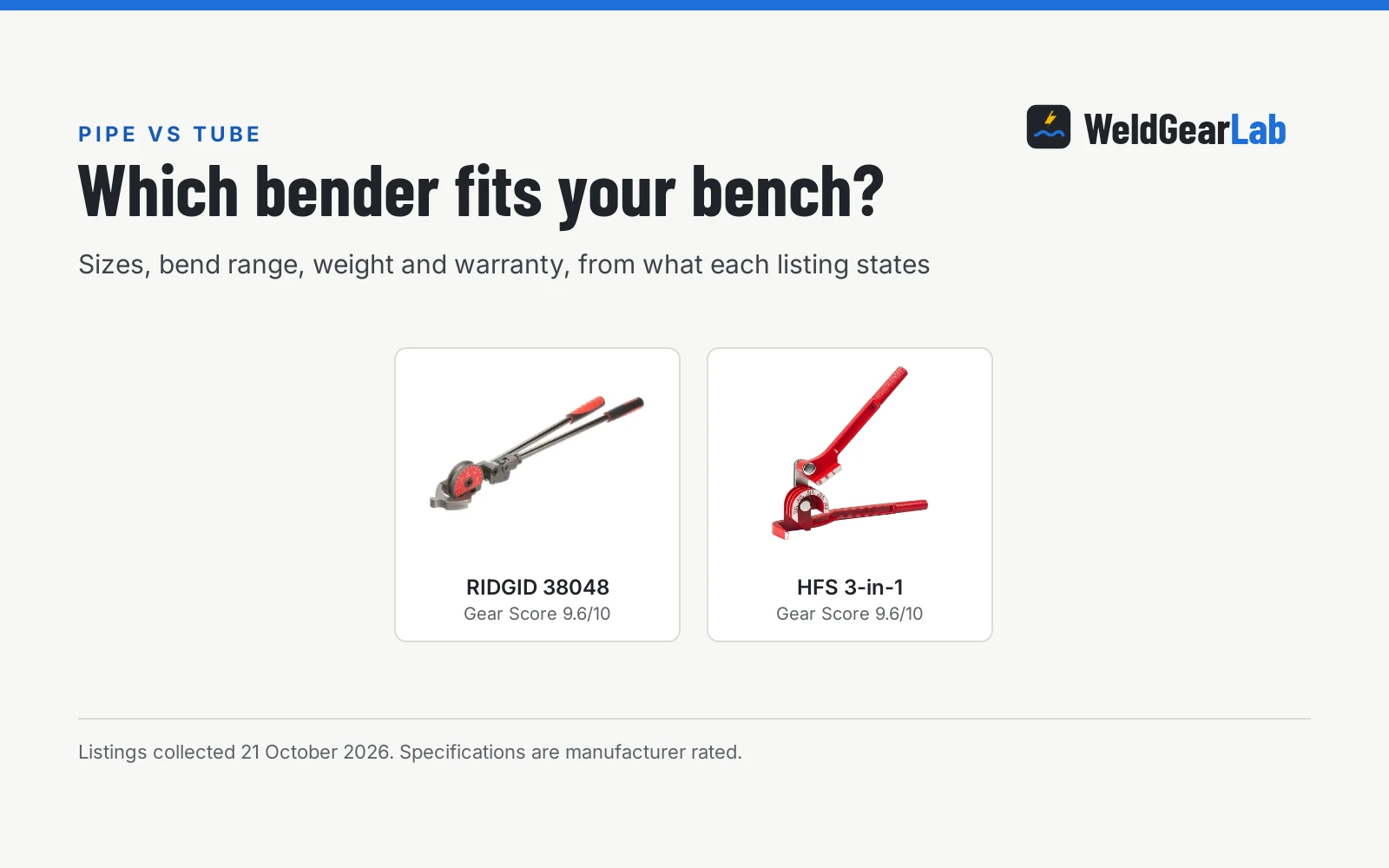
A bender handles both pipe and tubing only if its frame accepts dedicated die sets for each standard. Fixed handheld benders cannot swap dies. Pipe dies fit nominal pipe dimensions, so placing tubing in a pipe die crushes the walls. Likewise, pipe will not seat in a tube die of the same nominal name and jams the die.
Clean fit-up is critical for welded joints. After bending tubing for frames or furniture, tube ends must be notched to wrap tightly around mating tubes before welding. See our guide to the best tubing notcher for joint prep.
Bender pinch points and workpiece safety. Bending metal generates strong leverage and pinch points. Keep hands clear of rotating dies, clamp hooks, and follower shoes during the stroke. Long tubes swing through a wide arc, so clear surrounding shop space before pulling the lever. Wear leather work gloves and safety glasses to guard against burrs and unexpected slips.
FAQ for welders
Can you use a pipe bender to bend tubing?
Generally no, unless you install dies machined specifically for tubing outside diameters. Standard pipe dies leave unsupported gaps along tubing walls, causing hollow tubes to flatten or kink.
Why does tubing kink or flatten when bending?
Tubing kinks when the die groove does not support the tube outside diameter or when the wall is too thin for the bend radius. Using a matched die and steady clamping pressure keeps the wall round as it stretches.
How do you account for springback when using a tube bender?
Sweep the handle slightly past your target angle on the tool degree scale. Metal springs open slightly when released, so fabricators verify springback on scrap tubing before making final bends.
Do you need lubrication when using a tube bender?
A light coat of lubricant along the tube where it slides against the follower shoe reduces drag and scoring. Never lubricate the clamp block, because the tube must stay firmly anchored without slipping.
Can you bend square tubing in a round tube bender?
No, square tubing requires dies with flat, square grooves to support the sidewalls. Round dies concentrate pressure on the tube corners, causing buckling. Some bench benders, like the model ECOTRIC lists, offer square dies up to 1-1/2″ for square stock.
Related: best tube bender for hobby fabrication, best tube bender under 100, tube bender for brake lines, tube bender for stainless steel, and the metal fab tools hub.