Tube Bender for Brake Lines: 5 Picks Scored for the Shop (2026)
Five manual tube benders for brake lines, compared on tubing sizes, maximum bend angle, materials, leverage, and the warranty each listing states.

On this page
Top picks at a glance
As an Amazon Associate I earn from qualifying purchases.
- 1
 Best OverallOEMTOOLS 254409.7/10View on Amazon
- 2
 Best 180-DegreeTUBPRO 4-IN-19.6/10View on Amazon
- 3
 Compact 90-DegreeDURATECH 90 Degree9.5/10View on Amazon
- 4
 Maximum LeverageSuper Stars 3-in-19.5/10View on Amazon
Routing replacement hydraulic lines along a vehicle frame rail requires clean bends that maintain full fluid flow without kinking or flattening the wall. When shaping replacement hard lines on the shop bench or under a chassis, choosing the right tube bender for brake lines determines whether your flares seat square and your runs follow factory routing clips. This guide compares five manual benders across what each listing states: tubing diameter capacity, bend angle limits, chassis materials, leverage, and stated manufacturer warranty terms.
WeldGearLab gets a commission on purchases made through links on this page, and your price stays the same. Read our affiliate disclosure.
Quick picks
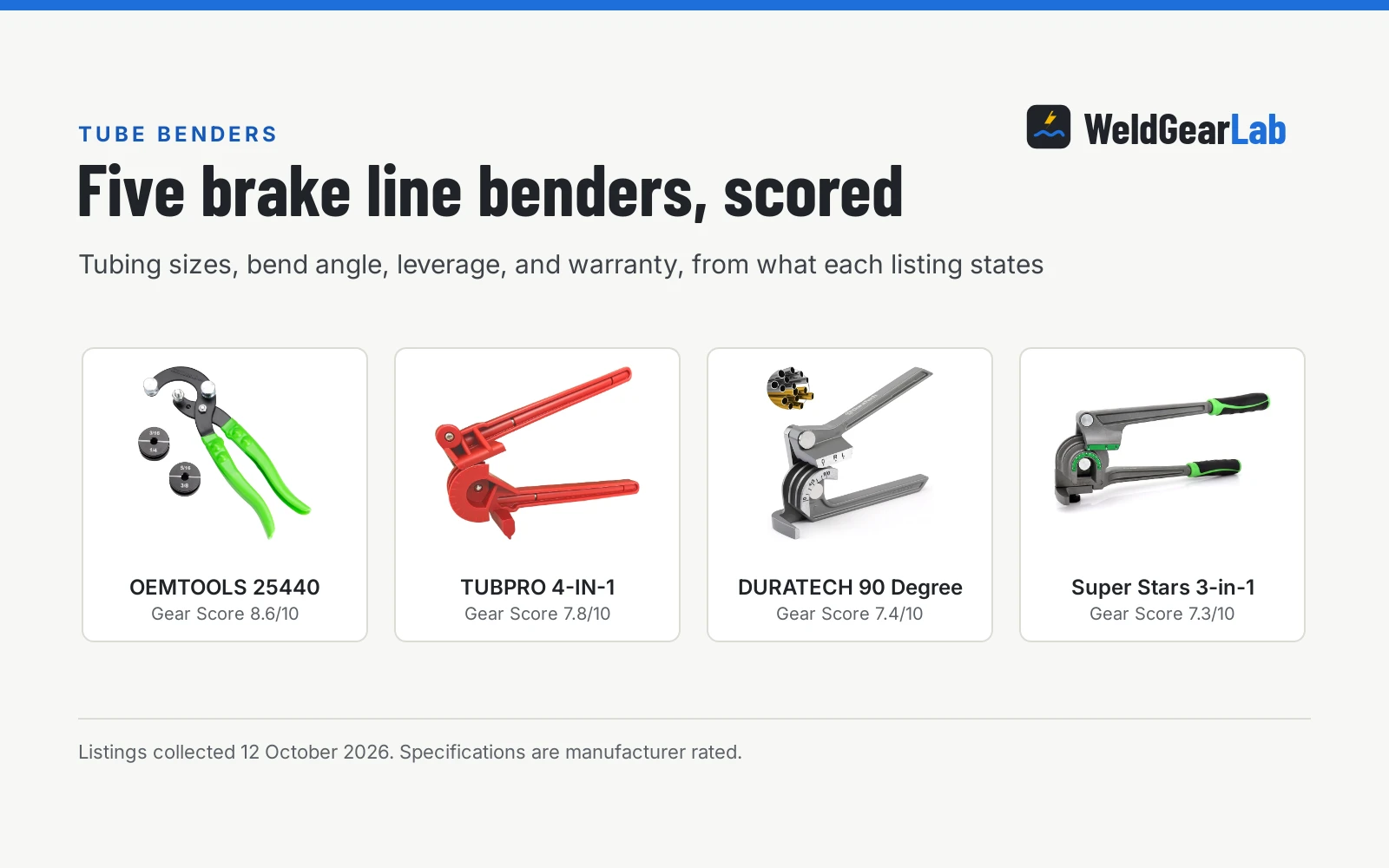
- Best Overall OEMTOOLS 25440: Alloy steel plier design with dual-sized adapters for 3/16 to 3/8 inch tubing and an OEMTOOLS Limited Lifetime warranty. Check price on Amazon
- Best 180-Degree TUBPRO 4-IN-1: Bends 3/16, 1/4, 5/16, and 3/8 inch tubing up to 180 degrees using an internal steel core and a protective plastic surface. Check price on Amazon
- Compact 90-Degree DURATECH 90 Degree: A 15.1 ounce aluminum tool with calibrated angle markings for 1/4, 5/16, and 3/8 inch lines up to 90 degrees. Check price on Amazon
- Maximum Leverage Super Stars 3-in-1: Features 12 inch handles, a vise clamp, and a two-stage trigger for 1/4, 3/8, and 1/2 inch tubes up to 180 degrees. Check price on Amazon
The machines


OEMTOOLS 25440 Tube Bender Pliers & Brake Line
A plier style bender built from alloy steel with two dual-sized adapters for 3/16, 1/4, 5/16, and 3/8 inch tubing and a limited lifetime warranty.
Pros
- Covers four tubing sizes including 3/16, 1/4, 5/16, and 3/8 inch brake lines
- Built from alloy steel with forged separators and knife edges
- Includes two dual-sized adapters for tight under-car spaces
- Listing states an OEMTOOLS Limited Lifetime manufacturer warranty
Cons
- Maximum stated bend angle is 90 degrees rather than 180 degrees
- Plier format offers less leverage on stiff tubing than long lever benders

Tubing Bender, Tube Bender, 3/16”, 1/4", 5/16"
A manual lever bender that shapes 3/16, 1/4, 5/16, and 3/8 inch lines up to 180 degrees using an internal steel core and a protective plastic surface.
Pros
- Handles four common tubing sizes including 3/16, 1/4, 5/16, and 3/8 inch
- Bends lines from 0 to 180 degrees for complete loops and tight returns
- Internal steel structure provides strength while plastic outer surface prevents marring
- Weighs 1.12 pounds for easy bench and field handling
Cons
- No warranty term is stated in the listing
- Outer surface is engineering plastic rather than all-metal construction
- Single channel layout requires careful alignment when feeding tubing

DURATECH 90 Degree Tubing Bender
A lightweight aluminum 3-in-1 bender with calibrated angle markings for 1/4, 5/16, and 3/8 inch lines up to 90 degrees.
Pros
- Calibrated angle markings for left-hand, right-hand, and offset bends
- Lightweight aluminum construction weighing 15.1 ounces
- Grey powder coating prevents corrosion on the bench
- Handles copper, brass, aluminum, and thin steel lines
Cons
- Does not accommodate 3/16 inch tubing common on automotive brake lines
- Bending angle is limited to 90 degrees
- No warranty term is stated in the listing
Super Stars 3-in-1 Tubing Bender for 1/4 Inch
A heavy duty 180 degree tubing bender featuring 12 inch handles, a built-in vise clamp, and a two-stage repositioning trigger for 1/4, 3/8, and 1/2 inch tubes.
Pros
- Extra-long 12 inch handles provide increased bending leverage
- Bends tubing up to 180 degrees with a two-stage repositioning trigger
- Built-in vise clamp secures the tool firmly during bench work
- Robust aluminum alloy build weighing 2.79 pounds
Cons
- Lacks channels for 3/16 inch and 5/16 inch automotive lines
- Heaviest bender in this group at 2.79 pounds
- No warranty term is stated in the listing
- Sized primarily for refrigeration and larger fluid lines rather than primary brake lines

Automotive Tubing Bender Brake Line Bending Tool
A plier style bender designed for 3/16 and 1/4 inch lines, featuring forged construction and rubber grip handles.
Pros
- Sized specifically for 3/16 inch and 1/4 inch brake and fuel lines
- Compact plier design fits into confined automotive spaces
- Rubber grip handles provide a non-slip hold
- Forged metal construction for durability
Cons
- Accommodates only two sizes, omitting 5/16 and 3/8 inch tubing
- No item weight, bend angle limit, or warranty term stated
- Bullets mention only copper pipes despite title claiming automotive brake line use
Other welders and gear to compare
 DURATECH 180 Degree Tubing BenderCheck price on Amazon
 RIDGID 36117 403 Instrument BenderCheck price on Amazon
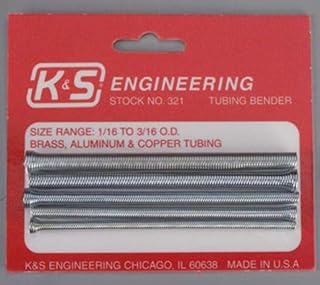 K&S Precision Metals Tube Bender Set 321Check price on Amazon
 maXpeedingrods Round Tube Bender Die For Wfb2 Tubing BenderCheck price on Amazon
Spec sheet comparison
| Model | Gear Score | Tubing sizes | Max bend angle | Material | Design | Item weight | Warranty |
|---|---|---|---|---|---|---|---|
| OEMTOOLS 25440 | 9.7/10 | 3/16, 1/4, 5/16, 3/8 in | 90° | Alloy Steel | Bending pliers | 1.2 lb | Limited Lifetime |
| TUBPRO 4-IN-1 | 9.6/10 | 3/16, 1/4, 5/16, 3/8 in | 180° | Steel core, plastic surface | Lever bender | 1.12 lb | Not stated |
| DURATECH 90 Degree | 9.5/10 | 1/4, 5/16, 3/8 in | 90° | Aluminum | Lever bender | 15.1 oz | Not stated |
| Super Stars 3-in-1 | 9.5/10 | 1/4, 3/8, 1/2 in | 180° | Aluminum alloy | Two-stage lever bender | 2.79 lb | Not stated |
| ATNHYING ANY-10013 | 9.4/10 | 3/16, 1/4 in | Not stated | Carbon Steel and Brass | Bending pliers | Not stated | Not stated |
These numbers are the manufacturer’s ratings exactly as each listing gives them, recorded on 12 October 2026.
Buying guide: how to choose a tube bender for brake lines
Tubing diameter compatibility
Automotive hydraulic brake lines commonly run 3/16 inch or 1/4 inch hard line, while fuel, transmission cooler, and vapor lines often use 5/16 inch, 3/8 inch, or 1/2 inch tubing. Only two listings here, the OEMTOOLS 25440 and the TUBPRO 4-IN-1, accommodate 3/16 inch tubing. The DURATECH starts at 1/4 inch, while the Super Stars handles 1/4 inch, 3/8 inch, and 1/2 inch. Matching the tool to your exact line diameter ensures the forming grooved shoe supports the tube walls during bending.
Maximum bend angle
Routing lines through chassis crossmembers and around steering gear frequently requires tight directional changes. Two models here, the TUBPRO and the Super Stars, support bends from 0 to 180 degrees, allowing complete return loops. The OEMTOOLS 25440 and the DURATECH are limited to 90 degree bends, which suit standard cornering runs and offset clearing.
Plier design versus lever handles
Form factor dictates where you can work. Plier format tools, like the OEMTOOLS and ATNHYING, allow you to bend, adjust, and align lines directly under the vehicle chassis in cramped spaces. Lever style benders require more operating clearance but deliver mechanical advantage through extended handles. The Super Stars listing specifies 12 inch handles and a built-in vise clamp for dedicated bench fabrication.
Body materials and tubing protection
Bending forces put substantial stress on forming dies and pivot pins. The listings show varied approaches: OEMTOOLS specifies alloy steel, DURATECH uses aluminum, and Super Stars specifies aluminum alloy. TUBPRO combines high-strength steel inside with an engineering plastic outer surface to prevent marring soft copper and aluminum lines. For steel hard lines, rigid alloy steel frames minimize tool deflection during heavy forming.
Listing contradictions and warranty coverage
Checking product listings closely reveals spec inconsistencies. The ATNHYING lists Carbon Steel under Material but Brass under Material Type, and OEMTOOLS has a title typo and size discrepancy between its title and bullet points. On warranty coverage, only OEMTOOLS states a term, citing an OEMTOOLS Limited Lifetime manufacturer warranty. The other four listings state no warranty term.
Safety on the bench. Always deburr cut tube ends before bending, clear fluid lines before applying heat or pressure, and inspect bends for flattening or wall collapse before installing them in hydraulic systems. Wear eye protection while forming metal tubing and follow vehicle manufacturer routing specifications. See our Safety Disclaimer.
Before You Strike an Arc
- Check that forming dies and grooved shoes match your line diameter before applying bending force.
- Verify package contents on arrival, confirming dual-sized adapters on plier models and grooved guide channels on lever benders.
- Inspect forming shoes and roller surfaces for metal burrs or machining grit that could scratch soft copper, brass, or aluminum tubing.
- Deburr tube ends thoroughly and practice on scrap tubing to confirm your bend radius clears vehicle mounting brackets.
FAQ for welders
What is a tube bender for brake lines?
A tube bender for brake lines is a manual hand tool that curves metal tubing without kinking or collapsing the tube wall. It supports the outer wall in a radiused channel while a shoe or roller forms the bend. This maintains smooth internal fluid flow in automotive hydraulic brake systems.
How do you use a tube bender?
You insert the straight tubing into the matching size groove and clamp it under the retaining hook or clamp. Align your bend mark with the zero indicator on the bender shoe. Slowly pull the operating handle until the indicator reaches your desired bend angle.
What size tube bender do I need for automotive brake lines?
Most automotive hydraulic brake systems use 3/16 inch or 1/4 inch outer diameter tubing. Tools like the OEMTOOLS 25440 and TUBPRO 4-IN-1 include channels specifically for these smaller line sizes. Always verify your vehicle hard line outer diameter before selecting a bender.
Can a tube bender handle steel brake lines?
Yes, manual benders built from alloy steel or reinforced steel cores handle thin steel and mild steel brake lines. Tools designed for soft copper or aluminum may require excessive effort or flex when bending stiff steel line. Choosing a tool with adequate handle leverage prevents irregular bends on steel lines.
Why do brake lines kink when bending?
Brake lines kink when tubing is bent by hand without radial support or placed in an oversized bender channel. Without a closely fitted die supporting the sidewalls, the inner radius bunches while the outer radius thins and collapses. Using a bender grooved for the exact line diameter prevents kinking.
Related: metal fab tools hub, tube bender for stainless steel, and best tube bender for hobby fabrication. Also see our guide on best tubing notcher. Also see our best MIG wire for auto body. Also see our best welder for body panels. Also see our angle clamps for welding. Also see our types of welding clamps. Also see our how to use bead roller. Also see our best cold cut saw.
Scoring, line by line
Each tool is scored out of 10 on performance, build, value, safety listing and warranty, with the weights published on our How We Pick page. Manual tube benders have no electrical safety listing to state, so every tool here scores zero on that criterion; the ranking comes from the other four.
| Product | Gear Score | Perf. /35 | Build /25 | Value /25 | Safety /10 | Warranty /5 |
|---|---|---|---|---|---|---|
| OEMTOOLS 25440 | 9.7 | 30 | 22 | 21 | n/a | 4 |
| TUBPRO 4-IN-1 | 9.6 | 29 | 20 | 21 | n/a | 0 |
| DURATECH 90 Degree | 9.5 | 27 | 20 | 20 | n/a | 0 |
| Super Stars 3-in-1 | 9.5 | 26 | 21 | 19 | n/a | 0 |
| ATNHYING ANY-10013 | 9.4 | 23 | 18 | 18 | n/a | 0 |
Displayed scores fall between 9.2 and 9.8: the weighted point total is mapped onto that band in a straight line, so earning more points always lifts the score. Safety points apply to gear that runs on power or lists safety features. Without either, we score out of 90 instead of 100.