Pipe Bender vs Tube Bender: Which One Fits Your Bench?
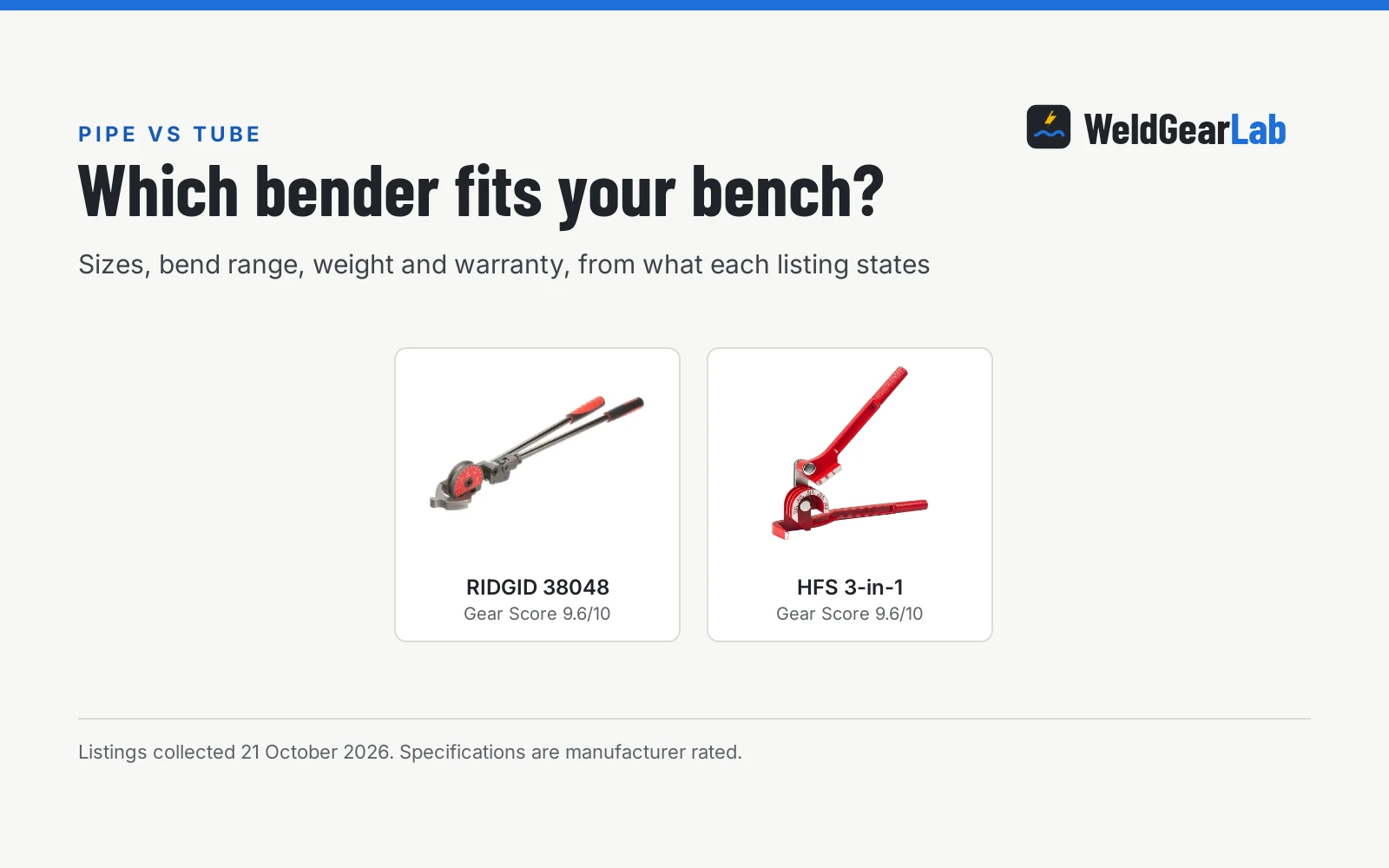
A RIDGID 1/2 inch pipe bender and an HFS 3-in-1 tube bender compared on sizes, bend range, weight and warranty, with a verdict.

On this page
Top picks at a glance
As an Amazon Associate I earn from qualifying purchases.
- 1
 RIDGID 38048 Model 608 Heavy-Duty Stainless Steel9.6/10View on Amazon
- 2
 HFS(R) 3-in-1 Manual Tube Bender, 0-180°, 1/49.6/10View on Amazon
Verdict. Pipe bender vs tube bender? Pick the pipe bender if you bend 1/2 inch pipe and want leverage and a warranty: the RIDGID example has extra long handles, weighs 6.6 lb and states 12 months. Pick the tube bender if you work small-diameter tube: the HFS example covers three sizes with a 0 to 180 degree gauge and bench mounting, but states no warranty. Match the tool to the stock, not the name.
Pipe bender and tube bender sound like the same tool, but they answer different jobs: one bends pipe measured by nominal size, the other bends tube measured by outside diameter. This comparison puts the RIDGID 38048 pipe bender against the HFS 3-in-1 tube bender on what each listing states.
WeldGearLab gets a commission on purchases made through links on this page, and your price stays the same. Read our affiliate disclosure.
The two benders
RIDGID 38048 Model 608 Heavy-Duty Stainless Steel
A heavy-duty 1/2 inch pipe bender with extra long handles, 6.6 lb, and a stated 12 month warranty.
Pros
- Stated 12 month warranty, the only one here
- Extra long handles for leverage
- 6.6 lb heavy-duty build
- From RIDGID, a plumbing trade brand
Cons
- Bullets give almost no detail beyond the model number
- Single size: 1/2 inch pipe only
- No bend angle stated
- Heavier than the 14.4 oz tube bender

HFS(R) 3-in-1 Manual Tube Bender, 0-180°, 1/4
A 3-in-1 manual tube bender for 1/4, 5/16 and 3/8 inch OD tubing, with a 0 to 180 degree gauge and bench mounting.
Pros
- Three sizes in one tool: 1/4, 5/16 and 3/8 inch OD
- Marked degree gauge for 0 to 180 degree bends
- Bench or frame mounting for stable bending
- 14.4 oz, easy to carry to the job
Cons
- No warranty term in the listing
- Only covers tube up to 3/8 inch OD
- Cast iron frame adds bulk on the bench
- Round tubing only, per the listing
Other welders and gear to compare
 DURATECH 90 Degree Tubing BenderCheck price on Amazon
 VEVOR Copper Pipe BenderCheck price on Amazon
 Tnisesm Spring Tube Bender Set 1/4''Check price on Amazon
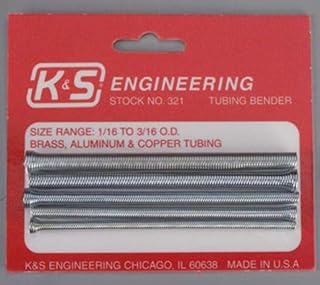 K&S Precision Metals Tube Bender Set 321Check price on Amazon
 3-in-1 Tubing BenderCheck price on Amazon
 maXpeedingrods Round Tube Bender Die For Wfb2 Tubing BenderCheck price on Amazon
Side by side
| Factor | RIDGID 38048 | HFS 3-in-1 | Edge |
|---|---|---|---|
| Gear Score | 63 | 57 | RIDGID |
| Type | Pipe bender | Tube bender | Tie |
| Sizes | 1/2 in pipe | 1/4, 5/16, 3/8 in OD | Tie |
| Bend range | Not stated | 0 to 180 degrees | HFS |
| Leverage | Extra long handles | Bench mount option | Tie |
| Weight | 6.6 lb | 14.4 oz | Tie |
| Warranty | 12 months | None stated | RIDGID |
All specs here repeat what the maker rates and the listing prints, copied down 21 October 2026.
Pipe bender vs tube bender: the core difference
The RIDGID is a pipe bender for 1/2 inch pipe with extra long handles and a 6.6 lb build. The HFS is a tube bender for 1/4, 5/16 and 3/8 inch OD tubing with a degree gauge and bench mounting. Pipe is sized by nominal size; tube is sized by outside diameter and, in these listings, runs smaller. Neither listing states the other’s sizes, so there is no direct overlap: pick by the stock you bend.
Bend range
The HFS states a 0 to 180 degree range on a marked gauge. The RIDGID listing states no bend angle at all, which is a gap: you cannot check how far it bends from the listing. On stated bend range, the tube side is the only one with a figure.
Leverage and mounting
The RIDGID brings extra long handles and 6.6 lb of tool to the bend, which is how a manual pipe bender makes force. The HFS takes the other route: a cast iron frame that bolts to a bench or frame, so the work stays put while you bend. Both approaches are stated in their listings; neither is stated for the other tool.
Weight and portability
The RIDGID weighs 6.6 lb at 24 x 4 x 3 inches; the HFS weighs 14.4 oz in a 10.71 x 2.95 x 2.64 inch package. The tube bender is the carry-to-the-job tool; the pipe bender is the plant-your-feet tool. Neither weight is a win on its own; each fits its design.
Warranty
The RIDGID listing states a 12 month warranty. The HFS listing states no warranty term. The warranty term is the pipe bender’s edge on warranty.
Materials each listing names
The HFS listing names its materials: copper, brass, aluminum and thin-wall steel tube. The RIDGID listing names its trades instead: construction, plumbing and industrial use. If your stock is copper or aluminum tube in the 1/4 to 3/8 inch OD range, the HFS listing names it directly. If your stock is 1/2 inch pipe for plumbing runs, the RIDGID listing names your trade. Neither listing names the other’s stock, so buy the tool whose listing describes your material.
Hand power vs bench mounting
The RIDGID is hand powered with two extra long handles: you make the bend by leverage, anywhere you can stand. The HFS uses a cast iron frame that mounts to a bench or frame, so the tool stays fixed and the tube moves. For a run of identical bends, a mounted tool wins on consistency; for a single bend in place, the hand tool wins on convenience. The RIDGID states no mounting and the HFS states no hand-only mode, so each listing commits to its own approach.
Warranty in writing
The RIDGID listing states a 12 month warranty, and that term is the pipe bender’s edge on warranty. The HFS listing states no warranty term at all. A stated term is not a promise of better quality, but it is a promise you can point to if the tool fails. When two listings are otherwise close on your job, the one with the warranty in writing is the safer pick.
Choose the RIDGID 38048 pipe bender if
- You bend 1/2 inch pipe and want long handles for leverage.
- A stated 12 month warranty matters to you.
- You want a heavy, simple hand tool with no setup.
Choose the HFS 3-in-1 tube bender if
- You bend 1/4, 5/16 or 3/8 inch OD tube.
- You want a 0 to 180 degree gauge for accurate bends.
- You can bench-mount the tool for stable work.
- You work copper, brass, aluminum or thin-wall steel tube.
FAQ for welders
What is the difference between a pipe bender and a tube bender?
In these listings, the pipe bender handles 1/2 inch pipe with long handles, while the tube bender handles 1/4 to 3/8 inch OD tube with a degree gauge. Pipe and tube are sized differently, so match the tool to your stock’s stated size.
Can a tube bender bend pipe?
Not beyond its stated sizes. The HFS here covers tube up to 3/8 inch OD; 1/2 inch pipe is outside its listing. Use the tool whose listing names your size.
Can a pipe bender bend small tube?
The RIDGID here is a 1/2 inch pipe bender with no smaller sizes stated. For small tube, use a bender with dies sized for your tube OD, which is what the HFS provides for its three sizes.
Do I need to mount a tube bender?
The HFS can mount to a bench or frame, which the listing calls the safest way to bend. The RIDGID is a hand tool with long handles and no mounting. Mounting suits repeat bends; hand bending suits one-offs.
Which one should I buy first?
Buy for the stock you bend most. If your work is 1/2 inch pipe, the RIDGID’s leverage and warranty lead. If it is small copper, brass or aluminum tube, the HFS’s three sizes and bend gauge lead.
What does 3-in-1 mean on the HFS?
It means three tube sizes in one tool: 1/4, 5/16 and 3/8 inch OD, all stated in the listing. You do not swap dies; the one tool covers all three sizes.
Related: best tube bender for copper pipe, best tube bender for handrails, best tube bender for hobby fabrication, how to use a tube bender, rotary draw vs mandrel tube bender, tube bender for brake lines, tube bender for stainless steel, and the metal fab tools hub.
Scoring, line by line
Both benders are scored on performance, build, value, safety listing and warranty, with the weights published on our How We Pick page. Neither listing states a safety certification, so both score zero there; the RIDGID’s 12 month warranty is the warranty difference.
| Product | Gear Score | Perf. /35 | Build /25 | Value /25 | Safety /10 | Warranty /5 |
|---|---|---|---|---|---|---|
| RIDGID 38048 | 9.6 | 27 | 21 | 19 | n/a | 3 |
| HFS 3-in-1 | 9.6 | 28 | 20 | 21 | n/a | 0 |
A pick’s weighted total decides where it lands between a 9.2 floor and a 9.8 ceiling, and a bigger total never produces a smaller number. Where safety does not apply (unpowered gear with no listed safety features), it is left out and the remaining 90 points make up the score.
Before you strike an arc. Wear gloves and eye protection when bending; a slipping tube or a snapping handle hurts. Secure the work, by bench mounting the HFS or bracing the RIDGID, and keep hands clear of the bend point. Check the tube or pipe for damage before bending, since a bender cannot fix a cracked wall.