TIG vs Stick for Stainless Steel: Which to Use
TIG vs stick for stainless steel compared: the three TIG filler rods and the wire feeder we checked, and which filler fits 304, 308 or 316.

On this page
Top picks at a glance
As an Amazon Associate I earn from qualifying purchases.
- 1
 YESWELDER 110V Tungsten Electrode Sharpener9.7/10View on Amazon
- 2
 YESWELDER Stainless Steel TIG Welding Rod ER308L 1/16"x16"View on Amazon
- 3
 YESWELDER Stainless Steel TIG Welding Rod ER308L 1/8"x16" 5LBView on Amazon
- 4
 ER308LView on Amazon
- 5
 1-Lb ER316L Stainless Steel 316 TIG Welding Rod 1/16"x36"View on Amazon
- 6
 ARCCAPTAIN Stainless Steel TIG Welding Rod ER308LView on Amazon
- 7
 ER309LView on Amazon
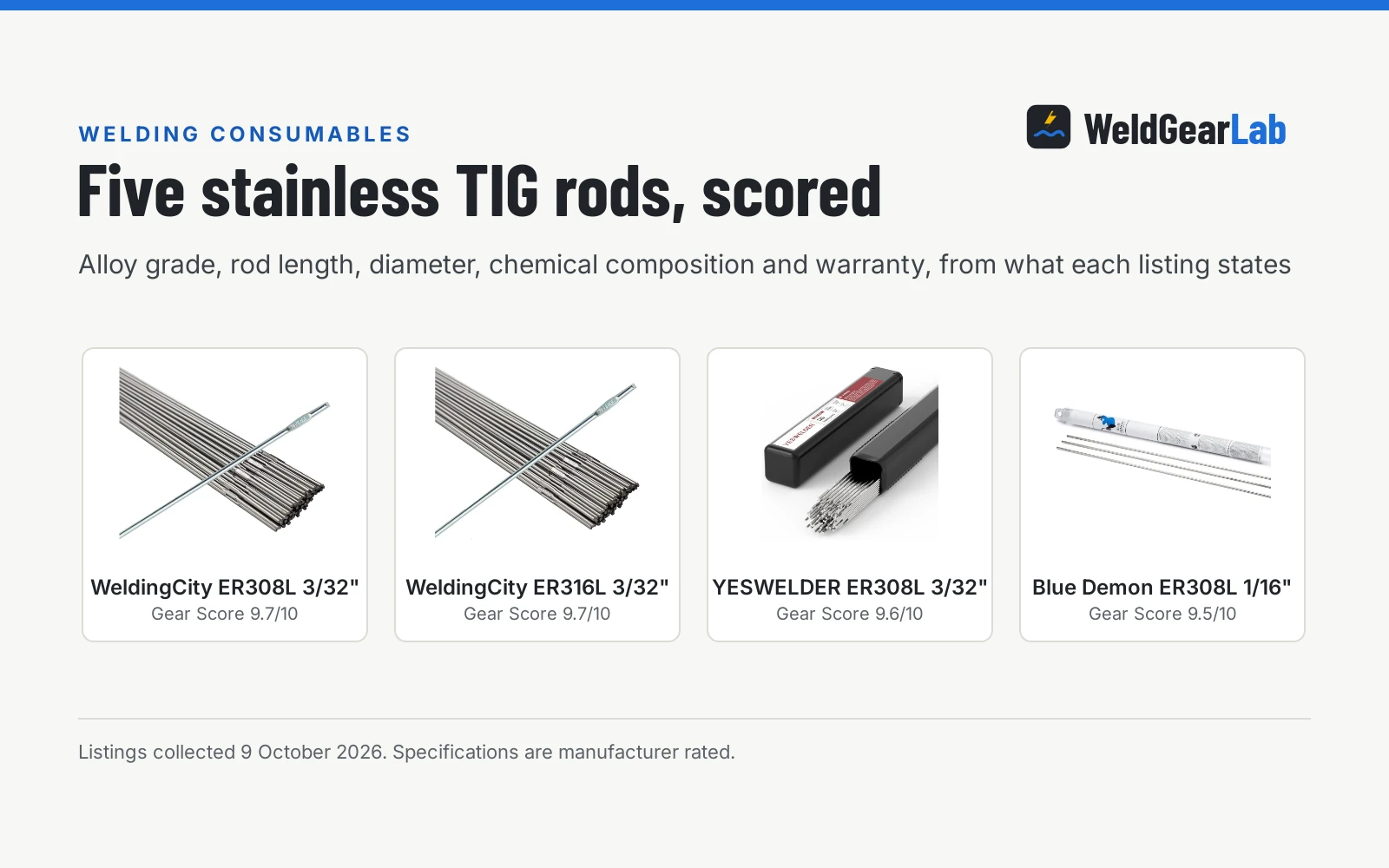
The short answer to tig vs stick for stainless steel is that the listings we checked stock TIG gear, not stick electrodes. Four TIG products made the cut: three stainless filler rods in ER308L and ER316L, and a TIG wire feeder. This guide ranks them by what their listings state and notes which rod fits which stainless grade, so you can match the filler to the metal.
Other welders and gear to compare
 YESWELDER Stainless Steel TIG Welding Rod ER308L 1/16"x16"Check price on Amazon
 YESWELDER Stainless Steel TIG Welding Rod ER308L 1/8"x16" 5LBCheck price on Amazon
 ER308LCheck price on Amazon
 1-Lb ER316L Stainless Steel 316 TIG Welding Rod 1/16"x36"Check price on Amazon
 ARCCAPTAIN Stainless Steel TIG Welding Rod ER308LCheck price on Amazon
 ER309LCheck price on Amazon
This guide links to our product roundups, where WeldGearLab gets a commission on purchases made through links on this page, and your price stays the same. Read our affiliate disclosure.
Tig vs stick for stainless steel: the short answer
Stainless steel wants a clean, controlled arc, and the listings checked for this guide answer with TIG. The three filler rods are all TIG rods: two in ER308L (the YESWELDER lists 304, 304L, 308, 308L, 321 and 347; the SÜA lists 304L, 308L, 321 and 347), and one in ER316L for 316. The fourth product is a TIG wire feeder that feeds filler wire up to 3/32 in. No stick electrodes were in the listings, so this guide ranks the TIG gear and leaves the stick side to a future roundup. See the 308 vs 316 stainless welding rod comparison for more on these fillers.
The TIG gear, ranked
First is the YESWELDER ER308L 5 lb box: 1/16 in by 16 in rods, which the listing calls the most popular stainless rod for general-purpose work where corrosion is moderate. The listing names 304, 304L, 308, 308L, 321 and 347, and calls for 100% argon or an argon/helium mix. At 5 lb it is the bulk buy of the four, suited to a shop that burns through filler.
Second is the SÜA ER308L 1 lb pack: 36 in by 0.045 in rods for 304L, 308L and the stabilized grades 321 and 347. The listing gives TIG parameters (DCEN, 2% thoriated or ceriated tungsten, 100% argon) and notes the low carbon content preserves intergranular corrosion resistance for x-ray quality welds. The 1 lb pack is the try-it size.
Third is the WeldingCity ER316L 1 lb pack: 1/16 in by 36 in rods to AWS A5.9, for 316 and similar alloys with about 2% molybdenum. The listing states 0.03% maximum carbon and 2 to 3% molybdenum for corrosion resistance, with 100% argon shielding. Pick this one when the base metal is 316.
Fourth is the Strong Hand Tools ATF100 TIG wire feeder: a lightweight feeder that smoothly feeds TIG filler wire up to 3/32 in (2.4 mm) with adjustable tension arms and a knurled thumb wheel. A base magnet stands it upright on any steel bench. It is an accessory, not filler, so it ranks last as gear but first as a helper for long TIG sessions.
Which rod for which stainless
Match the rod to the base metal. ER308L covers 304, 304L, 308, 308L, 321 and 347 per the YESWELDER listing, which makes it the general-purpose stainless rod. ER316L is for 316 and similar molybdenum-bearing alloys per the WeldingCity listing. The SÜA listing adds that its ER308L suits 304L and 308L as well as the stabilized 321 and 347 grades. Both ER308L listings note low carbon content (0.03% maximum) for resistance to intergranular corrosion, and the WeldingCity listing gives its ER316L composition as 18.5% chromium, 12.5% nickel and 2-3% molybdenum. When in doubt, the 308 vs 316 comparison linked above walks through the choice.
Rod diameters and pack sizes
The three rods come in different diameters. The YESWELDER is 1/16 in by 16 in in a 5 lb box, the SÜA is 0.045 in by 36 in in a 1 lb pack, and the WeldingCity is 1/16 in by 36 in in a 1 lb pack. The 5 lb YESWELDER box is the value buy for a shop that welds stainless regularly, while the 1 lb packs are the right size for occasional work or for trying a grade before committing. The SÜA listing notes other diameters from 0.030 in to 3/16 in and packs from 1 lb to 10 lb are available in the size menu, and the WeldingCity listing offers 1 lb, 5 lb and 10 lb packs. The SÜA listing notes the main image is for reference only and points to picture number 2 for the approximate rod count per pound.
Feeding the wire by hand
Stainless TIG means feeding filler by hand, and the Strong Hand Tools ATF100 feeder is built for that job. It fits rods up to 3/32 in, with adjustable tension arms and a center-grooved knurled thumb wheel that keeps the wire aligned without slipping, even with gloves on. The open-frame arms are stainless steel, the feeder measures 7.0 by 3.0 by 0.8 in, and it weighs 0.1 lb, so it will not tire the hand. A base magnet stands it upright on a steel bench between welds. For 1/16 in and 0.045 in rods like the ones in this roundup, the feeder’s center-grooved knurled wheel keeps the wire aligned and prevents slipping, per the listing.
The feeder matters most on long beads: it feeds filler wire up to 3/32 in with adjustable tension arms, and the center-grooved knurled wheel keeps the wire aligned, per the listing. The 3/32 in maximum covers every rod diameter in this roundup, and the two pre-drilled base holes accept custom heat shields or articulating arms if the bench setup grows.
Shielding gas and setup
All three rod listings call for 100% argon, with argon/helium mixes noted for greater penetration and higher speeds. The SÜA listing recommends DCEN (DC-) with 2% thoriated, 2% ceriated, lanthanated or rare earth tungsten. The YESWELDER listing names welding, petrochemical, pressure vessels, food processing machinery and medical equipment as typical uses. Set the gas, set the polarity, and match the rod to the grade.
FAQ for welders
Can I TIG weld stainless steel with ER308L?
Yes. The YESWELDER lists ER308L as TIG filler for 304, 304L, 308, 308L, 321 and 347, and the SÜA lists it for 304L, 308L, 321 and 347, with 100% argon shielding.
When do I need ER316L instead?
Use ER316L for 316 and similar alloys containing about 2% molybdenum, per the WeldingCity listing. The 2 to 3% molybdenum increases corrosion resistance over 308L.
What shielding gas for stainless TIG?
All three listings call for 100% argon. Argon/helium mixes are noted for greater penetration and higher speeds. See argon vs helium for TIG welding for the trade-offs.
What tungsten for stainless TIG?
The SÜA listing recommends 2% thoriated, 2% ceriated, 2% or 1.5% lanthanated, or rare earth tungsten, run DCEN.
What does the wire feeder do?
The Strong Hand ATF100 feeds TIG filler wire up to 3/32 in with adjustable tension, so the wire feeds smoothly even with welding gloves on. It is a helper, not a replacement for the right filler rod.
More welding guides
See the 308 vs 316 stainless welding rod, argon vs helium for TIG welding, best all-around tungsten electrode for TIG and best all-around stick welding rod.