Mig vs Tig for Stainless Steel: Which One Should You Buy?
MIG and TIG both weld stainless, but they suit different work: how the processes compare on speed, heat control and cleanup, plus four stainless TIG rods ranked.

On this page
Top picks at a glance
As an Amazon Associate I earn from qualifying purchases.
- 1
 035" V Groove Drive Roll Kit Compatible with Miller9.6/10View on Amazon
- 2
 4-Pack 0.035" Gasless Flux Core MIG WireView on Amazon
- 3
 2-Pack 0.035" Gasless Flux Core MIG WireView on Amazon
- 4
 ARCCAPTAIN ER308L Stainless Steel MIG Wire .035" 2LB GaslessView on Amazon
- 5
 ARCCAPTAIN ER308L Stainless Steel MIG Wire .030" 2LB GaslessView on Amazon
- 6
 WeldingCity ER309L Stainless Steel MIG Welding Wire 2-LbView on Amazon
- 7
 PGN ER308L .035" Stainless Steel MIG Welding WireView on Amazon
The job on the bench is a stainless repair: a cracked exhaust hanger, a food cart frame, a brew kettle fitting. The mig vs tig for stainless steel question decides how that weld goes down. TIG gives you a clean, controlled bead on thin stainless with filler rod you feed by hand. MIG runs faster and suits thicker sections and long runs, with wire feeding through the gun. Pick TIG for thin stock and visible work; pick MIG for speed on heavier stainless.
Other welders and gear to compare
 4-Pack 0.035" Gasless Flux Core MIG WireCheck price on Amazon
 2-Pack 0.035" Gasless Flux Core MIG WireCheck price on Amazon
 ARCCAPTAIN ER308L Stainless Steel MIG Wire .035" 2LB GaslessCheck price on Amazon
 ARCCAPTAIN ER308L Stainless Steel MIG Wire .030" 2LB GaslessCheck price on Amazon
 WeldingCity ER309L Stainless Steel MIG Welding Wire 2-LbCheck price on Amazon
 PGN ER308L .035" Stainless Steel MIG Welding WireCheck price on Amazon
This guide links to our product roundups, where WeldGearLab gets a commission on purchases made through links on this page, and your price stays the same. Read our affiliate disclosure.
Mig vs Tig for Stainless Steel: The Short Answer
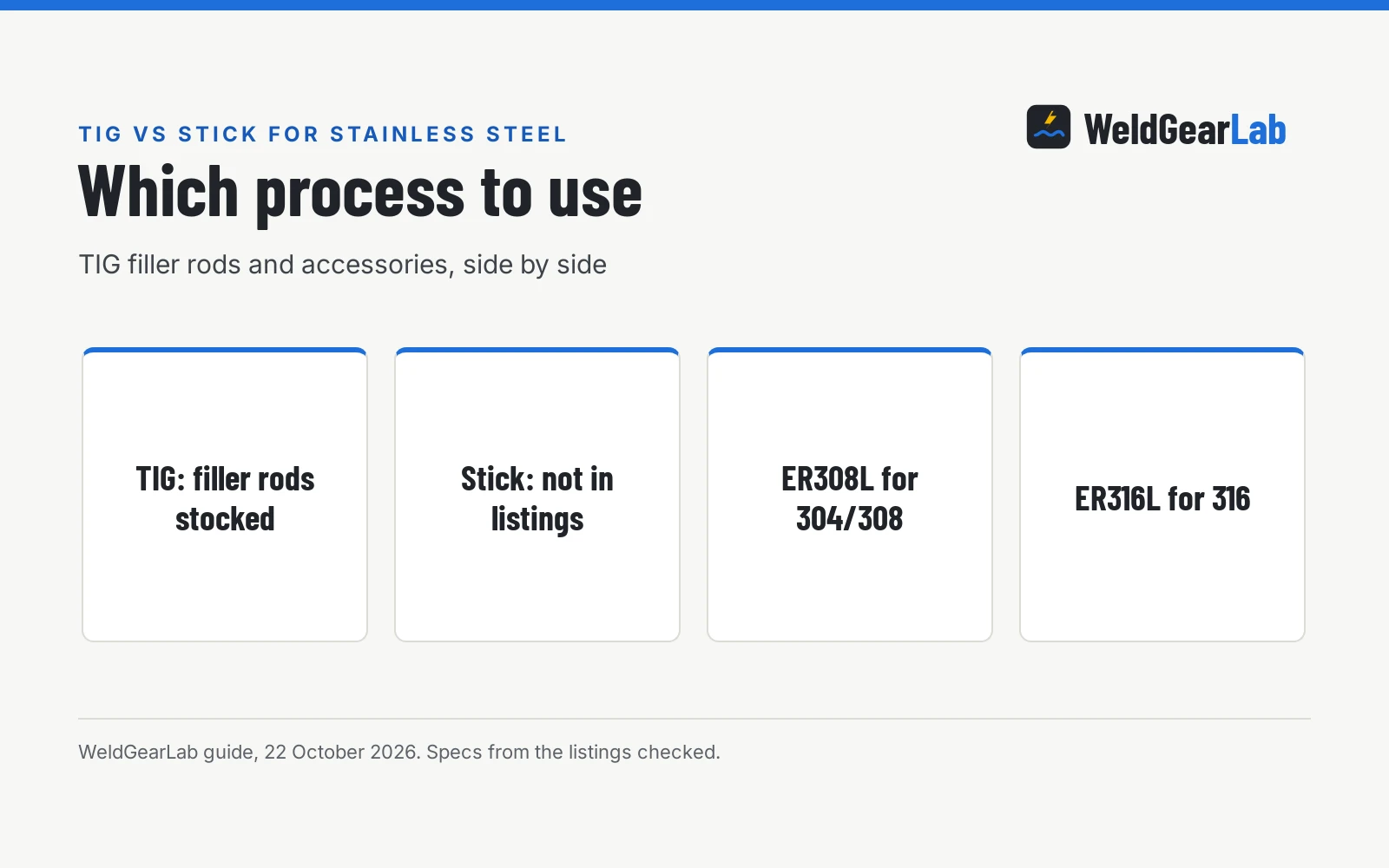
For stainless, TIG is the default in most home and small shops: precise heat control, clean beads, and filler choice matched to the alloy. MIG earns its place on thicker stainless and production-style runs where travel speed matters. The rods below are all TIG filler, ER308L or ER316L, and every rod listing here states 100% argon shielding gas for TIG.
Side by side
| MIG on stainless | TIG on stainless | Notes | |
|---|---|---|---|
| How it works | Wire feeds through the gun; the arc melts it into the joint | Arc between tungsten and work; you hand-feed the rod | Gas stated for the TIG rods |
| Speed | Faster travel, quicker on long runs | Slower, more deliberate | MIG wins on production |
| Heat control | Higher heat input | Precise, pedal-controlled heat | TIG wins on thin stainless |
| Bead and cleanup | Spatter possible, more cleanup | Clean beads, minimal cleanup | TIG wins on visible work |
| Learning curve | Easier to start | Steeper: two hands plus pedal | |
| Filler | Stainless MIG wire on a spool | ER308L or ER316L rod matched to the base metal | Rods below are TIG filler |
| Shielding gas | Not stated in these listings | 100% argon stated on all four rod listings | |
| Thin stainless | Hotter, warping risk | Better control | TIG for thin stock |
Gas choice and settings follow your wire and machine manual. Every rod listing here states 100% argon for TIG; two of them note argon/helium for greater penetration and higher speeds.
When TIG is the better choice
- Thin stainless. Sheet, tube and sanitary fittings. Pedal control keeps heat where you want it and warping down.
- Visible welds. Clean beads with minimal cleanup, no spatter to grind off.
- Alloy matching. ER308L for 304 and 308 families, ER316L where molybdenum-bearing alloys need it, per the rod listings.
- Small or awkward joints. Hand-fed rod reaches where a gun cannot aim well.
When MIG is the better choice
- Thicker sections. MIG suits heavier stainless and long runs where wire feed keeps the work moving.
- Long runs. Continuous wire feed beats stopping to grab a new rod.
- Speed over looks. Structural brackets and frames where the bead gets ground or stays hidden.
- Lower skill floor. Easier to lay an acceptable bead early on.
Four stainless TIG rods
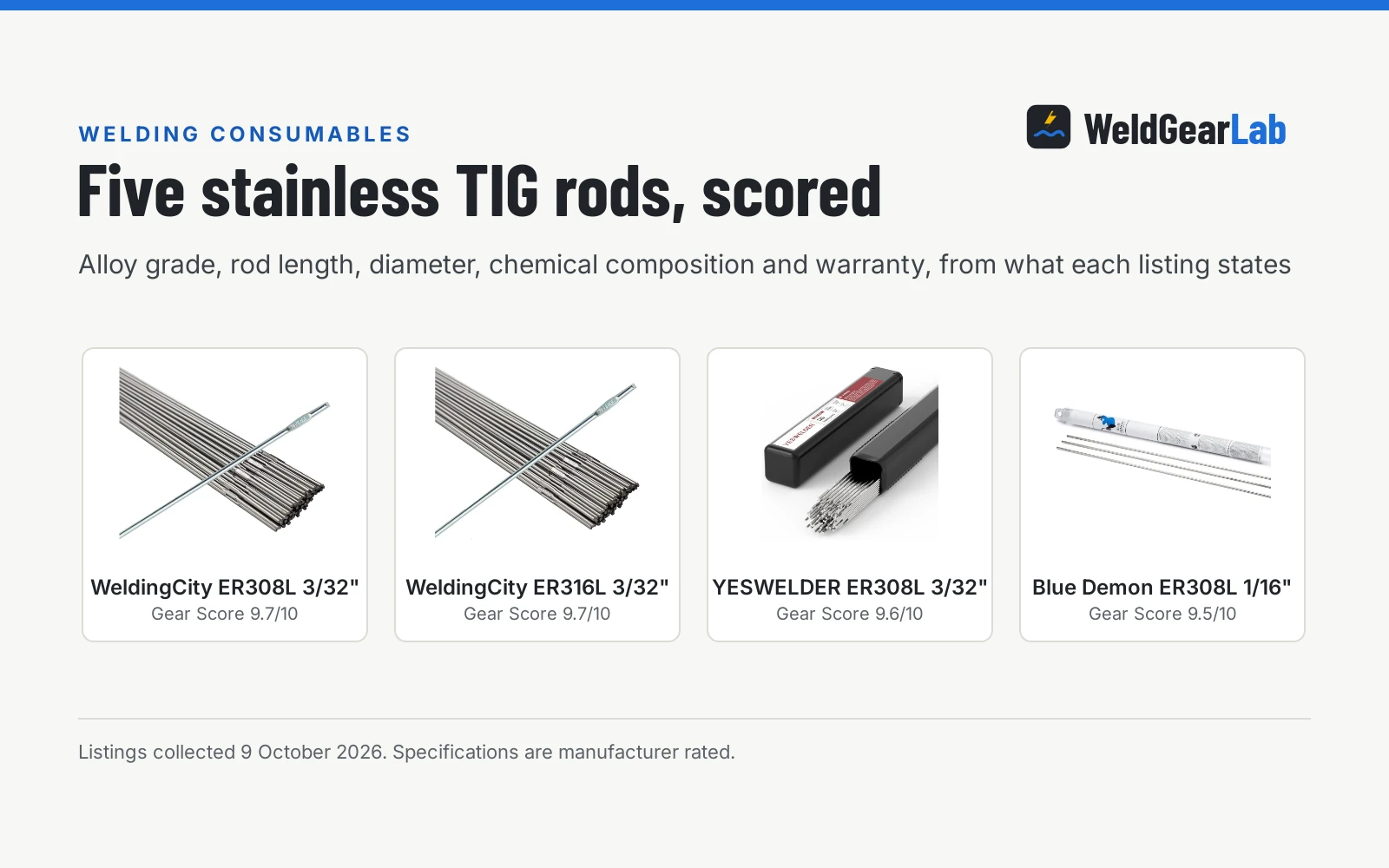
All four are stainless TIG filler rods from the listings:
WeldingCity ER308L 3/32 in x 36 in, 5 lb
The deepest listing here. A 5 lb pack of ER308L TIG rod, 3/32 in diameter and 36 in long, with AWS A5.9 spec stated and deposited chemistry listed (20.0% chromium, 10% nickel, carbon at 0.02%). The listing states diameters from 0.045 to 1/8 in and 1, 5 and 10 lb packs, and names the applications: TIG filler for 304, 304L, 308, 308L, 321 and 347, with carbon held to 0.03% max against intergranular carbide precipitation. Shielding gas: 100% argon. Who it suits: general stainless TIG work on the 304, 308, 321 and 347 grades the listing names. Who should skip it: welders who need 316L for molybdenum-bearing alloys.
WeldingCity ER316L 1/16 in x 36 in, 1 lb
The 316L option. A 1 lb pack of ER316L TIG rod, 1/16 in by 36 in, with AWS A5.9 spec stated and 2.50% molybdenum in the deposited chemistry. The listing states it for similar alloys containing about 2% molybdenum, with 0.03% max carbon for intergranular corrosion resistance, plus good bead wetting and puddle control with minimal smut. Shielding gas: 100% argon. Diameters 0.045 to 1/8 in and 1, 5, 10 lb packs are stated. Who it suits: 316 and other molybdenum-bearing stainless where corrosion resistance matters more. Who should skip it: anyone welding plain 304, where ER308L is the stated match.
YESWELDER ER308L 1/16 in x 16 in, 5 lb
A 5 lb pack of ER308L rod at 1/16 in diameter and 16 in long. The listing states 100% argon or argon/helium shielding for greater penetration and higher speeds, low carbon at 0.03% max for intergranular corrosion resistance, and applications across 304, 304L, 308, 308L, 321 and 347, plus petrochemical, pressure vessel, food processing and medical equipment work. One wrinkle: the title says 5LB while the spec table lists item weight as 5.15 pounds; the title wins. Who it suits: shops that burn through 308L rod and want the argon/helium option stated. Who should skip it: anyone wanting 36 in rods for fewer rod changes.
ARCCAPTAIN ER308L 1/8 in x 16 in, 5 lb
A 5 lb pack of ER308L at 1/8 in by 16 in, the heaviest diameter here. The listing states 100% argon or argon/helium shielding and names thin plate welding among the uses, with smooth beads and corrosion resistance claimed. The spec table is empty, so diameter, length and pack size come from the title and bullets alone. Who it suits: heavier deposition with 308L where a fat rod helps. Who should skip it: welders who need 316L for molybdenum-bearing alloys.
ER308L vs ER316L: which rod
Match the rod to the base metal, not the process. ER308L is the general-purpose stainless rod: the listings name 304, 304L, 308, 308L, 321 and 347. ER316L lists Mo=2.50 in its deposited chemistry and is stated for similar alloys containing approximately 2% molybdenum, and is the stated pick for 316 and similar molybdenum-bearing alloys. Both are low carbon (0.03% max) to resist intergranular corrosion. If the base metal is 304, 308L is the answer; if it is 316, step up to 316L.
Welding stainless safely
Stainless brings the usual arc hazards plus fume and fire sense. Weld with ventilation that moves the plume away from your breathing zone, keep flammables and dry debris clear of the arc, and keep gas cylinders upright with a chain. Use a helmet with a shade matched to the amperage you are running, and check the machine manual for input power and duty cycle before a long session. See the OSHA welding overview.
FAQ for welders
Can you MIG weld stainless steel?
Yes. MIG runs faster on thicker sections and long runs. TIG stays the pick for thin stainless and visible beads.
What TIG rod do I need for 304 stainless?
ER308L. The listings here state it as filler for 304, 304L, 308, 308L, 321 and 347, with low carbon for intergranular corrosion resistance.
When do I need ER316L instead of ER308L?
When the base metal is 316 or a similar molybdenum-bearing alloy. ER316L lists Mo=2.50 in its deposited chemistry and is stated for similar alloys containing approximately 2% molybdenum; for plain 304, ER308L is the stated match.
What shielding gas do these rods need?
All four listings state 100% argon. The YESWELDER and the ARCCAPTAIN also note argon/helium for greater penetration and higher speeds.
Which diameter should I start with?
The listings here offer 0.045, 1/16, 3/32 and 1/8 in. Match the rod to the joint: thinner rod for thin stock, heavier rod for buildup. None of the listings states an amperage range, so set amps from your machine manual.
Related: our best TIG rod for stainless steel roundup, the best welding machine for stainless steel guide, argon vs helium for TIG welding, and how to TIG weld thin stainless without warping.