Safety Glass Goggles: Glasses vs Goggles for the Shop
Safety glass goggles seal out dust, splash and flying chips where open safety glasses leave gaps, and this guide shows how to pick a pair for welding and grinding work.

On this page
Top picks at a glance
As an Amazon Associate I earn from qualifying purchases.
- 1
 Hobart 770726 Shade 59.6/10View on Amazon
- 2
 LANON Welding Safety Glasses9.5/10View on Amazon
- 3
 Relaxweex Welding Goggles Welding Safety Glasses Shade 5 IR9.6/10View on Amazon
Grinding a weld smooth throws sparks, chips and dust in every direction, and a wire wheel can fling a bristle straight toward your face. Safety glass goggles are sealed eye protection that sits tight against the skin around the eyes, so dust, splash and flying debris cannot slip in around the edges the way they can with open safety glasses. This guide explains how goggles differ from glasses, what the sealed frame and strap change in the shop, and how to pick a pair that fits under a welding helmet.
This guide links to our product roundups, where WeldGearLab gets a commission on purchases made through links on this page, and your price stays the same. Read our affiliate disclosure.
Safety glass goggles vs safety glasses
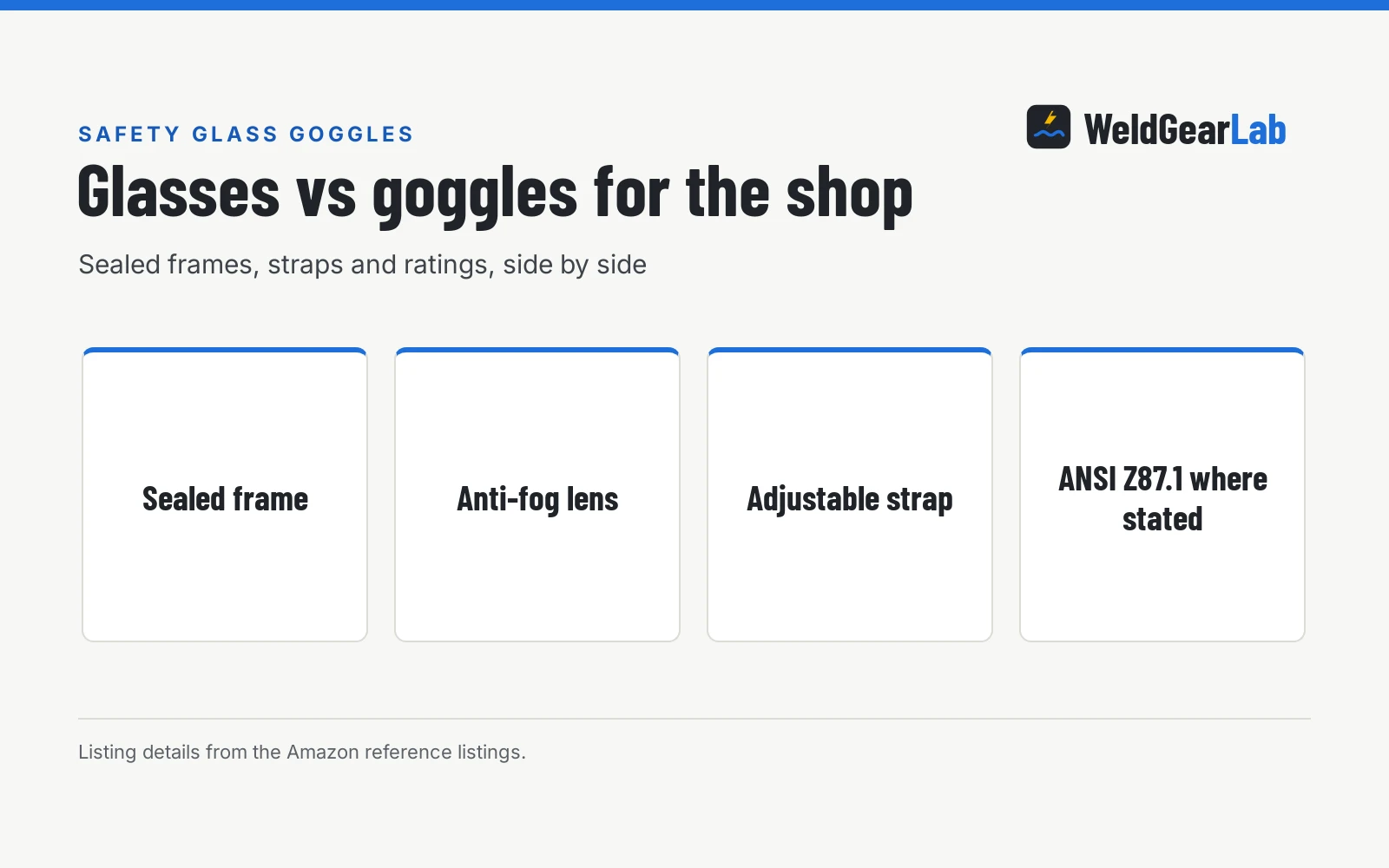
Safety glasses sit on the nose with temple arms, like ordinary eyeglasses, and leave the sides open. Safety glass goggles use a soft frame that seals against the face and a strap that holds the seal in place, so the eyes are covered from every angle. The sealed frame is the main difference: it keeps dust, splash and chips from slipping past the edge of an open frame. For grinding, cutting and wire wheel work, that seal is what keeps grit out of the eyes. For light work with no dust or splash in the air, open glasses can be enough, and the types of safety glasses guide covers the open frame options.
The listings used as reference for this guide show the range on offer. Super More lists an anti-fog coating, a sealed and adjustable fit, and a clear lens with a wide field of view. Honmein lists a polycarbonate lens, soft PVC frames, an adjustable headband, and a frame sized to wear over prescription glasses. OXG lists a TPU frame, a double layer anti-fog coating, and 4 indirect ventilation channels. The choice comes down to the seal, the fit over glasses, and the rating on the lens.
Side by side
| Safety glasses | Safety goggles | In the shop | |
|---|---|---|---|
| Seal around the eyes | Open at the sides | Sealed frame with a strap | Goggles seal the eyes against dust and splash at the edges |
| Ventilation | Open airflow | Indirect channels on some frames | OXG lists 4 indirect ventilation channels |
| Fit over prescription glasses | Varies by frame | Honmein lists an over-glasses design | Only Honmein lists a frame sized for prescription glasses |
| Anti-fog coating | Not covered by the reference listings | Stated on sealed frames | Each reference listing states an anti-fog coating |
| Splash protection | Limited at the sides | Sealed against splash | Chemical splash calls for a sealed frame |
| Strap or temples | Temple arms | Adjustable strap or headband | A strap holds the seal while bending and reaching overhead |
| Rating to look for | ANSI Z87.1 where stated | ANSI Z87.1 where stated | OXG lists ANSI Z87.1 on its 6-pack |
| Pack size | Sold singly or in packs | 2-pack and 6-pack options listed | Honmein lists a 2-pack and OXG lists 6 pairs |
The table shows the trade: goggles win on seal and splash, glasses win on airflow and easy on and off. A sealed frame still needs air, or the lens can fog once the work heats up, which is why the reference listings stress anti-fog coatings and vent channels. Check the rating printed on the lens before ordering, and check the fit with the helmet down.
When goggles are the better choice
- Grinding and cutting. Sparks, chips and dust fly in every direction, and a sealed frame keeps them out of the eyes.
- Chemical splash. Paint, solvents and cleaning fluids can splash upward, and an open frame leaves the eyes exposed from the sides.
- Dusty work. Sanding, wire brushing and sweeping a shop floor stir up fine dust that drifts around open frames.
- Work overhead. Chips and dust fall straight down, and a sealed frame stops them reaching the eyes from above.
The safety goggles for welding guide covers welding specific picks, and the grinding wheel safety guide covers guards and eye protection for grinder work.
When glasses are the better choice
- Quick jobs with no dust. A short look at a fit up or a quick check of a bead needs eye cover, not a sealed frame.
- Constant on and off. Glasses lift off and hang on a shirt pocket between jobs, while a strapped goggle takes longer to remove and refit.
- Hot, still air. Open frames breathe better when the shop air is hot and still, and fog is less of a fight.
- Under a helmet for tacking. Some welders wear glasses under the helmet for tack welds and switch to goggles for grinding.
See the safety glasses parts guide for how lenses, temples and frames fit together, and Rx safety glasses for prescription options.
How to pick a pair for the shop
Start with the hazard: grinding and cutting call for a sealed frame, while light inspection work can take open glasses. Then check the rating. OXG lists ANSI Z87.1 on its 6-pack, and a stated rating is the simplest check that the lens meets a known impact standard. Then check the fit. Honmein lists a frame that fits over prescription glasses, and Super More lists a size range of Medium to Large with an adjustable strap, so measure the fit against the glasses and the helmet that will sit over the goggles.
- Seal. Press the frame to the face and look for gaps at the nose and temples; a gap lets dust in.
- Strap. An adjustable strap or headband holds the seal while bending and reaching overhead.
- Anti-fog. Look for an anti-fog coating, and vent channels where the listing states them, and keep a cloth handy for wiping the lens.
- Fit over glasses. Readers who wear prescription glasses need a frame deep enough to clear the lenses, like the over-glasses design Honmein lists.
- Pack size. A 2-pack suits a home bench, while a 6-pack suits a shared shop where pairs go missing.
For plasma work, eye protection rules change with the arc: see plasma cutter safety glasses. For helmet picks, see the best welding helmet for price guide and the best welding helmet with light guide. The welding safety gear hub gathers the rest of the shop PPE guides.
FAQ for welders
Can safety glass goggles be worn under a welding helmet?
Yes, if the frame is low enough to clear the helmet shell and the strap sits flat. Try the goggles on with the helmet down before a job, and adjust the strap so the seal holds without pressing the frame into the skin. If the frame pushes the helmet out of position, try a lower profile frame.
Do safety goggles need an ANSI Z87.1 rating for shop work?
A stated rating is the simplest way to know the lens meets a known impact standard. OXG lists ANSI Z87.1 on its 6-pack of goggles. Listings that state no rating leave the buyer guessing, so check the lens marking before ordering.
Can safety goggles fit over prescription glasses?
Some can. Honmein lists a frame sized to wear over prescription glasses, with soft frames and an adjustable headband that contour to the face. Measure the depth of the frame against the prescription glasses before ordering, and check that the temples of the glasses sit flat under the goggle frame.
How do safety goggles stop fogging in a hot shop?
OXG lists a double layer anti-fog coating and 4 indirect ventilation channels, and the other listings state an anti-fog coating as well. Indirect channels let air move while blocking direct splash. Wipe the lens with a clean cloth when it fogs, and keep any vents clear of dust.
Are safety goggles enough protection for grinding?
Goggles protect the eyes from chips, dust and sparks, but grinding also throws debris at the face and neck. Wear a face shield over goggles for heavy grinding, and keep the grinder guard in place. See the grinding wheel safety guide for guard and speed checks.
Related: types of safety glasses, safety goggles for welding, plasma cutter safety glasses, and the welding safety gear hub.