Pneumatic vs Electric Rivet Gun: Which One Should You Buy?
Pneumatic vs electric rivet gun: 2 air riveters against 1 cordless tool, compared by pull force, rivet size, weight, box contents and warranty.

On this page
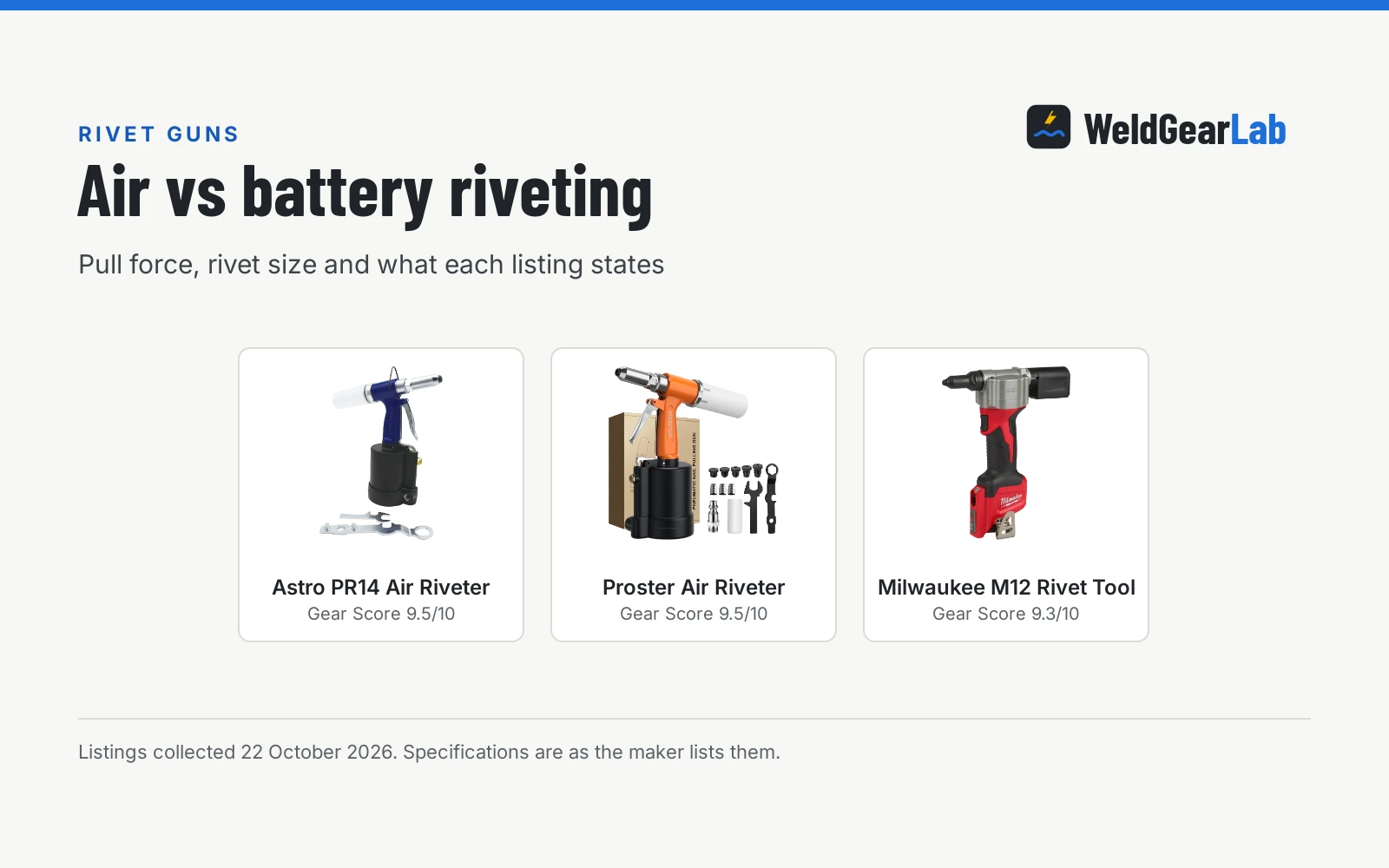
Top picks at a glance
As an Amazon Associate I earn from qualifying purchases.
- 1
 Astro Pneumatic Tool PR14 Air Riveter - 3/32"9.5/10View on Amazon
- 2
 Proster Pneumatic Rivet Gun Air Riveters 3924LBF 59.5/10View on Amazon
- 3
 Milwaukee Electric Tools 2550-20 M12 Rivet Tool9.3/10View on Amazon
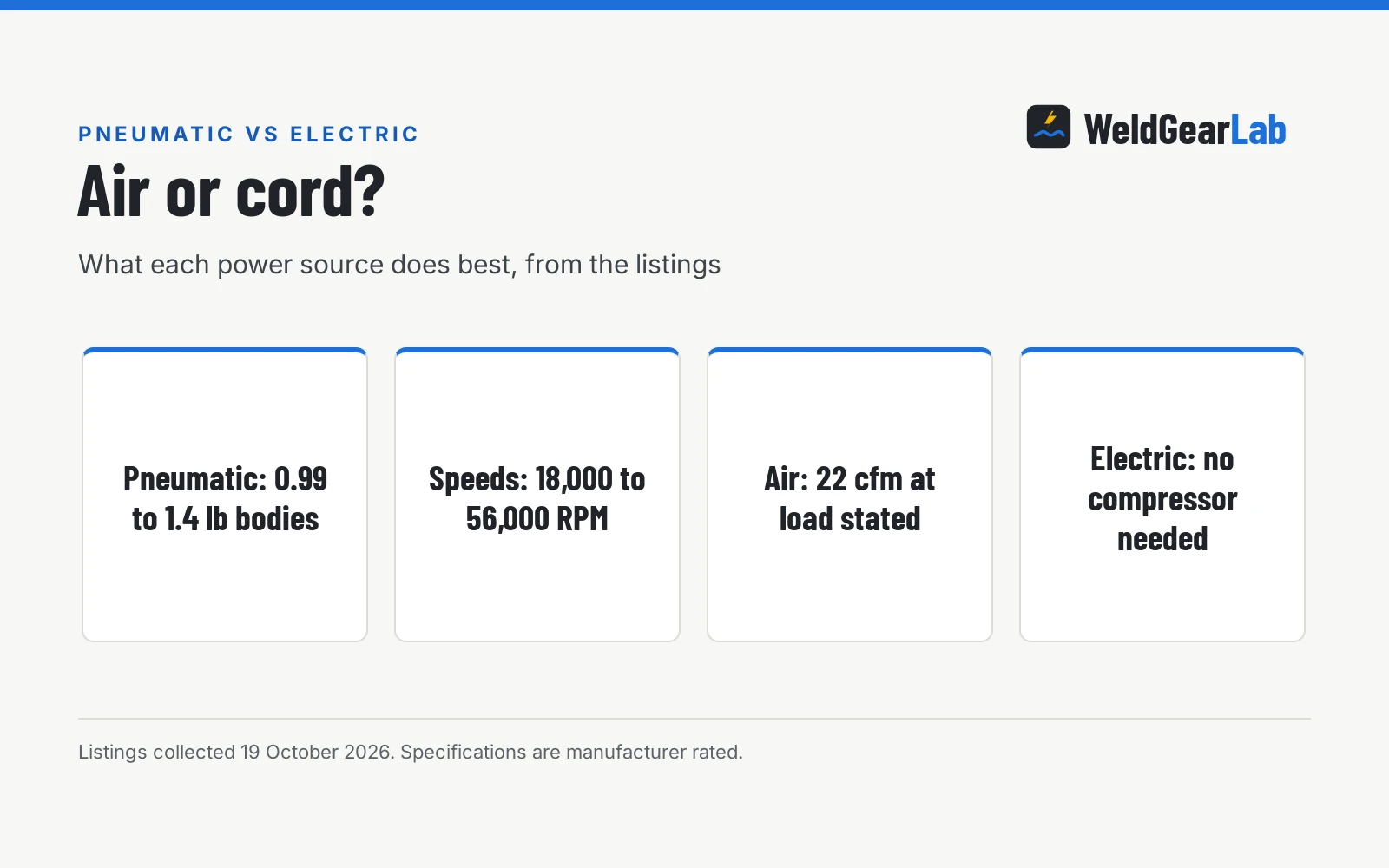
Pick pneumatic if you have shop air: the Proster example lists 3924 LBF of pull force and the Astro example carries the only stated warranty here, 1-year. Pick the Milwaukee M12 electric if you want cordless riveting away from a compressor; its listing claims 450 1/8 in steel rivets per charge. Neither side wins on every spec, so the listings below decide it feature by feature.
The rivets are waiting, the panels are clamped, and the hand squeezer is not going to cut it for this many holes. Pneumatic vs electric rivet gun is the power-source question underneath the job: shop air on a hose, or a battery on your belt. This comparison puts 2 pneumatic examples against 1 electric example and scores what each listing actually states, so the choice follows the work instead of the hype.
WeldGearLab gets a commission on purchases made through links on this page, and your price stays the same. Read our affiliate disclosure.
The 3 tools

Astro Pneumatic Tool PR14 Air Riveter - 3/32"
A pneumatic air riveter with 3/32 to 1/4 in capacity across 5 nosepieces and a stated 1-year warranty.
Pros
- 1-year warranty stated, the only one here
- 5 nosepieces from 3/32 to 1/4 in with 3 screwed onto the base
- Quick-release air valve for fast cylinder return
- Listed as performing well at any angle
Cons
- No pull force stated
- No stroke length stated
- Thin bullets with no application detail
- Needs shop air, which the listing assumes you have

Proster Pneumatic Rivet Gun Air Riveters 3924LBF 5
A pneumatic rivet gun listing 3924 LBF of pull force with 5 nozzles, spare jaws and a silencer.
Pros
- 3924 LBF (1780 KGF) pull force stated at 6-8 kg air pressure
- 5 nozzles 3/32 to 1/4 in plus a spare set of jaws
- Silencer and rivet collection bottle included
- 16 mm maximum stroke with the 2-pull case explained
Cons
- No warranty term stated
- Not for stainless steel rivets per the listing
- Needs shop air at the stated pressure

Milwaukee Electric Tools 2550-20 M12 Rivet Tool
A cordless electric rivet tool, sold as the bare tool, pulling 3/32 to 3/16 in rivets.
Pros
- Cordless: no compressor or air hose needed
- 450 1/8 in steel rivets per charge claimed
- Pulls 3/32, 1/8, 5/32 and 3/16 in rivets
- Simple listing with an easy-to-use claim
Cons
- No warranty term stated
- No pull force stated
Other welders and gear to compare
 Heavy Duty Pneumatic Rivet Gun 3097LBF Air Rivet Gun Set 4Check price on Amazon
 Pneumatic Air RiveterCheck price on Amazon
 Heavy Duty Pneumatic Rivet Gun 3916 LBF Air Rivet Gun 5Check price on Amazon
 Heavy Duty Hand RiveterCheck price on Amazon
 Dorman 743-100 Hand Rivet GunCheck price on Amazon
 Lincoln ElectricCheck price on Amazon
Side by side
| Astro PR14 Air Riveter | Proster Air Riveter | Milwaukee M12 Rivet Tool | |
|---|---|---|---|
| Side | Pneumatic | Pneumatic | Electric (cordless) |
| Rivet capacity | 3/32 to 1/4 in | 3/32 to 1/4 in | 3/32 to 3/16 in |
| Pull force | Not stated | 3924 LBF | Not stated |
| Weight | 3.52 lb | 1.55 kg (bullets) | 4.81 lb |
| In the box | 5 nosepieces | 5 nozzles, spare jaws, bottle | Bare tool |
| Warranty | 1-year warranty | Not stated | Not stated |
The table shows the shape of the choice. Both pneumatic examples cover rivets from 3/32 to 1/4 in; the electric example tops out at 3/16 in. Only the Proster example states a pull force. Only the Astro example states a warranty. Read the sections below for what those gaps mean.
Pneumatic vs electric rivet gun: power source and what it needs
A pneumatic rivet gun needs shop air. The Proster listing states its 3924 LBF pull at 6-8 kg air pressure and includes a US-specification air inlet; the Astro listing calls itself an air riveter with a quick-release air valve. No compressor, no rivets. The Milwaukee example is cordless and needs nothing but a charged pack, but note the listing sells the bare tool: the spec table states that 1 lithium ion battery is required, so the battery is a separate purchase unless you already own into the system. The listing leaves the voltage unclear: the spec table lists Voltage: 220 while the title says M12, so treat the voltage as unstated rather than guessing.
Pull force and rivet size
Pull force is where the listings go quiet except for the Proster example. It states 3924 LBF (1780 KGF) of pulling strength with a 16 mm maximum stroke, and explains that rivets with a 10-16 mm mandrel need 2 pulls to break. The Astro example states no pull force at all; it lists capacity from 3/32 to 1/4 in across 5 nosepieces. The Milwaukee example states no pull force either; it claims 450 1/8 in steel rivets per charge and pulls 3/32, 1/8, 5/32 and 3/16 in rivets.
Weight and build
The Astro example lists 3.52 pounds in its spec table. The Proster example contradicts itself: the bullets call it a 1.55 kg gun while the spec table lists 4.84 pounds. The Milwaukee example lists 4.81 pounds in its spec table. Build notes from the listings: the Proster example claims aircraft-grade aluminum with a silencer and includes a spare set of jaws; the Astro example claims a quick-release air valve and works at any angle; the Milwaukee example is the bare tool with no build detail beyond the listing basics.
What is in the box
The pneumatic examples come ready to rivet. The Astro example includes 5 nosepieces (1/4, 3/16, 5/32, 1/8 and 3/32 in) with 3 nose pieces screwed onto the base. The Proster example includes 5 nozzles in the same sizes, one pre-installed, plus an extra set of jaw pieces and a rivet collection bottle that catches spent mandrels. The Milwaukee example is the bare tool: the listing names no nosepieces, no battery and no charger in the box. If you are starting from nothing, the pneumatic examples need a compressor behind them and the Milwaukee needs a battery beside it.
Warranty
Only the Astro example states a warranty: 1-year warranty in its spec table. The Proster and Milwaukee listings state no warranty term. A stated warranty is not a quality claim by itself, but it is the only after-sale fact any of the 3 listings gives.
Choose the pneumatic side if
- You have shop air available, since both pneumatic examples need it and the Proster example states 6-8 kg air pressure.
- You want the strongest stated pull force: the Proster example lists 3924 LBF, and no other listing here states the figure.
- You rivet 1/4 in rivets: both pneumatic examples list that capacity, while the Milwaukee example tops out at 3/16 in.
- You want a stated warranty: the Astro example lists a 1-year warranty, the only one here.
Choose the electric side if
- You work away from a compressor: the Milwaukee example is cordless and needs no air hose.
- You want the stated per-charge figure: the Milwaukee listing claims 450 1/8 in steel rivets per charge.
- Your rivets run 3/16 in and under, which is the Milwaukee example’s stated range.
- You already own into the battery system, since the listing sells the bare tool and states a battery is required.
Before You Strike an Arc
- Confirm your air supply against the Proster example’s stated 6-8 kg air pressure before buying pneumatic.
- Check the rivet sizes: the pneumatic examples list 3/32 to 1/4 in, the Milwaukee example lists 3/32 to 3/16 in.
- The Milwaukee example is the bare tool; the spec table states a lithium ion battery is required.
- The Proster example warns against stainless steel rivets: use aluminum, iron or standard steel rivets per its listing.
FAQ for welders
Do I need an air compressor for a pneumatic rivet gun?
Yes. Both pneumatic examples are air tools, and the Proster example states its pull figure at 6-8 kg air pressure with a US-specification air inlet. The Astro example describes a quick-release air valve for the cylinder return. Without shop air, neither pneumatic example runs.
Can these rivet guns pull stainless steel rivets?
The Proster listing says no: it warns against stainless steel rivets and lists aluminum, iron and standard steel rivets instead. The Astro and Milwaukee listings state no rivet material limits. When a listing draws the line explicitly, respect it.
How many rivets does the Milwaukee pull per charge?
The listing claims 450 1/8 in steel rivets per charge. That figure is for 1/8 in steel rivets on the Milwaukee example only; the listing states no per-charge figure for other sizes, and the pneumatic examples state no per-charge figure at all.
Why would a rivet need 2 pulls?
The Proster listing explains it: the tool’s maximum stroke is 16 mm, and a rivet with a 10-16 mm mandrel needs 2 pulls to break. 1 stroke covers most rivet lengths; the longer mandrels need the second pull. The other 2 listings state no stroke figure.
What rivet sizes do these 3 handle?
The Astro and Proster examples list 3/32 to 1/4 in across 5 nosepieces or nozzles. The Milwaukee example lists 3/32, 1/8, 5/32 and 3/16 in. Match the nosepiece to the rivet before pulling.
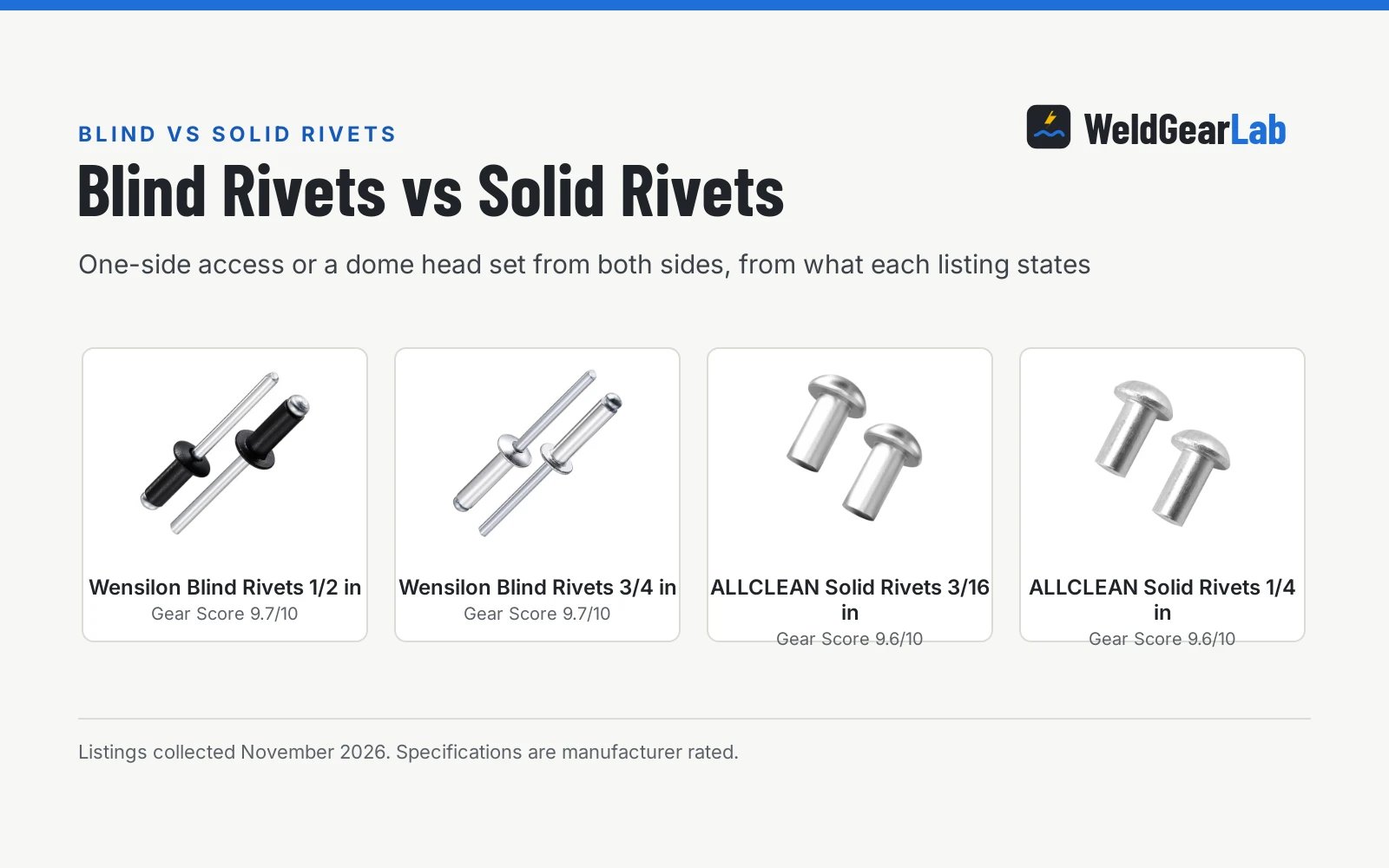
Related: the rivet gun for steel rivets picks, the heavy duty rivet gun picks and rivet gun vs rivet nut tool. Also see the rivet gun kits.
Scoring, line by line
Each tool is scored on performance, build, value, safety and warranty, using only what the listing publishes. The Astro example is the only one with a stated warranty term.
| Product | Gear Score | Perf. /35 | Build /25 | Value /25 | Safety /10 | Warranty /5 |
|---|---|---|---|---|---|---|
| Astro PR14 Air Riveter | 9.5 | 28 | 20 | 20 | 0 | 3 |
| Proster Air Riveter | 9.5 | 30 | 21 | 21 | 0 | 0 |
| Milwaukee M12 Rivet Tool | 9.3 | 26 | 19 | 19 | 0 | 0 |
The lowest score we show is 9.2 and the highest is 9.8; every point total is spread proportionally across that span, so extra points mean a higher figure.
Rivet guns are simple tools with simple listings, and this comparison stays inside what the 3 listings state. Where a listing is silent, the sections above say so.