Plasma Cutter vs MIG Welder: Which One Should You Buy?
A plasma cutter cuts metal and a MIG welder joins it: how the two tools differ, what four plasma cutter listings state, and which buy matches the job.

On this page
Top picks at a glance
As an Amazon Associate I earn from qualifying purchases.
- 1
 ARCCAPTAIN iControl CUT60 Pro Plasma Cutter Machine9.8/10View on Amazon
- 2
 50A Plasma Cutter MachineView on Amazon
- 3
 ARCCAPTAIN iControl CUT55 Prolux Plasma Cutter MachineView on Amazon
- 4
 ARCCAPTAIN 55A Non-HF Plasma Cutter MachineView on Amazon
- 5
 ARCCAPTAIN iControl CUT55 MP [Non-HF] Plasma Cutter MachineView on Amazon
- 6
 Reboot Plasma CutterView on Amazon
- 7
 Miller Electric 907529 Plasma CutterView on Amazon
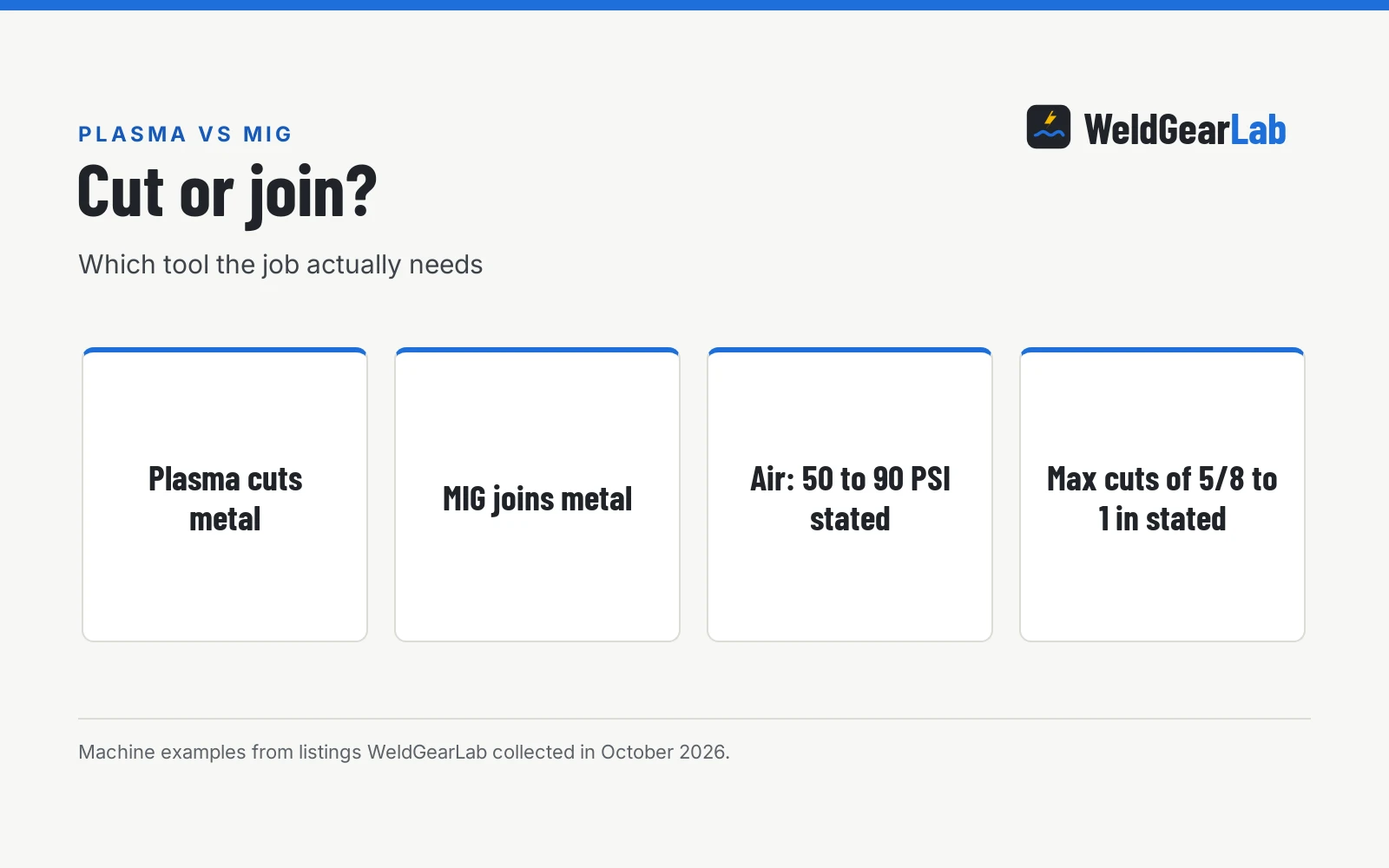
A plasma cutter and a MIG welder are not two versions of the same tool. A plasma cutter cuts metal; a MIG welder joins it. If the job is slicing plate, trimming patch panels or cutting rusted brackets off, the plasma cutter is the tool. If the job is sticking two pieces of steel together, that is the MIG welder’s work. Many home shops end up owning both, but the first buy should match the first job.
Other welders and gear to compare
 50A Plasma Cutter MachineCheck price on Amazon
 ARCCAPTAIN iControl CUT55 Prolux Plasma Cutter MachineCheck price on Amazon
 ARCCAPTAIN 55A Non-HF Plasma Cutter MachineCheck price on Amazon
 ARCCAPTAIN iControl CUT55 MP [Non-HF] Plasma Cutter MachineCheck price on Amazon
 Reboot Plasma CutterCheck price on Amazon
 Miller Electric 907529 Plasma CutterCheck price on Amazon
This guide links to our product roundups, where WeldGearLab gets a commission on purchases made through links on this page, and your price stays the same. Read our affiliate disclosure.
The difference in one paragraph: plasma cutter vs mig welder
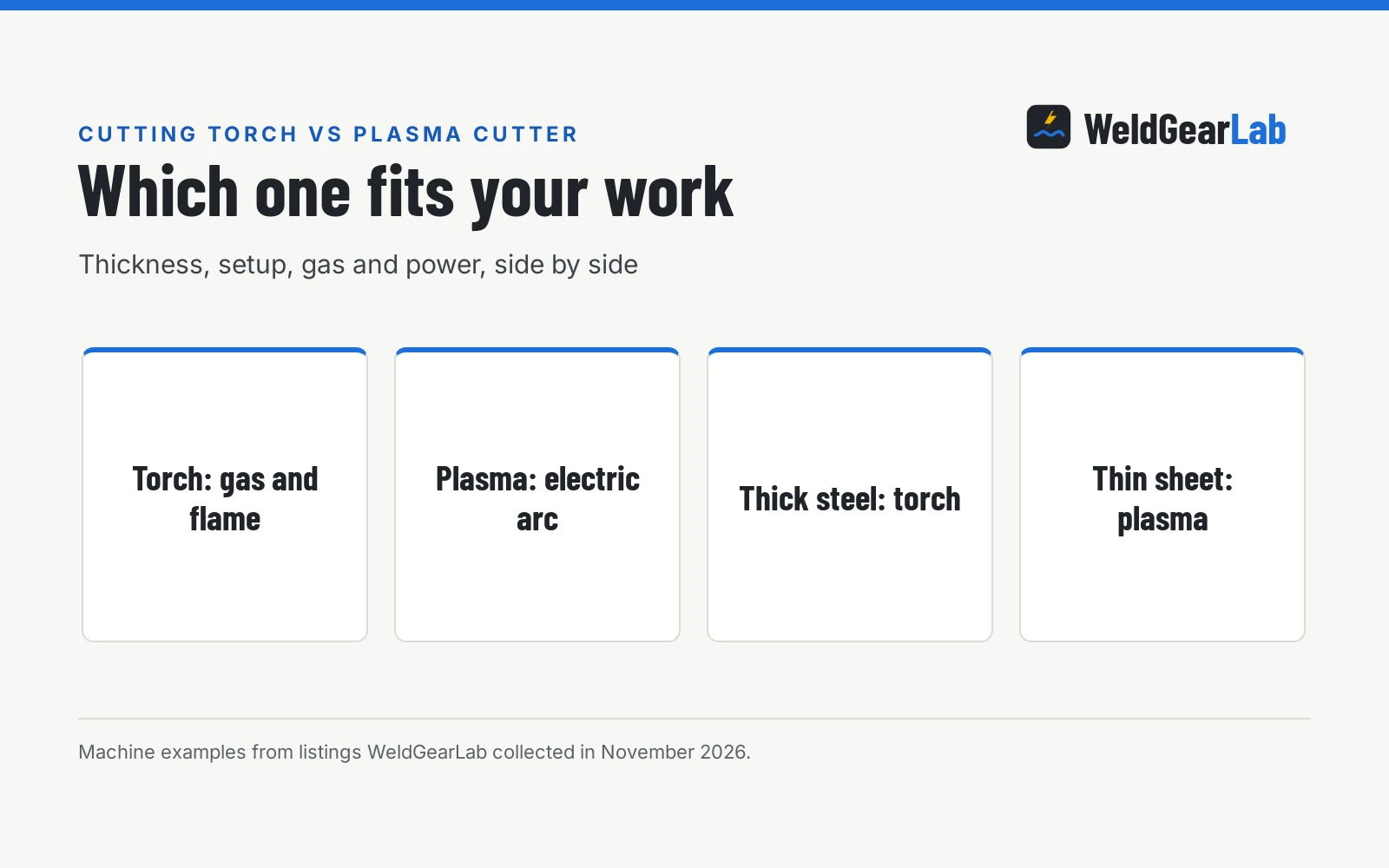
A plasma cutter blows a jet of ionized gas through the metal, melting and blowing it away along the cut line. A MIG welder feeds wire through a gun and melts it into the joint, building the weld up. One removes metal, the other adds it. That is the whole comparison in a sentence: cutting versus joining.
Side by side
| Plasma cutter | MIG welder | Notes | |
|---|---|---|---|
| Job | Cuts metal apart | Joins metal together | The core difference |
| Stated cut thickness | 1/2 to 3/5 in clean cut, 5/8 to 1 in max cut (per listings) | Not a cutting tool | Per the four listings |
| Air supply | Dry compressed air; 50 to 75 PSI on three listings, 90 PSI at 60 L/min on the Reboot | Not needed | Compressor not included |
| Pilot arc | Non-contact on three listings; touch start on the Reboot | Not applicable | Per the four listings |
| Duty cycle (stated) | 50% on the Reboot; not stated on the others | Not covered by these listings | Only the Reboot states one |
| Warranty (stated) | 3-year on the ARCCAPTAIN Prolux; not stated on the others | Not covered by these listings | Only the Prolux states one |
| Buy first if | The job is cutting | The job is joining | Match the tool to the job |
Cut thickness figures are manufacturer rated and vary with voltage and air supply; always check the listing’s stated conditions. The four examples below are all plasma cutters, so the MIG side is described from what the process does, not from a MIG listing.
When a plasma cutter is the better choice
- Cutting plate and sheet to size. Straight cuts and shapes in steel, aluminum and copper, where a saw would be slow.
- Removing rusted brackets. Three of the four start the arc without touching the metal (the Reboot uses a touch start), and the bestarc and both ARCCAPTAIN listings state they handle rusted, painted and dirty surfaces.
- Cutting expanded metal and mesh. The ARCCAPTAIN listings state mesh cutting modes that keep the arc alive across gaps.
- Working without a gas cylinder. A plasma cutter needs dry compressed air and electricity, no shielding gas bottle.
For the other side of the cutting decision, see our plasma cutter vs cold saw comparison.
When a MIG welder is the better choice
- Joining two pieces of steel. The core job: the welder builds the joint, the cutter cannot.
- Auto body panels and thin sheet. Small, controllable beads for light work.
- Building brackets, stands and frames. Fit up and weld in the same corner of the shop.
- Farm and trailer repair. The metal stays where it is; the weld goes to it.
How to read a plasma cutter listing
Amps come first: the four examples state 50, 55, 55 and 60 amps. Next is the cut rating, and listings split it two ways: clean cut, the thickness it slices neatly (1/2 in on the bestarc and the Reboot, 3/5 in on the ARCCAPTAIN non-HF), and max or severance cut, the thickest it gets through (2/3 in on the bestarc, 5/8 in on the Reboot, 7/8 in on the ARCCAPTAIN Prolux, 1 in on the ARCCAPTAIN non-HF). Pilot arc is how the arc starts: the bestarc uses a high-frequency non-contact arc, the ARCCAPTAIN non-HF uses a blowback non-high-frequency arc, and the Reboot uses a touch start. Air is the hidden requirement: every listing needs dry compressed air, the bestarc notes the compressor is not included, and the Reboot calls for 90 PSI at 60 L/min. All four are dual voltage, 110V/220V or 120V/240V, with lower amperage on the lower voltage.
The four plasma cutter examples, ranked
Ranked first is the ARCCAPTAIN CUT55 Prolux. The listing states 55 amps, 120V/240V with app control up to 10 meters, and a 7/8 in (22mm) maximum cut at 240V, with a stated cutting range of 9 to 12mm at 120V and 14 to 22mm at 240V. It adds expanded metal cutting, pilot arc rust removal, air pressure detection at 0.3 to 0.55 MPa, PT adjustment over 5 to 15 seconds plus PA adjustment for pilot arc timing, 2T/4T modes and a non-touch pilot arc. It weighs 19.84 pounds, claims ANSI certification, and states a 3-YEAR warranty, the only concrete warranty term of the four.
Second is the bestarc BTC500DP 50A. The listing states 50 amps, 110V/220V, a 1/2 in clean cut and a 2/3 in max cut, with an AG60P pilot arc torch that starts without touching the metal. The built-in air sensor shows green when pressure is in range and red when it is not, with 55 PSI recommended at 110V and 50 to 65 PSI at 220V. It has a 1/4 in NPT quick connect, 2T/4T modes, PA timing up to 15 seconds, post-flow of 3 to 15 seconds with 4 to 8 seconds recommended, and a digital LED screen. It weighs 14.48 pounds and measures 13.98 by 5.12 by 8.46 inches. No warranty term is stated.
Third is the Reboot RBC6000D 60A. The listing states 60 amps, 120V/240V, a 1/2 in clean cut and a 5/8 in (16mm) maximum severance cut at 240V and 60A, with a 50% duty cycle. It runs 10 to 35 amps at 120V and 30 to 60 amps at 240V, needs 70 to 75 PSI, and calls for a 90 PSI, 60 L/min compressor with PT31 consumables. It weighs 14.92 pounds. The listing calls the arc start a high frequency touch arc while saying the torch head must touch the metal; the touch requirement wins. No warranty term is stated.
Fourth is the ARCCAPTAIN 55A non-HF. The listing states 55 amps, 110V/220V, a blowback non-high-frequency pilot arc, a 3/5 in clean cut and a 1 in max cut, with 15mm at 35A and 110V on 50 PSI and 26mm at 55A and 220V on 60 PSI. It states mesh cutting, rust removal, air pressure monitoring with E80 below 30 PSI and E81 above 80 PSI, PA timing of 2 to 10 seconds, post-flow of 5 to 15 seconds, and an IPT60 torch. It weighs 18.81 pounds with IP21 water resistance and a pre-installed 1/4 in NPT fitting. No warranty term is stated.
Plasma cutting safety. Cutting makes intense light, hot metal, sparks and fumes. Wear a proper welding helmet and eye protection, keep flammables clear of the work, and ventilate the space or cut outdoors with your head out of the plume. Keep the air supply dry and the electrical supply matched to the listing’s breaker guidance. Keep the work area ventilated and clear of flammables.
FAQ for welders
Can a plasma cutter weld?
No. A plasma cutter removes metal along a cut line; it does not deposit filler or join parts. Joining is the welder’s job. If you need both operations, you need both tools.
Do I need an air compressor for a plasma cutter?
Yes. All four listings require dry compressed air, and the bestarc notes the compressor is not included. The Reboot calls for 90 PSI at 60 L/min, the ARCCAPTAIN non-HF recommends 55 PSI at 110V and 50 to 75 PSI at 220V, and the Prolux recommends 0.4 MPa (57.5 PSI). Size the compressor to the cutter, not the other way around.
What does pilot arc mean?
It is how the arc starts without the torch touching clean metal. The listings show three approaches: high-frequency non-contact on the bestarc and a non-touch pilot arc on the Prolux, blowback non-high-frequency on the ARCCAPTAIN non-HF, and touch start on the Reboot. The bestarc and both ARCCAPTAIN listings state they handle rusty, painted or dirty surfaces.
What is the difference between clean cut and max cut?
Clean cut is the thickness the machine slices neatly: 1/2 in on two listings here, 3/5 in on one. Max or severance cut is the thickest it gets through: 5/8 in to 1 in here, with rougher edges. Buy for the clean cut number if edge quality matters.
Can a plasma cutter run on 110V?
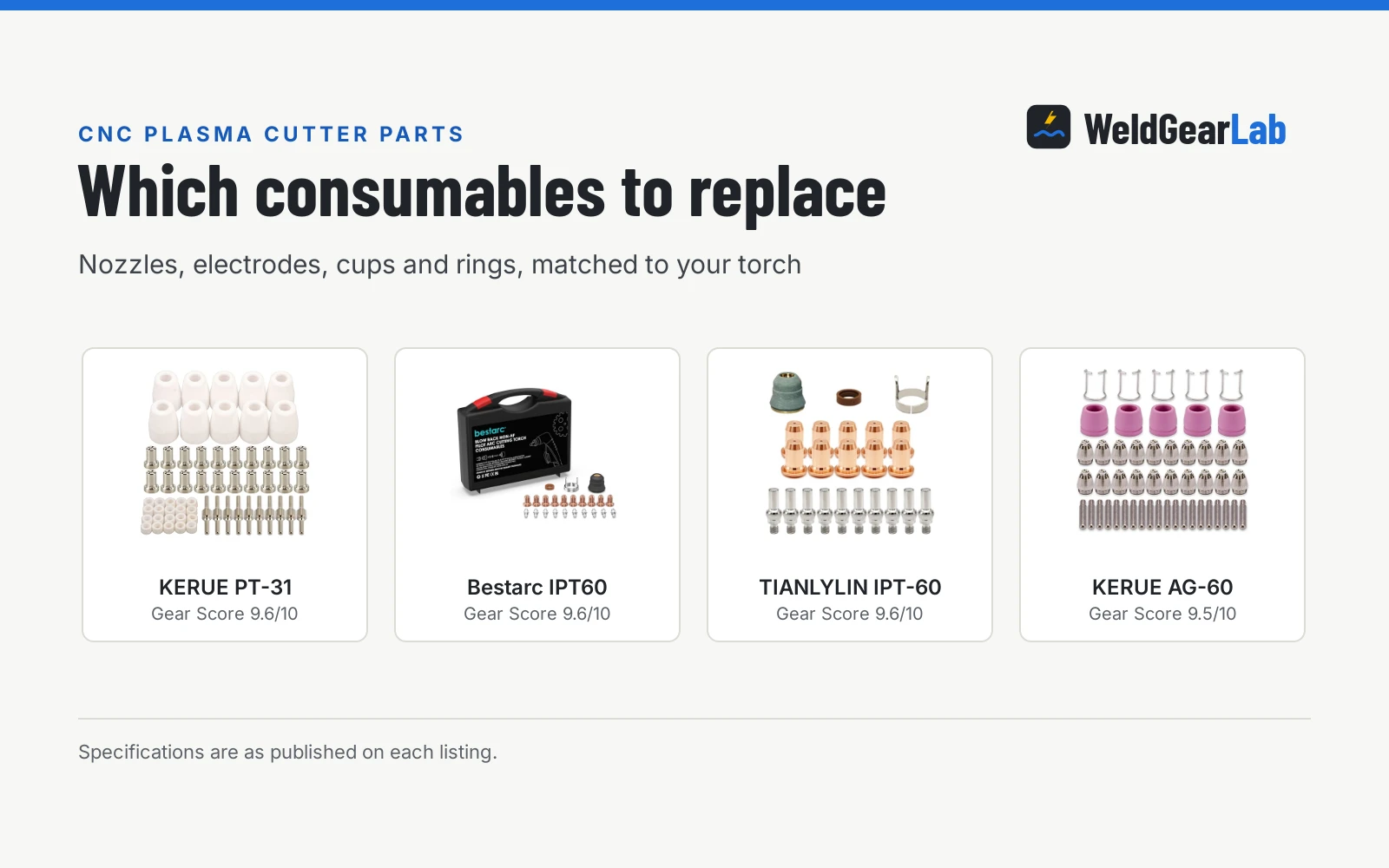
All four are dual voltage, 110V/220V or 120V/240V, and all four run lower amperage on the lower voltage. Check the listing’s stated thickness at each voltage before planning the work. Our best plasma cutter consumables for beginners guide covers what wears out first.
Related: plasma cutter vs cold saw, stick welder vs MIG welder for truck repairs, best extension cord for MIG welder, best MIG wire for home garage and best welding goggles for plasma cutting.