Metal Scribe vs Soapstone Marker: Which One Should You Buy?
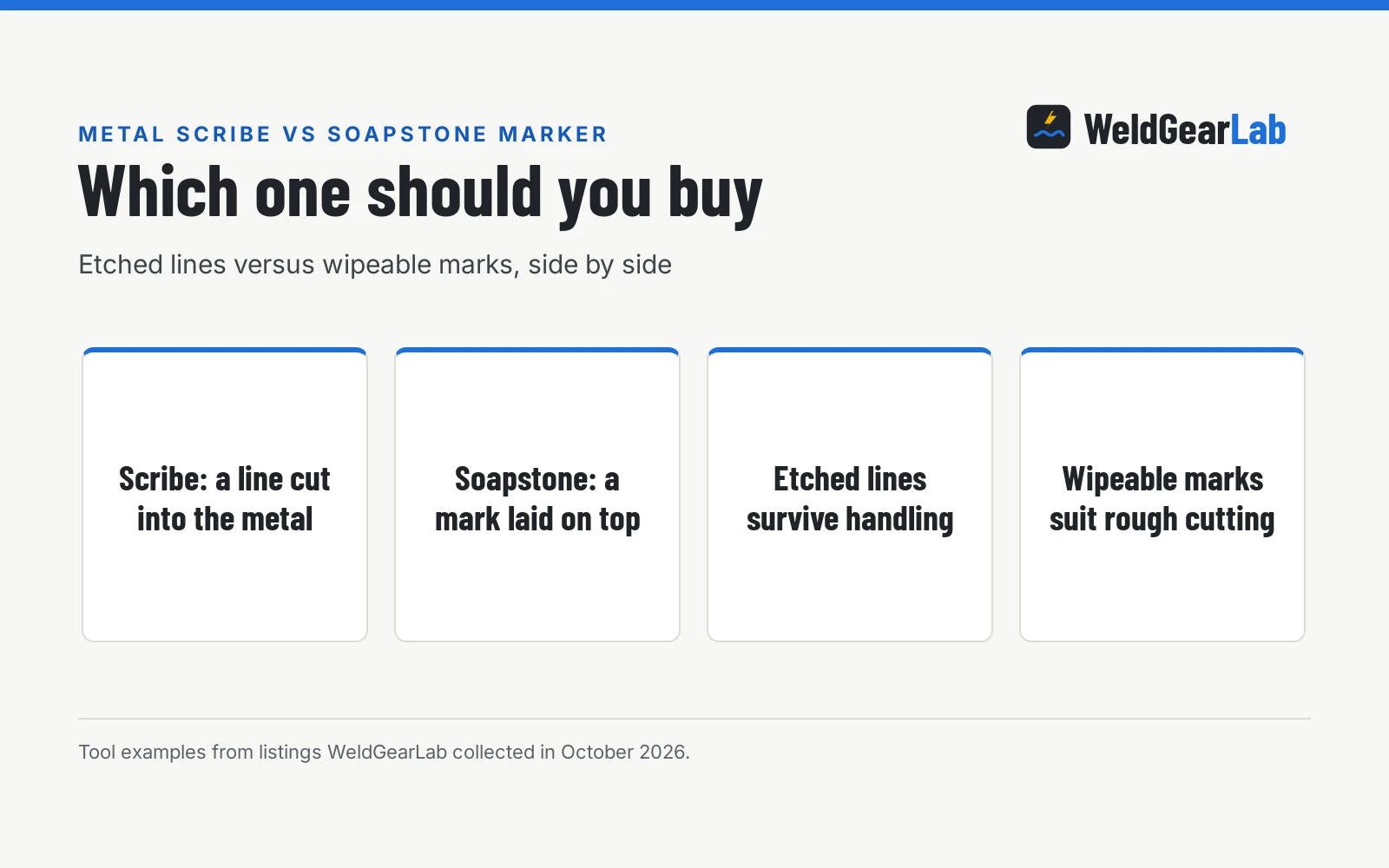
A metal scribe cuts a thin line into the metal that survives the job, while a soapstone marker lays a mark on top that wipes away; this guide compares the two and ranks three listed scribes for fab work.

On this page
Top picks at a glance
As an Amazon Associate I earn from qualifying purchases.
- 1
 NEPAK 4 Pack Metal Scribe Tool9.6/10View on Amazon
- 2
 Orange Paint Markers9.6/10View on Amazon
You have the metal on the bench and need a line you can trust before you cut, bend or weld. A metal scribe vs soapstone marker is the classic shop choice between a line cut into the metal and a mark laid on top of it, and the right one depends on whether that line has to survive the rest of the job. This guide explains the difference, then walks through the three metal scribes in this comparison, ranked for fab work.
This guide links to our product roundups, where WeldGearLab gets a commission on purchases made through links on this page, and your price stays the same. Read our affiliate disclosure.
The difference in one paragraph
A scribe is a hard point, tungsten carbide or hardened steel, that scratches a thin line into the metal surface. The GCHMDE set lists carbide nibs that mark metal, glass, ceramics, wood, marble and shells, while the PAGOW 70A lists hardened steel, stainless steel, ceramics and glass among its materials. A soapstone marker lays a light-colored mark on the surface instead of cutting one in, so the mark sits on top of the metal rather than living in it. One side gives you a line that stays put; the other gives you a mark you can change your mind about.
Side by side
| Malco A60 | GCHMDE 5-pack | PAGOW 70A | |
|---|---|---|---|
| Point | Replaceable 6 x 3/8 in Zip-In screw point | Tungsten carbide nibs, 25 replacements included | Carbide steel point, heat treat stated without a hardness scale |
| Layout range | 1/4 in to 12-1/2 in, 1/8 in graduations | 6 in stainless steel ruler in the kit | 2-7/8 in point length, 3/8 in handle |
| Body | Nickel-plated steel, knurled, pocket size | Knurled aluminum, pocket clip | 45# steel, knurled, nickel plated, hexagon-shaped head |
| When not marking | Point retracts and is protected when closed | Protective caps flip up over the nibs | Point reverses and telescopes into the handle |
| Marks | Sheet metal, stainless steel, alloy steel, plastic | Metal, glass, ceramics, wood, marble, shells | Steel, brass, plastic, glass, hardened steel, stainless steel, ceramics |
| Shop extras | Two spares stored in the handle; Made in USA | Magnetic cap collects shavings and picks up screws | Hexagon-shaped head stops rolling |
| Warranty | Limited Lifetime | 1 Year Manufacturer | Not stated |
Every figure above comes straight from the three listings. Where a listing disagrees with itself we went with the bullets.
When a metal scribe is the better choice
- The line must survive handling. An etched line stays readable through clamping, grinding nearby and parts rubbing in the pile, while a surface mark can wipe off at the worst moment.
- Hard or slick materials. The GCHMDE carbide nibs mark hardened surfaces like glass, ceramics and marble, and the PAGOW 70A lists hardened steel, stainless steel and glass, materials where a soft mark has little to grab.
- Layout measured off an edge. The Malco A60 is built for exactly this, with an adjustable depth from 1/4 in to 12-1/2 in in 1/8 in graduations, so trim lines repeat without a second measuring step.
- Tight fit-up. A fine scribed line is thin enough to cut to directly; a fat mark leaves you guessing which edge is the real one.
For the measuring half of layout, see welding square vs combination square and, for duct work, best sheet metal crimpers.
When a soapstone marker is the better choice
- Rough cutting lines. Big, fast marks you want visible from across the shop, then wiped or ground off before the weld.
- Lines you will change. A surface mark wipes or grinds off when the measurement was wrong; an etched line is a commitment.
- Dark or mill-scale steel where an etched line is hard to read. Light-colored marks read at a glance under shop lights.
- Teaching and shared shops. New hands can practice layout without scarring good material.
Metal Scribe vs Soapstone Marker: the three scribes compared
Ranked by how well each listing delivers for fab work. The Malco A60 takes the top spot: an adjustable scribe that sets from 1/4 in to 12-1/2 in in 1/8 in graduations, with a Zip-In sheet metal screw as the replaceable point and two spares stored in the handle, so you never hunt for a proprietary nib. The listing states nickel-plated steel construction, a strip-proof hardened steel knob insert and a Limited Lifetime warranty, and it is made in the USA. One flag worth noting: the bullets say 6.1 oz while the spec table lists 2.4 ounces, so we went with the bullets.
Second is the GCHMDE 5-pack: five magnetic scribers with tungsten carbide nibs, 25 replacement nibs in the box and a 6 in stainless steel ruler, with knurled aluminum handles and pocket clips. The magnetic cap collects shavings and picks up dropped screws, the protective caps flip up over the nibs, and the maker lists a 1 Year Manufacturer warranty. It is the obvious pick for a shop that outfits several benches at once.
Third is the PAGOW 70A, a basic pocket scriber in 45# steel, knurled and nickel plated, with a 2-7/8 in point and a 3/8 in handle diameter. The listing describes the needle as heat treated but gives the figure as ’50-55 degrees’ with no hardness scale; the point reverses and telescopes into the handle for pocket carry, and the hexagon-shaped head keeps it from rolling off the bench. No warranty term is stated. For occasional layout it does the job; the two picks above simply give you more.
Can one tool do both jobs?
Not really, and that is the point of the comparison. A scribe cuts the line in; a marker lays it on. Many fab benches keep both on hand: the scribe for fit-up lines that have to survive the job, the marker for cutting lines you want gone before the weld. If you cut to the line, a scribed edge is the one to trust.
See hacksaw vs angle grinder for metal for which tool takes that edge next.
Scribe points are sharp. The GCHMDE nibs ship with protective caps and the PAGOW point retracts into the handle, and that is how these tools should live in a pocket or pouch. Wear safety glasses when you chip slag or grind near a scribed line.
FAQ for welders
Does a scribed line weaken the metal?
A scribe scratches a shallow line rather than cutting a groove, but any mark in the surface matters where the part is stressed. Keep scribed lines off bend lines and out of fatigue-critical spots on structural work; if the part carries a load, have a qualified welder review it.
Can I scribe stainless steel and hardened steel?
The listings say yes within their limits: the Malco A60 lists stainless steel and alloy steel, and the PAGOW 70A lists hardened steel and stainless steel among its materials. The GCHMDE set’s carbide nibs are listed for glass, ceramics and marble as well as metal. Press lightly and let the point do the work.
What do I do when the scribe point wears down?
That depends on the tool. The Malco A60 takes a standard 6 x 3/8 in Zip-In sheet metal screw as the point, with two spares stored in the handle, so the fix is a trip to the pouch. The GCHMDE set includes 25 replacement nibs. The PAGOW 70A does not list a replaceable point.
Will a soapstone mark survive cutting and grinding?
A surface mark is vulnerable to exactly the things fab work involves: handling, oil and grinding dust. That is why the soapstone side of this comparison suits cutting lines and rough marks you plan to remove anyway, while etched scribe lines suit layout that has to survive to the weld.
Which should I buy first for a home fab shop?
A scribe, because the lines it makes survive the job and the tools are simple. Of the three here, the Malco A60 covers the most layout situations with its adjustable range, while the GCHMDE 5-pack outfits a whole shop. Add a soapstone marker later for big cutting lines you want gone before the weld.
Related: sheet metal brake vs hand seamer, best sheet metal crimpers, and the metal fab tools hub.