Measuring Tape Measurements: How to Read a Tape Measure
Measuring tape measurements explained step by step for the fab shop: reading inch, fraction and metric marks, hooking an edge, marking a cut line and checking layout for square.

On this page
You have a sheet of steel on the bench, a cut to make, and a line to lay out before the snips or the shear come out. Get the layout wrong and the part comes out short, crooked, or out of square. Measuring tape measurements are how you read the marks on a tape blade: whole inches, the fraction marks between them, and the metric edge when the drawing calls for it. Read them right and the cut lands where the drawing says it should.
As an Amazon Associate I earn from qualifying purchases. This guide links to our product roundups, where WeldGearLab gets a commission on purchases made through links on this page, and your price stays the same. Read our affiliate disclosure.
How to read measuring tape measurements
A tape blade is a ruler that rolls up. The end hook grabs the edge of the stock, the blade pulls out flat, and the marks run from the hook toward the case. Read the measurement where the stock edge crosses the blade, not at the case.
- Hook the edge. Set the end hook on the edge of the sheet or the end of the stock. Pull the blade out with light tension so it lies flat. A blade that sags or twists reads long.
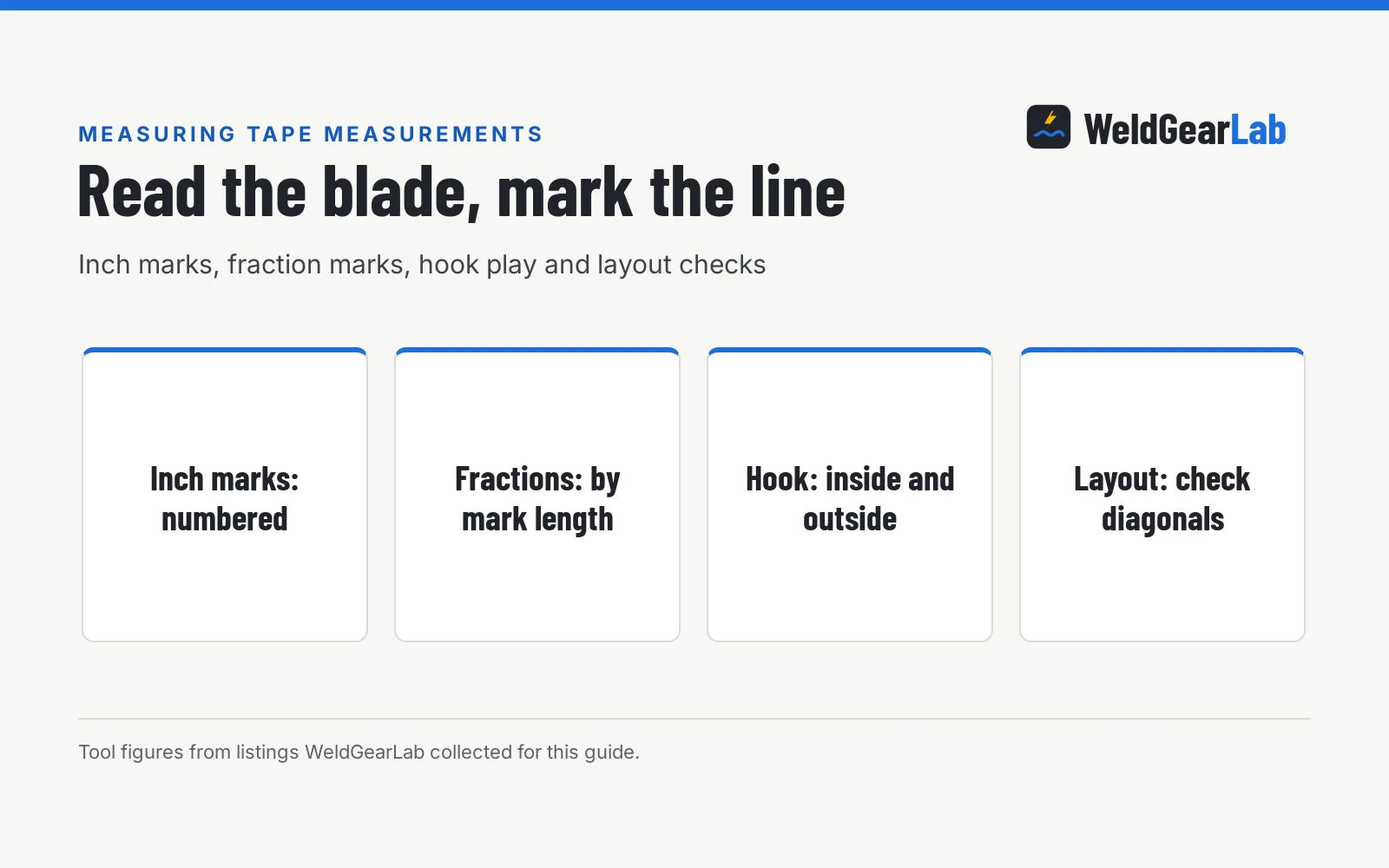
- Read the whole inches. The numbered lines are full inches from the hook. Find the last inch number before your mark. That count is the whole-inch part of the measurement.
- Read the fraction marks. Between inch numbers, the longest mark is 1/2. The next longest marks are 1/4 and 3/4. Shorter marks split the space further. Count from the last inch number to your mark and add the fraction to the inch count.
- Read the metric edge. Many blades carry millimeter marks along the opposite edge. Malco pairs 3-1/4 in with 82.6 mm for the cutting length of its 14 in combination snip, and VEVOR pairs 31.5 in with 800 mm for the max cutting length of its benchtop shear. Read metric work straight off the metric edge instead of converting in your head.
- Lock and mark. Set the blade lock, hold the tape steady, and mark at the edge of the blade with a scribe or awl. A pencil line is wide. A scribed line stays thin and reads clean at the cut.
A compact tape with clear fraction marks makes layout work faster at the bench. See our best compact tape measure picks for shop use.
Side by side
| Whole inch marks | Fraction marks | Millimeter marks | |
|---|---|---|---|
| Where they sit | Numbered lines along the blade | Shorter lines between the inch numbers | Lines along the metric edge of the blade |
| What they tell you | Full inches from the end hook | Parts of an inch past the last inch number | Metric length from the end hook |
| Mark length | Longest lines on the blade | Longest at 1/2, shorter at 1/4 and 3/4 | Even short lines, longer at each centimeter |
| Shop use | Stock length and cut length | Fit-up gaps and hole spacing | Work drawn in metric sizes |
Mark length is the tell. On the inch edge, longer marks mean bigger fractions. On the metric edge, centimeter marks run longer than millimeter marks and the printed numbers do the work.
Marking a cut line on sheet metal
Layout comes before cutting. Measure from a straight reference edge, mark the cut line, then check the layout before any blade touches the sheet.
- Pick a reference edge. Measure every mark from the same edge of the sheet. Measuring from different edges stacks small errors across the part.
- Mark with a scribe or awl. A scratch awl leaves a thin line that a shear blade can follow. See our best scratch awl picks for marking metal.
- Connect the marks. Run a straight edge between your marks and scribe the full line. Our best precision straight edge guide covers shop straight edges.
- Check for square. Measure corner to corner across the layout. Equal diagonals, with opposite sides measured equal, mean the corners are square. Unequal diagonals mean the marks need adjusting before you cut.
- Match the tool to the stock. Klein Tools states its aviation snips cut up to 22-gauge stainless and 18-gauge cold-rolled sheet metal. TOOLMAK states its 12 inch tin snips cut up to 20-gauge cold-roll steel and 22-gauge stainless steel. The Wild Edge electric shear (on Amazon) is stated for up to 14 gauge sheet metal and 15 gauge stainless steel. Measure the stock, then pick a cutter rated for that gauge.
Reading the hook and blade correctly
- The hook moves on purpose. The end hook slides a small amount on its rivets. That play makes up for the thickness of the hook itself, so inside and outside measurements read true. Do not tighten the rivets down.
- Keep the blade flat. A blade bent over an edge or sagging in the middle reads longer than the stock. Support long pulls on the bench or have a helper hold the far end.
- Read straight down. Reading at an angle shifts the mark. Put your eye over the mark and read where the stock edge crosses the blade.
- Hook the right face. For outside measurements the hook pulls against the end of the stock. For inside measurements the hook pushes against the inside face. The sliding hook handles the difference.
Common layout mistakes
- Measuring from a bent or burred edge. A bent edge moves every mark. Flatten or trim the reference edge, or measure from a clean edge.
- Marking on the wrong side of the line. The cut removes metal along the line. Decide which side of the line is the part and which side is scrap before you cut.
- Skipping the diagonal check. A layout can look right and still be out of square. The diagonal check catches it while the fix is still a new scribe line.
- Reading fractions by guess. Count the marks from the inch number. Guessing at small fractions is how fit-up gaps appear at assembly.
Sharp sheet edges. Cut sheet metal leaves edges that slice skin and gloves. Wear work gloves when handling cut stock, eye protection when cutting, and knock the burr off fresh edges with a file before fit-up. Keep hands clear of shear blades and snip jaws, and let cut pieces fall clear instead of catching them.
FAQ for welders
How do I read the small marks on a tape measure?
The numbered lines are whole inches from the end hook. Between them, the longest mark is 1/2, the next longest are 1/4 and 3/4, and shorter marks split the space further. Count from the last inch number to your mark to get the fraction.
Why does the end hook on a tape measure move?
The hook slides on its rivets to make up for its own thickness. Pulling the hook against an outside edge and pushing it against an inside face both read from the same starting point. Tightening the rivets makes inside measurements read short.
How do I check that a sheet metal layout is square?
Measure from corner to corner across the layout in both directions. Equal diagonal measurements, with opposite sides measured equal, mean the corners are square. If the diagonals differ, adjust the marks and measure again before cutting.
Should I measure sheet metal in inches or millimeters?
Measure in the units your drawing or cut list uses. Makers state both on many tools: Malco pairs 3-1/4 in with 82.6 mm on its snip cutting length, and VEVOR pairs 31.5 in with 800 mm on its benchtop shear. Reading straight off the matching blade edge beats converting in your head.
How do I mark a cut line that a shear can follow?
Scribe the line with an awl against a straight edge so the line stays thin and visible. Mark from the same reference edge, check the diagonals, and cut on the scrap side of the line so the part keeps its measured size.
Related: best compact tape measure, best scratch awl, best precision straight edge, and the sheet metal and tubing hub. Also see measuring and layout.