Magnetic Drill vs Benchtop Drill Press: Which One Should You Buy?
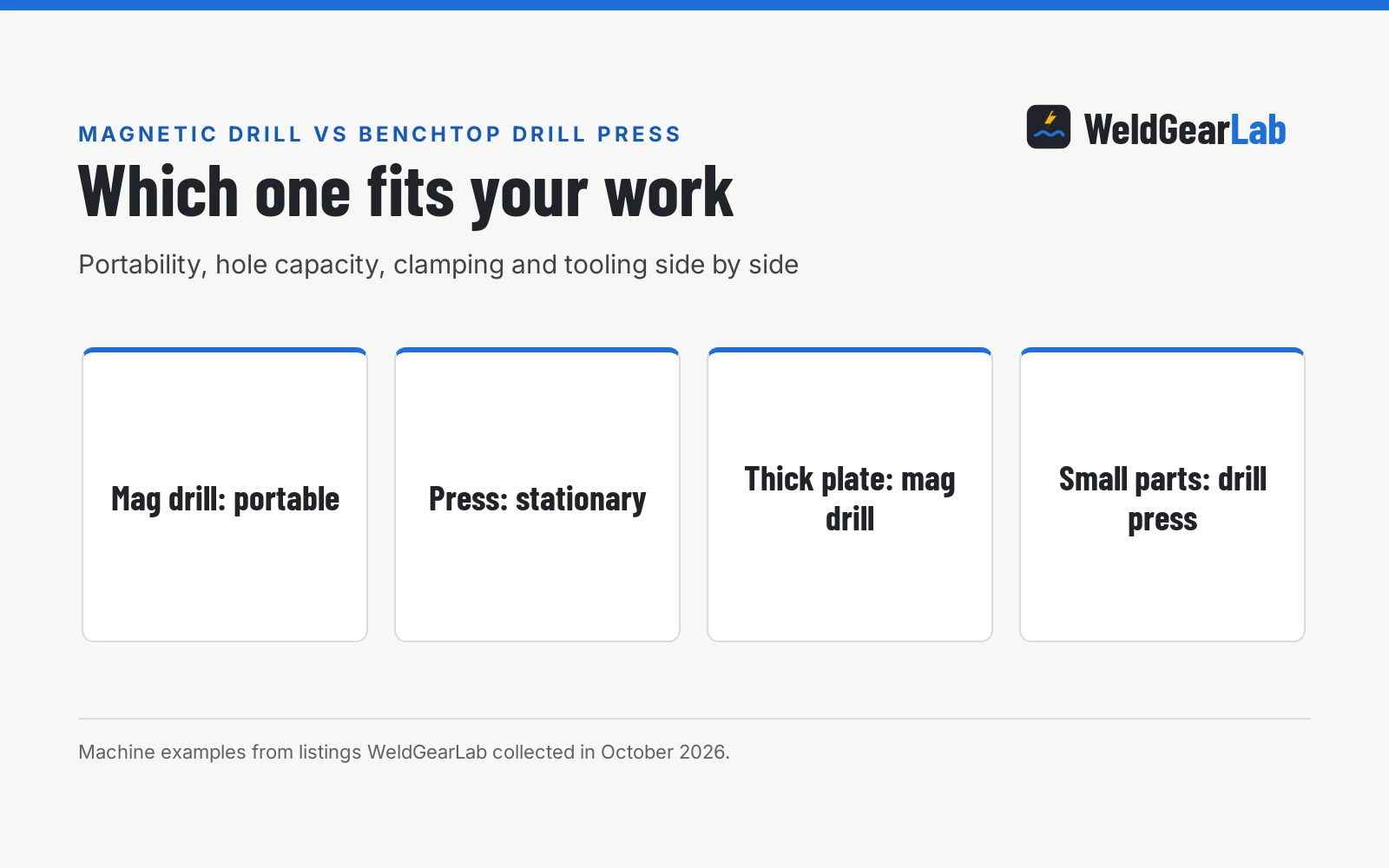
A magnetic drill clamps directly to structural steel with an electromagnet for field fabrication, while a benchtop drill press stays on the workbench for smaller shop parts.

On this page
Top picks at a glance
As an Amazon Associate I earn from qualifying purchases.
- 1
 S&F STEAD & FAST Annular Cutter Set 13 Pcs9.6/10View on Amazon
- 2
 BUCKTOOL 10-Inch Drill Press 6.2 Amp 3/4 HP Bench Drill Press9.7/10View on Amazon
- 3
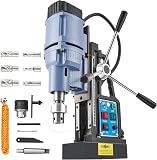 ZELCAN Magnetic Drill Press with 6 Drill Bits9.5/10View on Amazon
- 4
 VEVOR Magnetic Drill PressView on Amazon
- 5
 VEVOR Magnetic DrillView on Amazon
- 6
 VEVOR Mag Drill PressView on Amazon
- 7
 VEVOR Low Profile Magnetic Drill PressView on Amazon
- 8
 ZELCAN Mag Drill PressView on Amazon
When heavy structural steel needs bolt holes, deciding between a magnetic drill vs benchtop drill press comes down to whether the tool moves to the workpiece or the workpiece moves to the tool. A magnetic drill locks directly onto ferrous steel with an electromagnet to bore large holes through beams and heavy plate in place. A benchtop drill press stays bolted to a stationary table, providing a rigid spindle and variable speeds for small brackets and non-ferrous parts. This guide compares both machines for metal fabrication.
Other welders and gear to compare
 VEVOR Magnetic Drill PressCheck price on Amazon
 VEVOR Magnetic DrillCheck price on Amazon
 VEVOR Mag Drill PressCheck price on Amazon
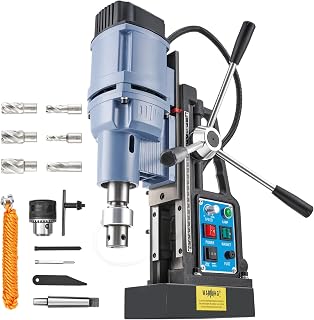 ZELCAN Magnetic Drill Press with 6 Drill BitsCheck price on Amazon
 VEVOR Low Profile Magnetic Drill PressCheck price on Amazon
 ZELCAN Mag Drill PressCheck price on Amazon
This guide links to our product roundups, where WeldGearLab gets a commission on purchases made through links on this page, and your price stays the same. Read our affiliate disclosure.
The difference in one paragraph
A benchtop drill press is a stationary machine where you clamp the workpiece to an adjustable table and lower a spinning chuck into the metal. It excels at small parts, repetitive depth stops, and non-ferrous metals like aluminum and brass. A magnetic drill is a portable tool with an electromagnetic base that adheres directly to structural carbon steel. Instead of pushing solid twist drill bits through metal, a magnetic drill spins hollow annular cutters that carve a perimeter ring and pop out a solid slug. The magnetic drill handles heavy structural steel, while the benchtop drill press manages daily bench work.
Magnetic drill vs benchtop drill press: side by side
| Magnetic drill | Benchtop drill press | Application fit | |
|---|---|---|---|
| Mounting method | Electromagnetic base adheres to ferrous steel | Bolted or clamped to a stationary workbench | Magnetic drill for structural steel; press for bench work |
| Workpiece positioning | Tool moves directly to the workpiece | Workpiece moves to the stationary machine | Magnetic drill for field steel; press for movable pieces |
| Structural steel and beams | Drills beams, truck frames, and plate in place | Limited by table support and throat clearance | Magnetic drill for heavy framing and trailer repairs |
| Non-ferrous materials | Requires steel backing plate or mechanical clamping | Clamps aluminum, brass, plastic, and steel in a vise | Benchtop press for aluminum, brass, and plastics |
| Typical cutting tools | Hollow annular cutters, twist bits, and taps | Solid twist drill bits, hole saws, and step bits | Magnetic drill for coring; press for general twist bits |
| Drilling orientation | Flat, vertical, or overhead with safety strap | Downward vertical drilling only | Magnetic drill for vertical columns and field positions |
| Large hole efficiency | Annular cutters bore in a single pass without pilot holes | Large twist bits require stepping up pilot holes | Magnetic drill for fast large-diameter hole cutting |
| Coolant supply | Through-spindle arbor bottle or cutting paste | Manual external squeeze bottle or paste | Magnetic drill for through-spindle arbor cooling |
Mounting style determines shop workflow. A benchtop drill press requires bringing metal to the table, while a magnetic drill clamps directly to the workpiece in horizontal, vertical, or overhead positions.
When a magnetic drill is the better choice
Choose a magnetic drill whenever the workpiece is too heavy or awkward to lift onto a workbench. Structural I-beams, equipment frames, and trailer chassis cannot fit under a compact drill press table. With a magnetic drill, you bring the tool directly to the metal and engage the electromagnet.
- Field fabrication. Drilling truck frames, farm equipment, or structural posts in place.
- Large holes in thick plate. Annular cutters bore large diameters through heavy plate in a single pass without pilot holes.
- Multi-position drilling. An electromagnet holds against vertical columns or overhead beams when secured with a safety strap.
- Job mobility. You can transport the tool to job sites instead of hauling steel to a machine shop.
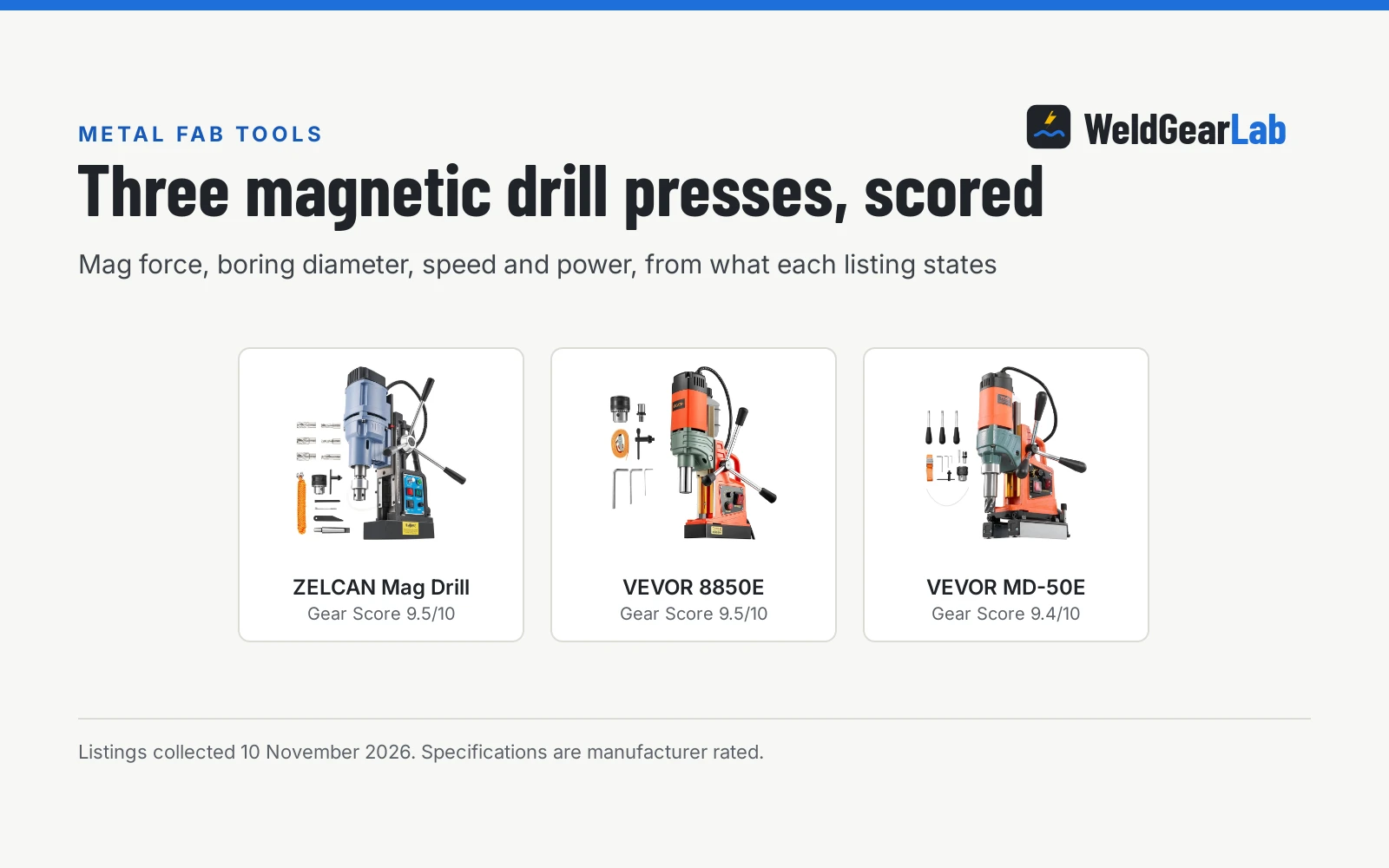
VEVOR listings publish magnetic drill motor ratings from 1300W to 1550W, electromagnetic holding forces from 2248 lbf up to 2922 lbf, and coring capacities from 1.4 inches up to 2.4 inches. ZELCAN publishes magnetic drill listings with 1550W motors, holding forces up to 3125 lbf, and boring capacities up to 2 inches. A VEVOR listing notes that optimal magnetic holding requires a steel plate thickness of at least 0.39 inches. For portability, VEVOR lists compact low-profile models at 22.9 pounds and 23.2 pounds, while larger units reach 49.6 pounds. ZELCAN lists weights from 23.8 pounds to 20.8 kg. Our best magnetic drill under 1000 guide reviews portable units for steel fabrication.
When a benchtop drill press is the better choice
A benchtop drill press is the better choice for routine bench fabrication, small brackets, and non-ferrous materials. Because electromagnets require structural steel for holding power, magnetic drills cannot grip aluminum, brass, copper, non-magnetic stainless steel, or plastics. A benchtop press relies on mechanical clamping, securing any workpiece in a drill press vise.
- Small parts and tabs. Drilling suspension tabs, base plates, and brackets smaller than a magnetic base.
- Non-ferrous metals. Boring clean holes in aluminum, brass, or plastics without specialty backing plates.
- Repetitive depth stops. Setting a mechanical depth stop for blind holes and countersinking.
- High spindle speeds. Running small twist drill bits at higher spindle speeds than magnetic drills reach.
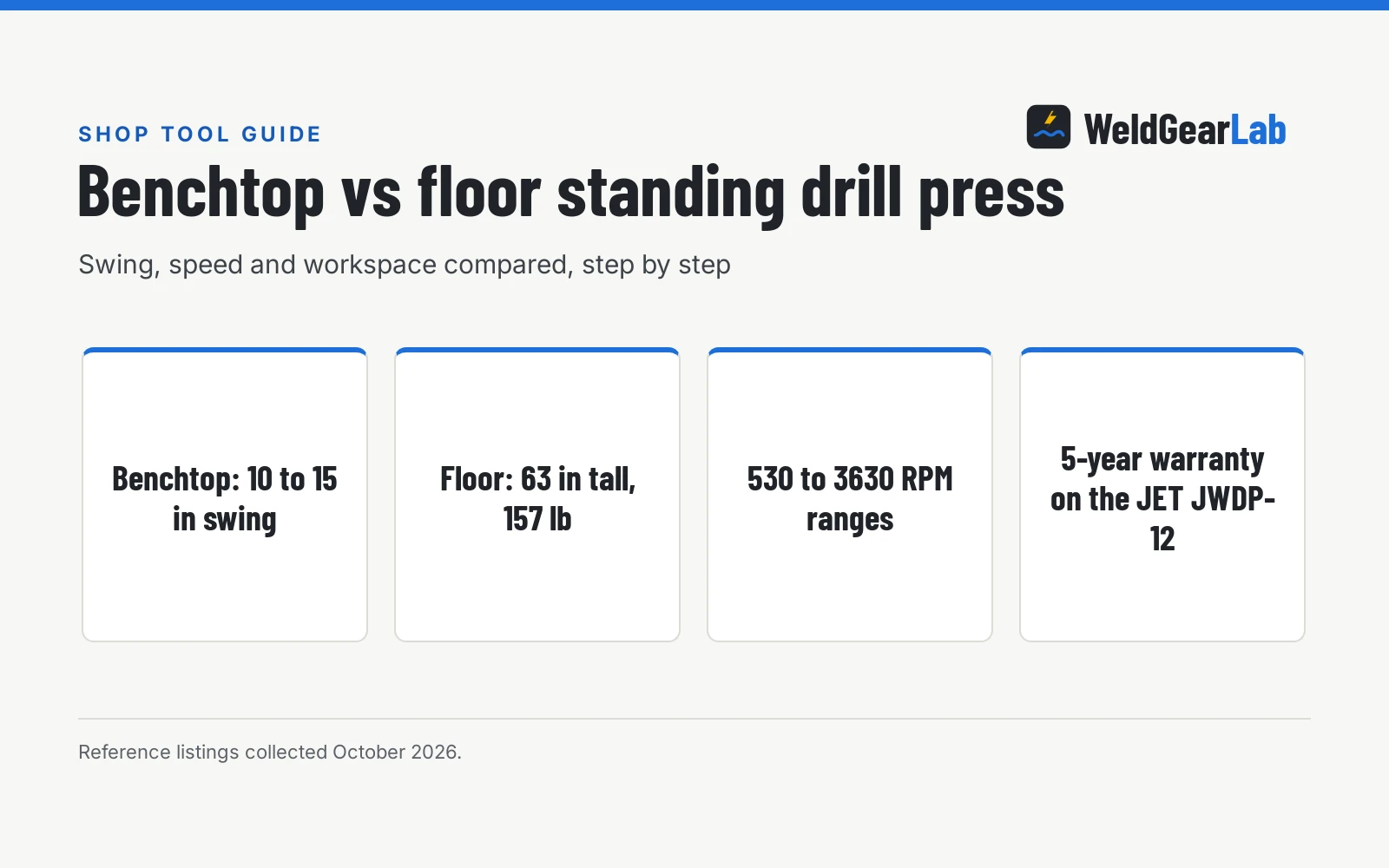
Benchtop drill presses do not publish electromagnetic holding figures because they bolt directly to a workbench. Capacity is determined by quill travel and throat depth from column to chuck. If your work centers on fabricating small brackets, see our guide to the best drill press for metalworking and our roundup of the best drill press vise.
Tooling and spindle mechanics
Tooling geometry and motor demands set these tools apart. Benchtop drill presses use twist drill bits in a keyed or keyless spindle chuck. A twist drill cuts across the full hole diameter, converting all displaced metal into chips. As hole diameter increases, required feed thrust rises rapidly, requiring pilot holes in thick steel.
A magnetic drill uses hollow annular cutters in a Weldon shank arbor. An annular cutter cuts only a perimeter groove, leaving a solid slug that ejects when the cut breaks through. By removing far less metal volume, an annular cutter requires less feed force and motor power to bore large holes.
Spindle speeds reflect these tools. Annular cutters require low rotational speeds with steady feed pressure. ZELCAN listings show stepless speed controls from 0 to 580 rpm and fixed speeds of 650 rpm. VEVOR listings specify speeds from 0-600 RPM up to 810 RPM. Benchtop drill presses use stepped or variable pulleys spanning broader speed ranges for small twist bits.
Coolant management also differs. Magnetic drills feature through-spindle coolant delivery, feeding fluid down the center arbor pin. ZELCAN listings include coolant tanks of 8.5 fl. oz. and 16.9 fl. oz. for continuous lubrication. On a benchtop drill press, cutting fluid is applied manually using a squeeze bottle or paste.
Can one drill do both jobs?
While adapters allow overlap, neither machine fully replaces the other. Many magnetic drills accept twist drill chuck attachments. VEVOR listings include 16 millimeters and 19 millimeters chuck capacities, with twist drilling ranges from Φ3 to Φ16 mm. However, vertical clearance and stroke vary widely. While VEVOR lists extended stroke travel of 8.66 in on select heavy units, compact low-profile models provide coring depths of 1.8 in to 2 in where chuck clearance is limited.
Using a magnetic drill for small bench parts is cumbersome. Workpieces must provide sufficient steel thickness for magnetic grip. Drilling small aluminum tabs requires clamping the part to a steel backing plate and mounting the drill on top. A benchtop drill press handles that task in seconds with a standard vise.
Most fabrication shops keep both tools available. The benchtop drill press handles daily brackets, hole chamfering, and non-ferrous parts. When structural steel, vehicle frames, or large plate holes arrive, the magnetic drill takes over.
Shop safety and workpiece security
Drilling metal generates substantial torque and hot chips. On a benchtop drill press, the primary hazard is workpiece spin. If a twist bit catches on breakthrough, it can wrench metal from your grip. Always secure parts in a drill press vise bolted to the table.
With a magnetic drill, the main danger is loss of magnetic adhesion. If power drops or a cord trips, the electromagnet de-energizes instantly. VEVOR and ZELCAN listings include safety ropes or straps in their packages. When drilling vertically or overhead, always cinch the safety strap around structural steel so the machine cannot fall. Wear safety glasses and clear metal slugs with pliers rather than bare hands.
FAQ for welders
Can a magnetic drill use standard twist drill bits?
Yes, many magnetic drills accept twist drill chucks or Weldon shank adapters. VEVOR listings publish twist drilling ranges from Φ3 to Φ16 mm for units with chuck attachments.
Will a magnetic drill stick to aluminum or stainless steel?
An electromagnetic base requires carbon steel or structural steel to produce full holding power. Non-ferrous metals like aluminum and non-magnetic austenitic stainless steels do not provide magnetic grip, requiring mechanical clamping or a benchtop press.
Can a benchtop drill press run annular cutters?
A benchtop drill press can run annular cutters using a Morse taper or shank adapter in the spindle. Because drill presses lack through-spindle arbors, you must apply cutting fluid manually from an external bottle.
What happens if power cuts out while using a magnetic drill?
If power fails, the electromagnetic base releases instantly. Makers like VEVOR and ZELCAN include safety straps with their units to secure the machine to structural beams during vertical or overhead cuts.
Why do annular cutters cut faster than twist drill bits?
An annular cutter only machines the outer perimeter of the hole and ejects a solid slug. Removing less metal volume requires less motor wattage and feed force, allowing fast large-diameter holes without pilot drilling.
Related: best magnetic drill under 1000, best drill press for metalworking, and the metal fab tools hub. Also see our drill press vs mill.