How to Spot a Good Welder Deal on Black Friday: A 10-Point Checklist
A ten point checklist for judging a discounted welder on what it actually delivers: output on your outlet, duty cycle, what is in the box, warranty and the total cost to start welding.
 By WeldGearLab Editorial
Updated October 6, 2026
By WeldGearLab Editorial
Updated October 6, 2026
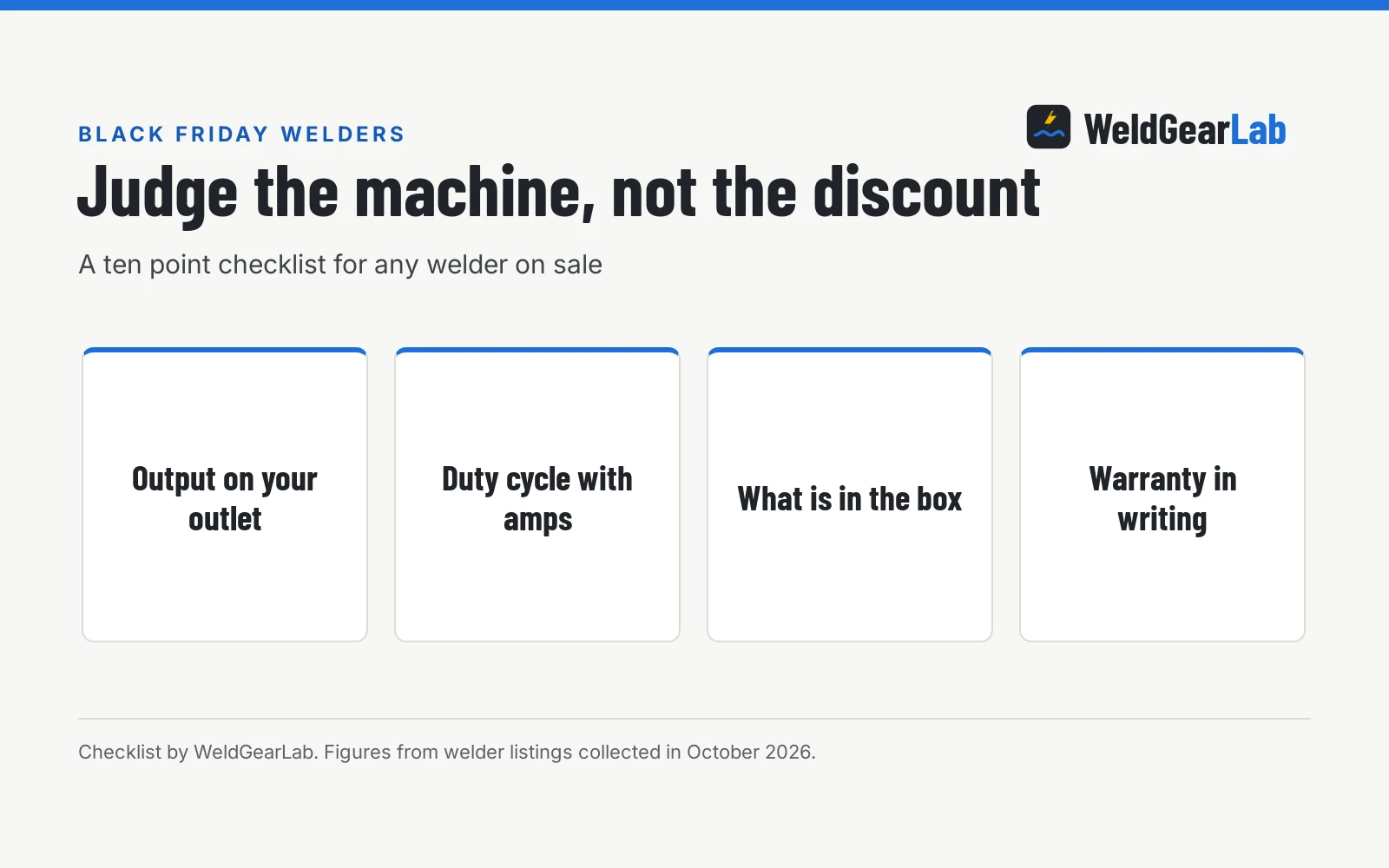
To spot a good welder deal on Black Friday, ignore the percentage off and check the machine first: its output on the outlet you have, a duty cycle stated with an amperage, what is actually in the box, and the written warranty. A deal is only good if the welder fits your work at the sale price. This guide is a ten point checklist for how to spot a good welder deal on Black Friday, built from what we see when we read welder listings for our guides.
As an Amazon Associate I earn from qualifying purchases. This guide links to our product roundups, where WeldGearLab earns a commission when you buy through links, at no extra cost to you. Read our affiliate disclosure.
Why the discount is the last thing to check
A sale price tells you what a machine costs today. It tells you nothing about whether the machine can weld the steel you have on the circuit you have. The listings we collected in October 2026 show how much the basic numbers vary: of 104 welder listings, only 9 stated a duty cycle with an amperage, and only 2 named a CSA or ETL safety listing. Those gaps do not go away when the price drops. Read the specs first, then decide whether the price is right.
How to spot a good welder deal on Black Friday: the checklist
| Check | What a good listing shows | Red flag |
|---|---|---|
| Job fit | Rated thickness for your steel, with the process | Only a top amp figure |
| Input power | Output stated for 120V and 240V separately | One amp figure for a dual voltage machine |
| Duty cycle | A percentage with an amperage, such as 30% at 90A | A bare percentage, or nothing |
| Processes | Each process with its own range | An in-1 count that includes spot or pulse modes |
| Box contents | Gun, ground clamp, regulator or gas hose, tips named | Photos of parts the text does not list |
| Gas or flux core | Gas MIG stated in the title, bullets and table | The table contradicts the title |
| Warranty | Length and what parts it covers | No warranty line at all |
| Safety listing | CSA, UL or ETL named | Nothing stated |
| Seller | Brand or a named authorized seller | A different seller than the brand store |
| Total cost | You have priced gas, wire, helmet and wiring | The welder is the whole budget |
Each check is explained below. None of them needs a live price, so you can do all ten before the sales start and only compare prices on the day.
1. Write down the job before you shop
Decide what you will weld most: thin sheet on a car, 1/8 inch angle for a cart, 1/4 inch plate on a trailer. Then look for the rated thickness in the listing, not the amperage. Hobart, for example, rates its Handler 140EZ for 24 gauge to 3/16 inch on 120V. If your work is thicker than what a machine is rated for, a deep discount does not fix that. Our guide to choosing a MIG welder walks through matching thickness to output.
2. Check the output on the outlet you actually have
Dual voltage machines are common in welder sales, and they are also where listings mislead most. The top amp figure in the title is usually the 240V figure. Of the welder listings we collected, 8 stated output for both voltages, and on those the 120V maximum was between 50% and 73% of the 240V maximum. If you only have a household outlet, the 120V number is the one you are buying. Our 120V vs 240V welder guide shows the figures machine by machine.
3. Find a duty cycle with an amperage
A duty cycle such as 30% at 90A means about 3 minutes of welding in every 10 at 90A. A listing that says only 60% duty cycle, with no amperage, cannot be compared with anything. When two machines are close in price, the one that states a full rating is easier to judge. See our welding duty cycle explainer for how to compare two ratings fairly.
4. Count the processes honestly
Many budget machines advertise 5-in-1 or 8-in-1. Those counts often include modes such as spot welding or pulse settings alongside the real processes: gas MIG, flux core, stick and lift TIG. A machine that does three processes well is a better deal than one that lists eight and states a range for none. Look for a stated amp range for each process you plan to use. Our best multi-process welder picks show what a complete multi-process listing looks like.
5. Read the box contents, not the photos
Sale bundles change. Before you buy, read the text list of what ships with the machine: gun and cable length, ground clamp, contact tips, drive rolls for the wire you will use, and for gas MIG a regulator and hose. Product photos often show parts that belong to a different bundle. If the listing does not name a regulator, budget for one.
6. Confirm gas MIG if gas is why you are buying
Some listings contradict themselves. The Lincoln Weld-Pak 90i MIG listing we compared in our Hobart vs Lincoln MIG welder article says MIG in its title and bullets but MIG welding capable: no in its specification table. If you want to weld with shielding gas, check that the title, bullets and table agree, and ask the seller if they do not. Our flux core vs MIG guide explains what changes when you add gas.
7. Get the warranty in writing
Warranty is one of the clearest differences between a cheap machine and a good deal. In the listings we have scored, written warranties range from none stated to Hobart’s 5/3/1 coverage, which the Handler 140EZ listing describes part by part. Check three things: the length, which parts are covered, and whether the seller you are buying from is the brand or a seller the brand supports. A long warranty is worth less if the purchase does not qualify.
8. Look for a safety listing
A CSA, UL or ETL mark means the machine was evaluated against an electrical safety standard. Most budget listings do not state one. It does not make a machine weld better, but it is one of the few objective signs of build quality you can check from a listing, and it is part of how we score welders on our How We Pick page.
9. Know who is selling it
The same model can be offered by several sellers on one product page, at different prices. Before you check out, look at who ships and sells it. A lower price from an unfamiliar seller can mean a different bundle, an older revision or a warranty that is harder to claim. Return windows also differ by seller, so read the return terms on the listing you buy from.
10. Price the whole setup, not just the welder
The welder is rarely the whole cost. Before you decide a deal is good, add what you still need:
- An auto-darkening helmet, leather gloves and a flame resistant jacket. See our best welding helmet under $200 and best welding gloves for MIG.
- Wire for the process, contact tips and, for gas MIG, a gas cylinder and regulator.
- An angle grinder, clamps and a magnetic square for prep and fit up.
- For a 240V machine, a correctly sized circuit installed by a licensed electrician.
A cheaper machine that leaves budget for a decent helmet is often the better buy than a bigger machine that leaves you welding behind a poor lens.
Electrical and fire safety. A new welder needs the right circuit before it needs a sale. Do not run a welder through a light duty extension cord or a homemade adapter, and have a licensed electrician fit any 240V receptacle. Clear flammable material from the area before the first arc and keep an extinguisher close. See the OSHA welding overview and our Safety Disclaimer.
How to compare prices on the day
Once you have a short list of two or three machines that pass the checklist, price is the easy part.
- Track the price for a few weeks first. A list price or a was price is set by the seller. Your own record of what the machine sold for in October is a better baseline.
- Compare the same bundle. A bare machine and a kit with a regulator and spool gun are different deals even under the same model name.
- Compare price per useful feature. If one machine includes a regulator, a second set of drive rolls or a longer warranty, count that.
- Do not trade up on impulse. If a bigger machine is on sale but you only have a 120V outlet, the extra 240V output is not something you can use yet.
Where to start your short list
- First welder: our best welder for beginners, picked for simple setup and clear listings.
- Household outlet only: our best 120V MIG welder.
- Budget ceilings: best MIG welder under $500 and best MIG welder under $1000.
- Cutting: best plasma cutter under $1000.
For more background reading, browse all our welding guides.
Frequently Asked Questions
Is Black Friday a good time to buy a welder?
It can be, if you already know which machine fits your work. Sales cover many welders, helmets and accessories at once, so it is a good moment to buy a complete setup. It is a poor moment to choose a machine from scratch under time pressure, so do the checklist before the sales start.
How do I know if a welder discount is real?
Track the price yourself for a few weeks before the sale, and compare the same bundle each time. A crossed out was price is set by the seller and is not proof of a saving. Your own record of the October price is the best baseline you have.
Should I buy a bigger welder because it is on sale?
Only if you can power it and need its output. A dual voltage machine on a 120V outlet gives only part of its 240V output (50% to 73% in the listings we collected that state both), a 240V only machine will not run on it at all, and a new 240V circuit adds to the cost. Buy for the thickness you weld most and the outlet you have.
What specs matter most when comparing welder deals?
Rated thickness for your process, output on your input voltage, and a duty cycle stated with an amperage. After that, compare what is in the box and the written warranty. These are the same specs we use to score welders.
Are cheap multi-process welders a good Black Friday deal?
Some are, but check that each process you need has a stated amp range. High in-1 counts often include extra modes rather than extra processes. A machine that states clear ranges for MIG, flux core and stick is easier to judge than one that only lists a count.
What else should I budget for besides the welder?
A helmet, gloves and jacket, wire and tips, and for gas MIG a cylinder and regulator. Add a grinder and clamps for prep, and an electrician if you need a 240V circuit. Pricing the full setup is the best way to tell whether a deal is actually good.
Related: how to choose a MIG welder, welding duty cycle explained, best gifts for welders, and the welders hub.
About the author
WeldGearLab Editorial is the editorial team behind WeldGearLab. We research product listings, specifications, safety listings and warranty terms, score every pick with the published Gear Score method, and correct errors when readers report them. We do not run our own shop trials; see How We Pick for exactly how picks are made.