How Does Powder Coating Work for Metal Parts
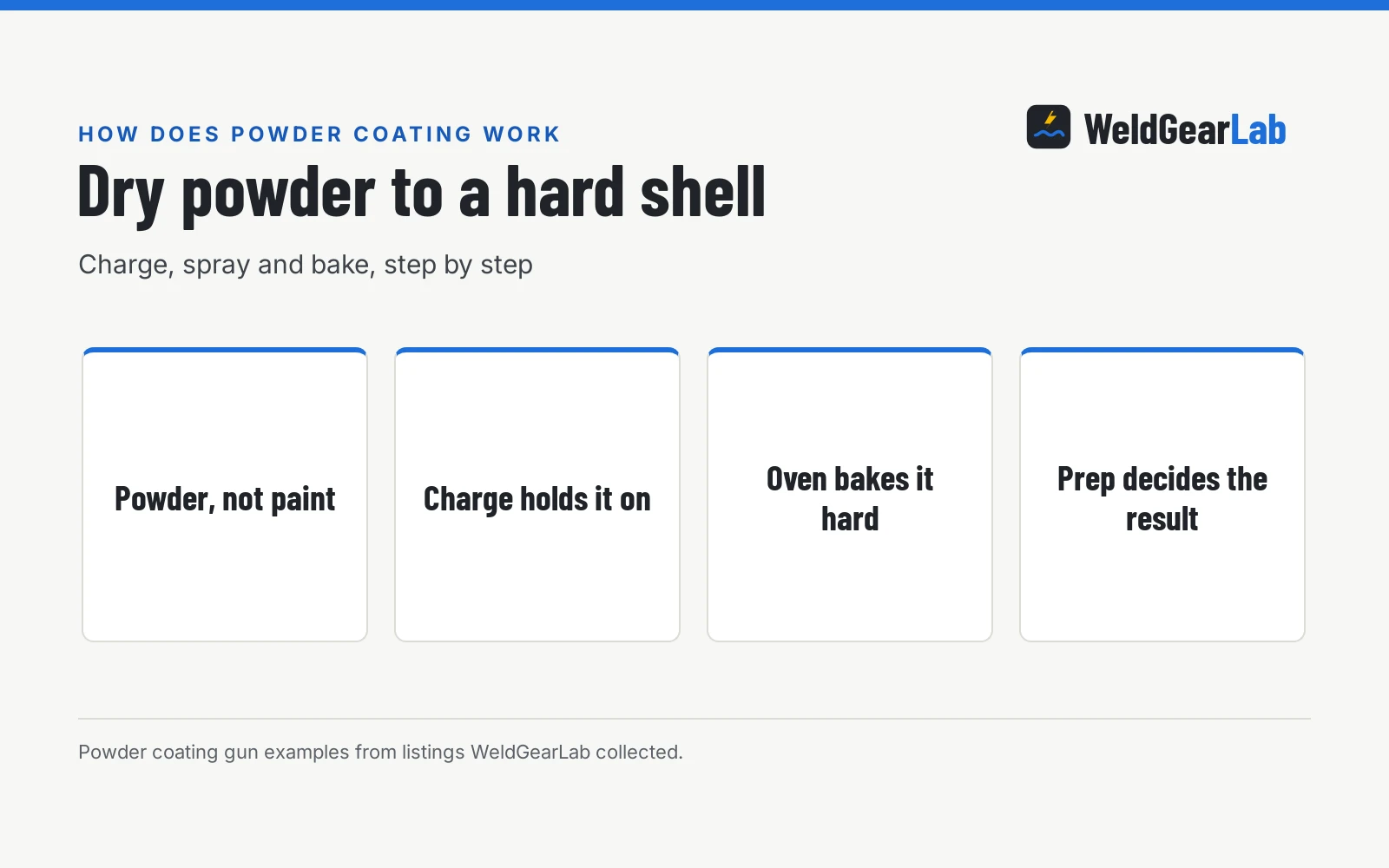
How does powder coating work: dry powder takes an electric charge, clings to grounded metal, and bakes into a hard shell in a hot oven.

On this page
Top picks at a glance
As an Amazon Associate I earn from qualifying purchases.
- 1
 Eastwood HotCoat 100kV Powder Coating Gun System9.6/10View on Amazon
- 2
 Eastwood HotCoat PCS-250 Powder Coating Gun Plus Benchtop9.6/10View on Amazon
- 3
 Eastwood Hotcoat PCS-250 Powder Coating System9.6/10View on Amazon
A steel bracket comes back from the shop with chipped paint, rust starting at the edges, and a finish that never looked right in the first place. Powder coating is the other way to finish that part, and the question most shop owners ask first is simple: how does powder coating work? Dry powder takes an electric charge, clings to grounded metal, and then bakes into a hard shell in a hot oven. There is no liquid paint and no solvent to flash off, and clean powder that misses the part can be collected and used again.
This guide links to our product roundups, where WeldGearLab gets a commission on purchases made through links on this page, and your price stays the same. Read our affiliate disclosure.
How does powder coating work, step by step
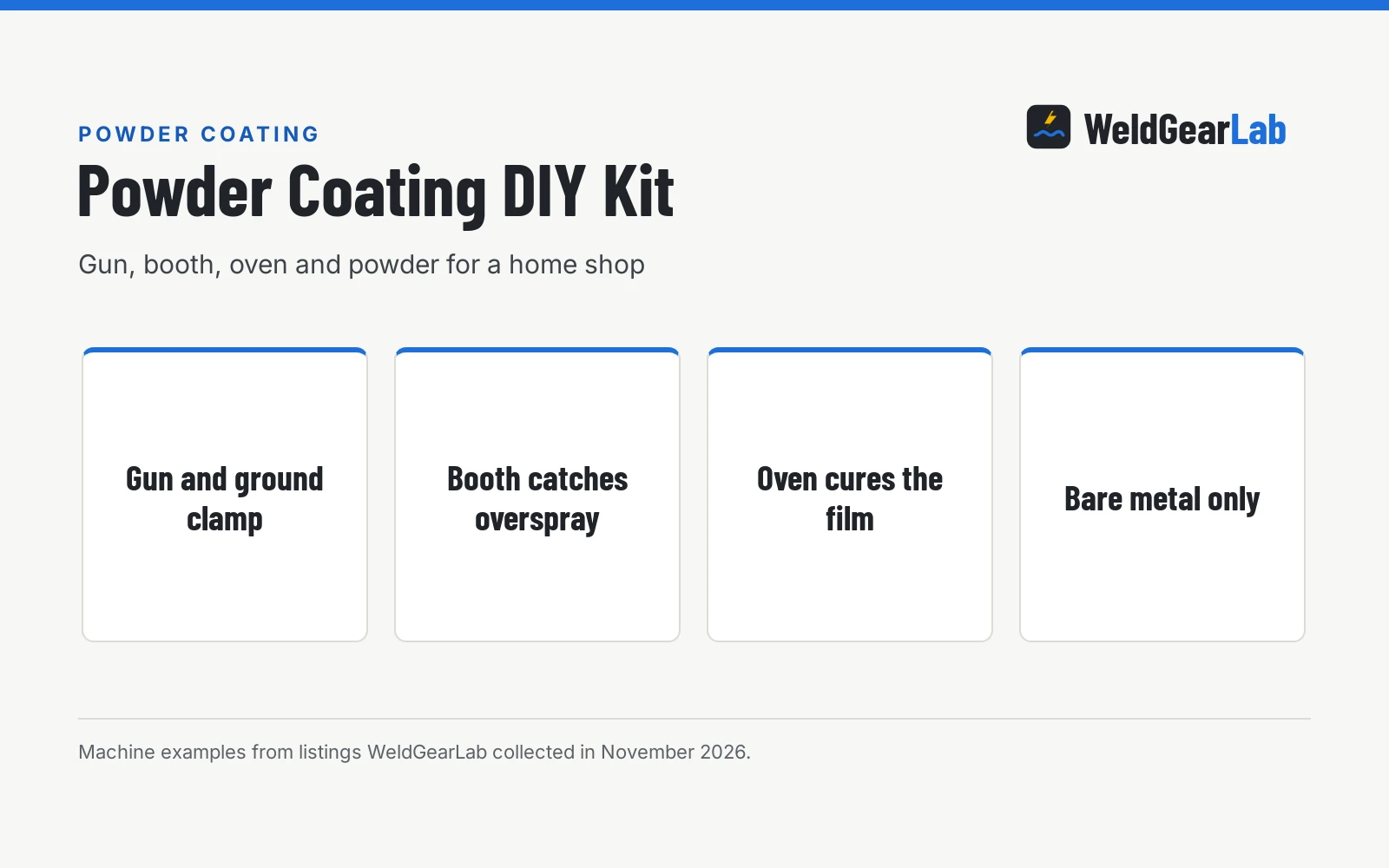
The whole process runs in order: prep, charge, spray, and bake. Each stage sets up the next one, and a weak stage shows in the finished part, so prep is the real work and spraying is the quick part.
The steps at a glance
| Step | What happens | What the powder does | What the gun and booth do |
|---|---|---|---|
| Prep | Bare metal is cleaned and hung | Nothing yet, the part must be bare and dry | Hooks hold the part, a booth catches overspray |
| Charge | The gun gives the powder an electric charge | Charged powder is drawn to grounded metal | 15,000-volt to 100 kV guns, ground clamp and lead |
| Spray | Powder is blown onto the part in an even layer | Powder clings where the charge holds it | Bottle, cup or hopper feeds the gun |
| Bake | Heat melts the powder into a smooth shell | Powder flows together and hardens as it cools | An oven holds the part at baking heat |
| Cool | The part cools and the finish is checked | The shell sets hard | Hooks and racks hold the part while it cools |
Voltage is the number that changes most between guns. A single-voltage gun holds one setting, while a dual-voltage gun switches between a low setting and a high setting for multi-coat coverage over larger areas. The example guns run from a 15,000-volt setting up to a 100 kV gun.
Prep the metal
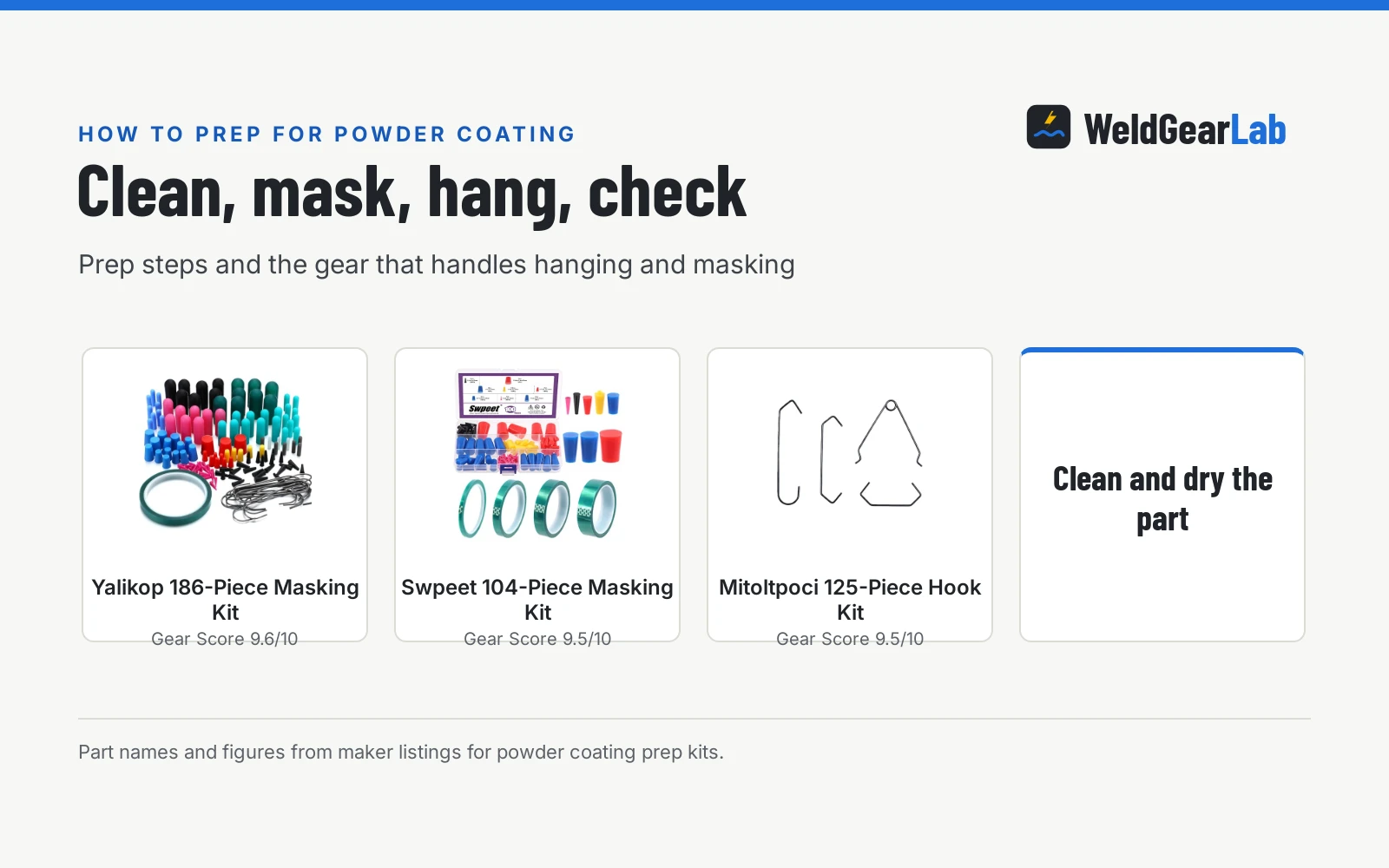
Powder bonds to clean, bare metal, so prep comes before anything else. Grease, rust and old paint keep powder from bonding, and a bare spot under the powder on steel turns into rust later, so the part gets cleaned down to bare metal and hung where the gun can reach every face. The how to prep for powder coating guide walks through the cleaning stages in order.
Parts hang from hooks while they are sprayed and baked. The MorningRo kit (on Amazon) holds 125 hooks in 4 inch to 7 inch sizes, made from 65 Mn spring steel, which covers small brackets and larger parts on the same rack.
Charge the powder and spray it
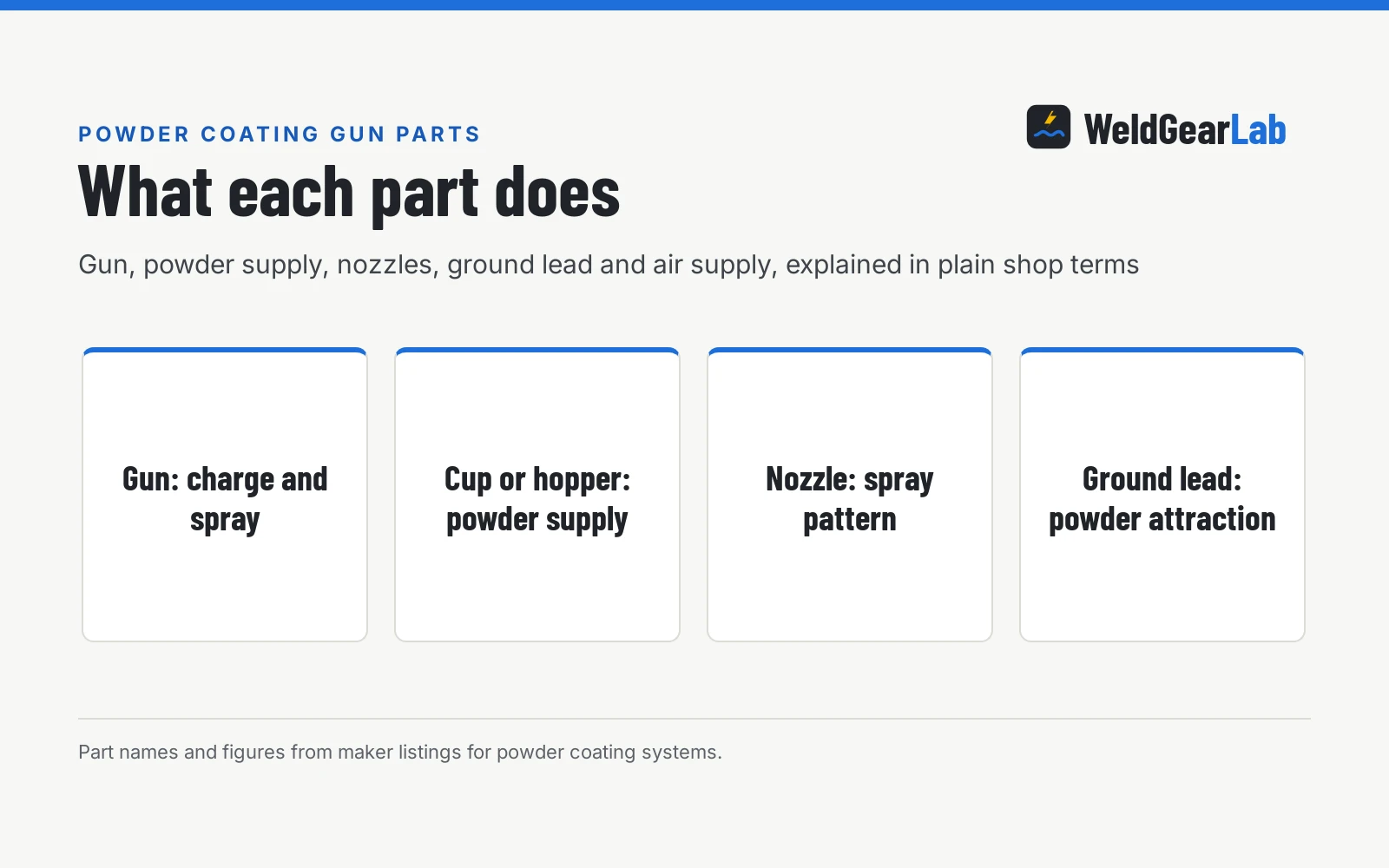
The gun does two jobs at once: it blows powder toward the part and gives each particle an electric charge. Grounded metal pulls the charged powder in, so the powder wraps around edges and into corners instead of falling past the part. A ground clamp and cable complete the circuit, and a dedicated grounding lead on a bench unit does the same job.
Voltage sets how hard the powder is pulled in. The Eastwood PCS-150 runs a single 15,000-volt setting, the Eastwood PCS-250 switches between a low 15,000-volt setting and a high 25,000-volt setting, and the Eastwood HotCoat (on Amazon) reaches up to 40kV with voltage and amperage adjustable from 0 to 40 kVDC and 10 to 50 μA. The PCA-305 gun runs at 100 kV and carries an 11.16 oz powder cup for longer runs without a refill. The PCS-150 runs on standard 120V, 60Hz household current, while the WX-958S accepts 90-260V power.
Powder feed differs by gun. The PCS-150 uses an 8-oz clear bottle that shows the powder level, the HotCoat uses a 2-lb stainless-steel hopper, and the WX-958S holds its powder in a 45L stainless-steel tank. A 1/4 inch FNPT air inlet fits common shop compressors, and the HotCoat ships with a 12.1-foot powder feed hose and 12-foot air tubing for reach around parts. See the powder coating gun parts guide for what each piece does, and the powder coating gun for beginners guide before buying a first gun.
Bake the powder into a finish
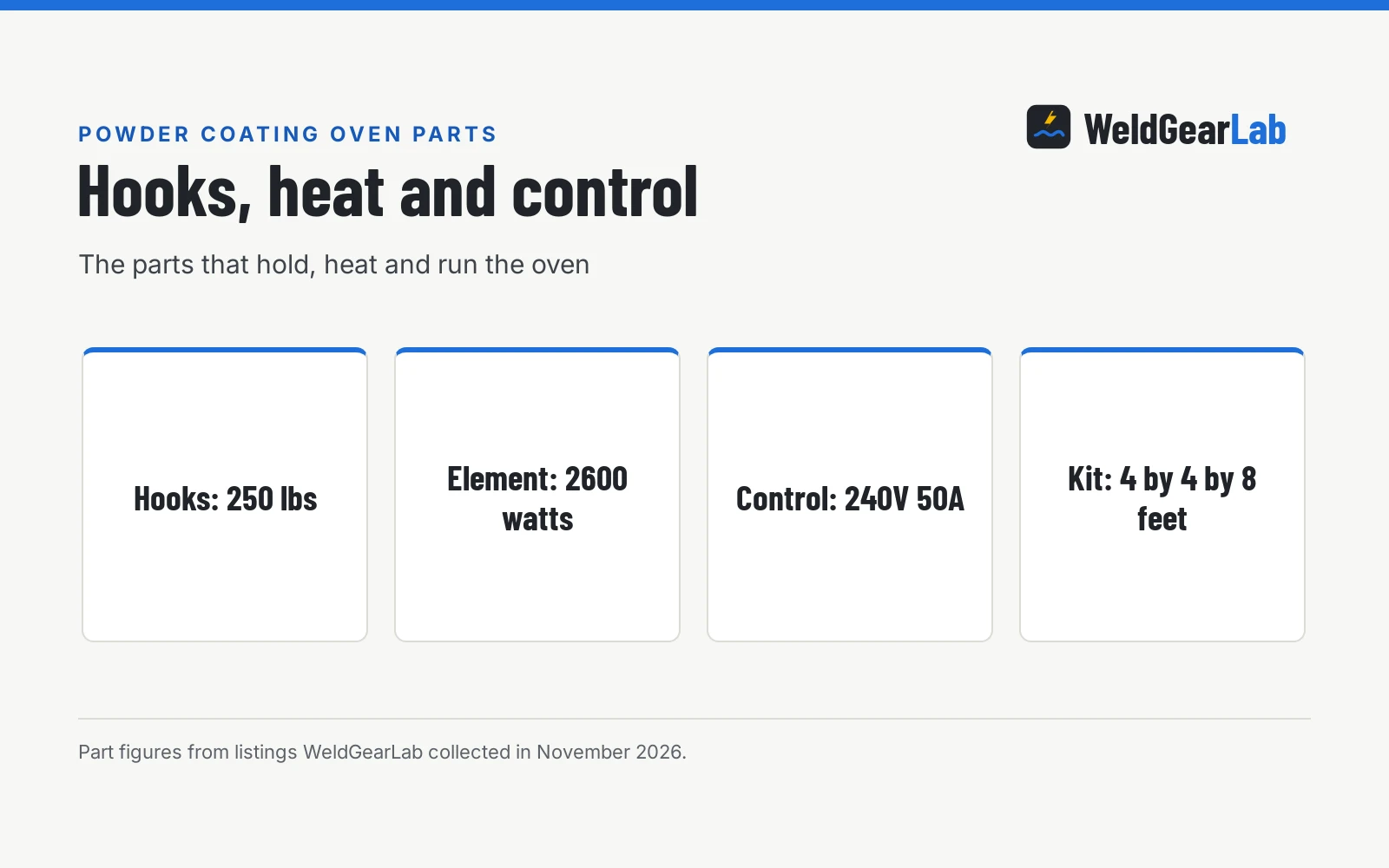
Once coated, the part goes into an oven, where heat melts the powder so it flows together into a smooth, hard shell. The Eastwood PCS-250 kit is sold as a coat and bake job that finishes in under an hour, and its booth captures over 95% of powder overspray while a 20 inch box fan pulls air through it. The how hot a powder coating oven needs to be guide covers bake settings, and powder coating oven parts explains the pieces of the oven itself.
Cool down and check the finish
When the bake ends, the part comes out hot and the finish hardens as it cools. Check for thin spots, bare edges and dust caught in the finish before the part goes back into service. A coat that went wrong can be stripped and redone; see how to remove powder coating from metal for the stripping options.
What the gear looks like in a home shop
Home setups range from a small gun and a bottle to a bench rig with a booth. The Eastwood PCS-150 gun and bottle weigh 4.4 pounds, the HotCoat control unit and gun weigh 13.0 pounds, and the PCS-250 kit with its booth weighs 25.9 pounds. The wall-mount WX-918W runs at 40W, holds 17L, and measures 11.5 inches by 11.5 inches by 15.4 inches. The Hrxllb gun (on Amazon) runs on 110V/220V power and carries three pressure gauges with voltage and amp displays for fine-tuning. For a full walkthrough, see how to powder coat at home, the best powder coating gun for home use roundup, and HVLP vs powder coating gun for the liquid paint comparison.
Safety notes for powder coating
Powder dust and hot ovens. Powder is a fine dust, so spray it with ventilation moving air away from the breathing zone and wear eye protection and a respirator rated for fine dust. Treat the oven like any hot shop equipment: gloves for hot parts, a clear area around the oven, and nothing flammable near it. Keep powder containers closed and away from flame, and keep the spray area free of ignition sources while the gun is running.
FAQ for welders
Can powder coating be done at home?
Yes, with a gun, a way to hang parts, and an oven that fits them. The PCS-150 runs on standard 120V, 60Hz household current, and the PCS-250 kit pairs its gun with a booth that captures over 95% of overspray. A dedicated oven is the right tool for the bake; an oven used for food is not.
What metals can be powder coated?
Powder coating suits steel and other metallic products, which is the use the Eastwood PCS-150 is sold for. The part must take a ground connection and stand up to oven heat, so the metal needs to be bare and able to hold a charge. Plastic and wood do not work the same way, since the powder needs grounded metal to cling to.
Does powder coating need a special oven?
Yes. The powder has to melt and flow in steady heat, which is what a powder coating oven is built to hold. The bake settings guide explains the setup, and the oven parts guide names the pieces that keep heat even. A home oven that also cooks food should not double as a coating oven.
How long does a powder coated finish last?
Eastwood says the baked finish resists most chemicals, fuels, acids, thinners, brake fluid and UV light, and that it lasts up to ten times longer than liquid coatings. Life in a real shop still depends on prep, since powder over rust or grease lets go early. A clean, bare part with a full bake is the finish that holds up.
What happens to the powder that misses the part?
Overspray falls to the booth floor or a collection tray, and clean powder can be used again. The PCS-250 booth captures over 95% of powder overspray, which is why a booth pays for itself in saved powder on bigger jobs. Keep collected powder dry and free of dirt, and do not mix colors that were sprayed apart.
Related: metal fab tools, how to prep for powder coating, powder coating gun for beginners, and best powder coating gun for home use.