Hand vs Hydraulic Rebar Bender: Which One Should You Buy?
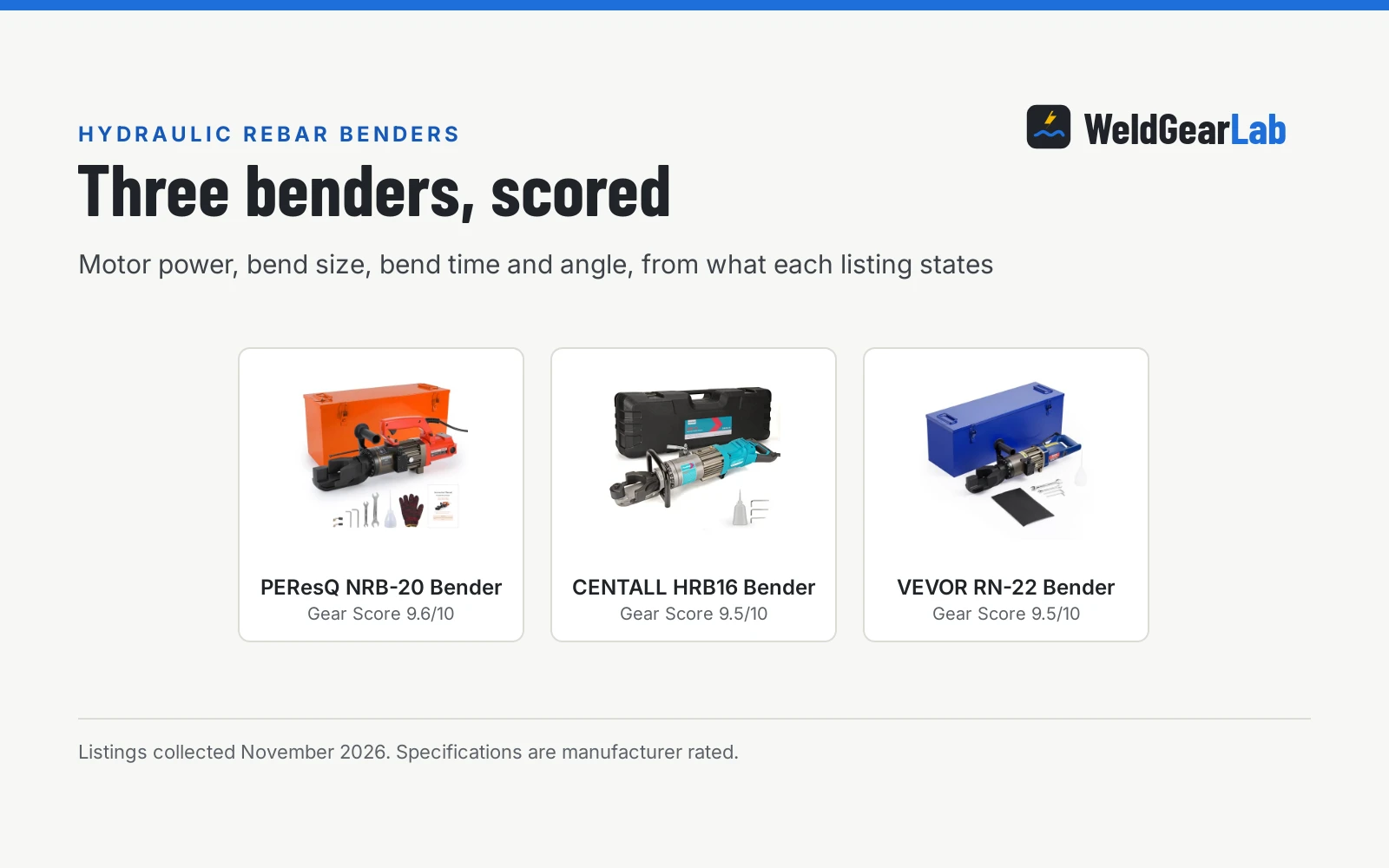
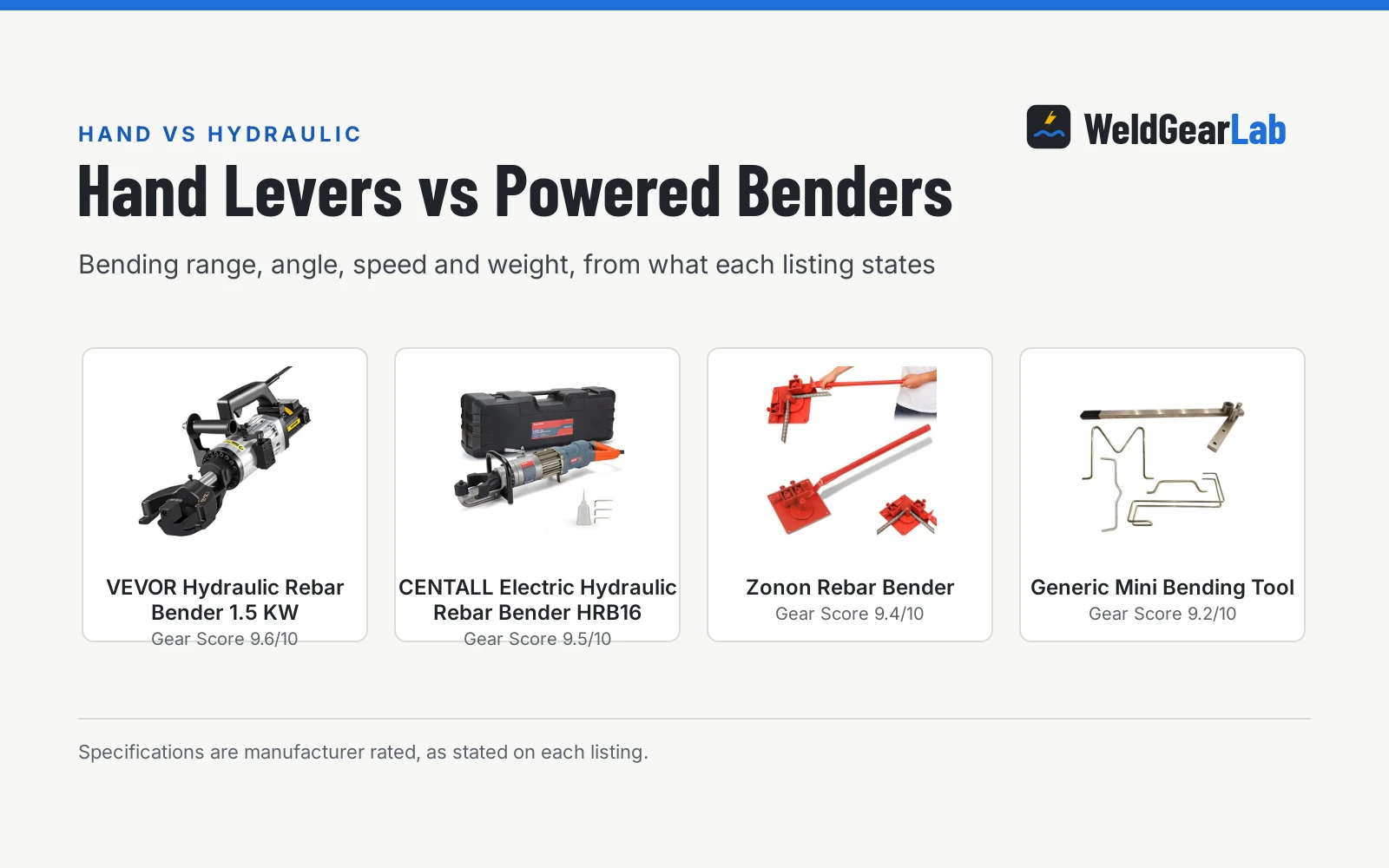
The VEVOR and CENTALL powered benders bend rebar with a motor, while the Zonon and Generic hand tools rely on leverage, and the listings separate them on range, angle, speed and weight.

On this page
Top picks at a glance
As an Amazon Associate I earn from qualifying purchases.
- 1
 VEVOR Hydraulic Electric Rebar Bender 1.5 KW9.6/10View on Amazon
- 2
 CENTALL Electric Hydraulic Rebar Bender HRB169.5/10View on Amazon
- 3
 Zonon Rebar Rod Bender Metal Rebar Bender Tool9.4/10View on Amazon
- 4
 Manual Bending Bender;Rod Forming Tool.Steel9.2/10View on Amazon
Verdict. In this hand vs hydraulic rebar bender comparison, powered models suit motor-driven bending, while hand levers suit lighter bar and bench work. The VEVOR listing covers the widest range and the CENTALL listing states the shortest bend time, at 2 to 2.5 seconds for 5/8 inch rebar, while the Zonon listing covers the widest angle and the Generic listing suits small stock. No listing here states a warranty term, so let range, angle and weight decide.
A bent bar on a footing or a cage starts as a simple job: hold the bar, make the angle, keep the bend where the plan puts it. The choice is between muscle and motor. This hand vs hydraulic rebar bender comparison puts two powered models against two hand levers, using only what each listing states, so the differences in range, angle, speed and weight stay visible.
WeldGearLab gets a commission on purchases made through links on this page, and your price stays the same. Read our affiliate disclosure.
The four benders
VEVOR Hydraulic Electric Rebar Bender 1.5 KW
A 1.5 KW, 110V powered bender for rebar from 0.2 to 1 inch (4 to 25 mm), bending in 5 seconds to an angle greater than 90 degrees.
Pros
- Bends rebar from 0.2 to 1 inch (4 to 25 mm), the widest range here
- Bends in 5 seconds, with a copper motor that runs only while bending
- Steel body and steel bent head frame for hard rebar
- Precision pressure relief valve releases pressure after the bend
Cons
- 49.0 lb in the table, the heaviest listing here
- Angle stated only as greater than 90 degrees, not a full range
- No warranty term is stated
- No weight in the bullets, only the table figure
CENTALL Electric Hydraulic Rebar Bender HRB16
An 1100 W, 110V powered bender for 1/4 to 5/8 inch (6 to 16 mm) rebar, bending in 2 to 2.5 seconds to angles from 0 to 130 degrees.
Pros
- Bends 5/8 inch rebar in 2 to 2.5 seconds, the quickest bend time here
- 1100 W copper motor with an eccentric wheel head for different thicknesses
- One button operation with a relief valve that returns the piston
- Back grip handle and front handle for lifting the machine
Cons
- Range tops out at 5/8 inch, below the VEVOR listing
- No weight is stated anywhere in the listing
- No warranty term is stated
- Turning the eccentric wheel adds a step when changing thickness
Zonon Rebar Rod Bender Metal Rebar Bender Tool
A hand lever bender for rebar from 0.04 to 0.79 inches, bending from 0 to 180 degrees with a 29.5 inch tool and a 22.5 inch handle.
Pros
- Bends from 0 to 180 degrees, the widest angle here
- Covers 0.04 to 0.79 inches with a lever and bearing disc design
- Bearing disc design stated to save 50% of effort
- 7.1 inch x 7.1 inch base fixes to the bench for stable work
Cons
- Rebar from 0.63 to 0.79 inch needs heating until red hot before bending
- Weight differs: 7.9 lb in the bullets, 8.69 lb in the table
- No warranty term is stated
- Tool length differs: 29.5 inch in the bullets, 29.13 inches in the table
Manual Bending Bender;Rod Forming Tool.Steel
A small stainless steel hand bender for round rod up to 3/10 inch (8mm) and flat stock up to 1/2 inch wide, bending up to 170 degrees.
Pros
- Stainless steel build with a detachable design for storage
- Bends round, flat and square stock for free-form work
- 17 inch (43cm) torsion bar gives leverage for precise bends
- Fixes with only two screws to a bench or a heavy-duty vise
Cons
- Round capacity stops at 3/10 inch, the smallest range here
- Flat stock limited to 3/16 inch thick for 1/2 inch wide mild steel
- No warranty term is stated
- Mini size suits small stock, not site rebar runs
Other welders and gear to compare
 TRUPER GRT-19 1/2"Check price on Amazon
 Happybuy Electric Hydraulic Rebar BenderCheck price on Amazon
 Crescent H.K. Porter Rebar Cutter and BenderCheck price on Amazon
 VEVOR Electric Hydraulic Rebar BenderCheck price on Amazon
 CENTALL Electric Hydraulic Rebar Bender HRB16Check price on Amazon
 CENTALL Electric Hydraulic Rebar Bender HRB25 1200w/17T/#8/4sCheck price on Amazon
Side by side
| VEVOR Hydraulic Rebar Bender 1.5 KW | CENTALL Electric Hydraulic Rebar Bender HRB16 | Zonon Rebar Bender | Generic Mini Bending Tool | |
|---|---|---|---|---|
| Gear Score | 65 | 61 | 53 | 45 |
| Drive | 1.5 KW powered, 110V | 1100 W powered, 110V | Hand lever | Hand lever |
| Bending range | 0.2 to 1 inch (4 to 25 mm) | 1/4 to 5/8 inch (6 to 16 mm) | 0.04 to 0.79 inches | Up to 3/10 inch round, 1/2 inch flat |
| Bending angle | Greater than 90 degrees | 0 to 130 degrees | 0 to 180 degrees | Up to 170 degrees |
| Bend speed | 5 seconds | 2 to 2.5 seconds | Not stated | Not stated |
| Weight | 49.0 lb (table) | Not stated | 7.9 lb (bullets), 8.69 lb (table) | 2.5 lb (table) |
| Build | Steel body, copper motor | Steel body, copper motor | Rust resistant, 6mm baffle | Stainless steel |
| Warranty | Not stated | Not stated | Not stated | Not stated |
Treat the specs as maker ratings pulled straight from the listings; we gathered them on 4 November 2026. Neither listing states a warranty term, and only the powered listings state a voltage.
Hand vs hydraulic rebar bender: power and drive
The powered side runs on a motor. The VEVOR listing states a 1.5 KW motor on 110V, and the CENTALL listing states an 1100 W copper motor on 110V. Both powered listings describe push-button or switch operation with a relief valve. The CENTALL listing states the piston returns after the relief valve is pulled, while the VEVOR listing states the valve releases pressure so the steel can be removed after the bend.
The hand side runs on leverage. The Zonon listing states a mechanical lever principle with a bearing disc design, and the Generic listing states labor-saving rollers with a 17 inch (43cm) torsion bar. Neither hand listing states a motor or a voltage. A hand lever needs no supply; a powered model needs the supply its listing states.
Bending range
Range is where the four listings spread out widest. The VEVOR listing covers rebar from 0.2 to 1 inch (4 to 25 mm), the largest top figure here. The CENTALL listing covers 1/4 to 5/8 inch (6 to 16 mm), a mid-size range.
On the hand side, the Zonon listing covers 0.04 to 0.79 inches, but with a condition: bar from 0.63 to 0.79 inch needs heating until red hot before bending, so the top of that range is not cold bending. The Generic listing is a different class of tool, covering round rod up to 3/10 inch (8mm) and flat stock up to 1/2 inch (12.5mm) wide and 3/16 inch (4.6mm) thick.
Bending angle and speed
Angle favors the hand side on paper. The Zonon listing bends from 0 to 180 degrees, and the Generic listing bends up to 170 degrees. The CENTALL listing bends from 0 to 130 degrees, while the VEVOR listing states an angle greater than 90 degrees without a top figure, so its full angle range stays unclear.
Speed is stated only on the powered side. The CENTALL listing bends 5/8 inch rebar in 2 to 2.5 seconds, and the VEVOR listing bends within 5 seconds. Neither hand listing states a bend time, so speed on that side stays unclear.
Weight and build
Weight separates the heaviest listing from the bench tools. The VEVOR listing puts its model at 49.0 lb in the table, the heaviest listing here. The Zonon listing puts its tool at 7.9 lb in the bullets and 8.69 lb in the table, and the Generic listing puts its tool at 2.5 lb in the table. The CENTALL listing states no weight at all, so its carrying weight stays unclear.
Build materials are stated plainly. The VEVOR and CENTALL listings both state a steel body with a copper motor. The Zonon listing states a rust and deformation resistant build with a 6mm baffle, and the Generic listing states a stainless steel build with a detachable design.
Choose a powered bender if
- You want motor drive rather than lever work.
- Your bar runs up to 1 inch, which only the VEVOR listing covers here.
- You want a stated bend time, with the CENTALL listing stating the shortest bend time here, at 2 to 2.5 seconds for 5/8 inch rebar.
- You work where the 110V supply the powered listings state is at hand.
Choose a hand bender if
- You bend lighter bar and want a tool with no supply cord.
- You want a wide angle, with the Zonon listing reaching 0 to 180 degrees.
- Your work is small rod and flat stock on a bench, which the Generic listing suits.
- You want a light carry weight, with the Generic listing at 2.5 lb in the table.
Before You Strike an Arc
- Check the voltage on the powered listing against the supply on site: both powered listings state 110V.
- Fix the base or the tool before bending: the Zonon listing fixes its base down, and the Generic listing fixes with two screws or a vise.
- Check the bar size against the listing range before the first bend, since the Zonon listing needs heat for its top sizes.
- After a powered bend, release the pressure through the relief valve as the listing describes before removing the bar.
- Wear eye and hand protection suited to bending steel, and keep the work area clear.
FAQ for welders
Which side bends thicker rebar?
Neither side wins outright on thickness. The VEVOR listing covers rebar up to 1 inch, the furthest top figure here, while the Zonon hand listing covers up to 0.79 inches, and only with heat for bar from 0.63 to 0.79 inch. The CENTALL powered listing covers up to 5/8 inch, below the Zonon hand top figure, and the Generic hand listing covers round rod up to 3/10 inch.
Do hand benders need power?
No. The Zonon listing works by lever, and the Generic listing works by rollers and a torsion bar, so neither states a motor or a voltage. The powered listings state 110V, so a powered model needs the supply its listing states.
Why does the Zonon listing mention heat?
The listing states that rebar from 0.63 to 0.79 inch needs heating until red hot before bending. The listing states no heat condition for smaller sizes, so plan the top of that range as heated work.
How fast do the powered benders bend?
The CENTALL listing bends 5/8 inch rebar in 2 to 2.5 seconds, and the VEVOR listing bends within 5 seconds across its stated range. Neither hand listing states a bend time, so no speed comparison is possible on that side.
Do any of these listings state a warranty?
No. None of the four listings states a warranty term, so every warranty cell in the comparison reads as not stated. Warranty therefore does not separate these four models, and range, angle, speed and weight carry the decision.
Related: best bolt cutters for rebar, best cut off wheel for rebar, bolt cutters vs rebar cutter, and the metal fab tools hub.
Scoring, line by line
Each model is scored on performance, build, value, safety listing and warranty, with the weights published on the How We Pick page. How we pick explains the weights.
| Product | Gear Score | Perf. /35 | Build /25 | Value /25 | Safety /10 | Warranty /5 |
|---|---|---|---|---|---|---|
| VEVOR Hydraulic Rebar Bender 1.5 KW | 9.6 | 32 | 21 | 20 | 3 | 0 |
| CENTALL Electric Hydraulic Rebar Bender HRB16 | 9.5 | 28 | 20 | 20 | 3 | 0 |
| Zonon Rebar Bender | 9.4 | 26 | 20 | 19 | 0 | 0 |
| Generic Mini Bending Tool | 9.2 | 19 | 19 | 18 | 0 | 0 |
Think of 9.2 as the bottom and 9.8 as the top. Totals are placed between them in proportion, which keeps the order intact: more points, higher score.