Fixed vs Variable Speed Bench Grinder: Which One Should You Buy?
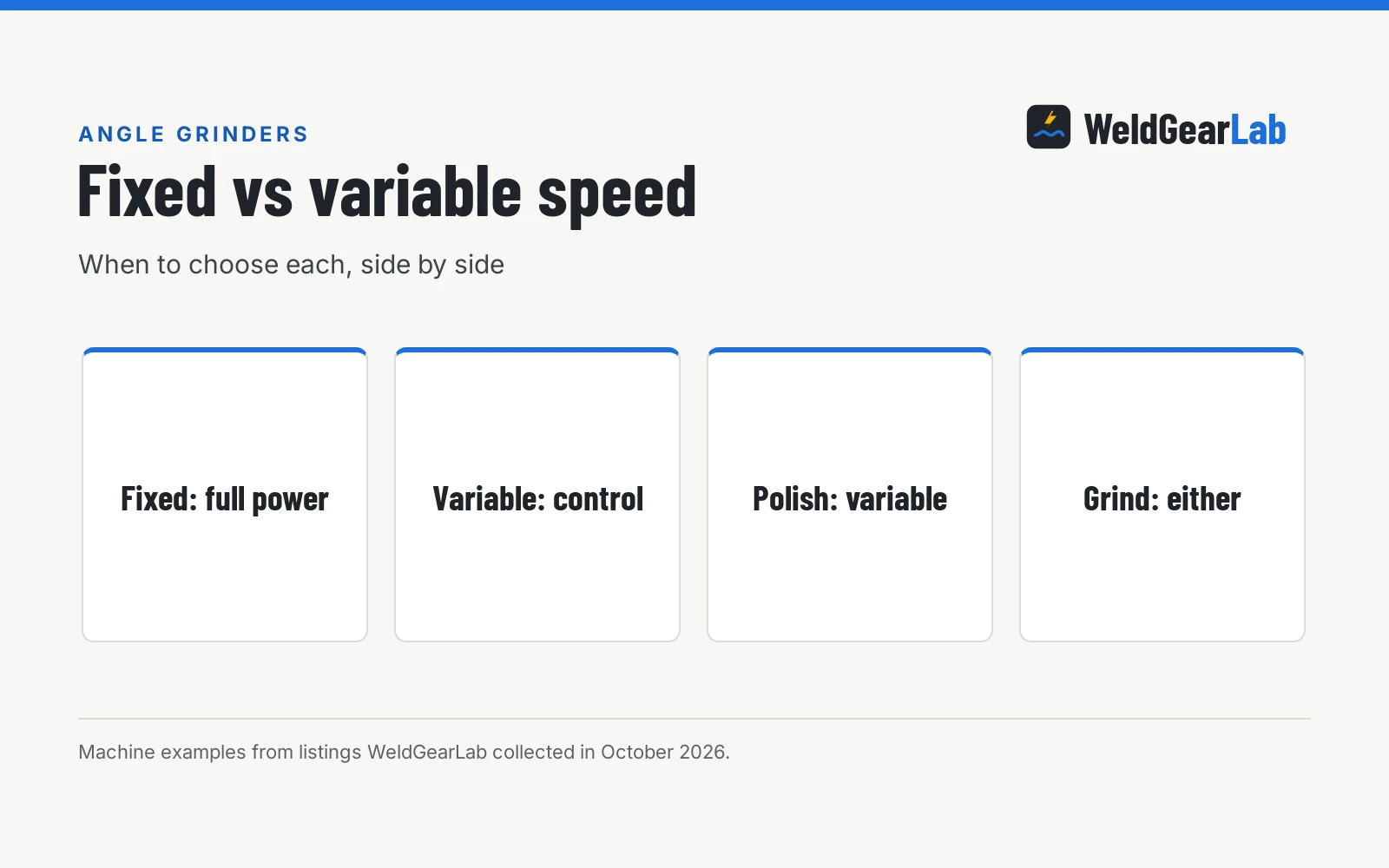
Fixed speed grinders run at a set wheel speed while variable speed grinders let the shop dial speed down for fine sharpening or up for faster stock removal.

On this page
Top picks at a glance
As an Amazon Associate I earn from qualifying purchases.
- 1
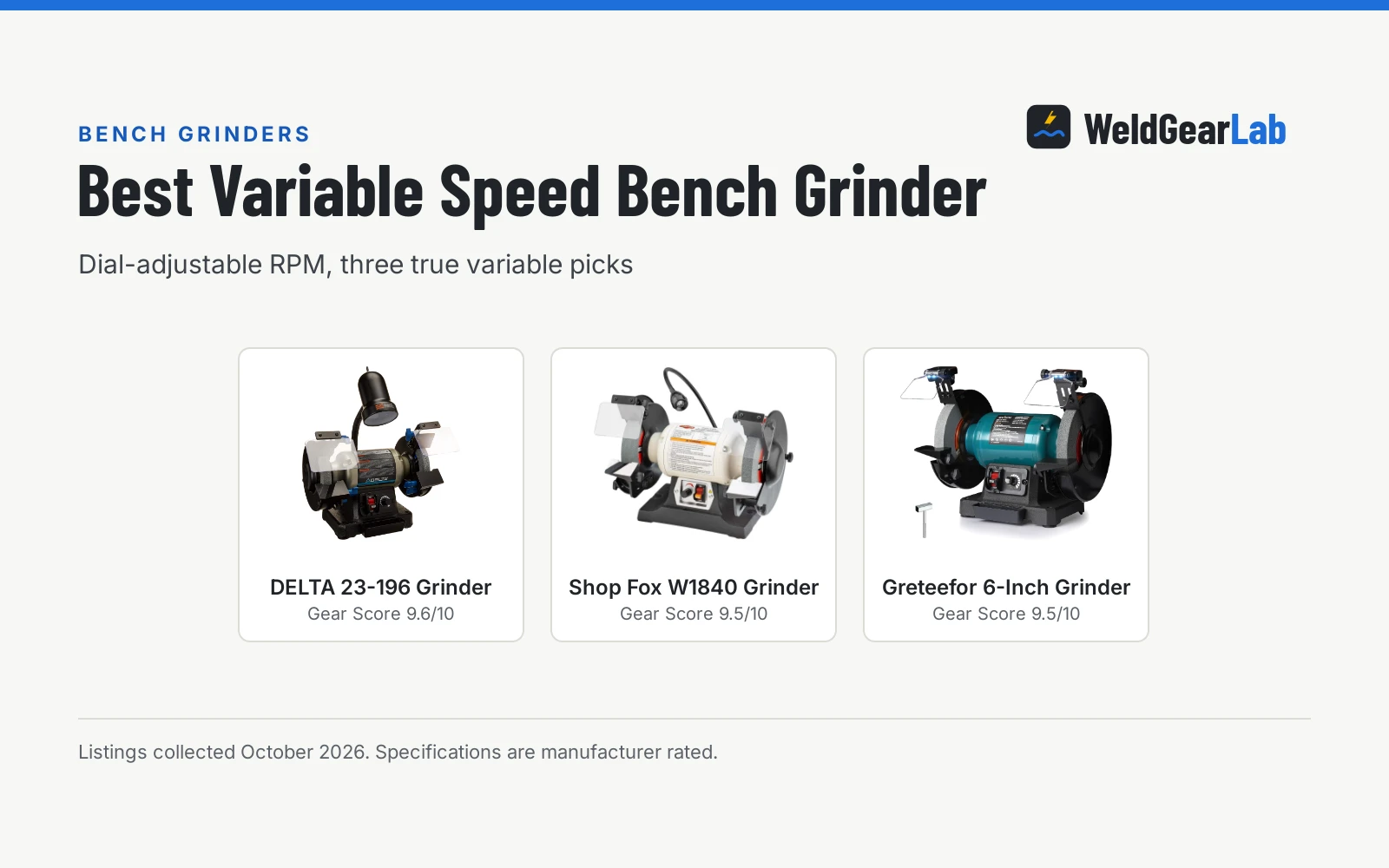
 Delta Power Tools 23-196 6-Inch Variable Speed Bench Grinder9.6/10View on Amazon
- 2
 6-Inch Variable Speed Bench Grinder with Grinding Wheel9.5/10View on Amazon
- 3
 Shop Fox W1840 Variable-Speed Grinder with Work Light9.5/10View on Amazon
- 4
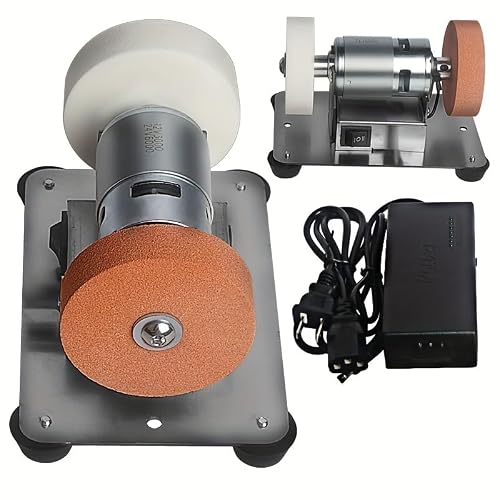 Mini Bench GrinderView on Amazon
- 5
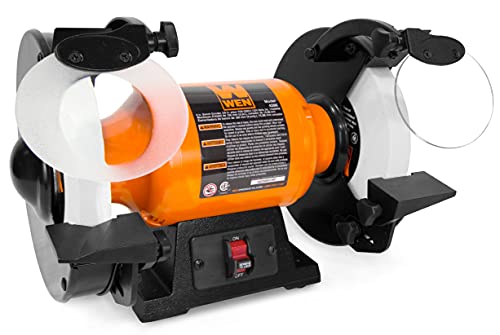 WEN BG4286 3-Amp 8-Inch Slow Speed Bench GrinderView on Amazon
- 6
 Genesis GBG600L 6" Bench Grinder with DualView on Amazon
- 7
 JET 8-Inch Industrial Bench GrinderView on Amazon
- 8
 WEN BG4276 2.1-Amp 6-Inch Single Speed Bench Grinder withView on Amazon
A dull chisel, a nicked mower blade, or a drill bit that skates instead of biting all point to the same bench job: putting a clean edge back on steel before the next weld or repair. The choice that shapes that job is fixed vs variable speed bench grinder speed control, because wheel speed affects how fast metal comes off and how much heat builds at the edge. This guide compares fixed speed and variable speed bench grinders on control, wheel size, power and shop fit, using the listings WeldGearLab collected, so the right setup for a home or farm shop is clear before buying.
Other welders and gear to compare
 Mini Bench GrinderCheck price on Amazon
 WEN BG4286 3-Amp 8-Inch Slow Speed Bench GrinderCheck price on Amazon
 Genesis GBG600L 6" Bench Grinder with DualCheck price on Amazon
 JET 8-Inch Industrial Bench GrinderCheck price on Amazon
 WEN BG4276 2.1-Amp 6-Inch Single Speed Bench Grinder withCheck price on Amazon
This guide links to our product roundups, where WeldGearLab gets a commission on purchases made through links on this page, and your price stays the same. Read our affiliate disclosure.
The difference in one paragraph
A fixed speed bench grinder runs its wheels at a set speed and the shop works around that pace. A variable speed bench grinder adds a control dial, so the shop can slow the wheel for fine sharpening and delicate edges, then speed it up for faster stock removal and shaping. The listings in this guide show that split clearly: the fixed speed model runs at 3450 RPM, while the variable speed models cover 2000 to 3400 RPM on a bench model and 2000 to 10000 RPM on a compact mini model. Wheel size, grit pairing and power still matter, but speed control is the decision that changes how each job feels at the wheel.
Side by side
| Fixed speed | Variable speed | Shop note | |
|---|---|---|---|
| Speed control | Set speed: 3450 RPM | Dial range: 2000 to 3400 RPM and 2000 to 10000 RPM | Variable speed suits fine edges; fixed speed suits a steady pace |
| Wheel size | 8-inch wheels | 6-inch and 3-inch wheels | Larger wheels cover broad edges; smaller wheels suit compact benches |
| Grit pairing | 36 grit and 60 grit wheels | 36 grit and 60 grit wheels | Coarse grit removes stock; fine grit sharpens |
| Power | 350W, 3.0A induction motor | 2.5A bench model; mini runs on a DeWalt 20V battery (battery not included) or a 110-240V adapter | Check the outlet and battery plan before buying |
| Eye protection | Adjustable transparent eye shield | Eye shields and spark deflectors on the bench model; not stated for the mini model | Adjust the shield to the working angle |
| Work rest | Adjustable work rest, tool-free adjustment | Adjustable tool rests on the bench model; not stated for the mini model | Adjust the rest to the working angle |
Speed figures above come from the listings themselves. A fixed speed listing states a set speed, while a variable speed listing states a range, and the range is what the dial covers, not a promise about every wheel or every job.
Fixed vs Variable Speed Bench Grinder: What Changes at the Wheel
Speed control changes heat, control and pace. A slower wheel cuts less aggressively and builds less heat on thin or fine edges, which suits sharpening knives, chisels and drill bits. A faster wheel suits faster stock removal, which helps with deburring, shaping and cleaning up rough edges before fit-up. Fixed speed keeps the pace steady from job to job. Variable speed asks the shop to pick a speed for each job, which takes a moment of thought but gives finer control over the finish.
Wheel size differs across the group. The fixed speed model in this guide carries 8-inch wheels, the variable speed bench model carries 6-inch wheels, and the variable speed mini model carries 3-inch wheels. The 3-inch mini model suits smaller edges and a compact bench, while the 8-inch and 6-inch bench models suit a fixed bench setup. Every model in this guide pairs a 36 grit wheel with a 60 grit wheel, so coarse stock removal and fine sharpening are both covered whatever the speed setup.
The gear in this guide
The VEVOR 8-inch Single Speed Bench Grinder leads this guide on wheel size, with the largest stated wheels in the group. The listing states a 350W, 3.0A induction motor running at 3450 RPM, with 36 grit and 60 grit wheels, an adjustable transparent eye shield, and a tool-free adjustable work rest. The heavy-duty steel plate body and die-cast aluminum base, plus rubber feet, are listed for stability and reduced vibration.
The Woodskil 6-inch Variable Speed Bench Grinder follows on control. The listing states a 2.5A motor with speed adjustable from 2000 to 3400 RPM through a control knob, plus 36 grit and 60 grit wheels, adjustable tool rests, eye shields and spark deflectors. The solid base can be mounted to a workbench for stability.
The Ecarke 3-inch Mini Bench Grinder closes the group on portability. The listing states a variable speed range from 2000 to 10000 RPM with a stepless speed dial, dual grinding wheels in 36 grit and 60 grit, and a stainless steel build with anti-vibration rubber feet. It runs on a DeWalt 20V battery, with the battery not included, or on an AC adapter supporting 110-240V input.
When fixed speed is the better choice
- Steady shop pace. The wheel runs at its set speed on every job.
- Stock removal and shaping. The fixed speed model here pairs a 350W motor with 8-inch wheels.
- Simpler setup. There is no dial to set before each job.
- Broad edges. The fixed speed model carries 8-inch wheels, and its listing pitches it for axes and chisels.
When variable speed is the better choice
- Fine sharpening. Dialing down to 2000 RPM gives a slower, more controlled pass on knives and fine edges.
- Mixed work. The same machine can run slow for edges and fast for deburring and shaping.
- Delicate tools. A slower wheel suits small or thin tools where heat would spoil the edge.
- Compact or cordless benches. The mini model adds a DeWalt 20V battery option and an AC adapter.
How to pick between them
Start from the work, not the dial. When the bench sees mostly shaping, deburring and heavy sharpening at a steady pace, fixed speed is the simpler answer. When the bench mixes fine sharpening with shaping, or when thin edges need a gentle pass, variable speed earns its place. Check the stated wheel size against the edges in the shop, check the power source against the bench, and check the work rest and eye shield adjustments before buying. See our best variable speed bench grinder roundup for more variable speed models, and our best bench grinder for beginners guide when the bench grinder is a shop addition.
FAQ for welders
What is the main difference between fixed and variable speed bench grinders?
A fixed speed bench grinder runs at a set speed, while a variable speed bench grinder lets the shop dial the speed across a stated range. In this guide, the fixed speed model runs at 3450 RPM, and the variable speed models cover 2000 to 3400 RPM and 2000 to 10000 RPM.
Is variable speed better for sharpening knives and chisels?
Variable speed suits sharpening work where a slower pass gives more control and less heat at the edge. The variable speed bench model here dials down to 2000 RPM, which the listing pitches for precision work and fine sharpening.
Does wheel size matter as much as speed control?
Wheel size matters for the size of edge the grinder can handle comfortably. The models in this guide carry 8-inch, 6-inch and 3-inch wheels, and larger wheels suit broader edges while smaller wheels suit compact benches and smaller tools.
Can a variable speed bench grinder also handle heavy stock removal?
Yes, when the listing states a range that reaches a fast speed and a coarse wheel for the job. The variable speed models here pair a 36 grit wheel for stock removal with a 60 grit wheel for fine work, and the mini model reaches 10000 RPM at the top of its dial.
What should a shop check on arrival?
Check that the wheels, work rests and eye shields match the listing, and that the work rest adjusts to the angles the shop uses. For the mini model, check the battery plan, since the DeWalt 20V battery is not included, and confirm the AC adapter suits the shop outlet at 110-240V input.
Related: best bench grinder for sharpening tools, bench grinder vs belt grinder for metal, and angle grinder vs bench grinder.