Fixed vs Variable Speed Angle Grinder: Which One Should You Buy?
Fixed vs variable speed angle grinders compared: when each wins, how to read the speed line, and four listing examples ranked by what they state.

On this page
Top picks at a glance
As an Amazon Associate I earn from qualifying purchases.
- 1
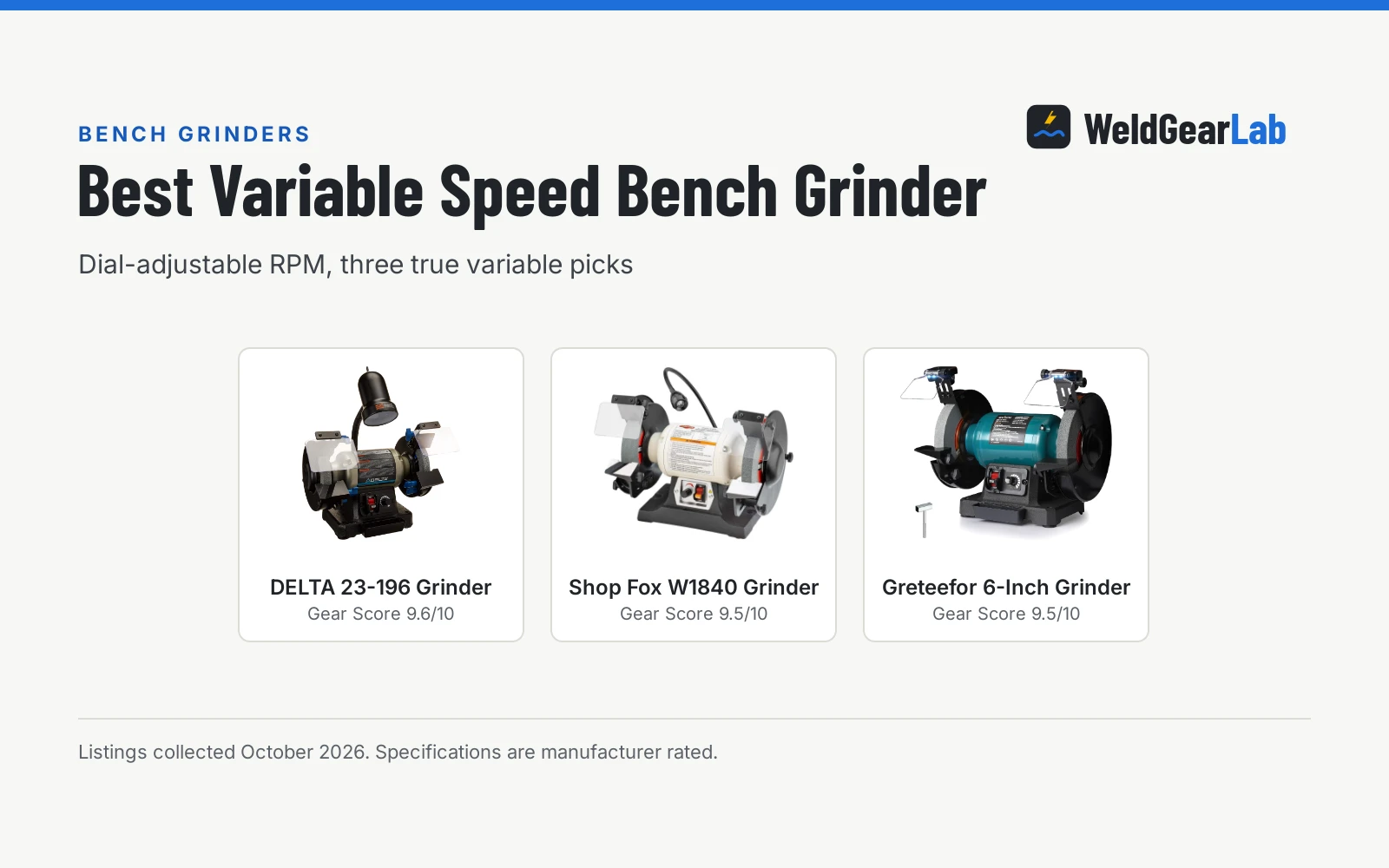
 Delta Power Tools 23-196 6-Inch Variable Speed Bench Grinder9.6/10View on Amazon
- 2
 Makita 9565CV 5" SJS™ High-Power Angle GrinderView on Amazon
- 3
 Makita GA4030 4-Inch Angle GrinderView on Amazon
- 4
 DEWALT Angle GrinderView on Amazon
- 5
 BOSCH GWS14-50 5 In. Angle GrinderView on Amazon
- 6
 Berkling BT 6323 1/4in Angle Air Die GrinderView on Amazon
- 7
 Berkling BT 6322 Right Angle Air Die GrinderView on Amazon
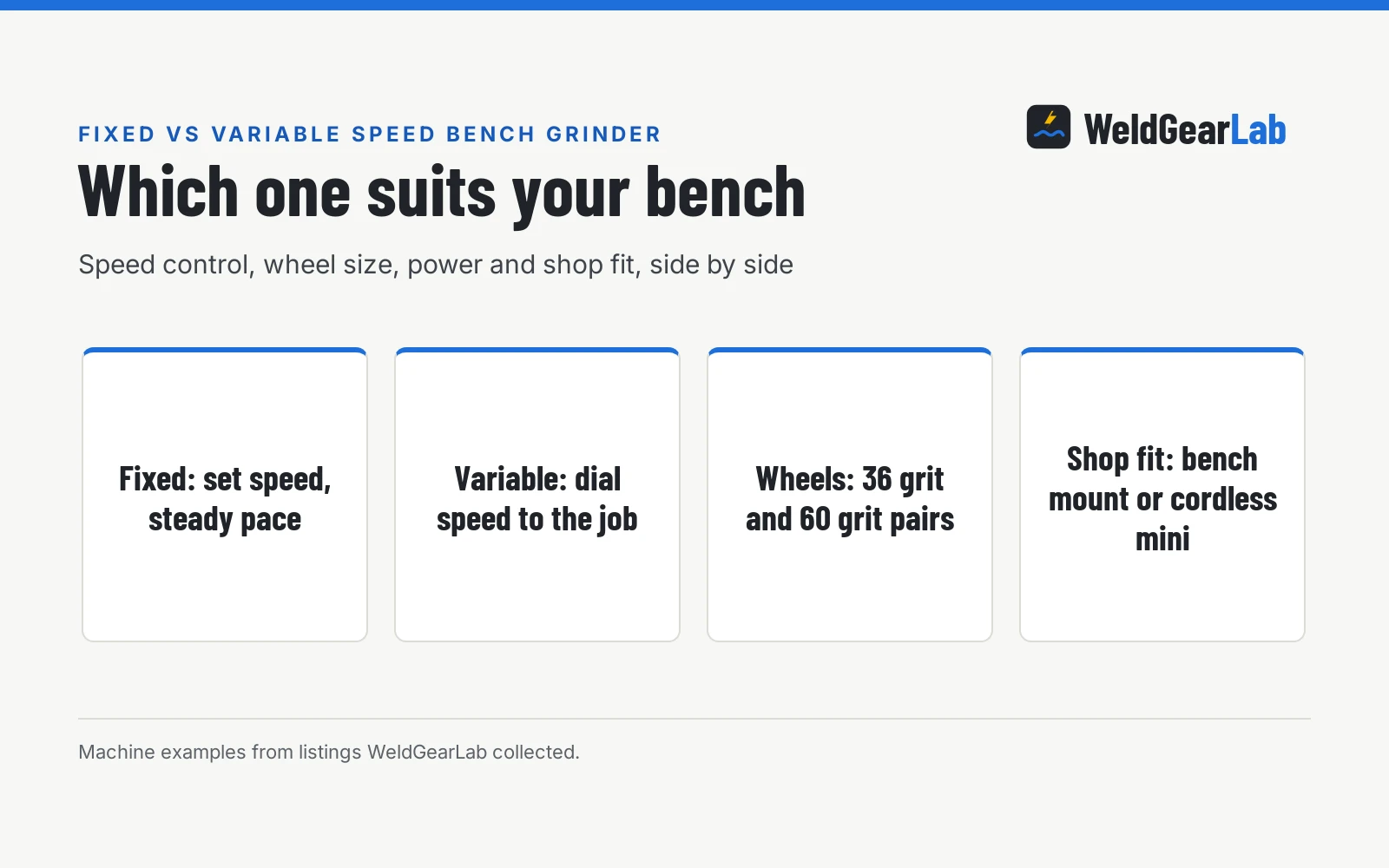
The fixed vs variable speed angle grinder question has a short answer: buy variable speed if you polish, run wire wheels, or work thin metal; buy fixed speed if you only grind and cut at full power and want the simpler tool. Speed control is about heat and accessory ratings, not power. This guide compares the two side by side and ranks four listing examples by what each one states.
Other welders and gear to compare
 Makita 9565CV 5" SJS™ High-Power Angle GrinderCheck price on Amazon
 Makita GA4030 4-Inch Angle GrinderCheck price on Amazon
 DEWALT Angle GrinderCheck price on Amazon
 BOSCH GWS14-50 5 In. Angle GrinderCheck price on Amazon
 Berkling BT 6323 1/4in Angle Air Die GrinderCheck price on Amazon
 Berkling BT 6322 Right Angle Air Die GrinderCheck price on Amazon
This guide links to our product roundups, where WeldGearLab gets a commission on purchases made through links on this page, and your price stays the same. Read our affiliate disclosure.
The difference in one paragraph
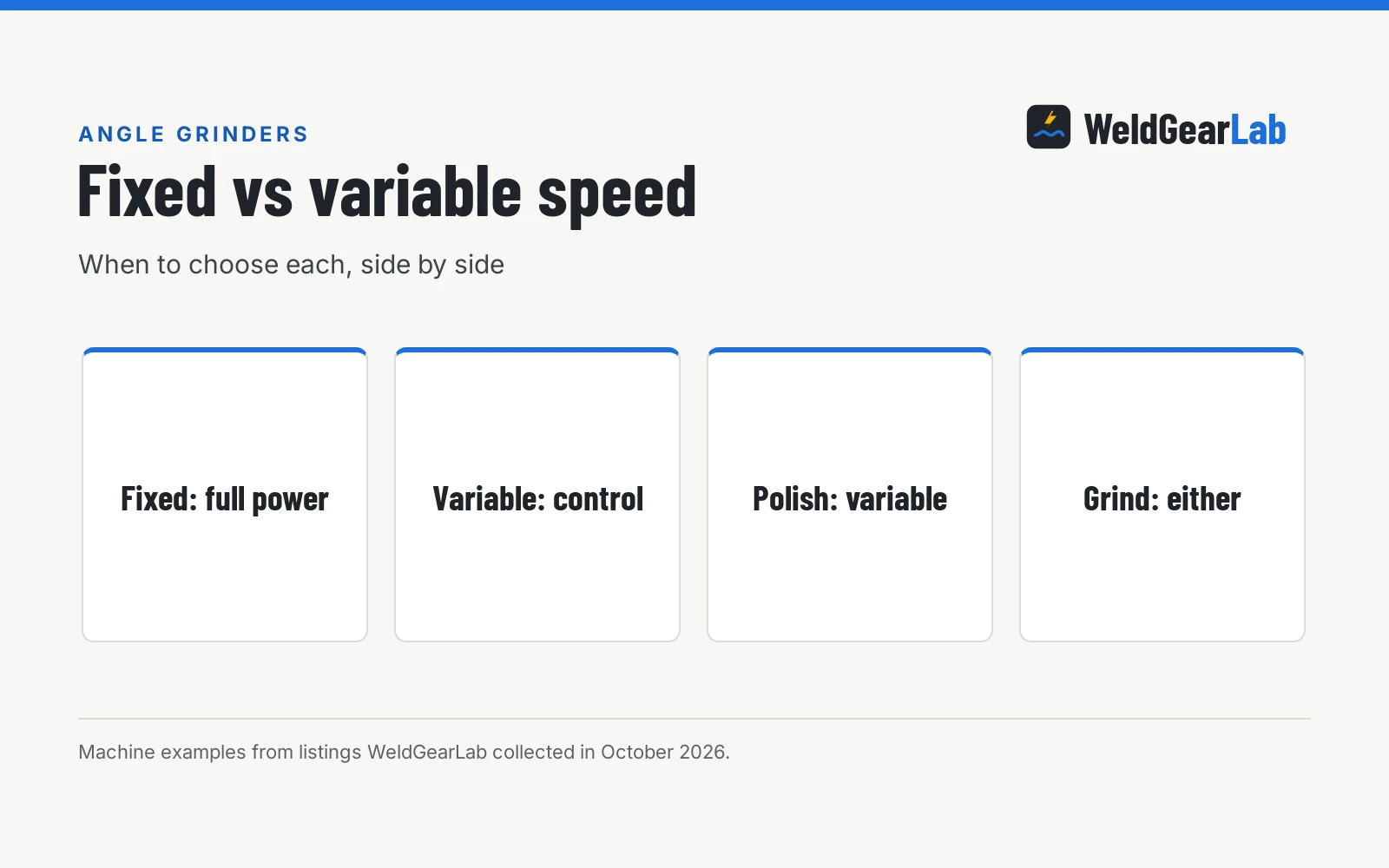
A fixed speed grinder runs one speed, always full: the Makita example here runs 11,000 RPM, period. A variable speed grinder lets you dial down: the VEVOR runs 3,000 to 12,000 RPM, the Powerbuilt offers 6 speeds from 4,000 to 11,000 RPM, and the DEWALT adjusts speed as the work needs. Lower speeds mean less heat and suit accessories like wire wheels and flap discs; full speed suits grinding and cutting wheels doing what they are made for.
Side by side
| Aspect | Fixed speed | Variable speed | Notes |
|---|---|---|---|
| Speed control | One speed, always full | Dial or settings across a range | Stated on all four listings |
| Best for | Grinding and cutting at full power | Polishing, wire wheels, thin metal | Match to your work |
| Heat | Full heat always | Lower speeds, less heat | Variable controls heat |
| Examples here | Makita GA4030, 11,000 RPM | DEWALT 5 in, VEVOR, Powerbuilt | Ranked in the gear section |
| Speed ranges stated | 11,000 RPM | 3,000-12,000 RPM; 4,000-11,000 RPM | A range means variable |
| Safety extras stated | None | Brake and kickback brake; 120-degree guard | DEWALT leads here |
| Warranty stated | 1 Year | 1 Year Limited (Powerbuilt) | Makita and Powerbuilt |
These numbers are the manufacturer’s ratings exactly as each listing gives them, recorded on 21 October 2026.
When fixed speed is the better choice
Fixed speed wins on simplicity. One speed means no dial to bump, no setting to second-guess: pull the trigger and the wheel runs at its rated RPM. For grinding welds, cutting stock and general shop abuse at full power, that is all the control the job needs. The Makita GA4030 is the fixed speed example here: a 4-inch grinder with a 6.0 AMP motor at 11,000 RPM, labyrinth construction sealing the motor and bearings from dust, a case in the box and a stated 1 Year warranty, at 3.7 lbs. If every job you do is full-power work, the fixed speed tool is the honest buy.
When variable speed is the better choice
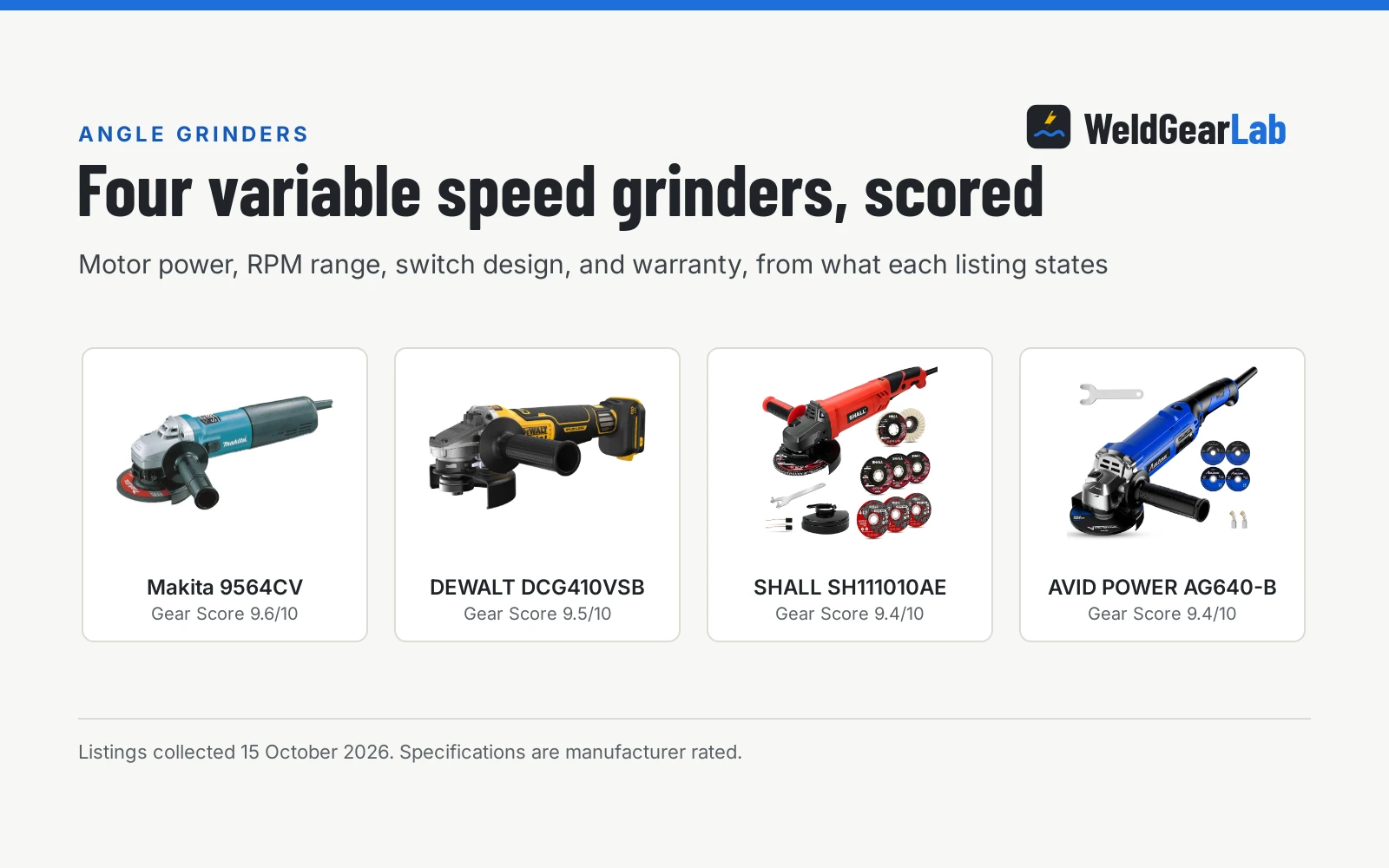
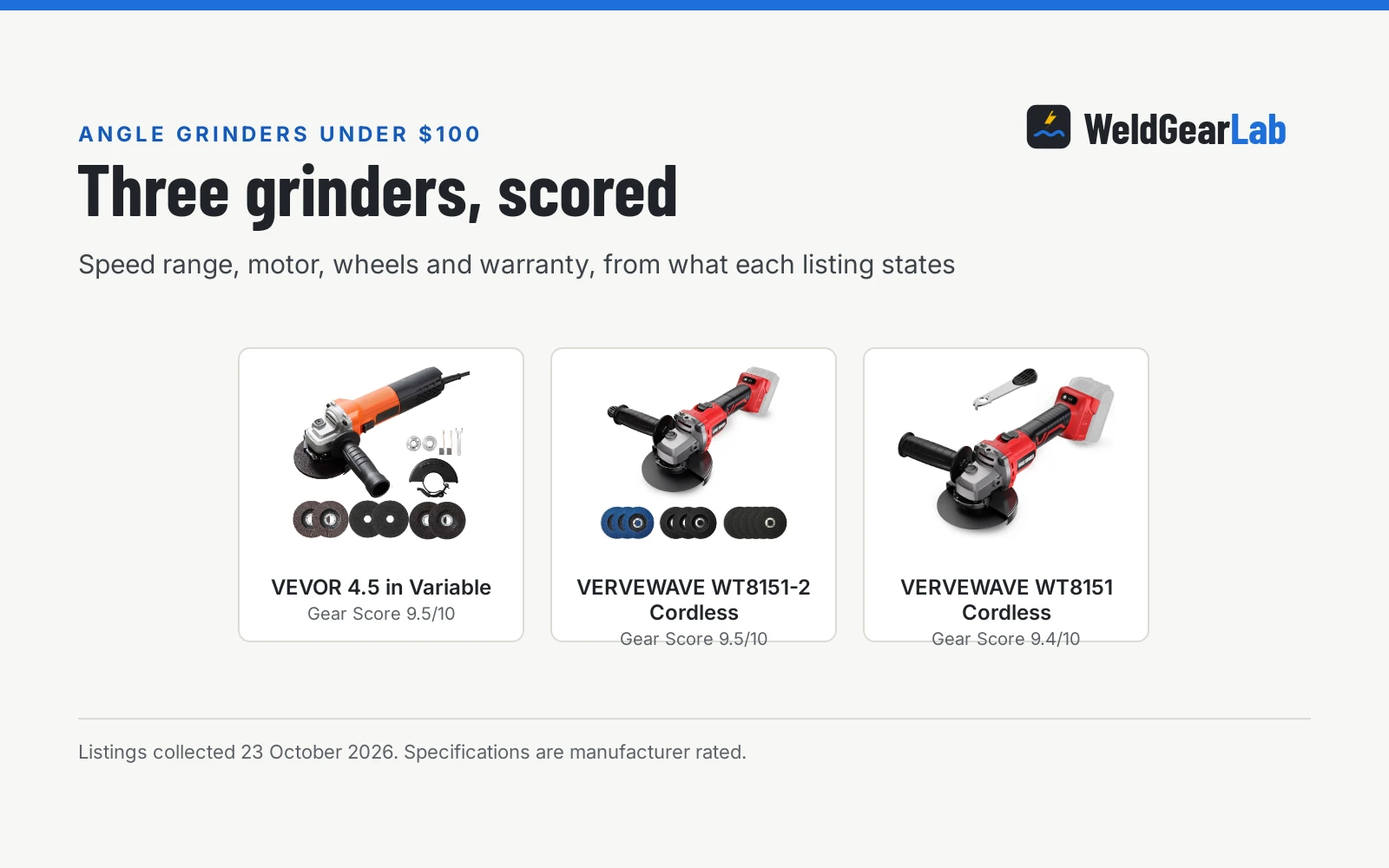
Variable speed wins wherever heat or accessory ratings matter. Polishing, wire wheel cleaning, rust removal with a flap disc and thin metal all go better below full RPM. Three of the four examples here are variable: the VEVOR spans 3,000 to 12,000 RPM with a 13A 1400W motor and ships 2 cutting wheels, 2 grinding wheels and 2 flap discs; the Powerbuilt gives 6 speeds from 4,000 to 11,000 RPM on a 10 Amp motor with an electronic module holding the setting; the DEWALT 5-inch adjusts speed as needed on a brushless motor. If your grinder does more than grind, variable speed earns its place.
Fixed vs variable speed angle grinder: four examples, ranked
1. DEWALT DWE43214NVS. The 5-inch variable speed paddle switch grinder, top of this ranking on safety tech: the brake stops the wheel in 2 seconds or less on average, the electronic kickback brake engages on a pinch, stall or bind-up to stop the wheel and shut the motor off, and power-loss reset means the trigger must be cycled after an outage before it restarts. Brushless motor, 2-stage trigger, lanyard ready, 9,000 rpm max, 6 lbs. No warranty term stated.
2. VEVOR 4.5-inch. The value variable speed pick: a 13A 1400W motor with 3,000 to 12,000 RPM, and the box does the talking with 2 cutting wheels, 2 grinding wheels and 2 flap discs. A 120-degree adjustable guard blocks debris. At 6.6 lbs it is the heaviest here, and no warranty term is stated.
3. Powerbuilt 240079. The 5-inch 6-speed: a 10 Amp motor from 4,000 to 11,000 RPM with an electronic speed control module that holds the setting, sub 6 lb weight (5.7 lbs per the table) with a reversible side handle. The box includes the wheel, side handle, wrench and spare brushes, and the listing states a 1 Year Limited Warranty.
4. Makita GA4030. The fixed speed example: a 4-inch grinder with a 6.0 AMP motor at 11,000 RPM, labyrinth construction sealing motor and bearings from dust and debris, and a case included. At 3.7 lbs it is the lowest weight here, with a stated 1 Year warranty. One speed, no dial, nothing to set wrong.
How to tell what a grinder supports
Read the speed line. A single RPM figure with no mention of speed control, like the Makita’s 11,000 RPM, points to fixed speed. A range, like the VEVOR’s 3,000 to 12,000 RPM or the Powerbuilt’s 4,000 to 11,000 RPM across 6 speeds, means variable. The DEWALT listing states variable speed functionality without printing a range, but names the feature outright, so a lone maximum figure is not proof on its own. If the listing names neither a range nor the feature, fixed speed is the safer assumption.
FAQ for welders
Can I polish with an angle grinder?
The VEVOR listing names polishing wood among its uses, and variable speed is what makes it practical: polishing at full RPM burns. The VEVOR’s 3,000 RPM low end and the Powerbuilt’s 4,000 RPM bottom speed are the settings for that kind of work.
What speed should I run a wire wheel at?
The listings give no wire-wheel speed, but this is the variable-speed use case: dial the VEVOR or Powerbuilt down into the low thousands instead of running flat out.
What does the DEWALT brake actually do?
Two things, per the listing. The wheel brake stops the wheel in 2 seconds or less on average, and the electronic kickback brake engages when a pinch, stall or bind-up is sensed, stopping the wheel with maximum force and shutting the motor off. Power-loss reset adds a third layer: after an outage, the trigger must be cycled before the tool restarts.
Is a 4-inch grinder enough, or do I need 5 inch?
The listings here span 4 inch (Makita), 4.5 inch (VEVOR) and 5 inch (DEWALT, Powerbuilt). Larger wheels cover more area per pass and reach deeper cuts; smaller grinders are lighter and handier overhead. Match the size to the work, not to the shelf.
Does variable speed mean less power?
No. The VEVOR pairs its 3,000 to 12,000 RPM range with a 13A 1400W motor, the highest amperage here. Variable speed controls RPM, not the motor’s muscle; the trade is complexity, not power.
Related: best wire wheel for angle grinder, angle grinder vs bench grinder, ryobi vs milwaukee angle grinder and the best angle grinder with speed control.