Bench Grinder vs Belt Grinder for Metal: Which One Should You Buy?
Bench grinders and belt grinders both shape metal in a fab shop, but bench wheels excel at drill bit and lathe tool sharpening while abrasive belts provide fast stock removal, flat beveling, and cool grinding.

On this page
Top picks at a glance
As an Amazon Associate I earn from qualifying purchases.
- 1
 HTC Adjustable Bench Grinder Stand Pedestal9.8/10View on Amazon
- 2
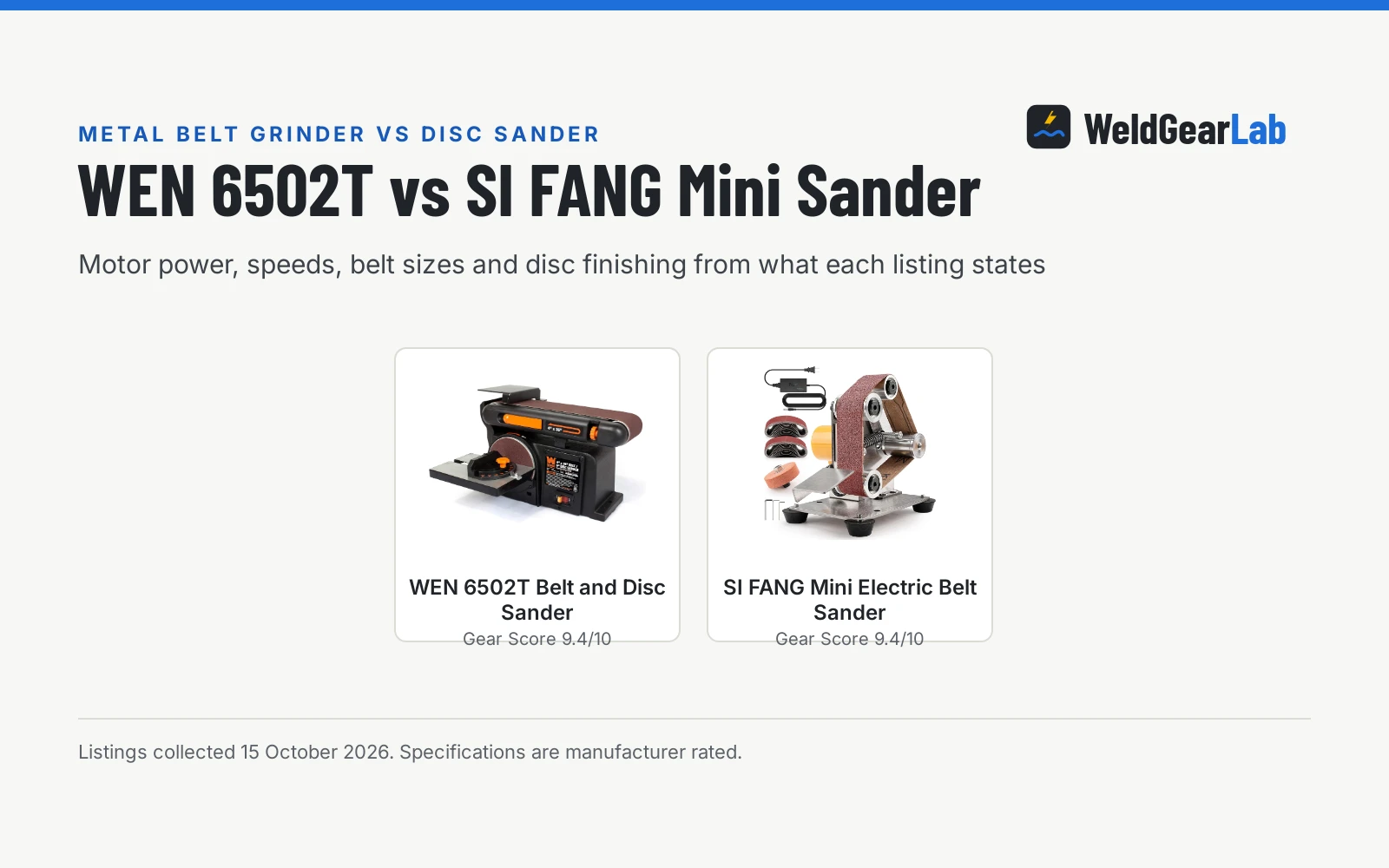
 SI FANG Mini Electric Belt Sander Knife-Sharpener Small Bench9.4/10View on Amazon
- 3
 WEN Benchtop Belt and Disc Sander with 4 x 36 in. Belt9.4/10View on Amazon
- 4
 DEWALT DW758 8-Inch Bench GrinderView on Amazon
- 5
 WEN BG4260 2.1-Amp 6-Inch Single Speed Bench GrinderView on Amazon
- 6
 WEN BG625V 2.5-Amp 6-Inch Variable Speed Bench Grinder withView on Amazon
- 7
 SEESII bench Grinder and Belt Sander Combo: 2"x27" Belt + 6"View on Amazon
- 8
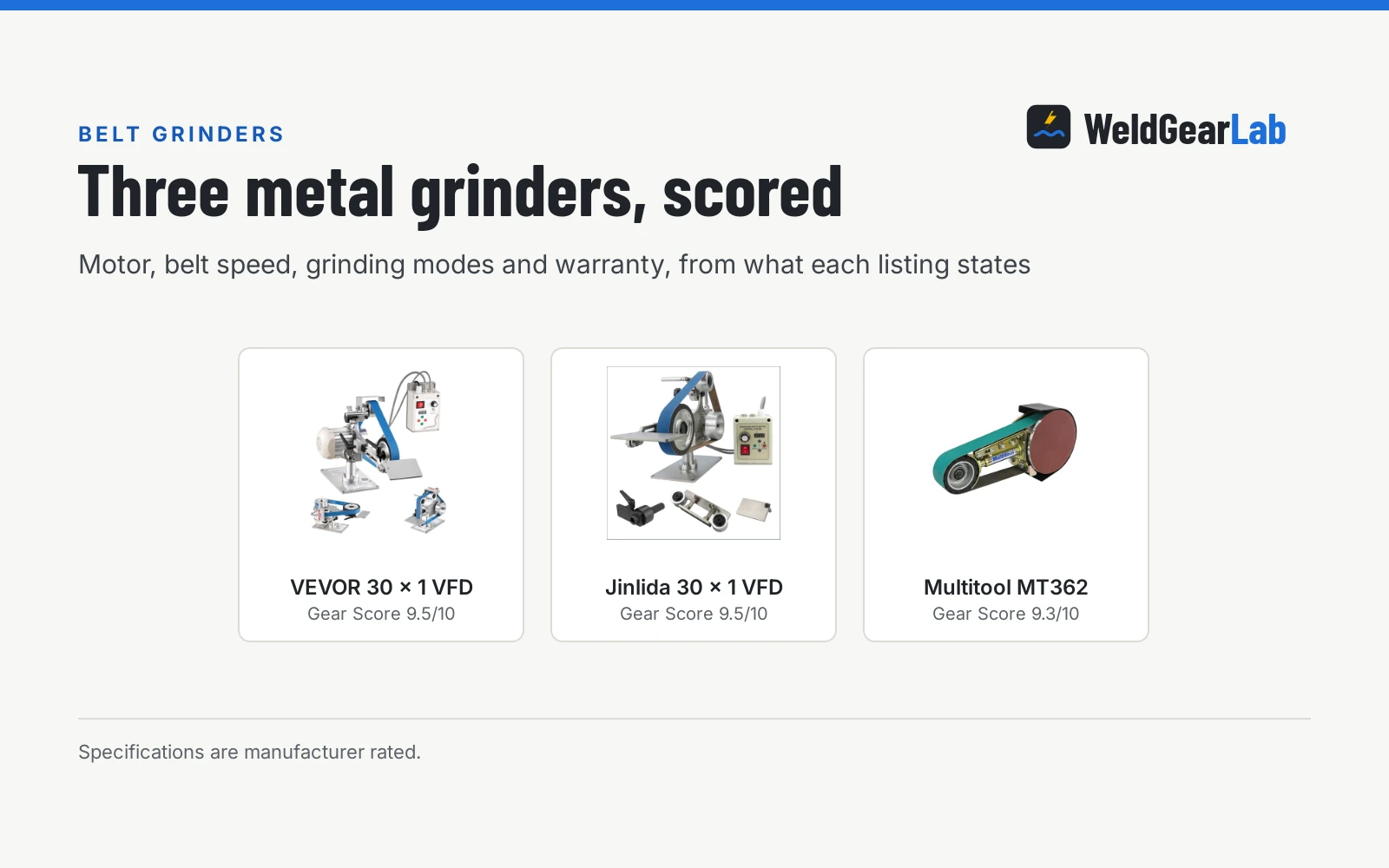
 VEVOR Belt Grinder SanderView on Amazon
- 9
 EXKRAEFT Flap Discs 4 1/2 for Angle GrinderView on Amazon
When you stand at the fab bench with cut tubing that needs deburring, plate ready for a weld bevel, or a dull drill bit that wanders on steel, you reach for a dedicated grinding station. Deciding between a bench grinder vs belt grinder for metal comes down to whether you need precision edge sharpening or rapid, flat stock removal. For sharpening drill bits and lathe tooling, dressing punch faces, or stripping rust with a wire wheel, a bench grinder is a reliable shop fixture. For beveling plate, squaring tube ends, smoothing weld beads, and shaping brackets without overheating your steel, a belt grinder is faster and far more versatile. In a working fabrication shop, both machines earn their bench space, but each handles a distinct phase of metal prep.
Other welders and gear to compare
 DEWALT DW758 8-Inch Bench GrinderCheck price on Amazon
 WEN BG4260 2.1-Amp 6-Inch Single Speed Bench GrinderCheck price on Amazon
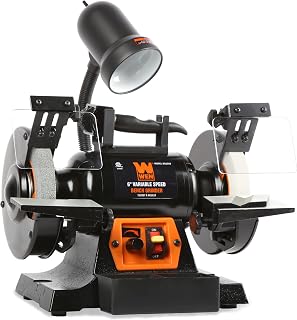 WEN BG625V 2.5-Amp 6-Inch Variable Speed Bench Grinder withCheck price on Amazon
 SEESII bench Grinder and Belt Sander Combo: 2"x27" Belt + 6"Check price on Amazon
 VEVOR Belt Grinder SanderCheck price on Amazon
 EXKRAEFT Flap Discs 4 1/2 for Angle GrinderCheck price on Amazon
This guide links to our product roundups, where WeldGearLab gets a commission on purchases made through links on this page, and your price stays the same. Read our affiliate disclosure.
The difference in one paragraph
A bench grinder drives abrasive wheels, wire wheels, or buffing discs directly from both sides of a central motor shaft. Grinding against the perimeter of a revolving stone wheel produces a concave hollow grind, and because the compact wheel rotates continuously without a long cooling path, friction heat builds up quickly in the workpiece. A belt grinder drives a continuous coated abrasive loop across a flat platen and contact wheels. The extended belt loop allows abrasive grains to cool in ambient air throughout their travel, cuts faster with fresh abrasive edges, and provides a flat reference plane for beveling, deburring, and squaring.
Bench grinder vs belt grinder for metal: side by side
| Bench grinder | Belt grinder | Shop takeaway | |
|---|---|---|---|
| Primary shop role | Sharpening cutting tools, deburring, wire wheel cleaning | Rapid stock removal, flat beveling, weld prep, profiling | Bench for edge tools; belt for fabrication |
| Abrasive surface | Vitrified stone wheels or wire wheels on arbor shafts | Continuous abrasive belt running over platen and wheels | Wheels hollow-grind; platen grinds flat |
| Grind profile | Concave hollow grind shaped by wheel curvature | True flat grind on platen, convex or radius on wheels | Belts maintain true flat weld bevels |
| Heat buildup on workpiece | Higher: continuous friction along wheel circumference | Lower: long belt loop dissipates heat before returning to cut | Belts reduce heat on temper-sensitive steel |
| Stock removal rate | Moderate to slow; abrasive grains dull and load | Fast and aggressive on thick plate and structural shapes | Belts clear heavy weld crowns faster |
| Beveling and weld prep | Difficult to keep edges flat without dishing | Fast, uniform flat bevels against rigid steel platen | Belt delivers uniform joint fit-up |
| Abrasive grit changing | Slow: requires unbolting wheel guards and arbor flanges | Quick: tension release lever allows rapid belt swaps | Belts allow fast grit progression |
| Non-ferrous metal risk | Vitrified wheels clog with aluminum and pose wheel burst hazard | Belts clear soft metal swarf without risk of wheel explosion | Never grind aluminum on stone wheels |
| Drill bit and tool sharpening | Standard shop method using adjustable tool rests | Requires steady freehand technique or specialized tooling | Bench grinder is standard for edge tools |
Abrasive grits determine how fast each machine removes steel and the surface finish it leaves behind. Always verify the maximum speed stamped on replacement grinding wheels and inspect wheels for cracks before mounting them to a machine arbor.
When a bench grinder is the better choice
- Sharpening lathe tooling and shop cutters. Bench wheels produce clean clearance angles on high-speed steel lathe bits, reshape center punches, and grind primary bevels on metal cutting tools.
- Restoring drill bit cutting geometry. Rigid tool rests mounted close to the wheel face provide a solid mechanical pivot for swinging drill bits to restore their cutting lips and relief angles.
- Stripping surface rust and paint with a wire wheel. Mounting a crimped steel wire wheel on one arbor gives you a dedicated station to scrub surface oxidation, paint, and welding spatter from parts without gouging the base steel.
- Compact footprint and simple setup. Solid stone wheels hold their shape, need no belt tracking adjustments, and bolt straight to a small bench or pedestal stand.
If your weld prep involves beveling plate edges for joint penetration, see our guide on how to bevel metal for welding, or read our comparison of the flap disc vs grinding wheel for handheld prep.
When a belt grinder is the better choice
- Fast stock removal on plate and tube. Abrasive belts cut through heavy steel far quicker than vitrified stone wheels, grinding torch slag and weld beads with light feed pressure.
- True flat beveling and squaring. Grinding against a rigid flat platen produces straight bevels on plate joints and squares mitered tubing without hollowing the edge.
- Cooler grinding on heat-sensitive steel. Long belt loops dissipate friction heat into the air, preventing tool steel and knife stock from overheating and losing temper.
- Contour blending and radius work. Running metal over the front contact wheel lets you blend inside radiuses, while the slack-belt area flexes around tubing and curved fabrications.
- Quick grit changes. A tension release lever lets you swap from coarse stock removal to fine satin blending in seconds without unbolting wheel guards.
For workshop comparisons of finishing tools, read our guide on the metal belt grinder vs disc sander, or see our roundup of the best angle grinder for welding prep.
Motor power and speed in shop grinders
Motor power and rotational speed determine how much feed pressure a grinder can handle before slowing down. Across reference listings for bench grinders, manufacturers publish differing power and speed specifications across 6-inch and 8-inch machine sizes.
Among 6-inch bench grinders, motor configurations vary based on intended shop use. For controlled tool sharpening where minimizing friction heat is paramount, the Bucktool TLG-150S listing specifies a 1/3 HP motor running at 1750 RPM. Higher-speed 6-inch models run around double that rotational speed: the Woodskil TDS-150CL-A lists a 1/2 HP, 2.8A motor spinning at 3450 RPM, while the WEN BG4260 lists a 2.1-amp motor at 3450 RPM on a 14 pounds machine (with 1 hp noted in its spec table). To bridge between shaping and sharpening, the WEN BG625V provides a 2.5-Amp motor adjustable from 2000 to 3400 RPM (with 0.4 hp in its spec table). In heavier shop machinery, the JET JBG-6W listing states a 1/2-HP motor at 3,450 RPM housed in cast iron weighing 31 pounds.
For 8-inch bench grinders, listings show higher power ratings. The DEWALT DW758 specifies a 3/4 HP induction motor operating at 3,600 rpm. The JET JBG-8W listing cites a 1 HP motor running at 3,450 RPM on a 54 lb cast iron base designed to stay steady during heavy grinding.
Belt grinders, by comparison, drive a flexible abrasive loop around balanced pulleys. Because the abrasive belt continuously presents fresh cutting grains and clears swarf around its tracking path, it maintains aggressive cutting action without requiring excessive operator pressure against the motor.
Wheel grit and abrasive selection for steel
Selecting the right abrasive determines how fast metal is removed and the finish left on the part. Bench grinders rely on vitrified aluminum oxide wheels bonded into solid discs. Reference models show common shop grit setups:
- Coarse 36-grit wheels. Supplied on models like the DEWALT DW758, Woodskil TDS-150CL-A, WEN BG4260, and JET JBG-8W, 36-grit vitrified wheels cut aggressively for rough shaping and beveling.
- Medium 60-grit wheels. Included on the DEWALT DW758, WEN BG4260, and Bucktool TLG-150S, 60-grit wheels provide an all-around grit for deburring tubing edges and general cleanup.
- Fine 80-grit wheels. Paired on units like the Bucktool TLG-150S and WEN BG625V, 80-grit wheels deliver smooth grinding for drill bit points and light tool honing.
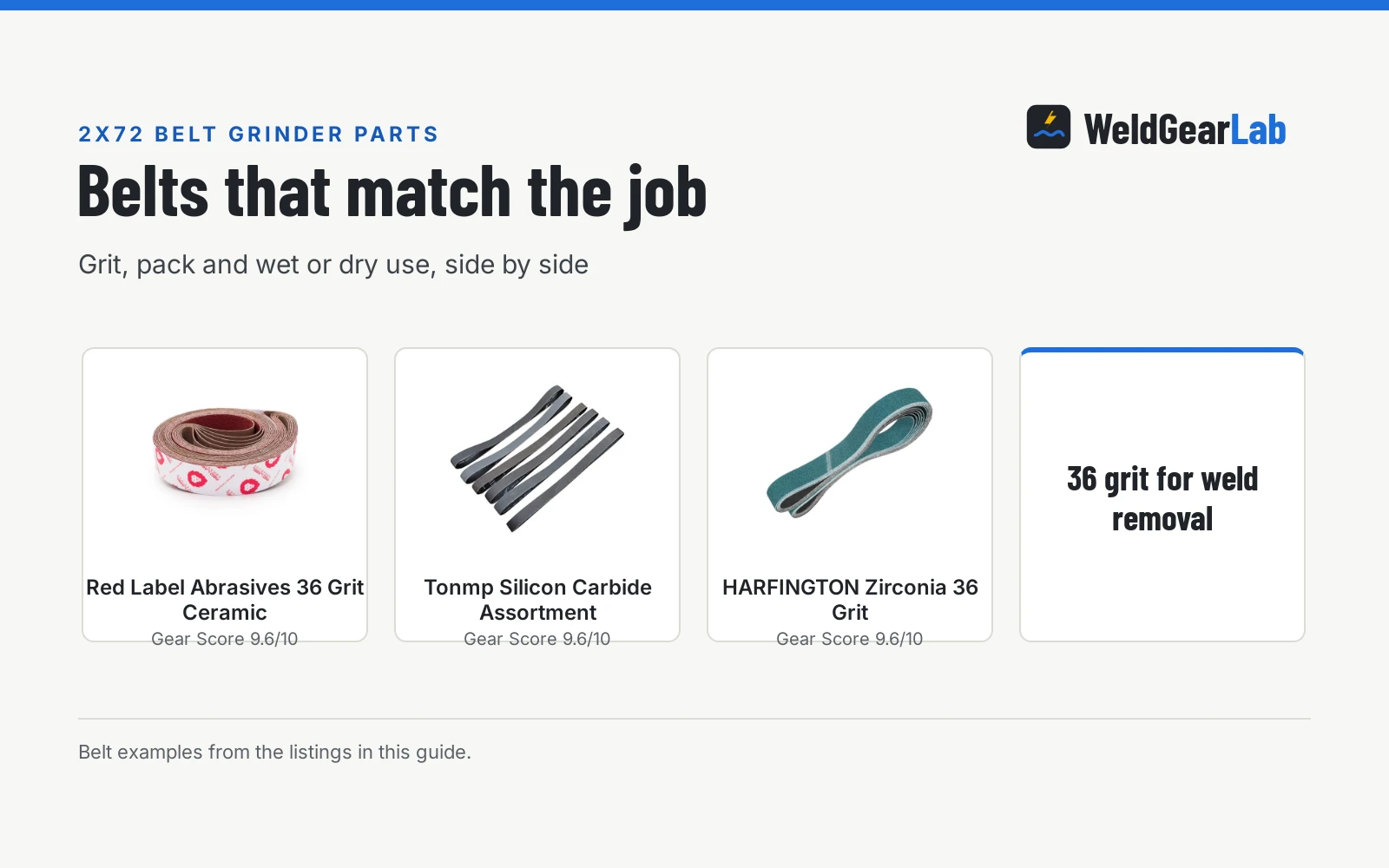
Belt grinders use coated abrasives on cloth or polyester backings. Instead of being locked to fixed wheel compositions, belt grinders run ceramic, zirconia, or aluminum oxide grains. A coarse ceramic belt strips weld crowns rapidly, while fine belts produce smooth satin finishes on fabricated assemblies.
Can one machine do both?
For small shops with tight bench space, combination grinders offer a practical middle ground. A combination unit mounts a conventional grinding wheel on one arbor and a belt attachment arm on the other. You can also mount aftermarket belt attachments onto a bench grinder arbor in place of a stone wheel.
While combination units save space, dedicated machines offer clear advantages in a busy shop. Dedicated belt grinders provide rigid platen backings, wider tracking adjustments, and open clearance for profiling long tube or bar stock. Keeping a separate bench grinder ensures your tool rests remain set for sharpening and leaves an arbor open for a wire wheel.
Grinding wheel safety. Never grind aluminum or magnesium on a vitrified bench grinder wheel. Soft metal loads the wheel face, traps friction heat, and creates a wheel burst hazard. The JET JBG-8W listing explicitly warns that grinding aluminum or magnesium on vitrified wheels is a fire hazard. Always wear safety glasses under a face shield, inspect wheels for fractures before starting the motor, keep tool rests adjusted close to the wheel, and ensure spark deflectors are secure. To prep plate without wheel loading, see our guide on how to remove mill scale before welding and explore the metal fab tools hub for shop gear.
FAQ for welders
Can a bench grinder replace a belt grinder in a metal fab shop?
A bench grinder handles basic deburring, rough stock removal, and tool sharpening, but it cannot fully replace a belt grinder for fabrication. The round wheel face produces a concave hollow grind that makes flat beveling difficult on plate steel. A belt grinder provides a flat platen for true edges and removes heavy stock much faster without overheating the workpiece.
Why does metal overheat faster on a bench grinder than on a belt grinder?
A bench grinder wheel rotates its abrasive surface continuously in a compact circle, giving abrasive grains virtually no cooling time before they re-contact the steel. An abrasive belt travels over an extended loop, allowing each grain to cool in ambient air before returning to the cut. This lower operating temperature protects tool temper and prevents bluing heat-sensitive steel.
Is grinding aluminum safe on a bench grinder wheel?
Grinding aluminum on a vitrified bench grinder wheel is dangerous and should never be done. Soft aluminum melts into the porous abrasive wheel, clogging the surface and causing severe overheating that can crack the wheel and trigger a burst. Use an abrasive belt or dedicated non-ferrous disc when shaping aluminum.
Which machine is better for sharpening drill bits and chisels?
A bench grinder is generally the preferred choice for sharpening drill bits and lathe tooling. Its rigid tool rests provide a steady mechanical pivot for maintaining consistent relief angles, and a trued wheel face produces repeatable geometry. Dedicated low-speed models running around 1750 RPM help sharpen fine edges without overheating the steel.
What is the advantage of running a wire wheel on a bench grinder?
Mounting a crimped steel wire wheel on one arbor creates a fast cleaning station for weldments, rusty hardware, and fabricated brackets. The spinning wire filaments strip loose surface rust, paint, and welding spatter without gouging into base metal or altering machined dimensions. It leaves clean steel ready for welding or primer without requiring chemical rust strippers.
Related: metal belt grinder vs disc sander, best angle grinder for welding prep, how to bevel metal for welding, and the metal fab tools hub. Also see our comparison of the flap disc vs grinding wheel.