Metal Belt Grinder vs Disc Sander: Which One Should You Buy?
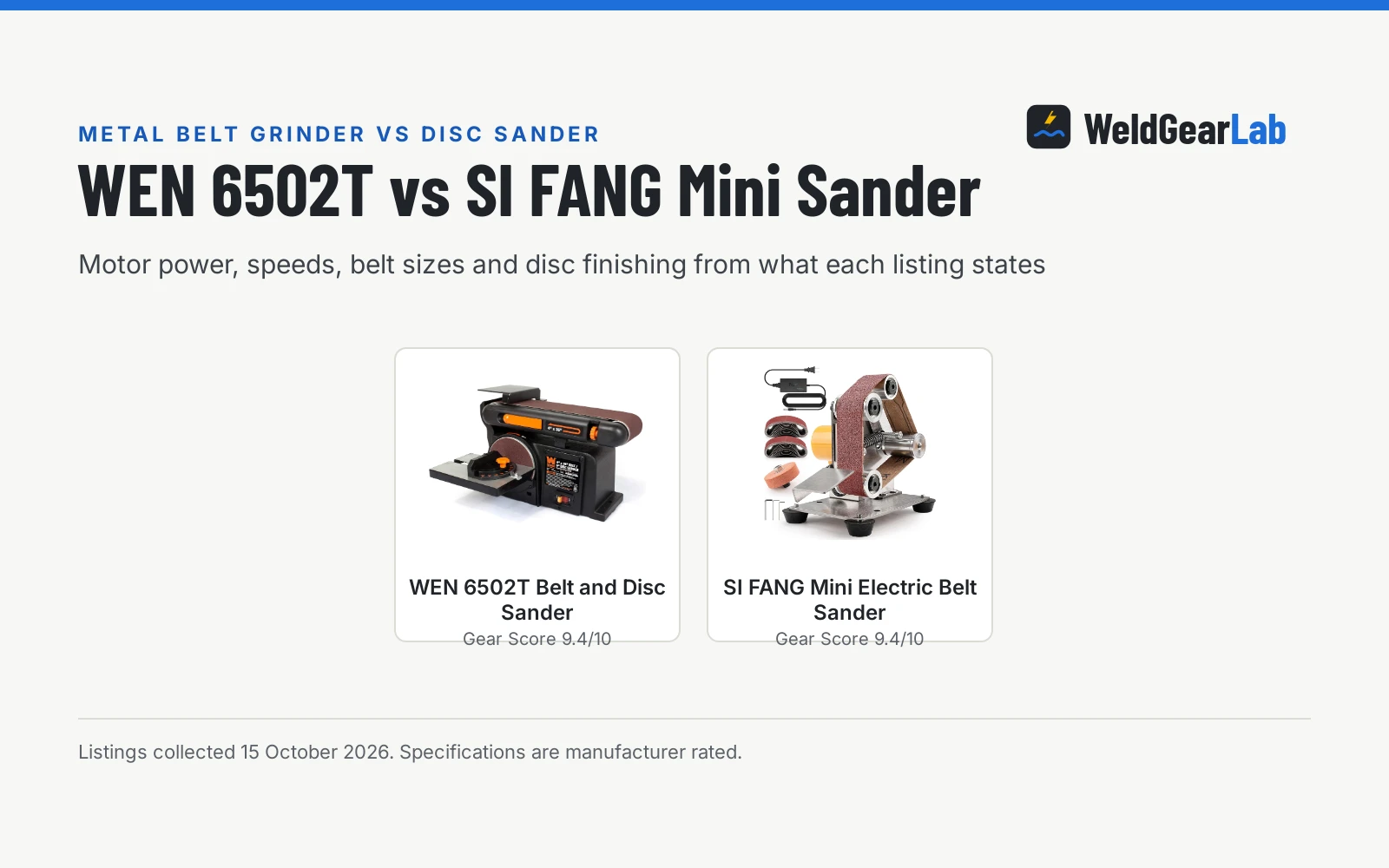
The WEN 6502T benchtop sander and SI FANG mini electric sander compare on motor power, belt speeds, disc sanding, cast iron build and workshop utility.

On this page
Top picks at a glance
As an Amazon Associate I earn from qualifying purchases.
- 1
 WEN Benchtop Belt and Disc Sander with 4 x 36 in.9.4/10View on Amazon
- 2
 SI FANG Mini Electric Belt Sander Knife-Sharpener9.4/10View on Amazon
Verdict. For squaring stock, true 90-degree end work, and general fab cleanup, the WEN 6502T disc sander combination provides a rigid 6 inch disc, a 4 x 36 inch belt, and a cast iron base. For sharpening small shop tools, tight bevels, and contour cleanup on small parts, the SI FANG mini electric belt grinder offers 7-speed adjustment with 20 included belts and multiple attachments.
When you are prepping joint edges, truing cut tubing, or deburring fresh cuts at the workbench, deciding between a metal belt grinder vs disc sander comes down to whether your fit-up needs flat, square geometry or flexible contour shaping. This comparison evaluates both approaches using these concrete shop examples from their published listing specifications.
WeldGearLab gets a commission on purchases made through links on this page, and your price stays the same. Read our affiliate disclosure.
The two machines

WEN Benchtop Belt and Disc Sander with 4 x 36 in.
A benchtop two-in-one sander pairing a 4 x 36 in. belt that tilts from 0 to 90 degrees with a 6 in. disc on a cast iron base.
Pros
- 4.3 Amp motor turning up to 3600 RPM on 120 volts
- Two-in-one machine with both a 4 x 36 in. belt and a 6 in. disc
- Belt tilts anywhere from 0 to 90 degrees for angled work
- Sturdy cast iron base helps prevent heavy vibrations
Cons
- Listing does not state an item weight
- No warranty term is stated in the listing
- No safety certifications stated in the listing
- Spec table lists included components only as disc sander

SI FANG Mini Electric Belt Sander Knife-Sharpener
A compact 4.3 pound bench grinder kit with a 7-speed motor, a 13 x 1.2 in. belt, and 20 sanding belts.
Pros
- 4.5 A motor with 7-speed adjustment and up to 9000 rpm
- Box includes 20 sanding belts across assorted grits with 4 pieces each
- Comes with grinding wheel, cloth wheel, dustproof cover, and 3 wrenches
- Stainless steel metal construction with all copper motor and double bearings
Cons
- Speed stated as 4,000 to 8,000 RPM in one bullet and 4000 to 9000RPM in another
- Small 13 x 1.2 in. belt limits material removal on larger stock
- No warranty term is stated in the listing
- No safety certifications stated in the listing
Other welders and gear to compare
 VEVOR Belt Grinder SanderCheck price on Amazon
 SEESII bench Grinder and Belt Sander Combo: 2"x27" Belt + 6"Check price on Amazon
 EXKRAEFT Flap Discs 4 1/2 for Angle GrinderCheck price on Amazon
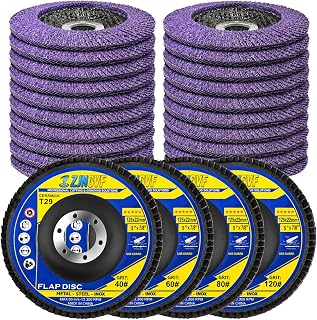 Flap Discs 5" for Angle Grinder Self-Sharpening PurpleCheck price on Amazon
 20 PCS Flap Discs 4.5" for Angle Grinder Type 29Check price on Amazon
 10 Pack Flap Discs 4-1/2" for Angle Grinder 40 Grit T29Check price on Amazon
Side by side
| Product | Gear Score | Belt Size | Disc Diameter | Power & Speed | Base Material |
|---|---|---|---|---|---|
| WEN 6502T Belt and Disc Sander | 9.4/10 | 4 x 36 in. | 6 inches | 4.3 A, up to 3600 RPM | Cast iron |
| SI FANG Mini Electric Belt Sander | 9.4/10 | 330 x 30 mm (13 x 1.2 in.) | No disc stated | 4.5 A, 7-speed up to 9000 rpm | Stainless steel |
Treat the specs as maker ratings pulled straight from the listings; we gathered them on 15 October 2026. Neither listing states a CSA, UL, or ETL safety certification or a written warranty term.
Metal belt grinder vs disc sander
The primary mechanical difference between these tools is how the abrasive contacts the steel. A disc sander relies on a circular abrasive disc backed by a flat plate. Because the disc spins across a single plane, it provides a stable reference surface that makes it easier to keep edges square and true before you tack pieces together. The WEN example uses a 6 inch disc driven by a 4.3 Amp motor at rotational speeds up to 3600 RPM, providing a rigid flat backing surface on the downward-travel side of the disc for squaring stock ends and leveling cut fit-up.
A metal belt grinder drives a continuous abrasive loop over drive wheels and a platen. The belt allows you to work against the backing surface for straight material removal or blend curves on the wheel radiuses. The SI FANG example runs a narrow 330 by 30 mm (13 by 1.2 inch) belt powered by a 4.5 A motor, giving you pinpoint control on small brackets, tight corners, and tool bevels.
Motor power and operating speeds
Motor power and abrasive surface velocity determine stock removal rates and edge control during fit-up prep. The WEN listing specifies a 4.3 Amp motor running on 120 volts corded electric power, generating speeds up to 3600 RPM for stock removal on its 4 x 36 inch belt and 6 inch disc.
The SI FANG listing states a 4.5 A motor on 110 volts and highlights a 7-speed adjustment mechanism, but its listing has clear internal contradictions regarding top speed. A bullet describes a speed range of 4,000 to 8,000 RPM, while another bullet states a no-load speed of 4000 to 9000RPM, and the specification table lists a maximum rotational speed of 9000 rpm. Trusting the bullets over the table still leaves an unresolved gap between 8000 and 9000 RPM. The listing describes the unit as a knife sharpener for small craft pieces, and states it can grind metal, wood, and acrylic.
Worktable adjustments and beveling
The WEN combination unit incorporates a belt mechanism that tilts anywhere from 0 to 90 degrees.
The SI FANG unit takes a different approach to work positioning. Its listing states that the angle of the worktable can be adjusted at will to control tightness and verticality on small parts. Because it is designed around knife edges and small craft pieces, its adjustments cater to delicate angles rather than heavy structural beveling.
Bench footprint and machine weight
Bench stability determines whether a grinding machine chatters or stays planted under pressure. The WEN unit features a sturdy cast iron base specifically designed to prevent heavy vibrations during operation. Its dimensions measure 22 inches long, 11 inches wide, and 12.5 inches high. However, the listing omits any mention of total weight. Without a published weight, buyers cannot verify bench anchoring requirements from the listing alone.
The SI FANG unit occupies a much smaller footprint. Its listing also contains contradictory dimension figures: the bullets state length and width dimensions of 4 inches by 4.7 inches, while the specification table lists 4.72 inches long, 3.94 inches wide, and 5.12 inches high. The listing states an item weight of 4.3 pounds, making it a portable tabletop tool with a stainless steel body, an all-copper motor, and double bearings.
Included accessories and grit selection
Out-of-the-box readiness varies sharply between the two listings. The WEN specification table lists included components simply as the disc sander itself, without detailing extra sandpaper grits or spare discs. It features a tension release lever to facilitate manual sandpaper changes between grits.
In contrast, the SI FANG kit arrives heavily equipped. Its listing specifies 20 sanding belts spanning assorted grits, with 4 pieces of each grit included. The package also includes 1 grinding wheel, 1 cloth wheel, 1 dustproof cover, 3 wrenches, and 1 power adapter. Installing the grinding wheel or cloth wheel allows the unit to perform auxiliary polishing and grinding tasks beyond belt work.
Warranty and safety listings
Neither product listing states a concrete manufacturer warranty term. Neither listing specifies a coverage window in years, months, or days. In addition, neither listing mentions recognized electrical or workshop safety standards such as UL, ETL, or CSA. When choosing either machine, confirm return terms and electrical safety details directly with the seller before purchasing.
Choose the WEN 6502T if
- You need a rigid 6 inch disc to square stock and true cut ends for clean fit-up.
- You want a larger 4 x 36 inch belt surface with a tilt range from 0 to 90 degrees.
- You require a sturdy cast iron base to minimize machine vibration on the bench.
- You operate on standard 120 volts workshop power with a 4.3 Amp motor.
Choose the SI FANG Mini Electric Belt Sander if
- You work primarily on small brackets, tool sharpening, and tight contour deburring.
- You want a variable 7-speed motor that reaches high rotational speeds up to 9000 rpm.
- You want an accessory kit complete with 20 sanding belts, a grinding wheel, a cloth wheel, and 3 wrenches.
- You need a compact 4.3 pound bench grinder with a stainless steel body and small footprint.
Before You Strike an Arc
- Check your electrical outlet and voltage against tool requirements, matching 120 volts for the WEN unit or 110 volts through the dedicated adapter for the SI FANG tool.
- Inspect abrasive belts and grinding wheels on arrival for tears, loose splices, or shipping damage before mounting them to the drive rollers or spindle.
- Confirm that the worktable and belt tracking hardware are tightened square to the abrasive plane before feeding workpiece stock into the machine.
- Clear grinding sparks away from open solvent cans, cleaning rags, and welding gas cylinders, and always operate with eye and face protection in place.
FAQ for welders
What is the difference between a metal belt grinder and a disc sander?
A belt grinder uses a continuous abrasive loop running over rollers and a platen, making it suited for linear deburring, edge profiling, and contour cleanup. A disc sander spins a flat circular abrasive disc against a rigid backing plate, providing a flat plane for truing cut ends and squaring fit-up before welding. Belt grinders handle curved and contoured shapes more readily, while disc sanders specialize in flat reference grinding.
Can the WEN 6502T sand both wood and metal?
The WEN 6502T listing describes a two-in-one benchtop unit with a 4 x 36 inch belt and a 6 inch disc powered by a 4.3 Amp motor at up to 3600 RPM. While benchtop disc sanders can handle metal deburring, users must match the abrasive grit and clean out combustible dust before grinding sparking metal. Cross-contaminating wood dust and metal sparks presents a shop fire hazard.
What belts come with the SI FANG mini belt grinder?
The SI FANG listing states that the kit includes 20 sanding belts measuring 330 by 30 mm (13 by 1.2 inches). The package provides 4 belts each across assorted grit grades. These assorted grits allow users to move from initial material cleanup to fine edge polishing.
Does either machine include a written manufacturer warranty?
Neither product listing states a written manufacturer warranty term in its bullets or specification table. Both listings omit warranty length and covered component details entirely. Buyers should contact WEN or SI FANG directly if written warranty coverage is required prior to purchase.
Do these benchtop tools require dedicated high-amperage shop circuits?
The WEN listing states a 4.3 Amp rating on 120 volts, while the SI FANG listing states a 4.5 A rating on 110 volts. Both listings describe corded electric tools designed for standard household voltage circuits. Neither tool requires high-amperage industrial power lines.
Related: metal fab tools, best angle grinder, best angle grinder for welding prep, flap disc vs grinding wheel, and how to remove mill scale before welding.
Scoring, line by line
Both machines are scored on performance, build, value, safety listing and warranty, with the weights published on our How We Pick page.
| Product | Gear Score | Perf. /35 | Build /25 | Value /25 | Safety /10 | Warranty /5 |
|---|---|---|---|---|---|---|
| WEN 6502T Belt and Disc Sander | 9.4 | 28 | 21 | 20 | 0 | 0 |
| SI FANG Mini Electric Belt Sander | 9.4 | 24 | 19 | 21 | 0 | 0 |
Think of 9.2 as the bottom and 9.8 as the top. Totals are placed between them in proportion, which keeps the order intact: more points, higher score.